



GrayScale's parent company DCG: Why is 50% of the new portfolio middleware?

 The reason for being optimistic about this niche market.
This article is from Digital Currency Group, translated by Rhythm BlockBeats.
Institutional investment in cryptocurrency is surging, and alongside the "Grayscale Effect," the movements of Grayscale's parent company, Digital Currency Group (DCG), are also attracting attention. Founded in 2015, this diversified group combines holding and investment, having not only created Grayscale Investments but also invested in numerous well-known teams and projects such as CoinDesk, Kraken, Coinbase, Blockstream, eToro, Zcash, Dune Analytics, and CoinList.
On March 2, 2021, DCG published an article revealing a new focus theme, "Building Web 3.0," which highlighted the important role of middleware in the ecosystem. Additionally, the organization disclosed for the first time that among the 13 new investments made by DCG from the second half of 2020 to the first quarter of 2021, 7 were middleware projects. Below is the original text compiled by Rhythm BlockBeats, and the English original can be found at the link at the end.
The crypto market is developing rapidly, and it's common to hear descriptions like "there's too much happening!" in the crypto space; however, we prefer "there's too much being built!"
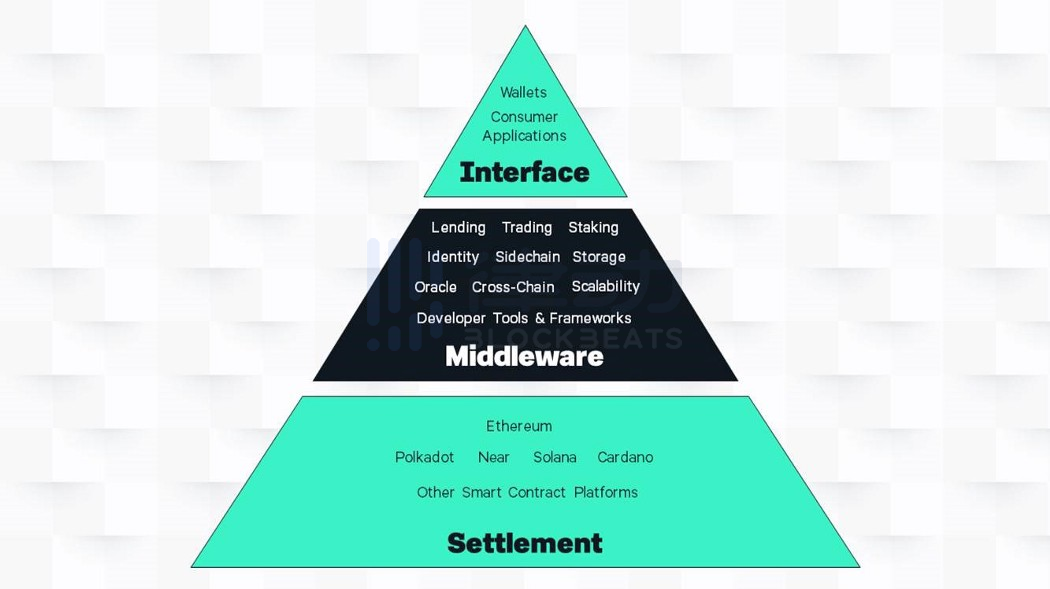
Mental models are useful for assessing the current situation, as they help early investors connect industry progress with the strategy and outlook of their portfolios. Below is our three-layer model after the decentralization network segmentation:
How is the decentralized stack evolving?
Settlement Layer: A Year of Solid Foundations
In 2020, Ethereum's dominance as a transaction settlement layer was further solidified. Currently, there are over 3,000 DeFi applications running on the Ethereum blockchain, a figure more than 10 times that of the second-ranked blockchain. With the scalability, layer two performance, user experience, and stronger network effects brought by the Eth2 upgrade, Ethereum's dominance may be further reinforced.
"With better middleware solutions, developers can embed secure, high-quality development results into their applications, deliver faster, and focus on providing a superior user experience."
Middleware Layer: A Year of Experimentation and Growth
In 2020, middleware projects experienced rapid growth. Middleware sits above the settlement layer, acting as a bridge for data and interoperability, and supporting application development.
The emergence of middleware is a typical characteristic of industry maturity; they improve efficiency as specialized service providers enter the market, reducing the degree of vertical integration. With these new "Lego" components, commercialization speeds up, and business expansion becomes easier. As specialized technologies begin to pave the way for richer end-user applications, the golden age of Web 3.0 middleware is approaching.
Among the 13 new investments made by DCG from the second half of 2020 to the first quarter of 2021, 7 were related to middleware for decentralized networks.

For example, API3 is a middleware protocol that allows decentralized applications to access real-world data off-chain. Consider DeFi lending applications, which need to obtain the current market price of assets to complete settlements; similarly, competitive games need to synchronize data with professional athletes. While other projects have built bridges for data interoperability without using blockchain, API3 innovatively improves the user experience for developers and data API providers.
"Oracles" are mechanisms for connecting external data with blockchains. In the past, blockchains only collaborated with third-party intermediaries running nodes to connect them to DApp smart contracts, while API3 allows data providers to connect directly to DApps by running an "Airnode"—an oracle node that is serverless and lightweight. Without intermediaries, blockchains can fully control their data, making data flows easier to access and more reliable, which is beneficial for developers.
Another middleware solution that excites us is Ceramic Network, which allows application developers to easily access distributed data and identities. Any application that wants to gather user information from different sites and synchronize user identities across devices needs a data solution.
For instance, when you connect your MetaMask wallet, it displays information including account names, contact lists, past transactions, settings, and token watchlists. In providing such services, MetaMask needs cross-platform access to user data, but they (and of course the users) do not want this information stored on centralized servers. Through Ceramic, developers can easily obtain identity indexes, allowing users to traverse decentralized networks with their identities without leaving data traces.
In the past, developers needed to run their own nodes and data queries and create their own identity solutions, which wasted a lot of time and resulted in some rough or non-standard products. With better middleware solutions like Ceramic Network, developers can embed secure, high-quality development results into their applications, deliver faster, and focus on providing a superior user experience.
"If 2021 is the golden year for middleware, it is likely to be the turning point for DeFi to go mainstream."
Interface Layer: Still in Early Stages
Today, there are very few companies that have succeeded in user interface design. One might find it amusing to see browsers like Netscape or Ask Jeeves from the 1990s; although their interfaces weren't bad, the designers lacked taste, stemming from an imperfect middleware. As decentralized network channels continue to improve, user-friendly and complex interfaces will emerge, pushing DeFi and DApps into the mainstream.
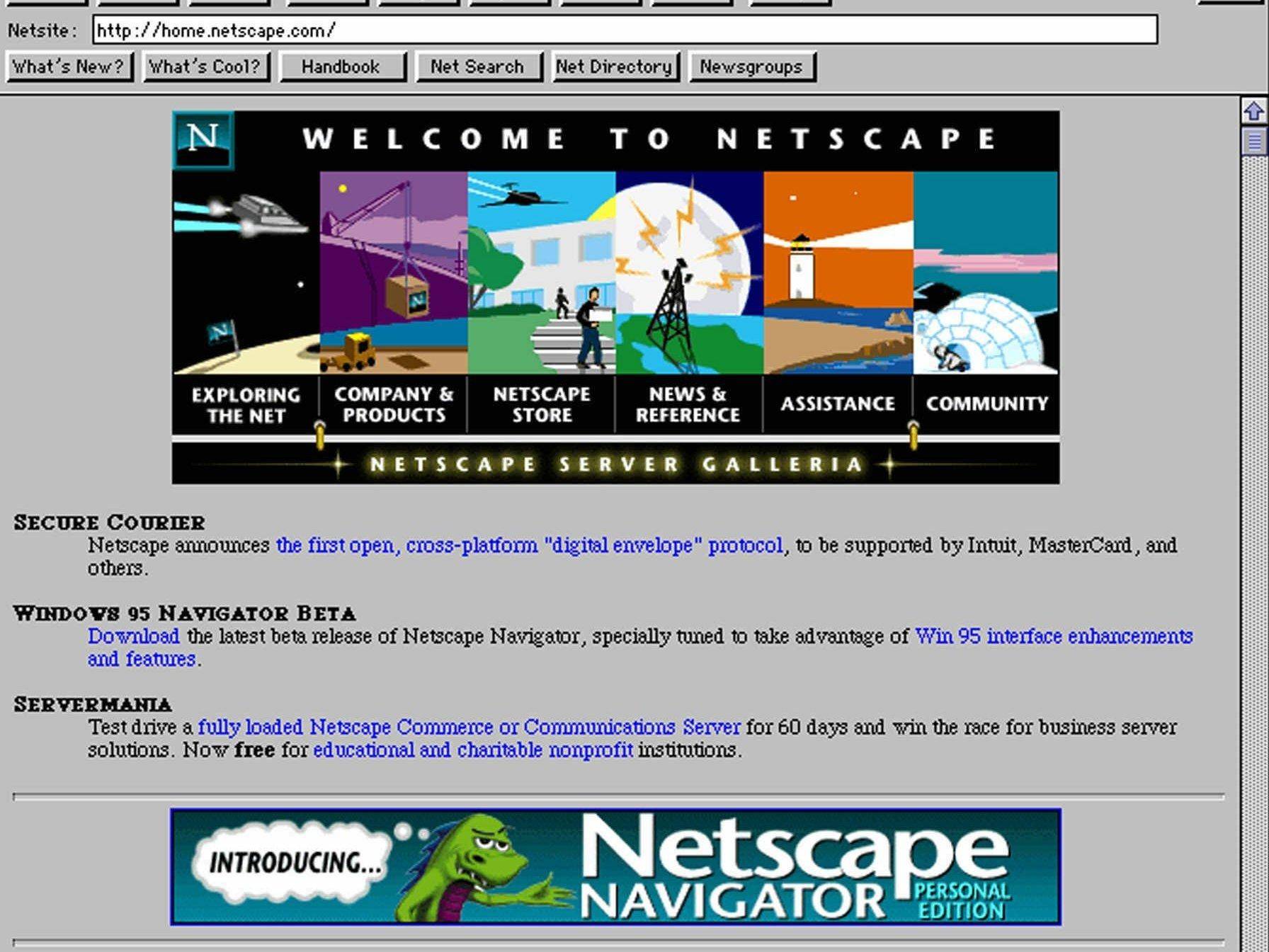
Image source: Internet
As investors, the challenge we face is to find those interface companies that most effectively absorb middleware development. We invested in Slingshot, which is a smart order router (SOR) for DeFi, accessible through a user-friendly front end and API.
We believe that businesses and teams at the forefront of DeFi can better integrate new middleware than most companies. As the settlement layer expands and the middleware layer improves, Slingshot's capabilities will further iterate—perhaps even beyond what its current interface can recognize.
As middleware continues to grow, leading custodial and hardware wallets (such as Luno and Ledger) and portfolio management tools (such as Zerion) will continuously improve user experience and leverage their professional product development experience to develop more advanced features.
If 2021 is the golden year for middleware, it is likely to be the turning point for DeFi to go mainstream. After years of hard work in an environment with only HTML, developers completed a leap from CSS to Flash, ushering in the heyday of Web 2.0 and driving the development of modern web frameworks. A similar iteration will also occur among developers, users, and entrepreneurs in the blockchain space.
 Risk warning
 Risk warning

Popular articles