BSC: The Barbarians at the Gate of Ethereum

 Zhao Changpeng is a major representative of the centralized network in the crypto world, while Vitalik is a major representative of the decentralized network in the crypto world. Due to the differing interests they represent, the two sides have had intense confrontations in public on multiple occasions.
This article is an original piece by Chain Catcher, authored by Gong Quanyu.
In a capital-dominated market, the presence of "barbarians" is never lacking. They attempt to become part of the mainstream narrative through the power of capital and aggressive operational tactics.
In 2015, the story of Vanke's battle against the "barbarian" Baoneng stirred considerable attention. Baoneng continuously purchased Vanke shares in the secondary market, investing a total of 43 billion yuan to acquire about 25% of Vanke's shares, surpassing China Resources to become the controlling party.
However, Vanke's management believed that Baoneng lacked credibility, operated aggressively, and did not follow the rules. Subsequently, through measures such as suspending trading and introducing Shenzhen Metro as the controlling party, they ultimately drove away the "barbarian" Baoneng.
Similar stories have played out in many industries, and now it is the turn of the blockchain industry. In this sector, Ethereum is the most prominent public chain project, with most excellent developers building application ecosystems around Ethereum. However, its position is also coveted by numerous challengers. Previously, Tron attempted to defeat Ethereum as a "barbarian," and now this role is taken by Binance, the world's largest cryptocurrency exchange, and its launched BSC public chain.
1. A Carefully Planned "War"
Binance's dream of a public chain has a long history. In April 2019, Binance was the first among major exchanges to launch Binance Chain. To promote its public chain ecosystem, Binance even announced that projects performing well on Binance DEX could directly list on the main Binance platform, incentivizing projects from external public chain ecosystems like Ethereum to migrate to Binance Chain. Over 100 new tokens were issued within three months, but due to barriers to entry and market recognition, the development of Binance Chain did not go well and almost disappeared from the industry.
In 2020, as DeFi rapidly developed, Binance decided to significantly adjust its public chain strategy, almost entirely transplanting Ethereum's infrastructure and code to develop Binance Smart Chain (BSC), thereby achieving compatibility with Ethereum's EVM. This allows developers to easily migrate their projects from Ethereum, and its official block explorer is also highly similar to Ethereum's block explorer, Etherscan.
In terms of consensus mechanism, BSC adopts a proof of staked authority (PoSA) mechanism similar to DPoS, selecting 21 candidates with the highest BNB holdings as validators to maintain the operation of the BSC network. This number is comparable to EOS nodes and is also viewed as having excessive centralization, making it vulnerable to disruption.
However, through this mechanism, BSC can achieve faster transaction speeds and lower transaction fees, significantly enhancing user experience. In the blockchain industry, many public chains offer high performance and low fees; BSC's aforementioned characteristics provide basic competitiveness, but the more critical core competitiveness lies in application ecology and wealth effect. At this time, Binance's advantage as the world's highest-revenue exchange is fully displayed.
On September 10, 2020, Binance announced the establishment of a $100 million seed fund to support DeFi projects and developers on BSC, while also establishing cross-chain bridges for mainstream assets like ETH, DOT, and LTC to BSC, laying the foundation for introducing more applications and funds to BSC.
Subsequently, BSC's ecological projects gradually gained momentum, with leading applications like PancakeSwap, Venus, and Autofarm attracting billions of dollars in locked funds, with token prices increasing by over 100 times, and total locked funds reaching up to one-fifth of Ethereum's.
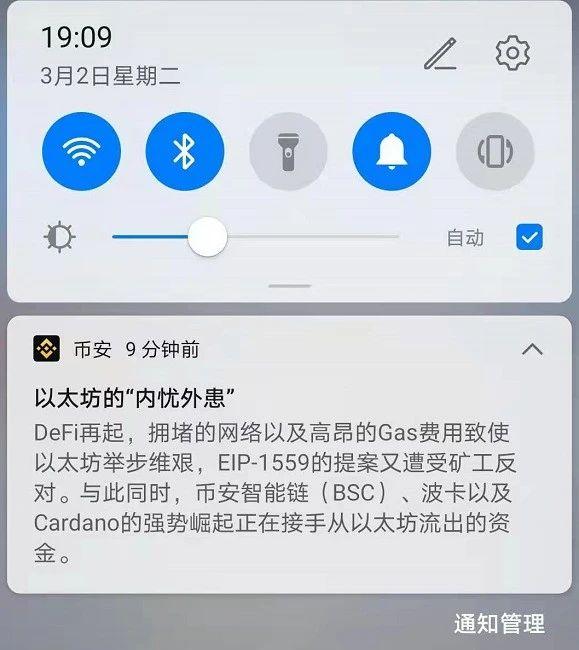
Binance APP pushes articles disparaging Ethereum to all users
Now, with Binance's full support and significant wealth effect, BSC continues to erode funds and users from Ethereum, becoming a strong competitor to Ethereum. BSC's success indeed meets the needs of a portion of users who pursue wealth effects and low transaction costs. But is this truly a good thing for the blockchain industry?
The core spirit of blockchain technology lies in decentralization, while BSC's degree of centralization is evidently high, meaning Binance theoretically has the ability to control blockchain activities on BSC.
First, BSC has only 21 nodes, most of which are closely linked to Binance; second, the main criterion for BSC node elections is BNB holdings, and the Binance team is the largest holder of BNB. Moreover, most users' BNB is stored in wallets controlled by Binance, which theoretically gives Binance the ability to control the node election process.
Of course, having this ability does not mean Binance will implement it, and it does not align with Binance's interests, but the existence of this ability itself poses a potential risk and threat to network security, especially given past experiences.
In March 2020, Sun Yuchen announced the acquisition of the blockchain content platform Steemit and obtained a large number of pre-mined tokens. Subsequently, the witness nodes of the Steem chain initiated a soft fork to freeze his tokens to counter the possibility of Sun controlling the Steem chain. However, exchanges closely related to Sun, such as Binance and Huobi, directly misappropriated users' STEEM tokens to re-elect witness nodes, thus helping Sun stop the soft fork.
The actions of exchanges like Binance after the incident sparked strong criticism from the entire crypto community, being deemed as blatant wrongdoing.
Now, Binance is attempting to push the BSC public chain, which is also based on a similar DPoS mechanism, into the crypto community, aiming to become the infrastructure of the entire DeFi market, which inevitably provokes strong dissatisfaction among Ethereum supporters and many neutral members of the crypto community.
"BSC is 100% centralized and there is no debate; the only reason it pretends to be decentralized is to enhance the narrative of BNB," tweeted Anthony Sassano, founder of The Daily Gwei and EthHub. "This is a marketing scam."
Tom Shaughnessy, co-founder of Delphi Digital, stated that given CZ's influence and BNB's share, BSC's governance mechanism might allow him to control the blockchain, "but the key is not to provide cheaper transactions; anyone can use Amazon Web Services to achieve that, but to foster a community-driven builder spirit where they enjoy working together without centralized management."
However, these criticisms have had little impact on BSC. Its relatively centralized mechanism gives BSC an advantage akin to a "dimensionality reduction attack" against Ethereum, while Ethereum can only remain passive until Layer 2 and 2.0 arrive. Arthur0x, founder of Defiance Capital, tweeted that BSC is like a barbarian at Ethereum's doorstep.
Even more "barbaric," Binance is also suspected of conducting gas fee attacks on the Ethereum network. According to research by Twitter user @BulloTaurus and previous investigations by Chain Catcher, Binance's average gas fees have been over 50% higher than those of other exchanges for a long time, likely intentionally raising Ethereum's network gas fees, increasing the barriers for ordinary users to participate in the Ethereum ecosystem, thereby forcing users to migrate to the BSC public chain to engage in various DeFi ecosystems.
The war between BSC and Ethereum has already erupted, and it will be a long-term battle that transcends technology itself, more concerning capital and ideals.
2. Origins and Future
Zhao Changpeng's dissatisfaction with Ethereum and its founder Vitalik has likely existed for a long time. For a long time, Zhao Changpeng has been a major representative of centralized networks in the crypto world, while Vitalik has been a major representative of decentralized networks. Due to the differing interests they represent, the two have had several heated exchanges in public.
In July 2018, Vitalik expressed his heartfelt hope that centralized exchanges would completely disappear from the earth, "Why do projects need to pay $10 million to $15 million in listing fees to allow users to trade on exchanges?" Zhao Changpeng later responded in an interview, "We need a vision that drives the industry forward, rather than a narrow perspective."
In March 2020, during the previously mentioned Steemit incident, Vitalik also tweeted directly accusing exchanges of being bribed and facilitating scammers, forcing Zhao Changpeng to publicly apologize and cancel the vote under public pressure.
In December 2020, after XRP was deemed a security by the SEC, Vitalik criticized XRP on Twitter, calling it a "shitcoin," but Zhao Changpeng disagreed with Vitalik's stance, responding, "Let's decentralize, but not split. Let's help each other and develop this industry together."
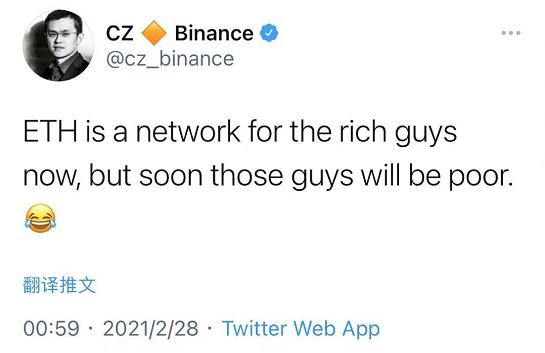
Although Zhao Changpeng often expresses support for Ethereum on Twitter, his attitude has significantly changed with the rapid development of BSC. Just as the cryptocurrency market was declining at the end of February, Zhao Changpeng tweeted that Ethereum is a network for the rich, but soon these people will become poor, clearly expressing his bearish view on Ethereum, which was even seen as a provocation by many Ethereum supporters.
Meanwhile, the Ethereum community is also retaliating. Recently, developers deployed projects with politically sensitive keywords on BSC, hoping government departments would take action or that BSC would proactively delist to prove its centralized nature. However, BSC has yet to take any related action, leading to considerable criticism.
Ultimately, the future of public chains will depend on the richness of application ecology and scenarios. Currently, although many DeFi applications are continuously deploying on BSC, almost no leading application-level DeFi projects have announced plans to deploy on BSC, except for 1inch, which was previously led by Binance's incubator. Its degree of centralization is the main negative influencing factor.
In a tweet released when BSC launched in early September last year, Aave's name was still listed among the partners, but no progress has been announced to date. In an interview with Chain Catcher, Leslie, the Lead for Aave in China, stated that they would keep observing and look forward to seeing more efforts from exchange public chains in terms of decentralization.
Messari analyst Ryan Watkins believes BSC is equivalent to an Ethereum sidechain, gaining incremental value from users who are more price-conscious and less security-conscious. However, the value captured by DeFi protocols on BSC will ultimately accumulate back to Ethereum's headquarters, where the final settlement occurs, and users and protocols will store their wealth there.
More importantly, if project parties decide to fully develop within the BSC ecosystem, they may be rejected by other mainstream exchanges, as exchanges like Huobi and OK may be unwilling to support the Binance Chain ecosystem due to conflicts of interest, while overseas compliant exchanges like Coinbase may not consider listing due to BSC's centralization issues. These problems will significantly limit the development space for projects.
On March 4, the BSC ecological application Meerkat Finance reportedly ran away with assets worth $31.5 million. Previous incidents of running away with funds have also frequently occurred, and the health of its application ecosystem has already suffered considerable damage.
Therefore, BSC is unlikely to become the launch platform for innovative high-quality projects; it will more likely serve as a platform for some copycat projects to seek short-term wealth effects and for second- and third-tier DeFi applications to expand their ecological space. As Ethereum's scaling solutions are gradually implemented and performance issues are resolved, truly high-quality DeFi ecosystems will still gather towards Ethereum.
Currently, BSC has indeed achieved short-term success and possesses stage-specific industry value, bringing more incremental users to the DeFi market through its platform effect. However, its relatively barbaric development path also limits its future development space.
"I bet that within five years, BSC's usage rate will be almost zero compared to Ethereum. BSC's trade-offs are crucial for short-term success, but it will fail in the long run," said Larry Cermak, research director at The Block, with a sharper perspective.
 Risk warning
 Risk warning