Airdrop Feast: The Market Always Favors Explorers

 This is the golden age of the DeFi industry, and it is also the golden age for every DeFi explorer.
This article is an original piece by Chain Catcher, authored by Gu Yu.
On April 22, the algorithmic stablecoin project Ampleforth announced the issuance of the governance token FORTH and an airdrop. Any address that has interacted with the AMPL smart contract can claim the FORTH token airdrop, with over 75,000 addresses eligible to receive it. Based on today's prices, each address can receive an average airdrop worth about $5,000.
Meanwhile, various wealth stories with different narratives have spread across major crypto communities. Some users have received airdrops worth tens of thousands of dollars with just 0.001 AMPL left in their wallets, while others have received similar airdrops due to previous deposits of AMPL to exchange addresses. All early AMPL users have reaped substantial financial rewards.
Previously, early users of projects like Uniswap and 1inch also received generous airdrops from the project teams. Now, under the leadership of these representative projects, more and more DeFi projects are beginning to airdrop tokens to early users. To date, at least hundreds of projects have airdropped tokens to users in various forms, allowing early users to share in their growth dividends without any investment, truly embodying the open and sharing spirit of blockchain.
1. Airdrop Feast
From the actual situation in the crypto industry, airdrops can be broadly and narrowly classified into two types, each pointing to different airdrop purposes.
Narrowly speaking, airdrops refer to the direct distribution of tokens by crypto projects to users with a history of on-chain interactions. The value of the airdrop is not directly related to the continuity of interaction behavior or asset value; the user's expenditure cost is relatively fixed, and market risk is limited. The main purpose of this type of airdrop is to reward early users.
Broadly speaking, airdrops refer to the direct distribution of tokens by crypto projects to users who meet specific conditions, where users do not need to pay any funds to receive them. These conditions may include providing liquidity, holding other tokens, which involve higher capital costs and price risks (such as the risk of token depreciation and impermanent loss), as well as completing social media tasks, which have very low but relatively cumbersome costs.
The purposes of these airdrops include incentivizing specific user behaviors, increasing token liquidity, enhancing marketing effectiveness, etc., and this is the approach and purpose adopted by most projects.
Considering the purity of the airdrop's purpose, the following analysis in this article mainly refers to the narrow definition of airdrops, which clearly carry more sincerity and symbolic significance.
To gain a deeper understanding of the history of airdrops in the crypto industry, Chain Catcher has compiled a list of relatively well-known airdrop projects and their specific airdrop data since September 2020, as shown in the table below:
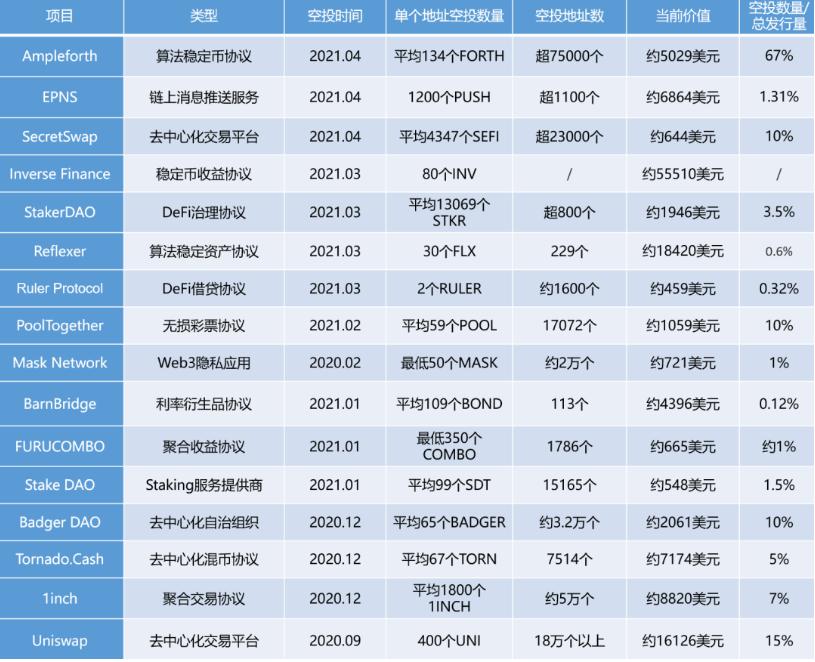
Note: Price statistics were taken on April 27 at 16:00.
In addition to the aforementioned projects, many others such as Tokenlon, OpenOcean, Sifchain, Deversifi, Opium, Force DAO, ShardingDAO, Chainswap, and Smoothy Finance have also announced airdrops to early users, but due to space limitations, they are not all listed here.
According to Chain Catcher statistics, since last September, at least 30 DeFi projects have airdropped tokens to their early users. Based on the average number of airdropped tokens (some being the minimum airdrop amount) and today's prices, if a heavy DeFi user interacted with these projects early on and retained these airdropped tokens until now, they could receive at least $160,000 in returns, with interaction costs not exceeding $1,000.
Based on the proportion of airdropped tokens to total issuance, projects like Ampleforth, Uniswap, Badger DAO, PoolTogether, and Secretswap rank in the top five, all exceeding 10%. Among them, the algorithmic stablecoin project Ampleforth has an airdrop ratio exceeding 67%, making it the most generous project in DeFi airdrop history.
Based on the number of airdrop addresses, Uniswap, Ampleforth, 1inch, Badger DAO, and Secretswap rank in the top five, with Uniswap's number of airdrop addresses nearly surpassing the total of all other projects combined, highlighting its influence in the crypto user community.
Based on average airdrop value, Inverse Finance, Uniswap, Reflexer, 1INCH, Tornado.Cash, EPNS, and Ampleforth rank in the top seven, with each airdrop value exceeding $5,000. The stablecoin yield protocol Inverse Finance ranks first with an airdrop value of $55,000, but its number of airdrop addresses is estimated to be less than three digits.
In terms of airdrop timing, there has been a noticeable increase in airdrop projects since January this year, with over half of the airdrops in the statistical range occurring in the past two months, reflecting that airdrops as a form of user feedback have been increasingly recognized by project teams.
2. The Market Always Prefers Explorers
In the internet industry, this phenomenon is unimaginable. Companies like Facebook, Alibaba, and Tencent have reaped huge profits and revenues from traffic dividends, becoming globally influential internet giants, while their early users were merely spectators, gaining no actual benefits from the process.
This year, Zhihu has set a precedent among domestic internet companies by gifting 100 shares of American Depositary Securities equivalent to certain early influential users after its listing in the U.S. in March, but the value was only a few hundred dollars, which is negligible compared to its tens of billions of market capitalization.
The crypto market, however, presents a completely different picture. Many mainstream DeFi projects are competing to "give money" to early users, ranging from hundreds to tens of thousands of dollars, and now most DeFi users have experienced receiving airdrops.
The principle reflected by these airdrops is that the market always favors those who dare to try and have a strong curiosity and desire for knowledge, especially in the DeFi market. If you have participated in governance voting for DeFi projects like Yearn Finance or Aave, if you have donated $20 to several early quality projects through Gitcoin, or if you have used several mainstream on-chain DEXs in the first half of last year, you can still receive airdrops worth tens of thousands of dollars today.
For early projects, each interaction by users serves as product testing, helping project teams optimize their code logic while improving product data performance and gaining more attention. For these early seed users who help projects grow, project teams should provide certain rewards and further enhance the stickiness of seed users.
This is also the true embodiment of blockchain technology and its spirit, where every user can become a sharer of product dividends and a participant in governance. Users and development teams become a unified interest body through tokens, jointly promoting product optimization and market expansion.
Of course, the enormous wealth effect has also attracted more and more speculators, who attempt to register multiple addresses and interact with project smart contracts to seek more airdrop opportunities. A typical case is the ninth round of Gitcoin donation activities in March this year, where the donation threshold was only a few dollars, leading many users to batch register accounts to donate to projects in hopes of receiving future airdrops.
In response, Ethereum founder Vitalik wrote about this issue, arguing that airdrop-driven donations have undermined Gitcoin's ideals and is considering launching a Gitcoin donation scheme that does not support airdrop tracing. Additionally, many projects now have requirements regarding the number of user interactions and interaction values. In the future, the airdrop thresholds for DeFi projects may further increase to better filter out truly contributing early users.
It can be said that the airdrop feast in the crypto market is still in its early stages, with more and more quality DeFi projects emerging and the market penetration of DeFi products accelerating. This is the golden age of the DeFi industry and also the golden age for every DeFi explorer.
 Risk warning
 Risk warning



Popular articles