



Coinbase Founder: How a $100 Billion Company Makes Decisions from 0 to 100 Billion

 The decision-making model that has a profound impact on Coinbase.
Source | Pangfu Mantou (ID: amazingfounder)
In the process of gaining insights into the growth path of super individuals, I proposed the concept of the "life algorithm" of super individuals. Humans may be the species with the greatest productivity differences among individuals. In the continuous decision-making process, super individuals seize key opportunities to stand out.
The countless decision-making scenarios that have occurred before are the big data accumulated by super individuals, and the decision-making process reflects the life algorithm of super individuals. With the development of technology, the advantages of the life algorithm of super individuals will continue to amplify.
Due to my involvement in early-stage investments, I have accompanied companies in their growth since their inception. Founders often come to me to discuss and sort out the challenges encountered in the decision-making process, such as "Should we bring in an important and outstanding candidate as a partner?", "What should be the next strategic direction for the company?", "How to weigh the options among several institutions' term sheets?", etc.
When faced with highly uncertain factors and decisions that have a profound impact on the company, these excellent founders need more information to help them weigh the pros and cons and make better decisions. As a participant in the process, I consciously collect more decision-making scenarios and decision-making models to provide better support to my partners.
Today's recommended content comes from a sharing by Brian Armstrong, the founder of Coinbase, which I believe is a very insightful article on decision management. The first stock of a "digital currency exchange," Coinbase, went public on NASDAQ on April 14, 2021, with a market value that once exceeded $100 billion.
Brian is an ambitious super individual who has always hoped to make a mark in the technology field. During Christmas in 2010, Brian first encountered Bitcoin and was deeply attracted. Compared to now, the blockchain and digital currency industry was in an extremely barren state at that time.
In 2012, Coinbase was born in such an early and highly uncertain industry. Under Brian's leadership, through nearly a decade of effort, Coinbase has gradually grown while promoting industry development. During this period, Coinbase has experienced countless impactful decisions. Brian has open-sourced the decision-making model he honed during Coinbase's development. This decision-making model is particularly applicable when facing ambiguous high-risk decisions. Let's get started, enjoy!
In this article, I will share a decision-making framework that was explored during Coinbase's development, which can help us make decisions more efficiently. At Coinbase, one of our core values is "transparent communication, efficient execution," and this decision-making framework embodies this value.
This decision-making framework can be used for the following decisions:
Whether to hire a certain candidate
Decision-making on the priorities in a product roadmap
Whether to acquire or sell a company
Naming a product or team
And so on…
If a difficult and slow decision-making process leads to lengthy meetings, frustrated employees, and doubts, then the challenging decisions are dragging your organization down, severely hindering business development. In that case, Coinbase's decision-making framework might just save you.
We have also created a Coinbase decision template to help you better grasp the entire decision-making process.
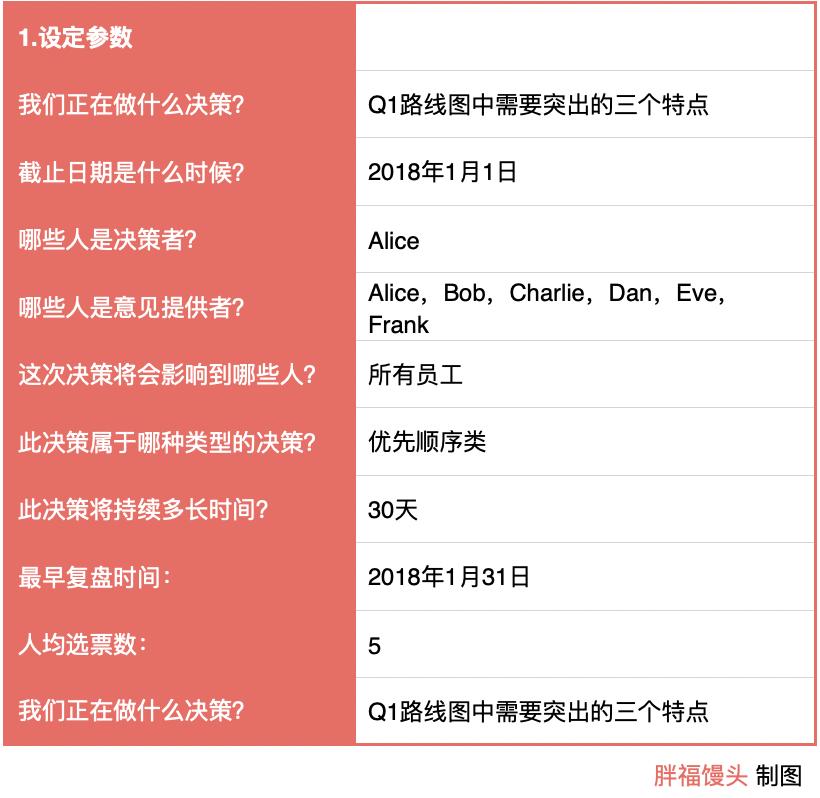
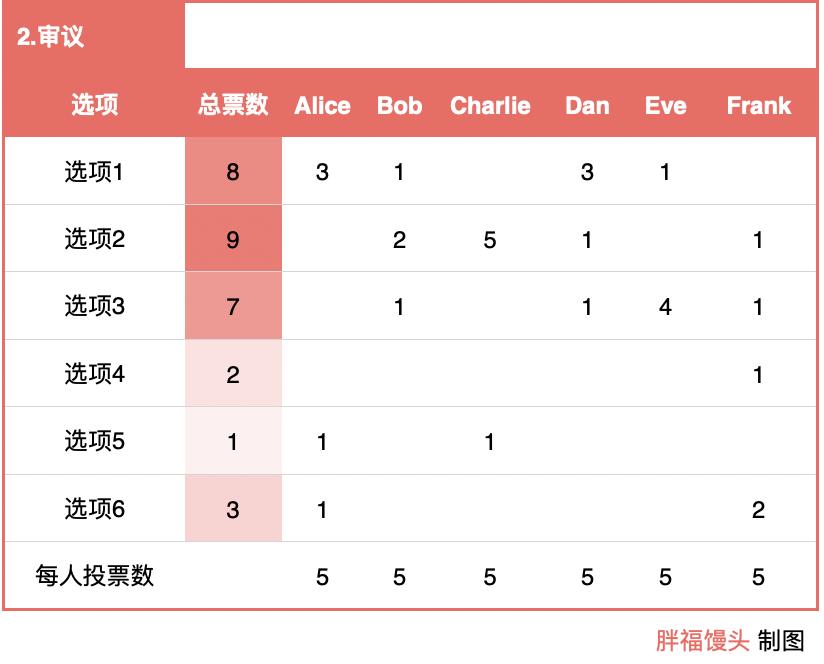
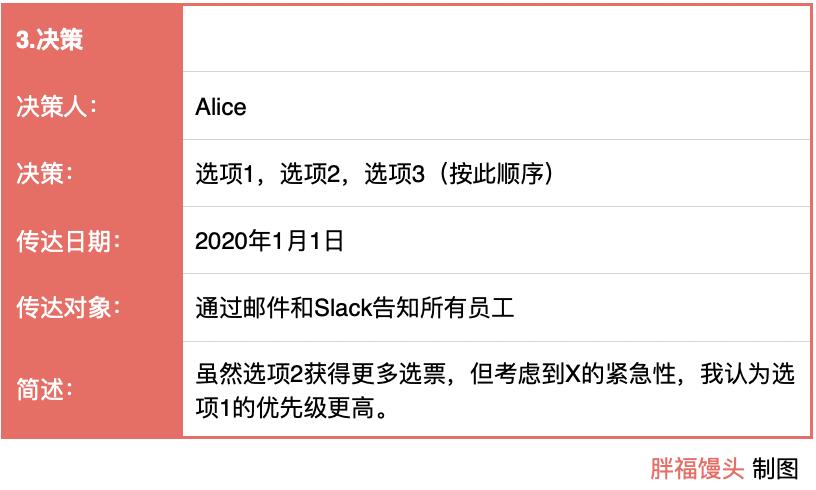
The three steps of the Coinbase decision template framework are as follows:
Set parameters
Review
Decide
Next, we will elaborate on each step. But before that, let's take a look at the characteristics of high-quality and low-quality decisions. 1. What does a high-quality decision look like?
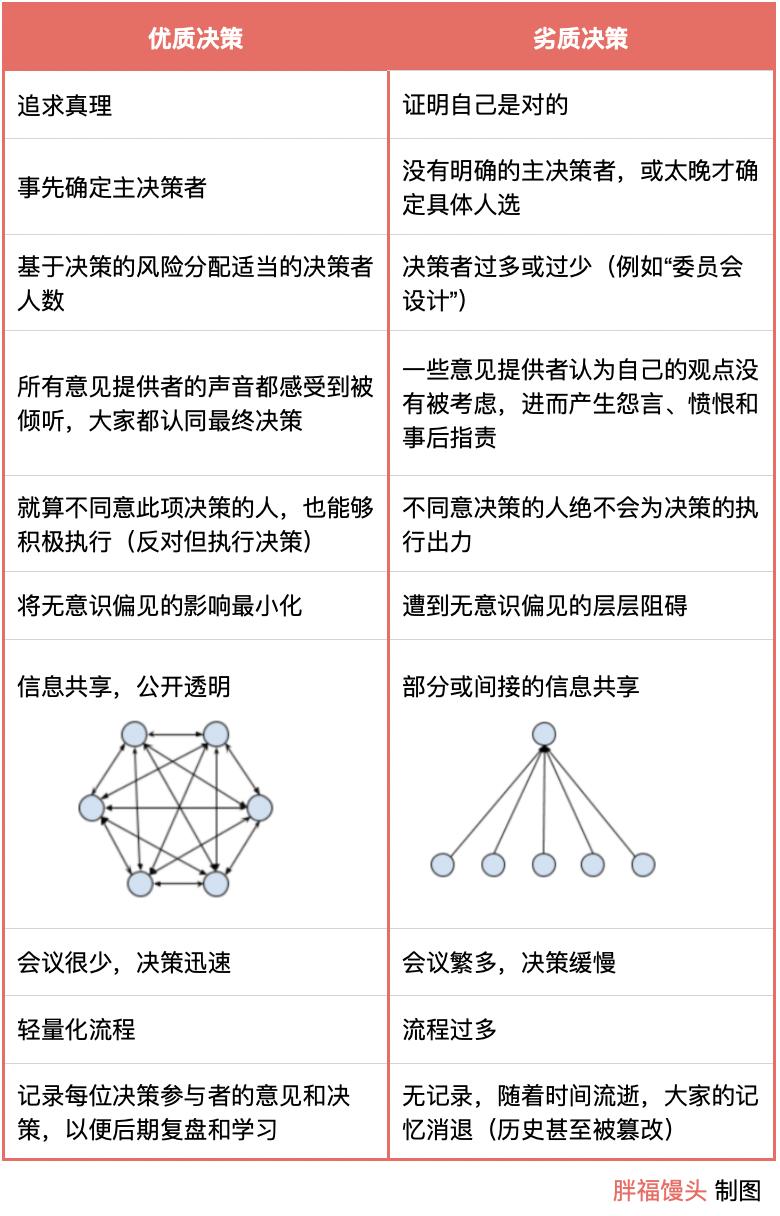
2. When is a decision-making framework needed?
Most decisions in a company are low-risk and can be decided unilaterally by leaders in the field (for example, whether to move this week's meeting from Monday to Tuesday, etc.).
A decision-making framework is only needed when facing ambiguous high-risk decisions. High risk means that this decision has long-term implications, or if the decision is wrong, it will incur significant costs.
The decision-making process can be very lightweight. For example, I have witnessed a decision being made from scratch in a 15-minute online meeting, but for major decisions, it may take several weeks.
Based on experience, you may be able to judge more quickly in which scenarios this framework is more suitable. In other cases, you will only know to use Coinbase's decision-making framework when you find disagreements or are unclear about the next steps. Regardless of the decision, once you decide to adopt this decision-making framework, just follow the steps below.
3. Coinbase Decision Framework
1 Set Parameters
In this step, you need to ensure that everyone fully understands how the decision is made and inform participants of the decision content in advance, which helps gain acceptance and minimizes the impact of second-guessing.
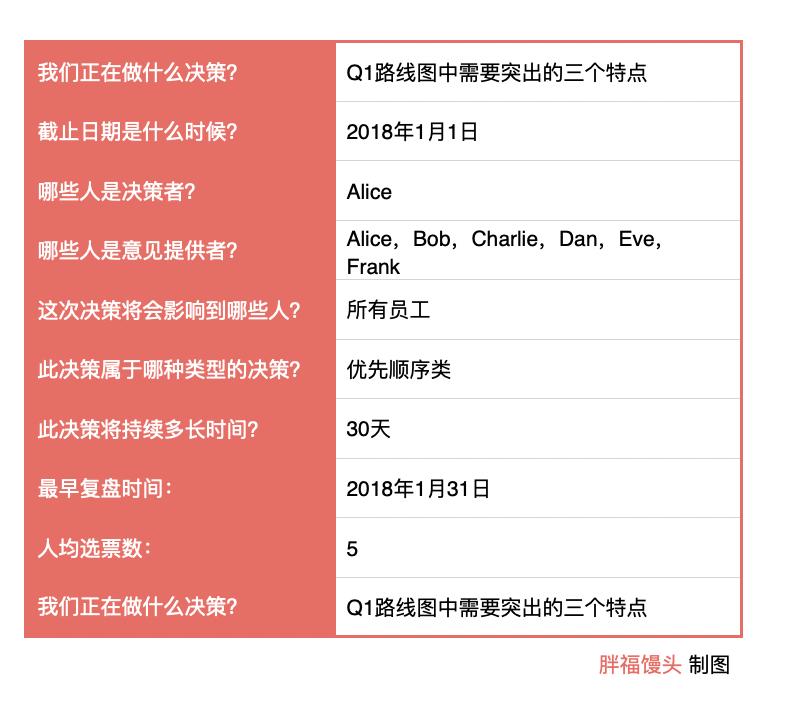
The following points need attention:
l Decision Date
Clearly set a deadline in advance to avoid falling into the trap of analysis paralysis (waiting too long to gather more information). A definite deadline can also reassure those who are uninformed and eagerly awaiting the decision.
l Review Date
Ask decision group members in advance to determine the execution time of the decision to avoid prematurely reviewing it. No decision is set in stone; you just need to clarify when and how to revisit the decision. When a decision is heading in the wrong direction, decision-makers also have the right to stop losses in a timely manner, pressing the "emergency button" to initiate a second discussion on the decision.
In any decision-making process, there are three types of people:
Decision Makers - Responsible for making the final decision;
Opinion Providers - Have some influence on the final decision;
Stakeholders - Individuals or groups affected by the decision.
The ideal number of opinion providers is about 3 to 8. If there are more than 8 or fewer than 3, the discussion may be significantly less effective. Since decisions may affect most people, try to ensure that each affected unit has a representative involved in the decision.
Finally, decisions can be categorized into three types:
Binary - "Yes or No" decisions, such as whether to hire someone or whether to acquire a company;
Priority - Must rank a series of options, for example, selecting the next five features to focus on from 100 options;
Choice - Selecting one from many options, such as naming a new product.
"A good plan, violently executed now, is better than a perfect plan next week." - Gen. George S. Patton
Should the decision maker be one person or a group?
For most decisions, I prefer to choose one person as the decision maker, as it tends to be simpler and more efficient. However, for high-risk decisions, it is also reasonable to involve multiple decision makers (the cost of an incorrect "Yes" decision is higher than that of an incorrect "No" decision).
Just as banks require multiple approvals to transfer large sums of money, you can increase the number of decision makers and grant them veto power to better manage high-risk decisions. This means that a decision can only pass if everyone agrees.
If you go too far in requiring unanimous agreement from all opinion providers before passing a decision, while this may further reduce the probability of decision errors, it may also compress your margin of benefit (for example, "committee design"). In certain fields (such as venture capital), a Yes decision may seem like a reverse bet, and team members are unlikely to reach a consensus, so being overly conservative may also lead to greater risks.
Weigh the pros and cons to find the right number of decision makers for your specific decision.
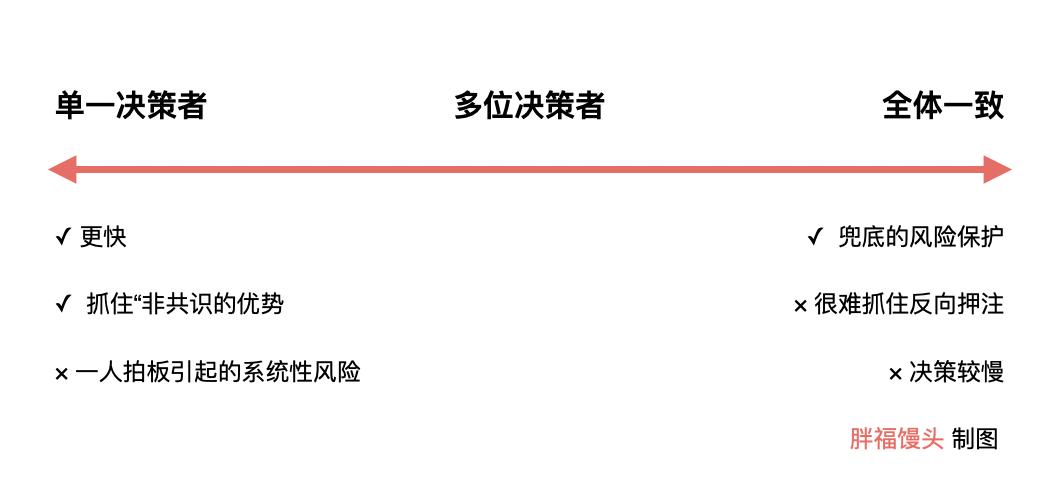
In general, if the cost of a wrong decision is within an acceptable range, then choose a single decision maker to gain speed benefits; but if the cost of a wrong decision is too high or irreparable, you can reduce excessive downside risk by increasing the number of decision makers.
2 Review
Next, you need to gather all opinion providers and decision makers in one room to achieve information sharing and gain their support.
l List Options
Conduct a small brainstorming session on the options. First, list as many options as possible, then make some judgments and filter them. Encourage each participant to actively think and propose ideas. Once a decision is made, try to consolidate any duplicate options. Note that when making binary decisions, you can skip this step since you already know the options: Yes or No.
l Present Data
At this point, you will need to present all the data collected from customers, comparative tests, legal teams, external consultants, etc., to the decision group, ideally having this data sent to the decision group for review before the meeting.
l First Round of Voting (Blind Voting)
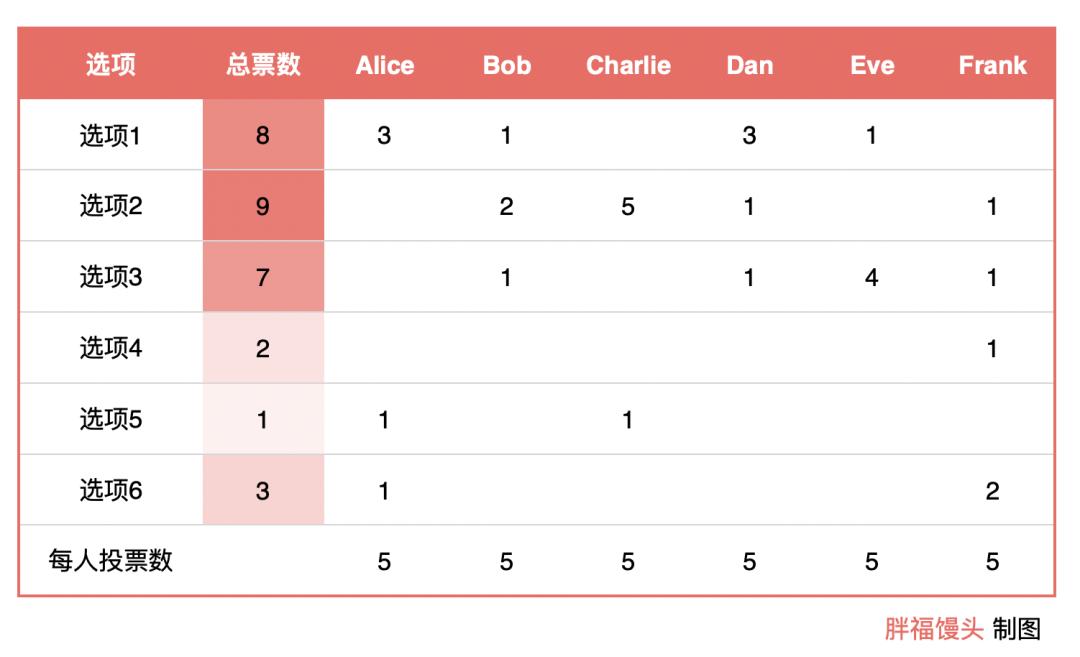
Organize the first round of voting among opinion providers to gauge the general sentiment. If done through blind voting, where no one knows how others voted, the effect will be better. For binary decisions, count down three seconds and have everyone indicate agreement or disagreement with a thumbs up or down. For priority or choice decisions, have everyone fill out an electronic spreadsheet (try to ensure they do not reference others' answers).
l Discuss Pros and Cons
Communicate with every participant in the room, from the least experienced to the most experienced, to understand the reasoning behind their votes. Communication can take various forms but should have a time limit. Record the pros and cons of each option and the reasoning behind them. Encourage each participant to speak up, spark their curiosity, and lead them to explore and learn new perspectives. In this process, you will find that the options you listed each have drawbacks, and there is no best option. You can continuously update this table, adding or merging options.
l Second Round of Voting
Finally, when all opinion providers have carefully listened to others' opinions and information sharing has been maximized, initiate a second round of voting and observe if anyone changes their votes. Record the results of the second round of voting in the spreadsheet for archiving.
In rare cases, at this stage, everyone may reach a consensus, making the decision maker's job much easier. They just need to communicate the decision, and the work is done. But more often, the decision maker's work is far from over. If necessary, you can hold another round of discussion and voting within the decision date.
3 Decide
l Make the Decision
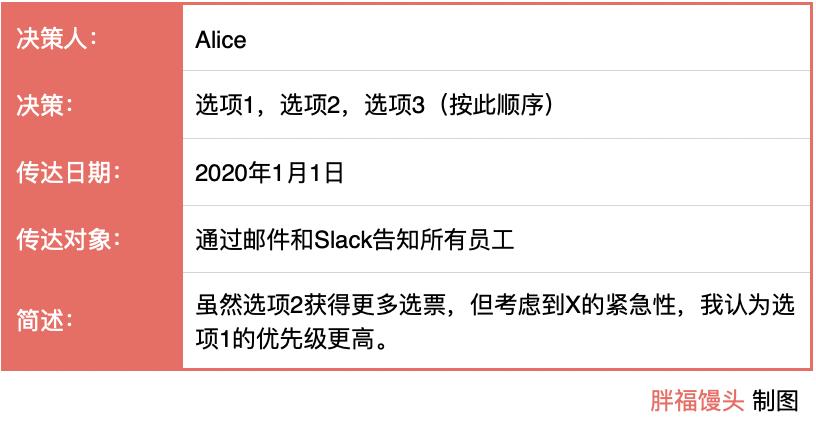
The decision maker can take one to two days to consider all opinions and make the final decision. Even if the "best option" has not been found, the decision maker still needs to make their choice before the decision date.
l Communicate the Decision
Send the decision via email to all stakeholders, including a list of opinion providers, the options considered, a summary of reasons (the pros and cons of this decision), and the review date. There is no need to include who voted for which option in the email, as at this stage, your team has already reached a consensus and will move forward together.
l Record the Decision
Finally, properly save the electronic spreadsheet used for voting, such as archiving it to Google Drive for future reference. You can also create a "review day" reminder to gather all opinion providers to discuss the decision again and continue learning. Reviewing how a wrong decision was made (post-mortem analysis) is also a very rewarding exercise and a good way to guard against historical revisionists.
If there are disagreements regarding the decision, inform them via email, allowing them time to digest the decision, which is more appropriate than confronting their immediate reactions in the office.
4. Conclusion
In many organizations and businesses, difficult decisions are a source of pressure, but you can turn pressure into motivation. In high-performing companies that operate at high speed, difficult decisions often present rare opportunities to drive rapid growth, innovation, and become winners.
Many factors can hinder decision-making and cause confusion, but practice makes perfect. As your decision-making experience increases, you will become more adept at it. I have created a list of patterns that may lead to decision failures and given it a memorable name:
l Too Many Voices
Too much meaningless small talk, too few quality opinions and information sharing.
l Headless Chicken
Until the front lines are established, there is no clear decision maker.
l Sudden Parachute
Only to realize late that someone should have been involved in providing opinions and trying to add them midway.
l Conflict of Interest
Decision makers have a tendency to take sides and cannot remain neutral.
l Chaos and Disorder
Managers designate themselves as decision makers but should actually delegate decision-making authority to others in the team.
l Abuse of Power
Managers designate someone as the decision maker but veto their decision at the last moment. (When you delegate someone else as the decision maker, you must respect the final decision regardless of the outcome and not interfere).
l Echo Chamber
The results of communication are swayed by the opinions of the most authoritative, vocal, and senior individuals, without listening to others' opinions.
l Coincidental Consensus
Decisions made through email exchanges (with everyone +1 agreeing), one-off conversations, or hastily convening a group of busy individuals are actually conclusions made without careful consideration.
l Analysis Paralysis
Continuously delaying a decision to gather more data, missing the decision date. ("Let's do a comparative test!" is a form of excessive data pursuit).
l Creativity Killer
Failing to distinguish between option listing and option evaluation.
l Abandoning Contingency Plans
Always thinking "there is no good option," thus overlooking the "safety net" choice.
l Excessive Processes
Applying a decision-making framework process to low-risk decisions complicates the issue. In such cases, it would be more efficient and quicker for a manager to make a unilateral decision.
l Unconscious Democracy
The decision maker, feeling pressured, chooses the option with the most votes to avoid responsibility, rather than selecting what they believe to be the best option. This decision-making framework has helped Coinbase make faster and higher-quality decisions, and I hope it can help your team as well!
This article is sourced from the public account @Pangfu Mantou, initiated by early-stage venture capitalists to gain insights into the growth of super individuals. The person in charge of Pangfu Mantou has won the LinkedIn Top Voice award for three consecutive years (2018-2020) and has over 700,000 followers. Everyone is a super individual in the new era, and the public account is extremely selective about input sources, with infrequent updates, but aims to provide high-quality insights and reflections.
 Risk warning
 Risk warning
Popular articles