Detailed Explanation of the BSC Ecosystem Comprehensive Project Dinosaur Eggs: A New Gameplay Combining DEX and Social Interaction

 The LP turnover rate of Dinosaur Eggs is significantly higher than that of other DEX platforms using the AMM mechanism, mainly due to its trading mining mechanism and unique token incentive strategy.
Author: Xu Xiaopeng
Source: Niu Bi Blockchain
Introduction
A comprehensive analysis of the comprehensive project Dinosaur Eggs from the perspectives of product mechanism, business model, token economy, risks, and investment logic.
Core Investment Logic: Dinosaur Eggs has a sophisticated token and mechanism design, with impressive planning of interests and responsibilities for multiple participants, the direction of incentive distribution for token output, and a remarkable combination of heterogeneous (NFT) and homogeneous assets. There is also a high degree of coordination among its core product modules. The two disclosed business areas, Swap and Social, align with major industry trends, indicating significant growth potential for the project.
Main Risks: The project has a short launch time and many uncertainties. Specific risks include project mechanism derailment, contract risks, governance level moral hazards, and competition from clones.
Valuation: From a static PS (Price-to-Sales ratio) perspective, compared to blue-chip swaps on BSC, Dinosaur Eggs is valued at an extremely low position, only 1/40 of Pancakeswap. However, considering it is in a high inflation period and has a short development time, this valuation can only serve as a rough reference. This research report will focus on qualitative analysis of mechanisms and products.
Project Overview
Business Scope
The Dinosaur Eggs project is a comprehensive project deployed on BSC. According to its official documentation, the disclosed business areas include Swap and social, with the first launched product being Dinosaur Swap, focusing on trading. Its social product has not yet launched.
Project Innovations
From the products that have already launched and the project's official documentation, the main innovations of Dinosaur Eggs compared to other swap projects are as follows:
Complex and Sophisticated Token Model Design
The token model of Dinosaur Eggs reflects many well-known projects, including Curve's governance lock-up (veCRV), DODO's membership system (vDODO), Bakery's NFT module, Kswap (a swap project on Okchain) trading mining, and even the transfer burn mechanisms of certain MEME tokens.
So far, the entire mechanism of Dinosaur Eggs operates smoothly, with a high degree of coordination and reinforcement effects among product modules. An in-depth analysis of the project's token model and business mechanism will be detailed in the Token Model section of Business Analysis.
Introduction of NFTs and Diverse Scenarios
Dinosaur Eggs has designed a rich set of functional scenarios for NFTs. Among the two types of NFTs currently disclosed and launched (the "Money-hungry Dino" and "Meat"), their main functions are to obtain protocol income and serve as LP yield acceleration tools for market makers. Additionally, the project has built-in a secondary trading market for NFTs and fragmented these two types of NFTs to enhance liquidity and turnover rates.

The project's NFT secondary trading market, currently available NFT types are "Money-hungry Dino" and "Meat"
Differentiated Market Trading Pair Selection
At the project's launch, VAI (an over-collateralized stablecoin issued by Venus, the largest lending project on BSC) was chosen as one of the trading tokens for many liquidity pools. Previously, the stablecoin VAI had long deviated from its pegged price of $1 due to severe supply-demand imbalances.
After the launch of the Dinosaur Eggs project, VAI was quickly pulled back to around $1 and remained stable in the following days. Additionally, the project also included XVS (Venus's governance token) as one of the main tokens in the liquidity pool. Subsequently, Venus began to interact multiple times with the Dinosaur Eggs project on Twitter.

In Dinosaur Eggs' liquidity incentive pool, VAI is one of the main tokens
Project History
Token Price Trends
The project launched on October 2, 2021, and has been operating for less than a week. Its core token DSG, as an early core mining material (commonly referred to as "shovel"), was contested to over $3000 before the project officially began mining (at that time, the project team had only pre-added 20 DSG tokens).
After mining began, DSG was pushed up to around $18, but later, due to significant token inflation, its price fell to a low of around $0.58, followed by a rebound, maintaining around $1.3-1.8 in the last three days.

Price trend of DSG within a week of launch; as inflation rates gradually decrease, the trend stabilizes. Source: https://dex.guru/
Major Project Events:
Although as of today, the project has been online for less than a week (10.2-10.7), the Dinosaur Eggs project has been very active, with frequent updates on its Twitter. Specific events include:
October 2: Project launch
October 3:
Initiated liquidity mining incentives for fragmented NFT tokens to enhance the liquidity of NFT fragment assets.
Announced a contributor support plan, stating that community funds would reward contributors in security, artistic creation, and community ambassador roles.
Gained retweets and attention from the Venus project, regarding liquidity mining rewards for VAI and XVS.
October 4:
First adjustment of the DSG reward distribution coefficient, reducing liquidity mining incentives, especially for stablecoin liquidity pools, while increasing trading mining reward distribution.
Announced that all rewards accumulated in the official member address would be distributed to other members (members refer to users who stake DSG, i.e., holders of vDSG, see the "Token Model" section for details).
Lowered the invitation threshold for the membership system to encourage invitations.
Announced a partnership with Babyswap on BSC.
October 6:
The first CEX to list the DSG token was Lbank.
Announced a reduction in the usage threshold for its LP yield acceleration token "Meat."
Started liquidity and trading mining incentives for Babyswap's token Baby.
October 7:
Announced the opening of liquidity incentives and trading mining incentives for RACA (an NFT track project on BSC, deeply involved with Musk's mother).
Adjusted the reward coefficients for liquidity mining and trading mining again, using its core token DSG as the counter asset for market making.
The number of members in the membership system exceeded 1500.
Overall, the project team has been quite active in the first week since launch, especially in adjusting incentive distributions and business collaborations.
Business Situation:
Currently, the core data of Dinosaur Eggs is as follows:

The author believes that the two most noteworthy indicators are LP capital turnover rate (daily) and membership joining rate. LP capital turnover rate (daily) = 24-hour trading volume / market-making capital, used to measure the turnover efficiency of market maker funds; the higher the turnover efficiency, the higher the market maker's capital fee return and protocol income.

Dinosaur Eggs' LP capital turnover rate is significantly higher than other DEX platforms using the AMM mechanism, primarily due to its trading mining mechanism and unique token incentive strategy (see: Token Model). Additionally, UNI V3, which utilizes a custom price range for market making, also shows significantly higher capital utilization efficiency compared to traditional AMM platforms.
Another indicator, membership joining rate = DSG deposited in the membership system / total DSG supply. A higher membership joining rate indicates a higher user retention rate for the entire system. Dinosaur Eggs' token lock-up indicator is 37.9%, which is very close to the lock-up amount of Curve's CRV token, the pioneer of token governance lock-up mechanisms.
Since launching its DAO, Curve's circulating token lock-up amount has been steadily increasing, currently at 41.76%. The achievement of Dinosaur Eggs in just one week is impressive.
It should be noted that Curve's CRV lock-up serves dual purposes of governance and earning protocol income dividends, while DSG can only earn protocol income distribution after being locked up, and currently lacks governance functionality.

Curve's CRV lock-up amount, data source: https://dao.curve.fi/releaseschedule
Team Background & Investment Institutions
The core team of Dinosaur Eggs is currently anonymous and has not disclosed information about its key personnel. However, the project has undergone a Certik audit. The project adopted a fair launch approach, with no financing or pre-sales, and the team did not reserve any original shares in advance.
Business Analysis
Industry and Competitors
According to Dinosaur Eggs' official documentation on the project's positioning, it is a comprehensive project that includes Swap, Social, and other businesses, referred to as the "Dinosaur Metaverse."

Dinosaur Eggs' project homepage, besides Swap (Defi), also reserves entrances for social and other products.
However, currently, aside from Swap, there is no confirmed launch time for other product segments, and specific product forms and directions have not been disclosed.
At present, the order of blockchain business explosions is: decentralized finance (DeFi), collectibles (art, avatars, trading platforms) market based on NFTs, and Gamefi (with few projects other than Axie that have large scale and sustainability).
The blockchain social track is currently in a phase where everyone is looking forward to it, and industry giants are making significant moves (decentralized project representatives include Aave, centralized institutions include Twitter factions), but there are few representative products. The product-market fit of this industry has not been clearly validated and remains to be observed.
In the Swap field on BSC, Pancakeswap's user base and business volume are in an absolute leading position, occupying a large share of mainstream asset trading volume. The rising star is the Babyswap project, which was selected for MVB Phase 3, focusing on trading and market-making services for long-tail assets.
Although Dinosaur Eggs has quickly gained traction, its trading pairs and number of partners are still in the early stages, with little overlap with the trading counterparts of Pancakeswap and Babyswap. In the short term, it will not pose a direct threat to leading projects on BSC, but as the project develops, it will inevitably face competition for business with first- and second-tier swap projects.
Token Model
Compared to traditional swap projects, Dinosaur Eggs' token model differs significantly in several aspects:
More Diverse Token Types Capturing Protocol Income
It includes both homogeneous tokens (FT) DSG and heterogeneous tokens (NFT) Money-hungry Dino, and DSG can be minted into vDSG, a membership rights token, with varying levels and parameters for the Money-hungry Dino NFTs.

An NFT of level 6 Money-hungry Dino listed for sale in the NFT secondary market, source: https://dsgmetaverse.com/#/nftdetail/market
The following explains the above token types:
1. DSG
DSG is the core token of the project, with a total supply and output model similar to Pancakeswap's cake, with no upper limit on total supply. The output is regulated through governance (the DAO is not yet online), and future deflation will be achieved through output regulation and increased scenarios.
Currently, 88 DSG are produced per block, with a daily output of 2,534,400 DSG.
The role and value capture of DSG mainly come from:
Directly capturing trading platform fee income: part of the trading fees will be used to repurchase and burn DSG.
Minting vDSG to join the dragon clan membership: vDSG is minted at a ratio of 100:1, gaining additional trading fee distribution, DSG transfer burn distribution, NFT trading platform trading fee distribution, NFT synthesis, and other membership rights.
Transfer burn deflation: DSG has a transfer burn mechanism, deducting 0.05% for each transfer, of which 0.03% is directly burned, and 0.02% is distributed to vDSG stakers.
Used for NFT synthesis and slot purchases.
DSG can be used to purchase various NFTs in the mall system.
Governance: After the DAO module is online, it can be used for proposals and voting.
However, the above still only captures a small portion of the protocol's value. To capture more protocol value, one needs to mint vDSG with DSG.
2. vDSG
vDSG is minted from DSG at a ratio of 100:1. The protocol value that vDSG holders can capture includes:
The entire membership system receives a reward of 18 DSG per block.
An additional distribution of 0.025% from the platform's 0.3% trading fee, distributed to vDSG holders after repurchasing DSG.
0.02% deducted from each DSG transfer is distributed to vDSG stakers.
Distribution of NFT trading platform trading fees.
DSG paid for upgrading Money-hungry Dino and purchasing slots (see "Token Model") is distributed to all members.
The usage fees of Meat NFTs are distributed to all members.
Members holding more than 1 vDSG can invite other members to mint vDSG, and 10% of the vDSG minted by the invited person will count towards the inviter's membership weight, but this right cannot be redeemed or transferred, and will permanently disappear after the invited person and inviter redeem vDSG.
When other users redeem vDSG, the exit fee charged at a ratio will be distributed to the remaining vDSG holders in the form of vDSG.

Dinosaur Eggs' membership system interface, source: https://dsgmetaverse.com/#/vdsg
3. NFT: Money-hungry Dino
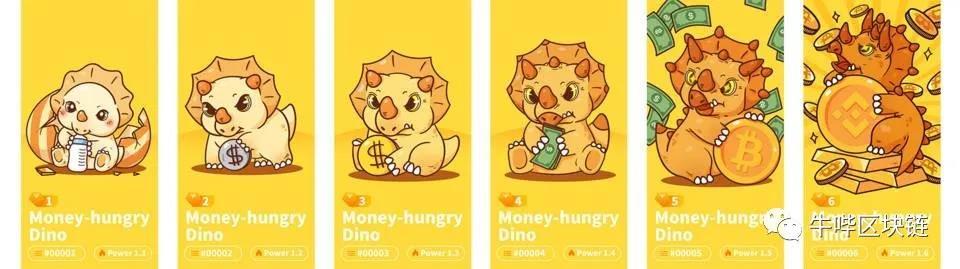
The total number of Money-hungry Dino NFTs is 20,000, of which 15,000 will be produced in the Pterosaur Farm in the form of egg fragments (a homogeneous token) within 60 days. 10,000 egg fragments can be exchanged for one Money-hungry Dino NFT, which can be seen as a blind box, randomly yielding a Money-hungry Dino NFT of level 1-6 upon opening.

Money-hungry Dino egg shell fragments (FT), Money-hungry Dino egg blind box (NFT), and level 1 Money-hungry Dino NFT, source: Dinosaur Eggs official documentation
The higher the level of the dragon, the higher the "Dragon Power," and ultimately, users can stake based on Dragon Power to share 13.3% of the 0.3% trading fee.
Why does the project design such a complex multi-token system to capture protocol value with DSG, vDSG, NFTs, and NFT fragments?
There may be complex motivations behind this, but the author believes there are three obvious benefits:
A more diverse token system, the introduction of NFT tokens, and the combinability of tokens can enhance the overall "gameplay" and "immersion" of the system. During the author's few days of lurking in the project community, many users expressed that the project is "fun."
The coexistence of homogeneous tokens and NFTs may leave ample room for the project to combine with other projects and explore future social business segments.
The existence of NFTs provides more trading scenarios, creating additional protocol income.

Dinosaur Eggs' multiple token descriptions and associated mechanisms, illustrated by community user xdord
Introduction of Multiple Game Theory Systems
The core business segments of Dinosaur Eggs in Swap can be divided into four parts: market making, trading, membership system, and NFT system. In these four business segments, the project team has fully integrated game design. Specifically:
Market Making Game: Market makers compete based on capital amounts, similar to traditional market-making logic, which will not be elaborated here.
Trading Game: Introduced through the trading mining mechanism. Trading mining refers to the project providing token distribution rewards for trading activities, where users receive token rewards based on their cumulative trading volume proportion. The higher the cumulative trading volume proportion, the higher the token rewards. In this mechanism, users' past cumulative trading volume is akin to "mining power."
However, once users choose to withdraw DSG, their past cumulative trading volume will reset to zero. During this reset process, the total power of the system will also decrease, meaning that the power ratio of other users who have not withdrawn DSG rewards will increase, while the withdrawers will need to accumulate power from scratch through new trades. Users who delay withdrawing rewards will receive more DSG but will also bear the corresponding risks of DSG price fluctuations.
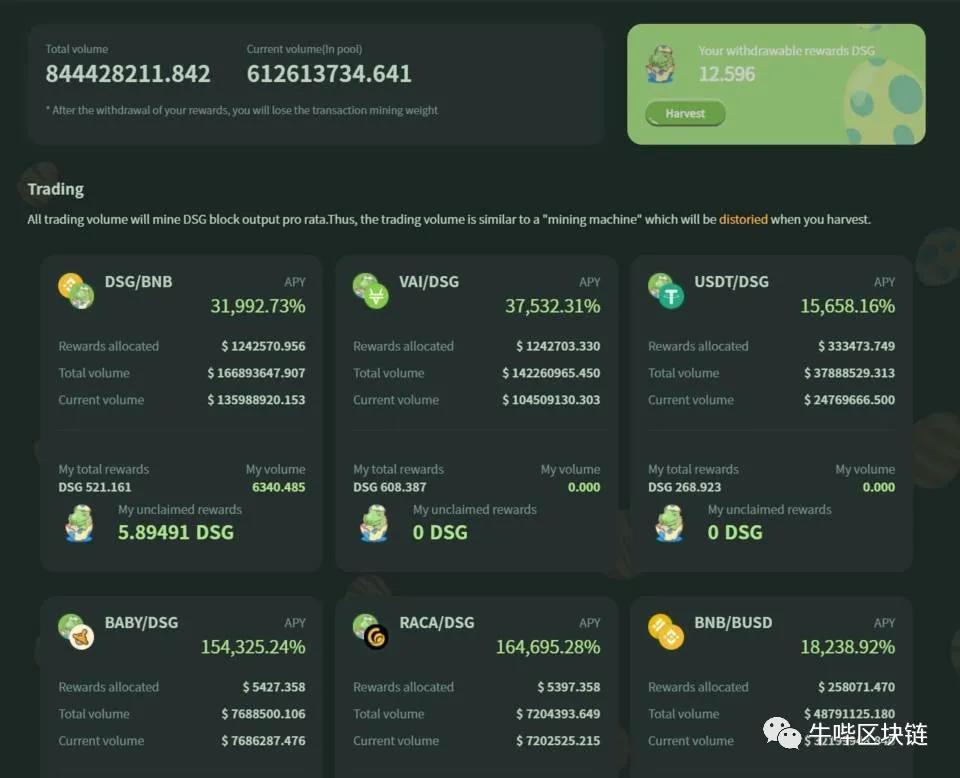
Dinosaur Eggs' trading mining page, source: https://dsgmetaverse.com/#/trading
Membership System Game: The membership system of DSG is derived and modified from another well-known swap project, DODO's vDODO membership system. Holders become project members by minting DSG into vDSG, and the vast majority of the project's protocol income will be distributed proportionally to vDSG holders.
In other words, DSG holders cannot directly capture most of the protocol's income; they must mint vDSG to maximize their share of the protocol's growth dividends. This approach is consistent with Curve's model, where only veCRV can earn protocol income. On the other hand, while profiting from distributions, vDSG users are responsible for absorbing the price fluctuations of the project tokens.
To achieve this, Curve incentivizes through the duration of the lock-up: the longer users lock up CRV, the higher their governance and dividend rights proportion; vDSG achieves this through an "exit burn" mechanism, which differs from CRV's inability to redeem after locking up to become veCRV.
vDSG can be redeemed for DSG at any time, but there will be an exit penalty upon redemption. This penalty is dynamic; the higher the proportion of circulating un-locked DSG, the higher the exit penalty rate, and vice versa.
It is important to note that most of the exit penalties will be distributed to other vDSG holders who have not exited. In other words, non-exiting vDSG holders can not only earn most of the protocol's income but also receive most of the penalties paid by exiters.
NFT System Game: The NFTs currently disclosed by the project mainly include two types (officially planned to have four types), one being income-generating NFTs—Money-hungry Dino, and the other being LP yield acceleration NFTs—Meat. The game logic of Meat is similar to market making and will not be elaborated here. This section mainly discusses the game logic among Money-hungry Dinos.
The function of Money-hungry Dinos is to distribute daily trading fee dividends, but this system has two special mechanisms: 1. Synthesis. Two Money-hungry Dinos of the same level can be synthesized into a higher-level Money-hungry Dino, with the higher-level Dino's Dragon Power being a random range but must be greater than the sum of the Dragon Powers of the two lower-level Dinos.
- Combination. When users collect a complete set of Money-hungry Dinos from levels 1-6, they can purchase a slot (paying DSG) to stake the entire set of Dinos. At this point, the overall Dragon Power (dividend weight) of the Money-hungry Dino combination will be five times the sum of the original levels 1-6 Dinos.
Under this logic, if users want to maintain an advantage in the dividend competition among Money-hungry Dinos, they must engage in synthesis and strive to obtain a complete set of Dinos for staking.
No longer "Liquidity is King," Multiple Incentive Measures in Parallel
As a fair launch project, how tokens are distributed is crucial. Trading projects like Pancakeswap primarily direct token incentives towards liquidity providers and Cake token stakers (commonly referred to as "self-mining"). In contrast, Dinosaur Eggs' incentives lean more towards traders (through trading mining) and members (through the membership system).

Dinosaur Eggs' token output distribution plan shows that the incentive for trading mining is much higher than for liquidity, source: official documentation
In the author's view, this may be a better incentive approach because increasing trading volume will directly enhance the turnover speed of market makers' funds, creating greater fee income for them. By incentivizing traders, it indirectly incentivizes market makers; fully incentivizing members can improve user retention and participation, contributing more long-term value to the protocol.
Directly subsidizing liquidity may not be as effective in these two areas. Of course, no token incentive model is perfect and requires adjustments. Perhaps this is why Dinosaur Eggs has updated its incentive weight parameters twice within five days of launch (see the previous section "Major Project Events").
Token Summary
The token model of the Dinosaur Eggs project is large and somewhat complex. We can see many excellent projects' token economies reflected in it, but the project's token designers have not merely "stitched together" multiple mechanisms; instead, they have a more holistic design and ensure a relatively balanced contribution and benefit among multiple participants through "game theory," jointly promoting the project's development.
Competitive Advantages
As of today, it is still early to discuss "moats" for Dinosaur Eggs, a project that has been online for less than a week. However, its complex and meticulously designed token model has a clear mechanical advantage compared to other swap projects.
Additionally, the team's sensitivity to project operations and adjustment speed is impressive.
Considering that the project has only launched one of its businesses, the subsequent integration of its Social and other NFT designs with existing mechanisms will also be crucial for the project's overall future development and may become the project's "deciding factor."
Project Risks
As an early-stage project, Dinosaur Eggs also faces numerous risks, including:
Project mechanism derailment: The existing mechanisms and token designs of the project are large and complex, with a high degree of interconnection among various modules. Although it is currently operating well, this mechanism will face more complex challenges in the future. For example, if a large number of members exit under the "burn mechanism," and many trading mining users withdraw profits, causing a price drop, will it lead to an irreversible "death spiral"? The current consensus on whether the project can withstand this remains to be seen.
Emergence of clones: If similar mechanisms appear in the short term, it may divert traffic from the project.
Contract risks: The protocol has many modules, and the combinations and calculations among modules carry certain contract risks.
Project governance issues: Currently, the project does not have a specific plan for DAO, and the team has strong control over the project. Its governance level and moral standards are one of the project's biggest "single-point risks."
Valuation Level
Five Core Questions:
What stage is the project in its business cycle?
Is it in the mature stage or the early to mid-development stage?
The PMF (Product Market Fit) of swap projects has been fully validated, and the project's Swap module is operating stably, but there is significant room for adding trading pairs. Moreover, other product modules of the project have not yet launched, indicating that the project is in a very early stage of development.
Does the project have a solid competitive advantage?
Where does this competitive advantage come from?
The project mainly relies on its excellent token design and combination mechanisms to achieve a cold start and rapid development. The team's sensitivity and adaptability are also commendable. However, whether these advantages can be maintained in fierce competition remains to be seen.
Is the project's mid- to long-term investment logic clear? Does it align with major industry trends?
The project's mid- to long-term investment logic is optimistic about the Swap track and the exploring Social track, where the Swap track is very broad (despite competitive incentives), and the Social track is favored by many leading players, possessing significant long-term development potential, although the business model is still exploratory. Overall, the two disclosed business areas of the project, one new and one old, align with major industry trends.
What are the main variable factors affecting the project's operations?
Are these factors easily quantifiable and measurable?
Currently, the main focus is on the operation of the project's mechanisms, requiring comprehensive observation of core indicators such as LP capital turnover rate and membership ratio, as well as the project's ability to withstand pressure during negative spirals. Externally, it is necessary to observe whether strong competitive clones emerge and the actual diversion situation.
What is the project's management and governance approach?
What is the level of DAO?
Currently, the project's DAO module has not yet launched, and there is no timetable. The core team is mainly responsible for project promotion.
Valuation Level
The project is in a very early stage of development, with both potential growth space and operational uncertainty being very high. Research reports focusing on project overviews primarily emphasize business or mechanism innovations, with light valuation analysis. Therefore, this section will only use PS (Price-to-Sales ratio) as a horizontal comparison indicator, comparing Dinosaur Eggs with the benchmark swap project Pancake on BSC. The lower the PS value, the more undervalued the project's market value is relative to its protocol income.

From a static PS perspective, Dinosaur Eggs is significantly undervalued compared to Pancakeswap, with Pancakeswap's PS being 39 times that of Dinosaur Eggs. However, as mentioned earlier, Dinosaur Eggs, as a newly launched project, has much greater uncertainty than mature blue-chip projects. Before its mechanisms and competitiveness are fully validated, the market is unlikely to assign it a high valuation initially. Additionally, Dinosaur Eggs faces greater inflation pressure; as of October 8, its daily inflation rate is around 17%.
Valuation Summary
Dinosaur Eggs' existing competitive advantages mainly stem from excellent token and mechanism design, and the team has good sensitivity and responsiveness. The project is in an absolute early stage of development, with huge potential on one hand but also facing significant uncertainty. From a valuation perspective, Dinosaur Eggs' PS valuation is far lower than that of the mature project Pancake, but it can only serve as a rough reference.
 Risk warning
 Risk warning