1kx Research: Why Connext Has the Potential to Unify Cross-Chain Liquidity
 Connext is an interoperability protocol that enables fast, non-custodial cross-chain transfers and contract calls between EVM-compatible blockchains.
Author: Nichanan Kesonpat
Original Title: 《Unifying Cross-Chain Liquidity with Connext》
Compiled by: Hu Tao, Chain Catcher
The multi-chain market has arrived. Thanks to years of research, open-source development, and the spirit of public learning within the crypto developer ecosystem, we now find ourselves amidst heterogeneous L1 blockchains and L2 scaling solutions, each with its own scaling capabilities and design trade-offs.
With the surge of blockchain networks, the demand for interoperability solutions has also increased. To date, there are over 40 cross-chain bridge projects that have bridged more than $26 billion in value from Ethereum L1 alone.
This is less than 1% of the $3 trillion market cap of cryptocurrencies. As cross-chain infrastructure becomes robust and cross-chain liquidity becomes abundant, we can expect this percentage to rise. Given that crypto itself has ample room for growth (in contrast, the global stock market is valued at $122 trillion), the cross-chain infrastructure market could also reach trillions of dollars.
Most bridging solutions today are either chain-specific, asset-specific, or application-specific. While they are effective short-term solutions for onboarding Ethereum users to L2, the true potential of crypto networks will be unleashed when liquidity is no longer fragmented, and applications can natively operate across chains from the start.
Connext is working to make this vision a reality. Connext is an interoperability protocol that enables fast, non-custodial cross-chain transfers and contract calls between EVM-compatible blockchains.
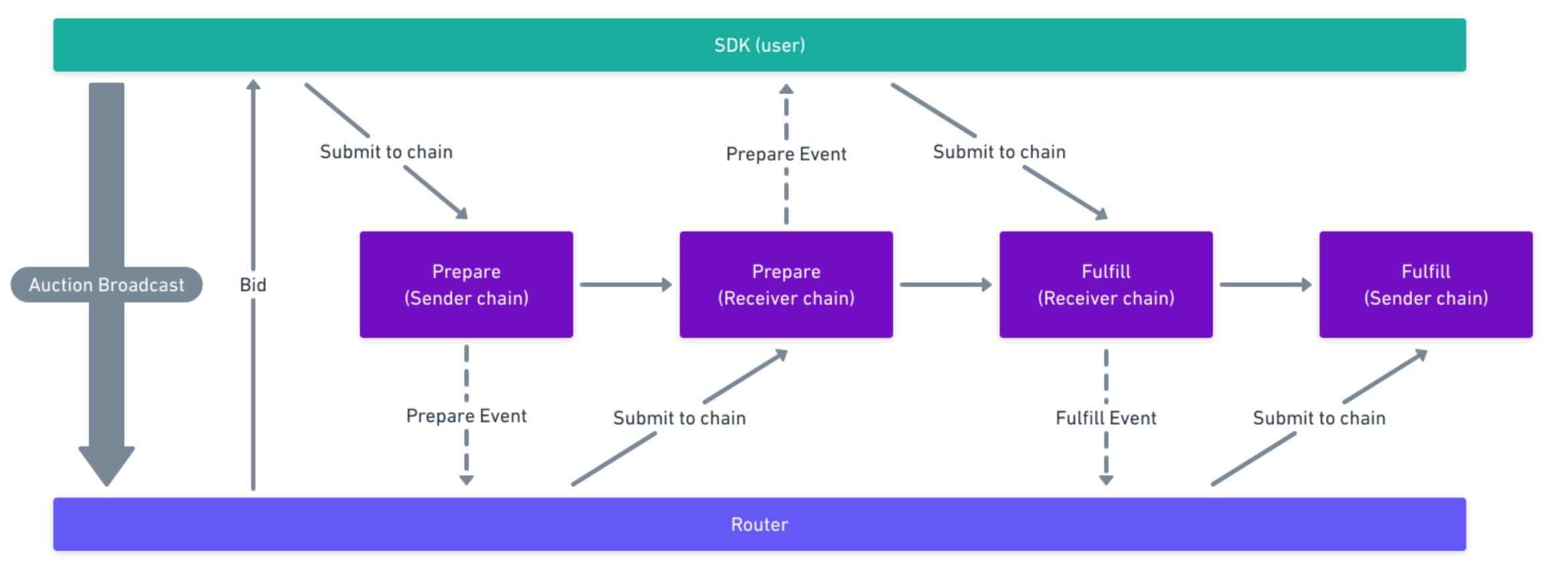
Connext is a liquidity network: a peer-to-peer off-chain network composed of nodes (routers) that hold a "stock" of assets to send and receive on-chain. Users transfer funds across chains by trading with a network of routers that have access to the desired asset liquidity.
Users "lock" funds on the sending chain and "unlock" the corresponding amount (minus fees) on the receiving chain. Conversely, routers lock funds on the receiving chain for users at the start of the transaction and receive the locked funds and fees on the sending chain.
The long-term foundation for cross-chain transfers should have maximum scalability and be highly secure as economic throughput surges. Liquidity networks are well-suited for this because they are:
- Trust-minimized: Due to the locking mechanism, users can be assured that routers will not cause fund loss. Connext's non-custodial cross-chain transfer protocol (NXTP) is the only universal interoperability solution that does not add new trust assumptions. Bridges that rely on external validators are fundamentally less secure because users need to trust third-party validators with their funds and data.
- Scalable: Cross-chain bridges that utilize their own validator sets to verify transactions have stronger trust guarantees. However, they need to be customized for each chain pair and cannot add support for new chains as quickly as liquidity networks (for example, Ethereum rollup bridges can only be used between that rollup and Ethereum L1). Connext can easily add new chains to the network, allowing for rapid expansion into other ecosystems.
- Capital efficient: Guaranteed/insured bridging solutions require validators to collateralize assets to provide services to the network. This collateral needs to scale proportionally to the economic throughput of the bridge; otherwise, incentives will fail. For liquidity networks like Connext, the economic throughput that the network can safely facilitate has no game-theoretic limit because capital locking is decoupled from the security model.
- Good user experience: Because validation occurs locally within the liquidity network (between trading counterparts rather than requiring global consensus), cross-chain transfers are fast. As long as the chain is EVM-compatible, the protocol is agnostic to L1 and L2. Connext enables users to perform direct L2-L2 transfers, completely avoiding L1 transaction costs.
These trade-offs position Connext optimally for cross-chain transfers and contract calls. Users can be assured that their funds are secure, the network can quickly expand to include new Dapp ecosystems, transaction speeds are fast, and mainnet fees can be entirely avoided.
Liquidity Rebalancing Under Arbitrage Incentives
Cross-chain transaction volume is a key growth metric for liquidity networks. However, a large volume of transactions in one direction can quickly deplete liquidity on the other side.
To address this issue, Connext employs dynamic pricing liquidity on AMM curves, mimicking stablecoin trading AMMs like Curve. The price of assets fluctuates as a function of the available liquidity ratio on each chain. The more imbalanced the liquidity, the larger the price spread.
In other words, users pay a higher price to acquire assets on the chain with stronger liquidity, while the price for assets on the chain with lower liquidity is lower (in fact, users may even be rewarded on the chain with lower liquidity if the routers are not balanced enough!).
This provides enticing arbitrage incentives for market makers who have already capitalized on such opportunities in AMMs like Uniswap. With Connext's Virtual AMMs, cross-chain arbitrage is also possible.
The router auction mechanism matches users with the cheapest price available for the transfer they desire. In turn, the best prices come from the most imbalanced routers. The virtual AMMs and router auctions continuously rebalance the liquidity across the network, achieving scale expansion while maintaining cross-chain price equilibrium.
Moreover, since trading counterparts negotiate routes and pricing offline, third parties cannot front-run transactions.
Vertical and Horizontal Liquidity Scaling
As more routers come online, the liquidity across the entire network deepens, making Connext highly defensive.
Today, over 100 assets have been connected from Ethereum to 17 different blockchain networks. As Connext expands its ecosystem, new routers have ample room to address liquidity bottlenecks. Routers can identify popular but yet-to-be-liquid routes and seed liquidity for them to discover profitable opportunities.
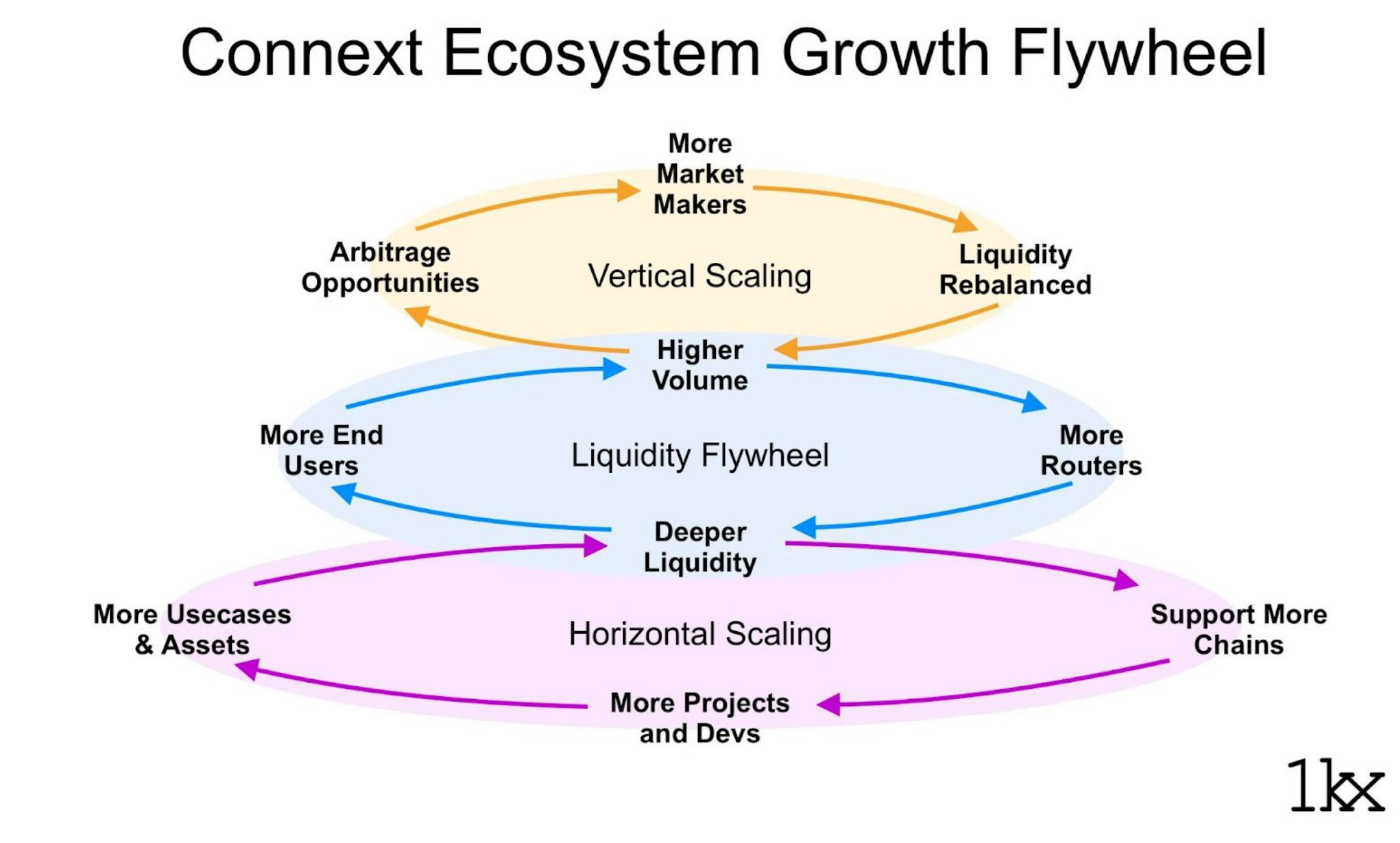
Increased liquidity enhances Connext's ability to horizontally scale the network and integrate more chains and projects. Integration is appealing and sticky because it allows the protocol to immediately tap into a broader user ecosystem with just one transaction. This is where the scalability of liquidity networks comes into play, enabling Connext to quickly respond to demands for new chains and assets. Just five weeks after launching on the mainnet, Connext's NXTP has expanded to nine chains, including Ethereum mainnet, Polygon, Arbitrum, and Avalanche. The growing applications and end-user base drive volume growth, which in turn boosts router revenue and network value.
At the same time, virtual AMMs and router auctions allow the network to vertically scale and facilitate growing capacity. Transaction volume provides arbitrage incentives, attracting market makers to enter and control the system. This mechanism also keeps the ratio of transaction volume to TVL high. A higher capacity/TVL ratio indicates higher asset turnover and capital efficiency, meaning higher returns on investment for routers and lower fees for users. Connext currently has $11 million in liquidity with a weekly transaction volume of $31 million.
These factors drive a liquidity flywheel that expands the network both horizontally (more chains and assets) and vertically (more transaction volume, with arbitrageurs continuously rebalancing liquidity):
The Foundation for Cross-Chain Native Applications
While the ability to transfer across chains in a low-cost and trustless manner is powerful, we have only scratched the surface of what can be built on Connext. As more chains are integrated and assets supported, the protocol networks across different chains are also becoming increasingly extensive, along with unexplored cross-chain native use cases such as AMM, yield farming, arbitrage, flow payments, and optimal pricing, yield, and loan rates across multiple chains.
NXTP is a layer protocol similar to TCP/IP that supports the simplest operations, such as cross-chain transfers and contract calls. It is developer-focused infrastructure with a buildable SDK. The protocol can eventually be upgraded for more complex communication between chains, depending on what other tools are available and which chains are communicating with each other.
For example, Li Finance is collaborating with Connext to build a cross-chain DEX aggregator that allows users to trade assets without worrying about which chain they are on, as long as they get the best price for the assets. Li Finance can insert Uniswap on chainA, make a single trade, route liquidity through NXTP, and call Uniswap on chainB to facilitate cross-chain asset swaps for users without requiring a single on-chain transaction.
What Connext Offers
- Decentralized router configuration and scalable liquidity. Connext is currently running a router pilot program, gradually introducing new routers to ensure that the protocol works as intended before a broader public rollout.
- Separation of liquidity supply from router operations. This will introduce a delegated collateral mechanism where liquidity providers can collateralize routers and earn a share of the fees.
- Integration with other cross-chain infrastructures. Collaborations with other cross-chain infrastructures, such as BWare (a decentralized API service for RPC and subgraphs), will provide a richer toolset for building cross-chain native applications on the protocol.
- Support for the next layer of interoperability stacks. By positioning Connext as a secure and scalable interoperability layer, new protocols can be built on top of it to add more features or optimize for more targeted use cases, such as cheaper transfers and greater generality.
The Team Behind Connext
The protocol was founded by Arjun Bhuptani, Layne Haber, and Rahul Sethuram in 2017, and has since been a core member of the L2 research community, building the first universal L2 payment system using state channels in 2018. Connext's current iteration is the product of years of valuable experience developing scalability and interoperability solutions.
 Risk warning
 Risk warning