Consumer Goods and Community Totems: Examining the Female-Oriented PFP Market from Coven

 Create real value for users, but this does not mean that it is necessary to decentralize as much as possible in order to achieve the goal of creating value.
Author: yikiiiii.eth
Editor: Sloth Run
Recently, I came across the Crypto Coven community. This has been my entry point into observing female-oriented NFTs, and this article will elaborate on some of my thoughts regarding female-oriented NFTs based on my observations of the Coven.
1. About Crypto Coven
Crypto Coven is a collection of NFTs that started selling on Halloween night in 2021. This collection features nearly ten thousand unique witch avatars, each with different characteristics—some have cat eyes, some wear veils, and they range from prophets to sorceresses, forming a variety of female images.
 The creators of the witches are two amateur artists from the tech industry. Since their launch last November, the team has done almost no marketing for the Coven, nor have they collaborated with any celebrities for exposure.
Yet, this laid-back project has gradually attracted more and more members, with over 6,000 people now in the Discord community. Many fans on Twitter have called it "the best community I've ever seen," and some are so enamored with the witches that they spontaneously imitate the hairstyles and jewelry in the images, creating merchandise and promoting it on social media…
Numerous celebrities and KOLs from both the East and West have also gradually joined the witch family, including Kat Dennings, the star of "2 Broke Girls," and Randi Zuckerberg, Mark Zuckerberg's sister, both of whom have temporarily changed their avatars to witches.
The witches have also gradually gained mainstream attention, receiving coverage from the well-known media outlet Business Insider in mid-February. Such a surge in enthusiasm and recognition has naturally led to a continuous rise in the prices of witch NFTs. Last year, the initial sale price of the witches was only 0.07 ETH (about $200), but the floor price has now surpassed 2 ETH, currently hovering around 1 ETH. In just over three months, a total trading volume of 7,500 ETH has been achieved on OpenSea.
 The popularity of the topic "crypto coven" on social media over time
 Crypto Coven
2. Minority Groups: The Female Market in the Crypto World
The most distinctive artistic feature of the Coven is its feminine style, which can be traced back to its two female founders.
Last summer, Coven's designers Aletheia and Nyx became interested in NFT digital art. They were very intrigued but couldn't find an NFT project that represented female tech professionals like themselves. Based on this opportunity, they decided to create one themselves—thus the witch series was born.
This market gap reflects the unequal gender structure in the crypto field.
In the entire crypto market, men have always held the dominant position. According to a report by Business Insider in October 2021, only 15% of Bitcoin traders are women, and the proportion of women among Ethereum investors is only 12%.
The NFT market is no different: whether as buyers or creators, the number of women participating in the NFT market is far lower than that of men. According to a survey report by the art market research organization ArtTactic in November 2021, as buyers, female users on the digital art trading platform Nifty Gateway accounted for only 15%, while as creators, male artists contributed a staggering 77% to the trading volume in both primary and secondary NFT markets.
"There is a kind of bro culture there," commented art collector Danielle Davis on the NFT market, "The resources available to women in business are quite limited."
 Beeple's artistic style
Indeed, whether it's the avatar NFTs like BAYC or the artistic NFTs like Beeple, they primarily target male audiences and are filled with distinctly male tastes.
If the price of NFTs directly reflects their popularity among audiences, then the investment logic given by F2Pool co-founder Shen Yu—"buy men, not women; buy white, not black; buy weird, not human"—is a testament to the status and financial power of white men in the crypto market. NFTs featuring women and black individuals are always priced lower than their male and white counterparts.
However, as more and more women begin to enter the crypto market, this investment logic is being challenged.
The more disadvantaged a group is in an unequal position, the more they want to change the status quo, and the consensus and goals of the group become clearer and stronger.
The first to target the female NFT space was Fame Lady Squad (FLS). In July 2021, FLS entered the NFT market under the banner of being "the first female virtual character project," selling out NFTs worth $1.5 million within weeks.
However, not long after, netizens discovered that the three founders named after women were actually male programmers from Russia—this instantly shattered the feminist appeal of FLS, and the prices of the NFTs plummeted.


Nevertheless, the female NFT space began to be explored, with a series of NFT projects claiming to be feminist attempting to fill the gap in the female market.
The Women Rise project, launched in November 2021, tells a story of challenging male authority in web3. When its founder, Pakistani-American female artist Maliha Abidi, attended an NFT event in New York, the first question she was asked was, "Are you sure you're in the right place?" This made her acutely aware of the gender inequality in the crypto field.
Thus, the idea of enhancing the status and participation of women in web3 was born. And NFTs, with their fashion and artistic attributes, provide a clever entry point for women into the crypto space.
Women Rise aims to build an NFT community that gathers and represents women in the tech and blockchain fields, and promises to donate 7.5% of its revenue to organizations supporting gender equality, girls' education, and mental health, including the Malala Fund. Maliha Abidi also hopes to one day open a school for girls in the virtual world.
 In addition to Women Rise, other well-known female-led NFT projects include World of Women, Boss Beauties, and Women and Weapons—just from their names, one can sense their strong feminist undertones and distinct political stances, thus rallying a group of NFT players dedicated to bridging gender biases and inequalities.
 In terms of artistic style, these projects also tend to emphasize the power of women rather than conforming to the stereotypical "feminine" traits of being fashionable and delicate. Crypto Chicks feature pursed lips and fierce expressions, Women and Weapons depict women wielding swords looking down at you, and Boss Beauties adopt a defensive posture with arms crossed, showcasing vigilance and impatience… All these details reflect their cultural assertion in the struggle for rights in a male-dominated world.
3. Coven: A Depoliticized Feminine Style
In contrast, the artistic style of Crypto Coven is entirely different—most intuitively, it is more visually appealing than the aforementioned avatars. The witches resemble female stars from fashion magazines—exuding more refined makeup and accessories, they are beautiful, confident, and charismatic.
This shows that Crypto Coven has chosen a depoliticized path. It does not rally women under the banner of feminism but instead opens the female consumer market through artistic aesthetics.
 In terms of overall image, the witches cater to the typical aesthetic characteristics of female consumers—featuring big wavy hair, colorful eyeshadow, and delicate features, they represent a beautiful image that is likely to be favored by men. But beyond beauty, the witches also exude a magical and mysterious charm, showcasing a rebellious spirit that defies authority.
This strong rebellious character is attributed to the detailed design in both art and text, collectively creating the unique witch aura of Crypto Coven. The head is tilted in disdain, the gaze is confident, cold, and unflattering; some random details—tattoos on the face, black lips, scars at the corners of the eyes, nose rings and veils, crescent moon ornaments, and a pair of horns—do not present an image of an urban woman in reality, but rather a punk persona filled with transgressive meaning.
 The combination of overall beauty and transgressive details allows women to easily project their pursuit of beauty while also expressing rebellious emotions—perhaps reflecting their nonconformity to mainstream values, or perhaps awakening a female consciousness that resists male authority, together forming a unique spirituality of the witches.
The witch's aura happens to become a contradictory psychological projection for women in web3.
As NFTs are products with high financial and knowledge thresholds, the female participants in this field are mostly well-educated and possess purchasing power. They may achieve certain accomplishments in real society under existing social rules, playing expected social roles, but at the same time, they also suppress their inner impulses to rebel against social rules to some extent.
Reflected in NFT consumption, they may admire and yearn for beautiful appearances while being unwilling to conform to socially constructed and imposed aesthetics. The enchanting yet dangerous aura of the witches perfectly meets the psychological needs of this demographic.
 This is the uniqueness of Crypto Coven. It not only timely fills the gap in the female NFT market but also chooses a depoliticized stance among a plethora of feminist projects, unabashedly embracing beauty and adornment, being both beautiful and rebellious against authority, thus unlocking the consumer power of the female market. It not only makes female NFT players desire to own it like they would a handbag, but also attracts male consumers who are captivated by its beauty.
4. Emotional Construction of Female Communities
The witches subtly satisfy the consumption psychology of women in web3 and allow for self-projection, but without the strong ideological rallying of feminism, this subtle cultural construction relies even more on community operation and brand building.
 "Lore, not floor" (discussing stories and legends, rather than NFT prices) is one of the most important tenets in the witch community, borrowed from another wizard-themed NFT project, Forgotten Runes Wizards Cult.
Although NFT communities are inevitably tied to money, the operators of the witches strive to suppress the atmosphere of speculation and hype within the community, focusing instead on building a culture around witchcraft. For example, organizing book clubs for witches to read science fiction together, gifting exclusive NFT presents for Valentine's Day, and so on.
In the roadmap, the project team also states that they will mint more witches on Layer 2, allowing more people the opportunity to join the community—but more development plans remain a blank slate, waiting for the witches to co-create.
The witches gather based on shared tastes and hobbies. They spontaneously imitate the witches' attire online, participate in community activities and rituals, and sometimes even become real-life friends, dining and chatting together.
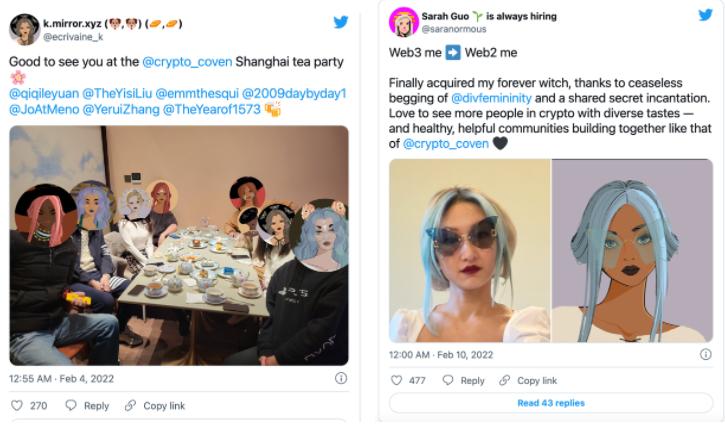 One of the main creators of the witches, xuannu.eth, explained her community-building philosophy: not doing marketing is marketing. She advocates for "building a brand" rather than "growth hacking": growth hacking involves order brushing, whitelist competition, and chasing trends; while branding is investing in interesting activity design and cultural tone to reach the true target audience.
Especially in a context where women have a lower risk appetite and are more cautious in investing, for an NFT project targeting women, mere growth hacking and hype marketing will not attract the desired female audience. Instead, it is crucial to focus on community and brand building, which requires strong cultural and community support.


5. Consumer Goods and Community Totems: The Source of NFT Valuation
The combination of a feminine aesthetic style and quality community building has made Crypto Coven a representative of the fusion of consumer goods and community totems. I would like to discuss why NFTs are so "expensive" from this perspective, attempting to analyze the sources of their valuation.
For the female market, Coven proves that beyond following a strong feminist ideological path, female NFTs can also pursue aesthetics and consumer goods routes. Female holders in the Coven community even say, "Since I bought Coven, I don't even want to buy bags anymore." To some extent, this reflects their motivation for purchasing Coven—a substitute for luxury goods.
Although the current NFT market remains highly speculative, we can still imagine that as NFTs become more popular and widespread in the future, their commodity characteristics will gradually emerge.
For example: sports fans buy sports NFTs, anime enthusiasts buy anime NFTs, feminists buy female-oriented NFTs… In fact, there are already collectors who only collect specific types of NFTs they love, just like purchasing their favorite products.
Generally speaking, the consumption of items is driven by self-reflection, where individuals symbolically express their values through objects. Meanwhile, within a set of NFTs, each image is generated based on algorithms and is unique, creating random and subtle personalization. This differentiation further stimulates individuals to project themselves onto the images, leading them to feel that a particular avatar resembles them more and even actively imitate the virtual image in the picture.
If offline consumption is a subject-centered symbolic expression, then virtual images online represent a construction process from nothing to something. The consumed items transform from symbols into the self, and the symbols and their accompanying culture gradually become an integral part of the self.
Furthermore, the boundaries between reality and the virtual are becoming increasingly blurred, and consumer goods are evolving from external symbols of expression to constructions of the self. People and digital consumer goods mimic and shape each other.
This is an important reason for understanding why the value of a jpg can exceed that of a luxury handbag. The high valuation of NFTs comes not only from financial speculation but also from their inherent deep cultural connotations and the identity mechanisms within the virtual world.------ In the construction of "self," we will always spend money.
Therefore, how to visually create NFTs that can stimulate users' self-identification and construct identity imagination in the virtual world will be a consideration for all upcoming NFT projects. This is also a significant reason why NFT project teams will compete for top artistic resources.
Beyond art, the operation of a project is also crucial to its success or failure. Almost all NFT project teams desire to have community members hold their NFTs long-term. To achieve this, they must build a community worth staying in for the long term, transforming their project's NFTs into effective identity signals, totems, and cultural and reputational capital.
Under the promise of blockchain decentralization, people's trust in technology replaces traditional interpersonal trust. Strangers worldwide develop a sense of intimacy based on the same narrative of NFTs.
If managed well, project teams can construct the atmosphere of the community through continuous interaction, rituals, and exchanges, attracting individuals with high spiritual density to the community and forming a specific culture within it. When this culture reaches a certain level, the NFT will become a clear cultural symbol.
NFTs publicly and monetarily express the differences in consensus and social status among people. They intuitively reflect the wealth levels of their holders and their respective tastes. The social and segregative nature of NFTs may explain why NFTs often have shorter speculation cycles than FT (fungible tokens) and more easily induce FOMO (Fear of Missing Out). Because not only economic capital but also cultural and social capital are visually presented in the decentralized infinite space.
In summary, NFT avatars are superficially just small images, but their value actually comes from community and culture. The visual representation of PFP works is responsible for eliciting self-projection and identity imagination among community members, while the ongoing operation of the project is responsible for the long-term construction of the community. This is the true source of NFT value beyond speculation.
It is precisely for this reason that the more speculative individuals in a project, the weaker the community's fantasy becomes; in a community without imagination, a small image truly only holds the value of a small image.
 Risk warning
 Risk warning
Popular articles