Cardano Paradox: Sparse Ecosystem, High Market Value

 In the cryptocurrency asset industry, the asset code ADA is more well-known than the Cardano public chain it is associated with. As the on-chain native token of Cardano, its market capitalization has consistently ranked among the top in the cryptocurrency asset market. However, in the public chain competition, Cardano's on-chain ecological applications are lacking, which creates a striking contrast that leaves a deep impression on its followers.
Author: Kyle, Hive Tech
As a project born in 2015, Cardano (ADA) has experienced several rounds of bull and bear markets in the crypto industry. However, it wasn't until September of last year that it first supported smart contract deployment, becoming a true DApp platform.
In the past six months, Cardano has been in the initial stage of building its on-chain ecosystem. According to data from DeFiLlama on March 23, the total value locked (TVL) in DeFi applications on the Cardano network surpassed $300 million, with the vast majority of the TVL provided by two DEXs, indicating that the network is still in a relatively early stage of development.
Currently, Cardano's on-chain TVL ranks 24th among all public chains, but its native token ADA ranks 7th in the cryptocurrency market capitalization leaderboard, a position that has already seen a decline. At the end of August last year, ADA once surged to the third position on this list.
The stark contrast between token market capitalization and ecosystem development has made ADA a subject of controversy. Industry insiders believe that as the crypto asset market grows, ADA will need to enhance the value of the project itself to maintain a high market cap, making the acceleration of on-chain ecosystem construction particularly important.
However, the current public chain sector is no longer a market dominated by a few chains like ETH, EOS, and Tron. Cardano faces unprecedented competitive pressure on its path to catch up with its high market cap.
Cardano's On-Chain TVL Exceeds $300 Million, DEXs Dominate
In the crypto asset industry, ADA's asset code is more well-known than the Cardano public chain it is associated with. As the on-chain native token of Cardano, its market cap has consistently ranked among the top in the cryptocurrency market, while Cardano's on-chain ecosystem applications have been lackluster in the public chain battle, leaving a strong impression on its followers.
In the blockchain field, Cardano is a well-established "old brand." Founded in 2015, it has claimed to be a third-generation blockchain platform since its inception, focusing on solving issues related to on-chain scalability, operability, and sustainability. Its core founder, Charles Hoskinson, is also famous in the crypto circle, being a co-founder of Ethereum and having co-created the first generation decentralized exchange BitShares with EOS founder Daniel Larimer (alias BM).
Despite the star-studded background, this blockchain has always seemed particularly slow in building on-chain applications. In 2021, when new public chains like Solana and Avalanche stirred up the market, Cardano finally supported smart contract deployment for the first time through the Alonzo hard fork on September 13. By then, the crypto market had already shifted from a bull to a bear phase, and Cardano's actions were perceived by outsiders as "waking up too early and arriving too late."
Recently, Cardano's on-chain ecosystem has shown some improvement. According to data from DeFiLlama on March 23, the total value locked (TVL) in DeFi applications on the Cardano network surpassed $300 million, with a 24-hour growth of 6.76%.
Additionally, Messari data shows that on March 23, Cardano's on-chain transaction volume reached $68.76 billion, surpassing Bitcoin ($15.9 billion) and Ethereum ($36 billion) networks.
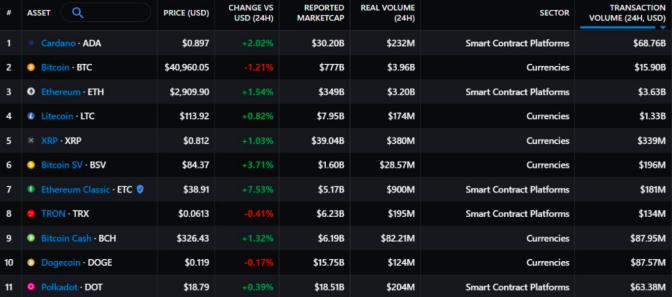
Cardano's daily on-chain transaction volume reached $68.76 billion
The activity in the on-chain ecosystem has brought Cardano back into the spotlight.
From the data on Cardano's on-chain applications collected by DeFiLlama, the main TVL providers for its network are still DEX protocols. As of March 23, the top three applications by TVL on Cardano are Minswap, SundaeSwap, and MuesliSwap, with TVLs of $194 million, $112 million, and $1.67 million, respectively. The TVL of the first two accounts for over 99% of Cardano's on-chain TVL.
This data indicates that Cardano is still in the early stages of development, with its TVL composition similar to that of most public chains in their early development, where DEXs lead the way, followed by various application tracks.
It is worth noting that due to the current lack of support for Cardano from mainstream crypto asset wallets like Metamask, there is still a certain operational threshold for users to access this public chain. Moreover, users who have experienced DEXs on Cardano have reported that transactions can be sluggish, indicating that the user experience still needs optimization.
ADA Lockup Concentration, Node Staking Rate Reaches 71.64%
Regardless, for Cardano, the launch of smart contracts and the initial construction of on-chain applications is a good start. Riding on the recent development momentum, Cardano currently ranks 24th on the public chain TVL leaderboard, surpassing Kusama and EOS.
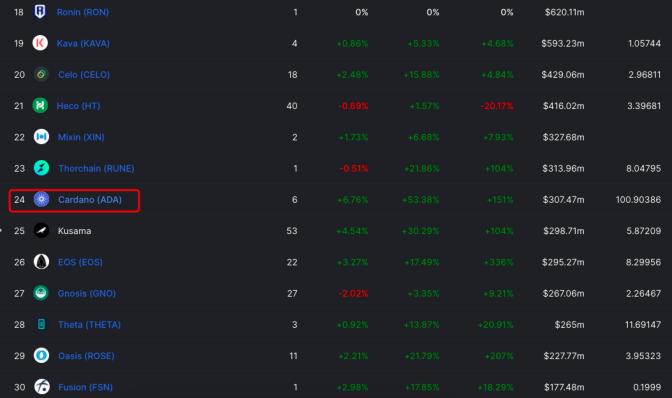
Cardano's on-chain TVL ranks 24th among public chains
According to an announcement on its official blog, Cardano also plans to increase transaction throughput this summer. This is mainly due to the significant increase in user activity resulting from the activation of smart contracts, as well as the growth in average transaction size due to script transactions carrying code. This indicates a demand for on-chain interaction, and the increase in demand also exposes the chain's insufficient capacity to meet it, which is why users have reported sluggishness when using Cardano's on-chain applications.
Researchers from this public chain believe that more applications are expected to be built on Cardano, and to keep up with this rising demand, the current transaction throughput of the system must be increased.
Perhaps influenced by the increase in on-chain adoption, ADA's market price has also risen recently. From March 16 to 23, ADA increased from $0.80 to $0.97, a rise of 21.25%.
However, it is important to note that compared to before the launch of smart contracts, ADA's market cap ranking has declined. Currently, ADA ranks 7th in the cryptocurrency market cap leaderboard, with a circulating market cap of $32.665 billion. At the end of August last year, ADA's market cap once ranked 3rd, only behind BTC and ETH.
In the eyes of ADA followers, the decline in ADA's market cap ranking is partly due to the fact that the positive effects of the smart contract launch have already materialized, leading to a decline in market speculation. On the other hand, the crypto asset market has also undergone a reshuffle during the downturn, and ADA's current position is closer to the rational expectations of the market.
In fact, although ADA has long ranked among the top ten in the cryptocurrency market cap leaderboard, many insiders view it as a "peculiar" asset. This is mainly because it has been difficult for people to find the value support behind ADA's high market cap.
During its seven years of development, Cardano, which claims to be blockchain 3.0, only launched smart contracts last year, which is seen as an inadequate performance in the eyes of investors. Even though it has begun to build its on-chain ecosystem, its current size, ranking 7th in the cryptocurrency market cap leaderboard, is still surprising.
There has always been a voice in the community suggesting that the significant gap between market cap and project development is related to the centralization of the ADA token and the control by whales.
According to data from Staking Rewards, there are currently $23.8 billion worth of ADA staked in the Cardano network, with this portion mostly serving as validation nodes for the PoS network, leading to a staking rate of 71.64%, surpassing many public chains, indicating that ADA has undergone centralized lockup, which to some extent controls the market circulation.
Industry insiders believe that as the crypto asset market grows, ADA will need to accelerate the construction of its on-chain ecosystem to maintain a high market cap, as locking up funds is not a long-term solution, and promoting ecosystem prosperity also requires market supply of ADA.
According to the future ecosystem roadmap previously released by the Cardano community, projects are being deployed in various sectors such as lending, launchpads, oracle services, stablecoins, wallets, gaming, and NFTs. Among these, the NFT sector is the most popular, with dozens of teams like CNFT, BitBunny, and PunksterArt planning or already developing projects on Cardano.
However, for the latecomer Cardano, it must face the competitive pressure from multiple emerging public chains in the market. After all, the current market is no longer the domain of just a few public chains like ETH, EOS, and Tron. Cardano still faces many uncertainties on its path to matching its high market cap.
 Risk warning
 Risk warning