




Review of the Two-Year Blank Period Development and Ecological Restructuring of EOS

 Most people still do not know what blockchain is. Importantly, that is enough—they do not need to know, and they may never know. The vast majority of people will never realize they are interacting with blockchain, as its complexity is hidden beneath beautiful and familiar interfaces.
Author: EOS Ecology 4 Billion DAO
The rapid development of DeFi in this bull market seems to have overshadowed the development and struggles of the underlying public chains behind DeFi.
Recalling the explosive growth of public chains in 2018, when the competition among tracks was fierce at every node, I can't help but think of EOS, the former king. Time has passed, and the current market has basically shed the glamour of this bull market. People are now discussing the rise and fall cycles of the industry while searching for new meme coins, but the former king—EOS—is notably absent from the conversation.
We can use a very interesting milestone to understand this former public chain king. Opening GitHub, we find the code contribution chart for the EOS project by ByteMaster (hereinafter referred to as BM) from 2018 as shown below:
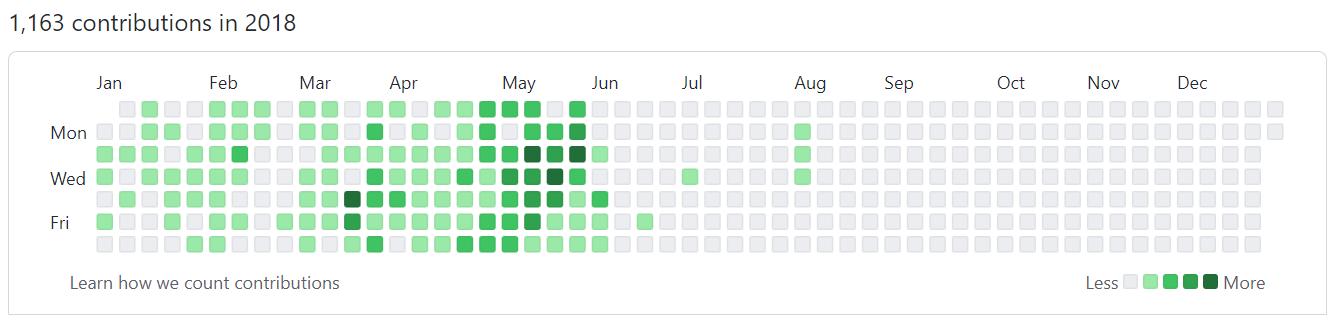
It can be seen that around the final mainnet launch date of June 15, 2018, this top developer in the EOS ecosystem experienced a long-term hiatus in code contributions. The left side of the timeline is filled with the busyness of preparing for the EOS mainnet launch, while the right side shows the desolation after the mainnet went live. Perhaps using the popular phrase from that time can better express the essence of this matter—the launch of the mainnet marked the beginning of the price crash.
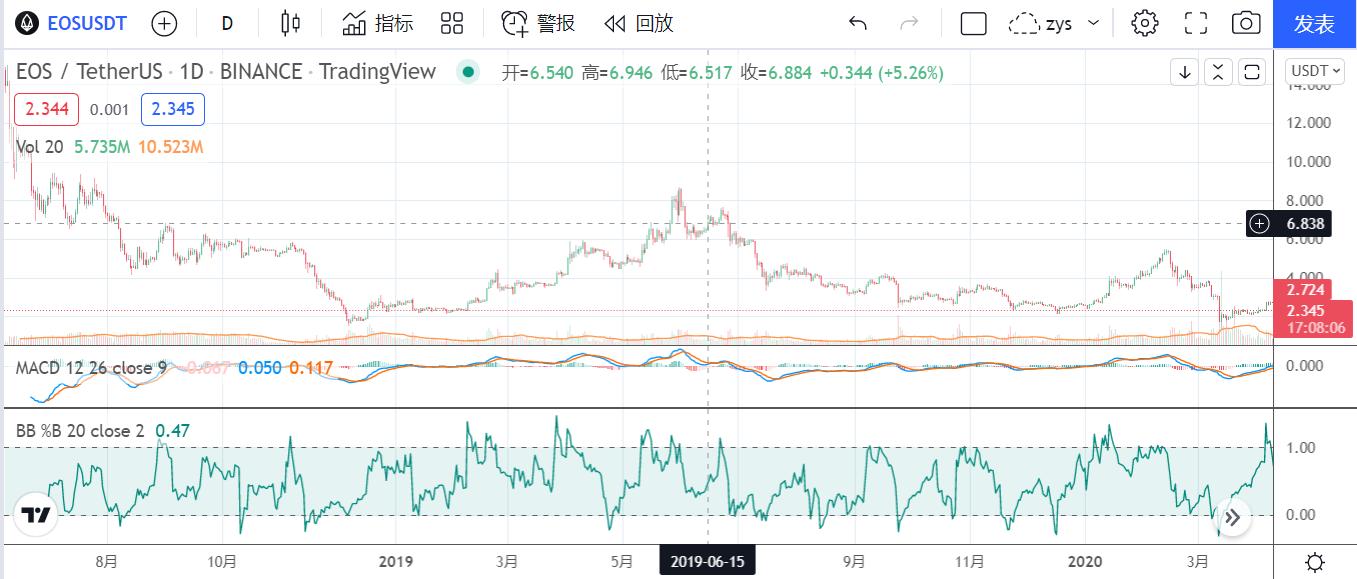
What Did EOS Once Have?
EOS was the most successful fundraising case of 2017.
In addition to Dpos technology, its year-long crowdfunding plan was also an innovative feat of the EOS vanilla era. It raised over $4 billion, continuing throughout the entire bull market of 2017. It is not an exaggeration to say that EOS initiated the craziest bull market of 2017 and became the largest and most successful project of that year.
EOS was one of the earliest public chains to launch DeFi.
EOS's technological advantages made it one of the first projects to kickstart the development of the DeFi ecosystem. Back in August 2019, when the entire market was experiencing a short-term recovery in coin prices, EOS had a total market capitalization of about $4.014 billion, ranking 8th globally. The number of DApp developers reached 500, and in the 13th issue of the CCID Global Public Chain Technology Assessment Index, EOS ranked first with a total index score of 153.1. Additionally, the results showed that Ethereum and TRON followed EOS, ranking second and third with total index scores of 148.6 and 138.2, respectively.
EOS was the first choice for DApp developers.
The first tier of DApp platforms showed a clear lead in scores. The main reason for the rising popularity of EOS DApps was that they were the fastest-growing among all blockchain projects at that time. By the end of 2018, the total number of EOS mainnet accounts had increased to 652,000, catching up with Ethereum's two-year growth in just six months. In just two months, the trading volume and total number of transactions surpassed Ethereum.
GameFi also had a preview in the EOS ecosystem at that time. Although the number of on-chain game projects on EOS was relatively small, the excellent performance of EOS's underlying technology led to a rapid growth trend in EOS chain game development. Chain games like EOS Knights had 4,791 active users in 24 hours, with a trading volume of 40,040 EOS over seven days.
In terms of user activity and trading volume, EOS Knights was ahead of the ETH chain game ecosystem at that time. Even a few months after the launch of Axie in the early bull market, the weekly trading volume was only about 4,000 Ether. This shows that the EOS ecosystem exhibited exceptionally forward-looking strategic vision and gained high recognition from users.
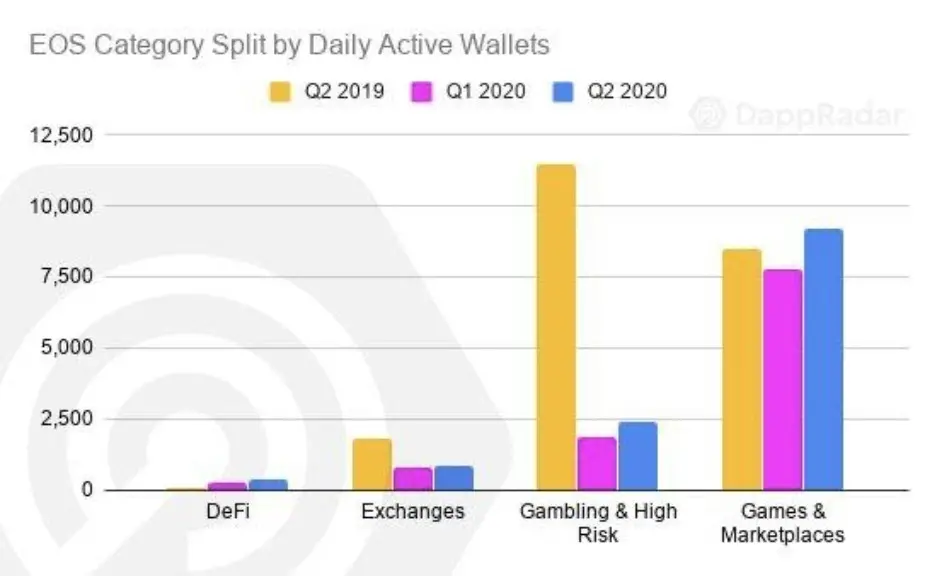
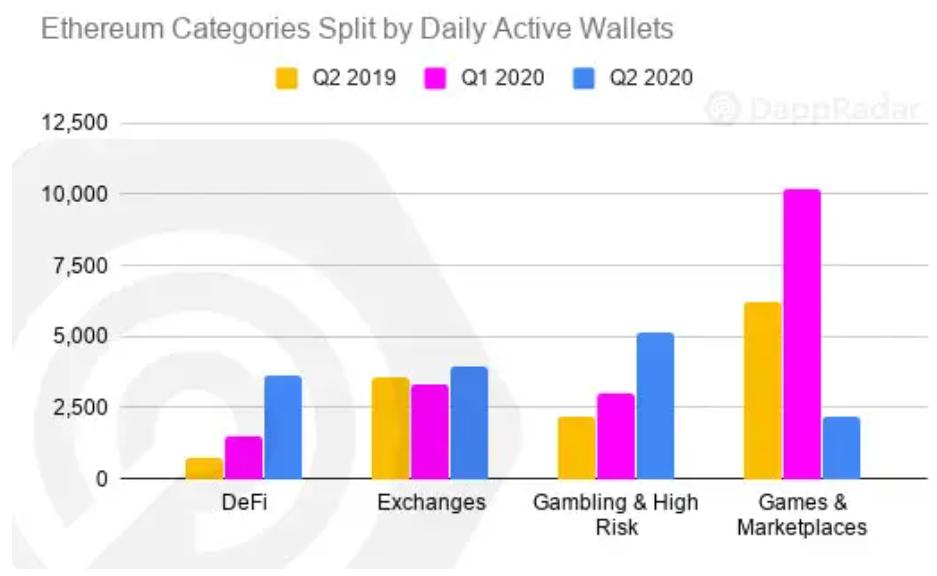
Before the bull market started, a comparison of daily active wallet data between EOS and ETH based on DappRadar:
The Blank Bull Market Report of EOS
Missing out on the DeFi ecosystem launch dividend.
The success of Uniswap and the popularity of on-chain Yield Farming laid the initial conditions for the start of this bull market. Compared to TRON's rapid catch-up, BNB's accumulation of strength, and SOL's strategic planning, the EOS ecosystem seemed to have ignored such obvious signs of a bull market launch. Unlike public chains like AVAX, HT, FTM, and Ploy that found their niches and vigorously supported multi-chain ecosystem projects, allowing their own ecosystem projects to receive precise support, thus enhancing their influence and strength in the public chain arena, EOS Media Announcements under Block.one only conducted one update in six months, and the public chain ecosystem was completely in disarray.
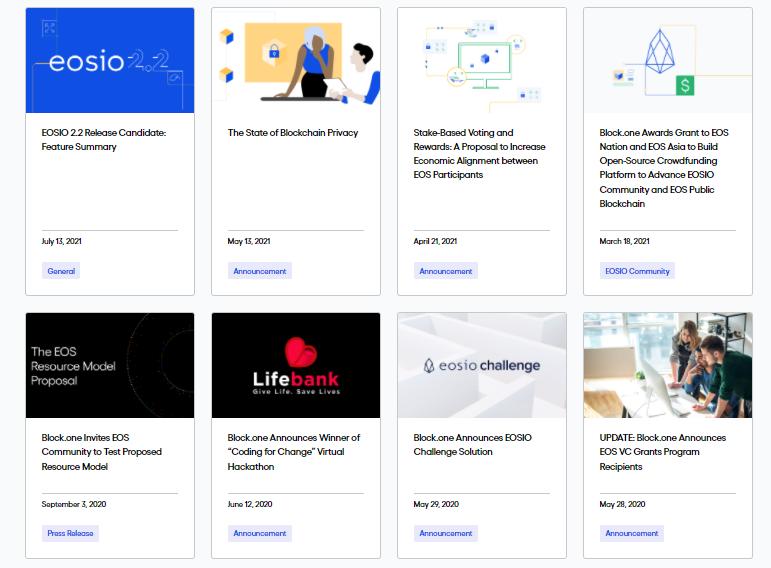
Since the hackathon in 2019, there have been no major events released in the EOS public chain ecosystem, and no incentives for the developer community have appeared. As the saying goes, "If you don't advance, you retreat." The contrast between EOS and its original competitor ETH has become even more pronounced.
Since August 2020, ETH has undergone about three upgrades, completing the beacon chain origin test, marking the official transition from PoW consensus to PoS consensus. Technological innovations have led to the explosive growth of foundational DeFi projects like Uniswap, Sushiswap, AAVE, and Compound. The UNI airdrop in October sent early users into a frenzy, with statistics showing that the active UNI meme coin community received as much as $28 million in airdrops on the day of the airdrop. Even though similar incentives caused ETH transfer fees to skyrocket at that time, they still could not dampen user enthusiasm for participation.
The popularity of the ETH ecosystem allowed its price to quickly break through the bottom range, achieving more than a tenfold increase. The enthusiastic participation of users rapidly dispersed ETH's hash power, reducing the influence of large miners, which in turn promoted the technical upgrades of ETH, making the transition from PoW to PoS consensus easier, allowing ETH to ultimately complete its consensus transformation. This gradually realized the goal set by Vitalik Buterin to change the consensus mechanism since 2019.
In summary, the development of the ETH ecosystem from 2020 to 2021 was characterized by a successful rise in both price and technology, achieving a double boost that established its position as the number one public chain.
Perhaps the changes in ETH are determined by its status within the circle and lack strong comparative significance. Looking back at TRX, which had a market value similar to EOS's consensus position in 2019, TRON was one of the first public chains to sense the bull market after August 2020. Sun Yuchen made a high-profile comeback in September, live-streaming and promoting tokens like Pearl, JUST, and SUN, making TRX the second hottest public chain after ETH. Although the project quality and retail consensus were not as strong as those on ETH's DeFi, early participants in Yield Farming still gained huge profits. Coupled with Sun Yuchen's ubiquitous hype tactics, TRX's public chain activity quickly increased, successfully catching the first wave of the DeFi boom.
GameFi Opportunities: Losing Out and the End of Internal Disputes in EOS
The opportunity in 2021 was primarily the launch of the GameFi market, represented by Axie. Although the disputes between the EOS Network Foundation and Block.One finally ended that year, Block.One's exit in December nearly drained the last utility value of the EOS public chain, causing EOS to miss out on the GameFi opportunities that exploded in August 2021.
As the former leader of the chain game ecosystem, EOS had surpassed the ETH ecosystem in terms of game project development and activity by the end of 2019. However, the disorderly development led to slow technological updates in the EOS public chain, failing to achieve the promised high-speed, high-concurrency, and low-consumption transactions outlined in the white paper. The entire on-chain ecosystem also feared that DApps would face severe congestion issues due to the EIDOS token airdrop event, leading users to abandon the EOS ecosystem. Meanwhile, the stagnant EOS public chain had neither technical maintenance support nor ecosystem support for two years. Users chose EOS with significantly less motivation compared to emerging public chains like BSC, SOL, PLOY, and AVAX.
The internal power struggles also caused the EOS ecosystem to miss the most critical GameFi opportunities after July 2021.
Taking the BNB ecosystem, the biggest beneficiary of GameFi opportunities, as an example, early on, BNB was merely a cross-chain token, with buybacks and IEOs serving as the basis for price stability. Although there were intentions to develop a public chain, it did not become a fully Turing-complete public chain. After sensing the consensus-gathering effect of public chain DApp development at the end of 2019, a large number of developers represented by CZ helped Binance complete the proposal and development of the BSC public chain. The BSC public chain offered large-scale ecosystem rewards, development incentives, and a relatively quicker, safer, and more transparent trading process during the mid-2021 bull market, leading to explosive growth of GameFi and NFT projects on the BSC chain, making it the biggest winner of the bull market wave.
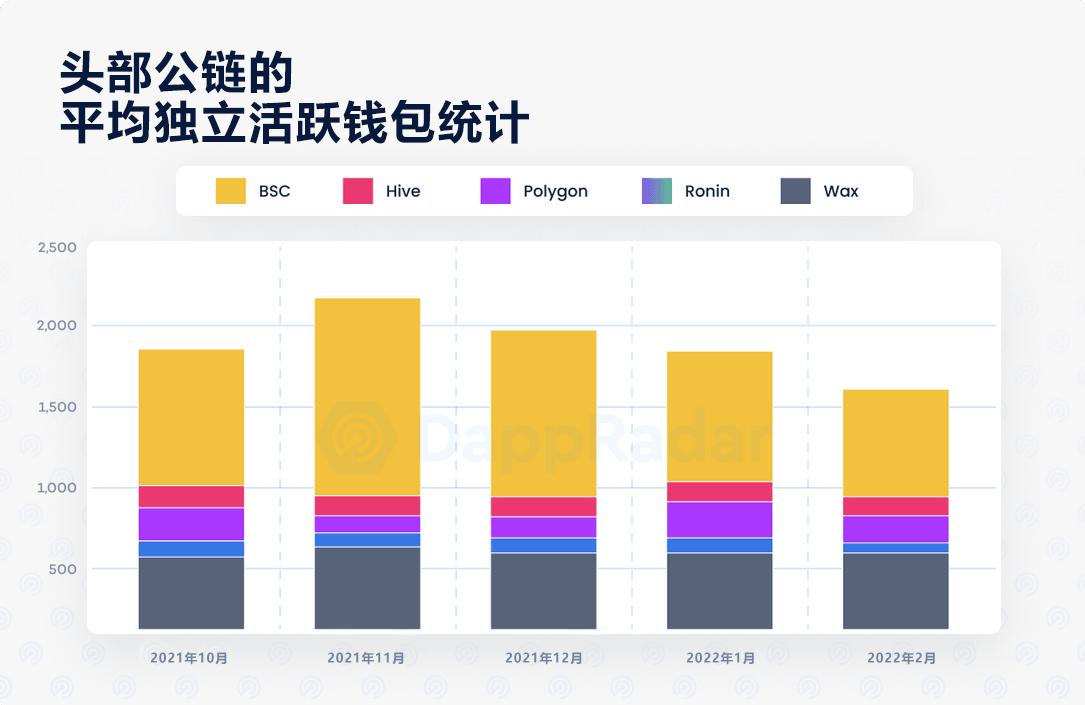
In December 2021, with the end of the disputes between the EOS Network Foundation and Block.One, the EOS ecosystem unanimously decided to stop paying Block.One for unreleased block rewards. The EOS Network Foundation also directly obtained $21 million from the EOS community for ecosystem development. All of this represented the establishment of the EOS Network Foundation's leadership position in the EOS ecosystem and signified EOS's return to the community and to the people who truly support it, with ecosystem development gradually improving.
Changes in the EOS Ecosystem After ENF Took Over
After several twists and turns, in December 2021, the EOS community unanimously decided to stop releasing tokens to the former parent company Block.one, completely parting ways with it. The EOS ecosystem began to be updated, restructured, and planned for new development routes under the leadership of the EOS Network Foundation (ENF) and founder Dan Larimer (BM).
After ENF regained control of EOS, it realized the long-awaited DAO governance model for the EOS ecosystem. As a representative of community opinions, the EOS Network Foundation serves the community. After taking over the EOS public chain ecosystem, it listened to the opinions of EOS supporters and quickly received positive responses from the community for several initiatives aimed at transforming EOS. The transformation of the EOS ecosystem even inspired the return of its founder BM, who recently announced: he is collaborating with the ClarionOS team to develop the Mandel codebase to replace the old EOS codebase. For more details, please check the following link:
With the EOS Network Foundation and the large EOSIO developer community, along with BM, taking control of EOS, the EOS platform has now completely detached from Block.One to achieve community DAO governance, which provides a foundation for the EOS ecosystem, which has been frozen for nearly two years, to become a new star in the Web 3.0 era.
Yves La Rose, the ENF leader who hopes to recreate the brilliance of the EOS ecosystem, confidently stated:
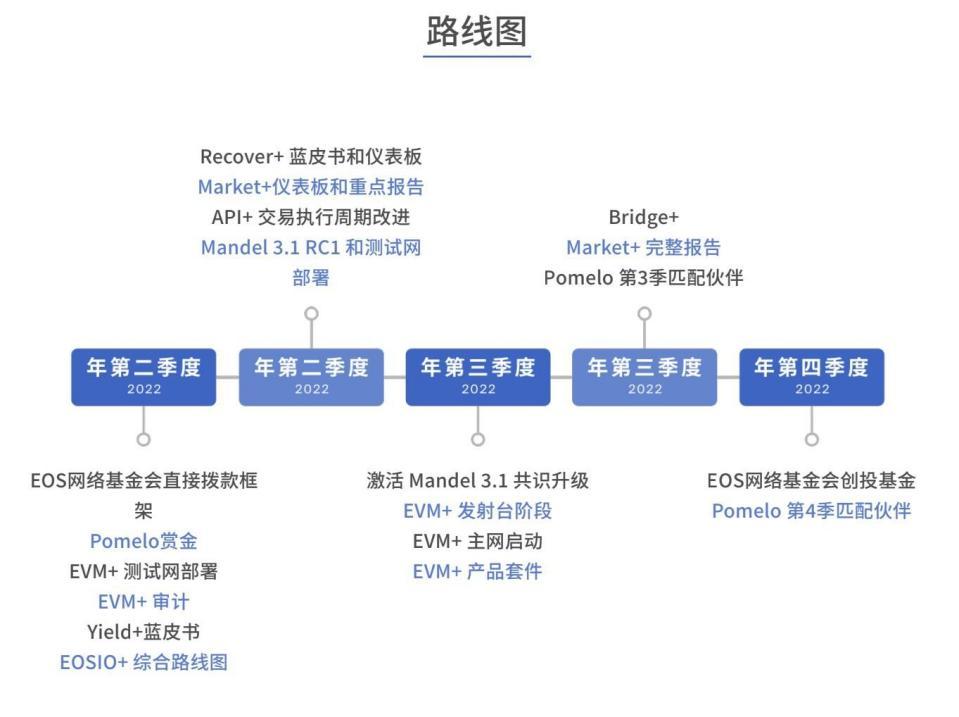
Currently, taking over and restarting the EOSIO codebase development is ENF's top priority. Dan Larimer's (BM) return has already achieved the first step toward this goal. With the joint efforts of the team and other members of the EOSIO family, we have ended the technological stagnation that EOS suffered under Block.One's leadership. The EVM was also launched on April 19, marking the first step for the EOS ecosystem in the Web 3.0 era.
During this honeymoon period of ENF and BM's restart, the independent development of EOS has successfully begun, and EOS is bound to create miracles again.
Recent development roadmap for EOS:
Conclusion:
The EOS ecosystem has gone through nearly two years of stagnation, and ENF's takeover has brought it back on track, which is no easy feat. The development of the EOS public chain is reminiscent of Apple, which also experienced a period of development vacuum. Now, with the return of EOS's "Jobs," not only has decentralized governance of the EOS ecosystem been achieved, but it has also called for more ecosystem projects to develop in the fertile ground of EOS. Moreover, forward-thinking decentralized supporters of the EOS ecosystem have begun to establish various decentralized autonomous communities on EOS, such as 4 Billion DAO and EOS DAO. They hope that EOS will get back on track and not repeat past mistakes, and when necessary, they will step forward to expand the territory of the EOS ecosystem.
 Risk warning
 Risk warning
Popular articles