Game NFT Market: Opensea is the easiest cake to cut

 The business model of blockchain games has not yet been established, which indicates that the market landscape is far from being defined, leaving many opportunities for entrepreneurs.
Author: Peter, IOSG Ventures
TL; DR
- Vertical NFT trading markets will emerge, eroding Opensea's market share.
- The gaming NFT trading market is expected to become one of the first successful vertical platforms.
- The ecosystem of the gaming NFT trading market is already taking shape.
- The gaming NFT trading market will occupy a more important ecological niche in the future.
The NFT market over the past year has been insane. It seems that at some point, well-known celebrities began purchasing NFTs, changing their Twitter and other social media avatars to these cartoon animal images. Coupled with the hype of the bull market and the wealth effect, most people started to learn about NFTs and participate around this time. Many companies have also used NFTs as one of their marketing tools, such as Adidas, Li Ning, McDonald's, Louis Vuitton, and others.
NFTs have become a cultural phenomenon. People buy NFTs (especially profile picture NFTs) to join communities that match their personalities, connecting with like-minded individuals through online and offline gatherings. NFTs have become a key to community, filling the psychological need for belonging. Stimulated by celebrities and the wealth effect, they gradually exhibit characteristics of luxury and investment goods.
The numbers speak for themselves: according to data from Nonfungible.com, the trading volume of NFTs reached $17 billion in 2021. This figure was only $82 million in 2020, growing more than 200 times. In 2021, there were over 2.5 million addresses that held or traded NFTs, compared to just 89,000 in 2020. The vast majority of transactions occurred on the general NFT trading market Opensea, which once held over 98% of the market share. With a 2.5% transaction fee, its highest monthly revenue exceeded $350 million.
However, with the explosive growth in the number of NFT users, different demands for NFTs will arise, leading to the further development of more types and functions of NFTs. As the market cap of niche markets expands, the general NFT trading market will gradually be replaced by vertical markets. This is not a new phenomenon; we have seen similar occurrences in the web2 world, such as eBay's market share being divided among several vertical markets with core categories.
The next cycle will be the moment of the split for the General NFT Marketplace represented by Opensea. We will see more vertical trading markets begin to seize Opensea's share. The author believes that thanks to real utility, the gaming NFT trading market is likely to become one of the earliest successful vertical platforms.
The Moment of Splitting the General NFT Trading Market
The current blockchain ecosystem is akin to the internet ecosystem of the 1990s. When eBay went public in 1998, its GMV was only $105 million, but it already had the most users among global e-commerce websites. At that time in the U.S., less than half of adults had used the internet, and even fewer had used e-commerce platforms. It was hard to imagine that a platform could survive by selling just one category, but by 2013, eBay's GMV had reached $83 billion, and almost everyone had learned to shop online.
eBay remains an online store that includes everything, a place where one can buy clothing, books, electronics, furniture, real estate, hotels, and even all sorts of bizarre items. Although it once dominated the industry, its GMV growth has significantly slowed in recent years. The most important reason is that more and more vertical platforms are gradually eroding eBay's market share, disrupting the areas where eBay once held an advantage.
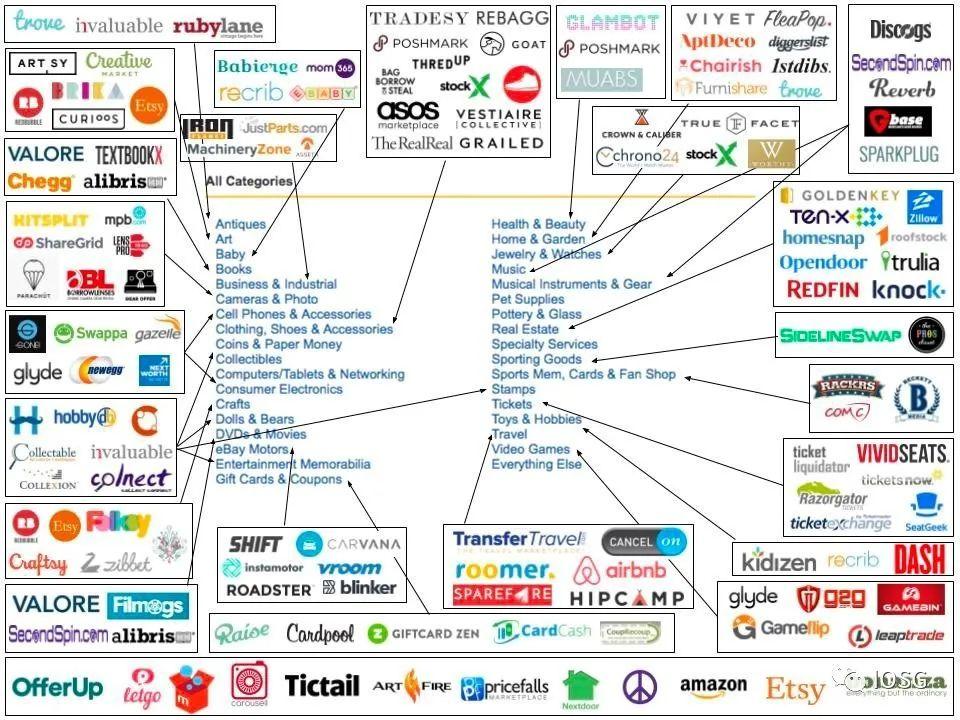
Source: Disrupting eBay: The Rise of Vertical Marketplaces
Justine and Olivia Moore described the trend of eBay's splitting in 2018. Consumers once concentrated their transactions on eBay to meet all their needs, but gradually migrated to more specialized vertical platforms. In these vertical markets, Etsy, 1stdibs, Airbnb, Chegg, and Zillow have a combined market cap of over $130 billion, several times eBay's current $30 billion valuation. What can we learn from this? In the early stages of e-commerce development, when the user base was not large, eBay was able to meet that demand well. As a large number of new users entered the market, the demand for specific categories expanded, and vertical markets could accommodate these users, thus creating a larger pie.
Similar to eBay, Opensea is also an absolutely dominant general trading market in the NFT space. It was built during the last bull market and became the market leader in this round, once holding 98% of the market share. Looking back at history, it took nearly a decade for vertical platforms to surpass eBay, but the pace of business transformation within Web3 is faster. We can expect to see the splitting of NFT General Marketplaces like Opensea in the Crypto market happen more quickly for the following reasons:
1. Opensea is not an exclusive content provider, and its product recommendation mechanism is relatively outdated.
First, all NFT assets listed on Opensea are not exclusive to the platform. Simply put, since all NFT assets are on-chain, there are no NFT assets that Opensea has that other platforms cannot provide. Other platforms only need to read the on-chain contracts to display all NFT series.
Additionally, Opensea does not have a robust mechanism for discovering and recommending NFTs. Currently, it often adopts a "post-recommendation" approach, such as displaying trading leaderboards and recently popular projects. Creators find it difficult to rely on Opensea's recommendations to increase their sales, and users cannot learn about interesting projects that suit them through the recommendation mechanism; they can only get information about what projects are popular. The underlying reason is that purely investment-driven financial products are hard to recommend; only content-rich gaming and music NFTs are more suitable for recommendation mechanisms.
2. User migration within the Web3 world has less friction.
Since all assets are on-chain, trading platforms can easily read on-chain data and list NFT series. For NFTs, liquidity primarily comes from sellers' listing actions, as many users search for low-priced NFTs through aggregation platforms (like Gem). In other words, to seize Opensea's liquidity, the key lies in incentivizing sellers to list. Currently, the cost for sellers to migrate to other trading platforms involves opening accounts and authorizing NFT gas fees. Compared to web2 platforms, which require filling out a lot of information, undergoing qualification reviews, and even paying deposits, the migration friction in web3 is already very low. For buyers, they can simply connect their wallets to buy across different platforms.
3. The liquidity barrier of Opensea is not insurmountable.
Opensea lacks user incentive measures, leading to the gradual loss of the liquidity barrier established in the early stages. Earlier this year, projects like OpenDAO and LooksRare launched vampire attacks on Opensea, using platform tokens to reward Opensea's loyal users. LooksRare's trading volume once surpassed Opensea. The emerging NFT trading market X2Y2 is rapidly capturing Opensea's market share with faster feature iterations, better UI/UX, and extremely low transaction fees (X2Y2: 0.5%, Opensea: 2.5%). To avoid misleading trading volume (based on trading volume, Opensea's market share is now less than 20%), we can also see a downward trend in Opensea's share from the proportion of active users.
Moreover, unlike in the DeFi space, the same NFT can be listed on multiple trading markets simultaneously, meaning that NFT liquidity is easier to transfer and disperse. Professional traders often list NFTs on multiple trading markets at the same time.
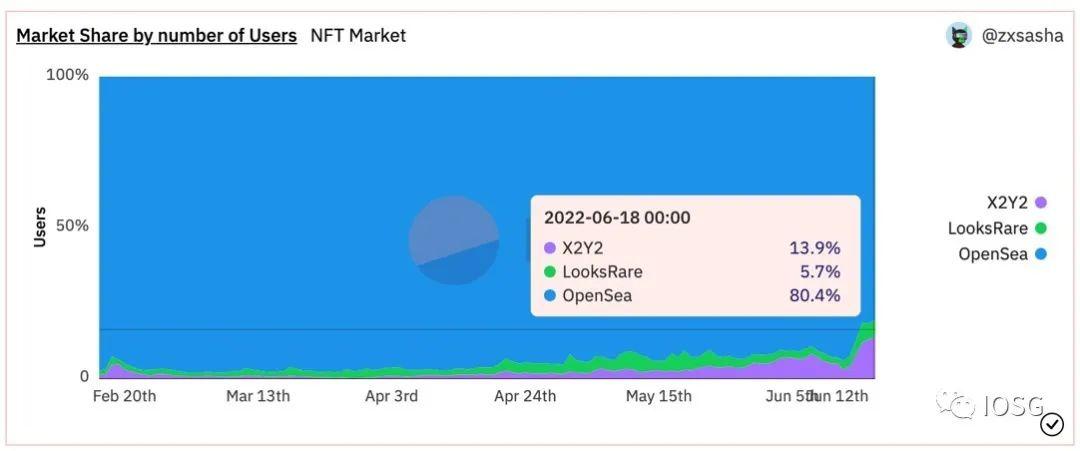
Source: Dune
4. Opensea's mismanagement has not created a significant brand value gap.
Users have long criticized Opensea's mismanagement issues. Its security has also been constantly questioned, and the platform's reputation has been damaged by incidents of theft, fraud, and contract bugs. Opensea has a large number of fake and counterfeit NFT series, and the time taken to handle complaints is lengthy, leaving the rights of developers and users unprotected. In May of this year, its homepage mistakenly recommended a counterfeit PXN NFT series, which had a trading volume of up to 3600 ETH before being delisted. Opensea's contracts have also had bugs that caused multiple Bored Ape NFTs to be sold at low prices, resulting in losses for collectors. Opensea has not significantly outperformed its competitors in terms of security and reputation and has yet to build a brand moat.
The Vertical Ecosystem of NFT Trading Markets
Long-term observation of the NFT trading market has also revealed direct competitors like Rarible, LooksRare, and X2Y2 that are positioned similarly to Opensea (some of which also have good trading volumes). However, we believe that the future platforms that can create a larger pie and surpass Opensea are likely not direct competitors of Opensea, but rather a bundle of vertical NFT trading platforms focused on specific niches.
NFTs are not just JPEGs. From a format perspective, NFTs can be divided into JPEG, MP3, MP4, SVG, iframe, arrays, matrices, etc. From a category perspective, NFTs can be divided into collectibles (PFP), pure art, virtual world, gaming, music, sports, rights, and finance, among others.
Tasha Kim summarizes the verticalization of the NFT trading market as follows. In several major categories, we can already see that a vertical ecosystem has begun to take shape, such as in gaming (Fractal, Lootex, DMarket), music (Catalog, Glass, Roya), and art (SuperRare, Sloika, Foundation). Some platforms have already achieved good results, and emerging platforms have also received significant funding.
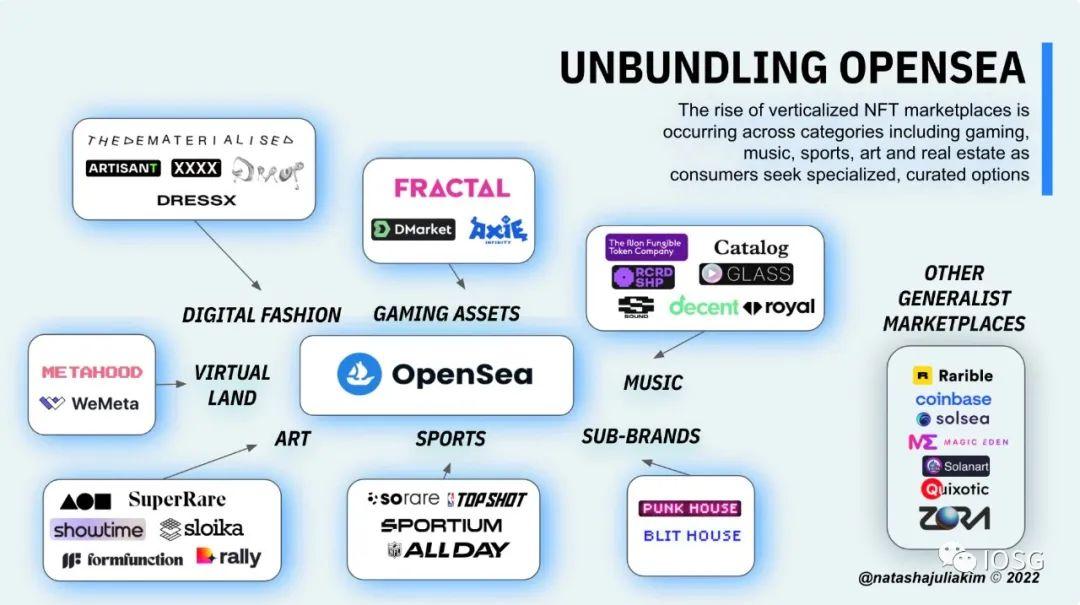
Source: The Unbundling of Opensea
So, what motivates users to migrate to vertical platforms rather than stay on general platforms? Let's take another look at the reasons eBay ultimately fell behind vertical markets in the traditional Web2 platform's vertical evolution path:
- Certification services: For certain products, people have a strong need for certification to reduce the risk of buying counterfeit goods. However, products listed on eBay do not ensure authenticity.
- Quality control: eBay does not conduct quality control on the products on its platform, leading to a large number of subpar and junk items flooding the platform, making it difficult to distinguish good from bad.
- Price guidance: eBay does not categorize similar products and provide minimum price references, making it hard for users to find reasonable prices among tens of thousands of returned results.
- Lack of community: eBay lacks an intimate sense of community, making it difficult to motivate users to make repeat purchases and actively participate in the marketplace.
For vertical markets to compete for Opensea's market share, they must also provide things that the general NFT market cannot offer, such as:
- Review systems to improve content quality: For specific niches, it is necessary to appropriately raise the entry threshold to filter quality projects for users and reduce their losses.
- Targeted design for specific niches: Platforms can optimize UI/UX for specific categories, such as providing a 3D immersive gallery for art or introducing player settings for music.
- NFT pricing services: For certain NFTs, such as rights, finance, and gaming, which have income-generating capabilities, DCF models can be used for pricing.
- Building communities: NFTs in specific niches are more likely to establish cohesive communities, such as gaming trading markets guiding players to share gaming insights and even facilitating asset exchanges between different games.
The Rise of the Gaming NFT Trading Market
So, on the eve of the explosion of vertical NFT platforms, what type of platform is likely to be the first winner? The gaming NFT trading market is the most promising seed player.
Gaming NFTs have consistently been the second-largest NFT category by trading volume after collectibles. With the arrival of the NFT bear market, trading data for collectible NFTs, which are more speculative than practical, may continue to decline. NFTs will evolve towards valuing intrinsic value more. According to data from Nonfungible.com, the trading volume of gaming NFTs reached $5.17 billion in 2021, and when combined with virtual world NFTs that can be attributed to the gaming category ($510 million), the total trading volume can reach $5.68 billion. Based on a 5% royalty calculation, the profit generated by gaming NFTs is $284 million. According to Nansen's estimates, by 2023, the total profit of the gaming industry will be around $200 billion, with the blockchain gaming industry profit reaching $5 billion, accounting for about 2.5% of the addressable market.
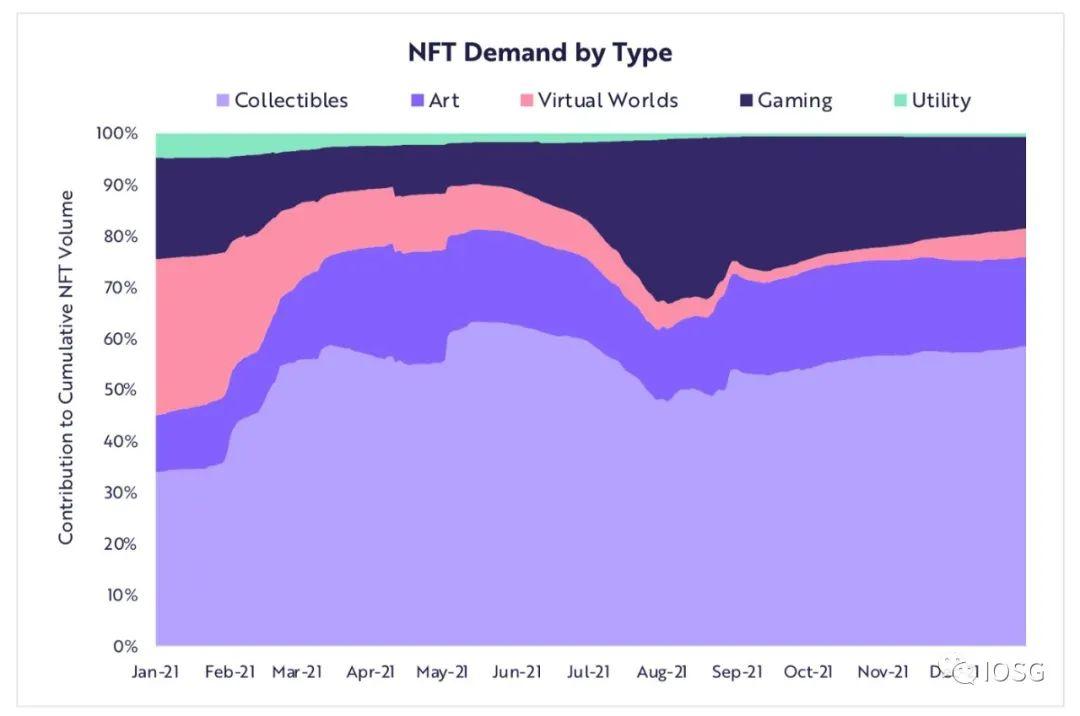
Source: Annual Research Report from Ark Invest
Gaming NFTs are the most obvious use case for NFTs. Gaming NFTs are not a new concept. As early as 2017, CryptoKitties was one of the first games deployed on Ethereum. Although PFP NFTs currently dominate the market, gaming NFTs can always stand out with their practical utility when faced with speculation.
For collectible or art NFTs, the stories and collections behind them provide value. However, gaming NFTs not only meet the needs of the first two but also provide additional utility value, allowing users to truly participate and immerse themselves. Usability is a sustainable direction that expands the addressable market for NFTs.
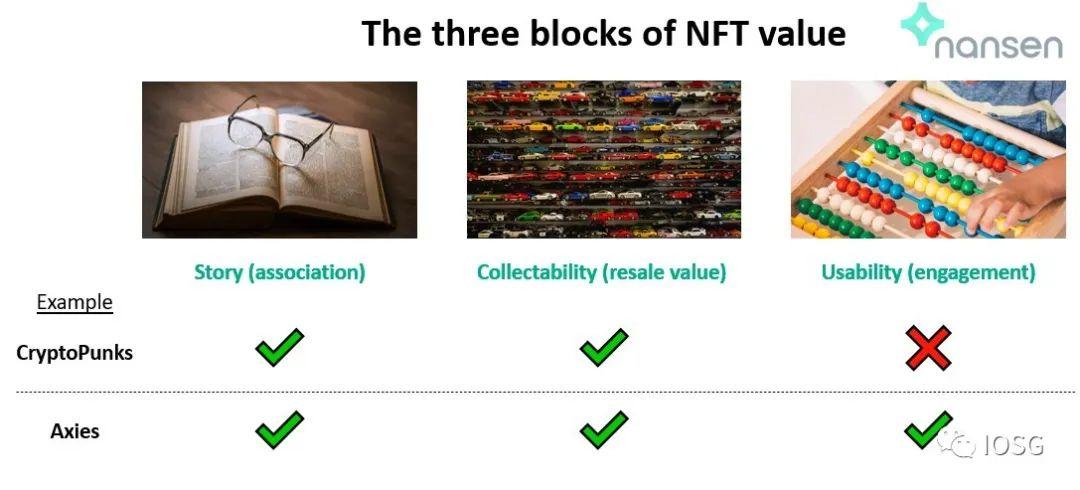
Blue-chip PFP NFTs are also entering the narrative of gamification, providing more value support. The BAYC series launched the gaming brand Otherside, and in the future, BAYC holders will be able to use NFT avatars in the game. Additionally, series like Cool Cat, Doodle, Pudgy Penguins, and Azuki all have plans to launch games.
Although large game developers are more likely to establish in-game NFT trading markets, users may prefer to trade within the game rather than jumping to other platforms. However, an open platform can also bring many advantages to games:
- Gaming community: The platform can provide a larger community than a single game, where players can appreciate and evaluate games, and the community's leaderboard and achievement systems make the platform a more immersive place than within a single game.
- Cross-selling opportunities: Based on platform data recommendations, cross-selling of games and game assets can be promoted. When different game assets converge on one platform, combined with the interoperability of NFTs, asset exchanges and cross-game migrations can be achieved.
- Asset pricing and comparison: Since the short-term motivation for users to play blockchain games comes from yield, open platforms can leverage the rich attributes of game assets and refer to the prices of other income-generating assets to provide price suggestions, facilitating user comparisons.
- Targeted improvements: Official markets often have many disadvantages, such as restricting currency types, price limits, high fees, and not allowing aggregated or bulk trading. Open platforms can make targeted improvements.
Even in the relatively closed ecosystems of web2, there are dozens of third-party trading platforms built around CS:GO, such as CSGORoll, Skinchshier, CSmoney, SkinMonkey, and DMarket. In the web3 world, since a trading market can encompass multiple (theoretically unlimited) games' NFT assets, the GMV of gaming NFT trading markets will be quite considerable.
Case Studies of Gaming NFT Trading Market Ecosystems
Eden Games: A Gaming Section within a General NFT Trading Market
Magic Eden is a general NFT trading platform similar to Opensea, focusing on the Solana public chain ecosystem. Eden Games is a one-stop platform launched by Magic Eden specifically for game developers and players.
Eden Games currently includes the following features:
- Dedicated game listings: Each game introduction page includes a game trailer, and the content display page shows the game's social content and description, as well as the NFTs included in the game.
- Content center: A game content recommendation mechanism helps players quickly find the content they need.
- Competition channel: Regularly holds gaming tournaments, inviting community members to participate and providing rewards.
The platform offers developers support services such as NFT consulting, customized minting, promotional marketing, and user security.
Idea: Magic Eden itself is the dominant NFT trading market on the Solana chain (with higher trading volume than Opensea), attracting 1.5 million active visitors daily and 10 million active visitors monthly. Eden Games is preparing to leverage the massive traffic that Magic Eden brings to become the discovery and distribution platform for games and gaming NFTs. Having a giant directly enter the gaming NFT trading market provides inherent traffic and liquidity advantages.
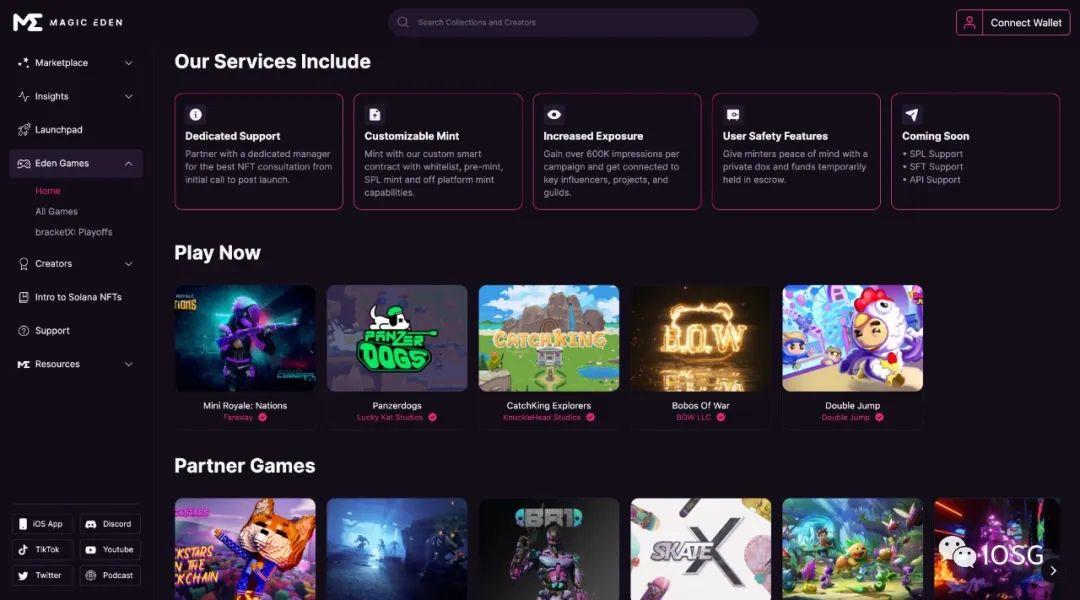
Eden Games
Fractal: A Vertical Gaming NFT Trading Market
This platform was established by Justin Khan, co-founder of Twitch, focusing on blockchain games and gaming NFTs. It aims to create a safer trading market for NFT games and provide promotion and distribution services.
Fractal's value comes from:
- High-quality gaming NFT Launchpad: Fractal adopts a strict review system, currently accepting only 5% of applicants, with over 20 projects in the pipeline waiting.
- Fractal provides NFT-fi related services with gaming characteristics, such as lending, staking, and fragmentation.
- Fractal will serve as the best management and discovery layer for games, empowering game developers to reach consumers.
Idea: Fractal does not develop games itself and is not backed by established NFT giants (like Magic Eden). Successful web2 gaming platforms, such as Steam, Epic, and even TapTap, have seed users brought in by their parent companies' self-developed games. Fractal's positioning as a management and discovery layer for games needs to overcome more resistance.
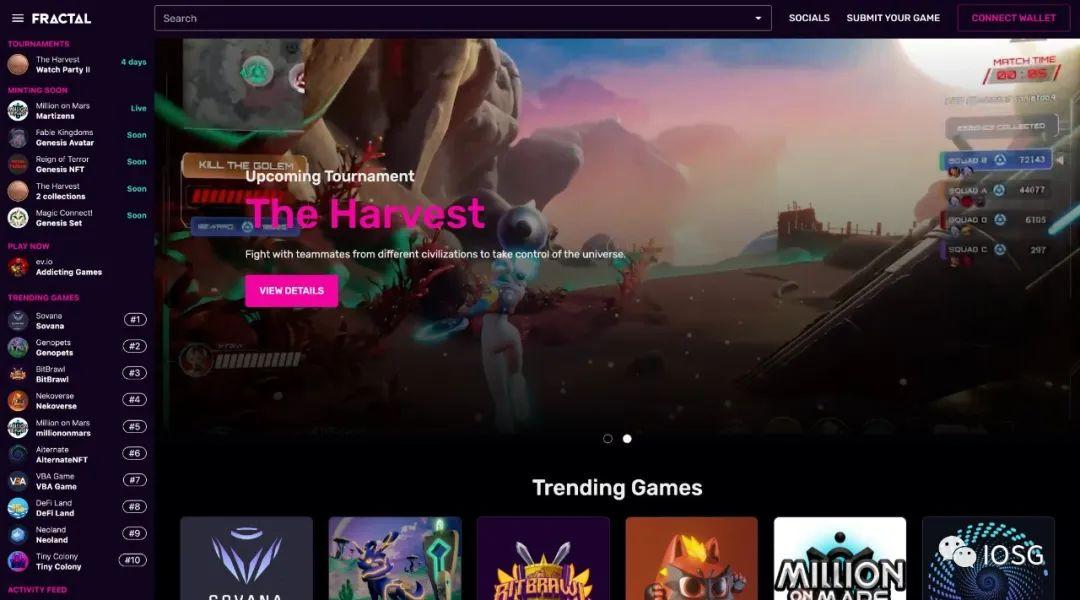
Fractal
DMarket: A Platform Integrating Web2 & Web3 Game Assets
DMarket aims to create a digital asset trading platform worth billions of dollars for game developers, players, streamers, and esports clubs. Uniquely, DMarket uses blockchain technology to connect web2 games (like CS:GO and Dota2) and web3 games (like Decentraland) with tradable game assets (not just NFTs).
Idea: In traditional gaming, the most profitable games are often free-to-play games with a "skin economy," with billions of dollars in digital assets circulating in the secondary market each year. In fact, as early as 2016, platforms like OPSkins emerged that allowed trading game assets using Bitcoin, utilizing Steam's API to connect to other payment systems and bypassing many restrictions set by Steam (like the limit of $1800 per weapon). These platforms include a large number of traditional players and are an important entry point for converting web2 players to web3.
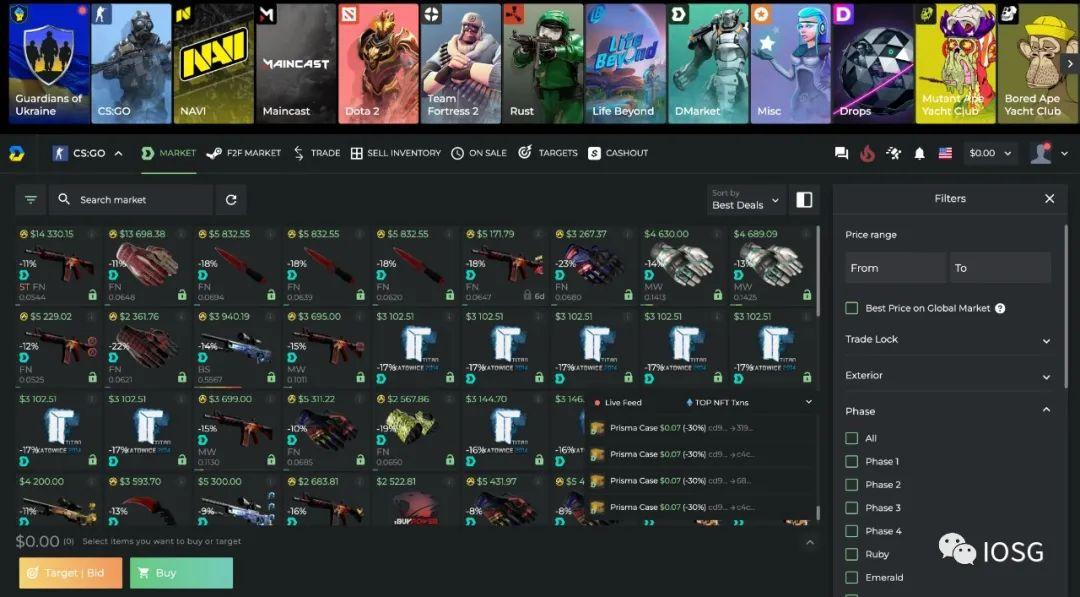
DMarket
Looking Ahead
No pain, no gain. After reaching its peak profit of $17.5 million in August last year, Axie Infinity's daily revenue has now fallen below $10,000. The narrative around blockchain games is changing, and the play-to-earn model is facing scrutiny, gradually becoming an "industry consensus" following Axie Infinity's "failure."
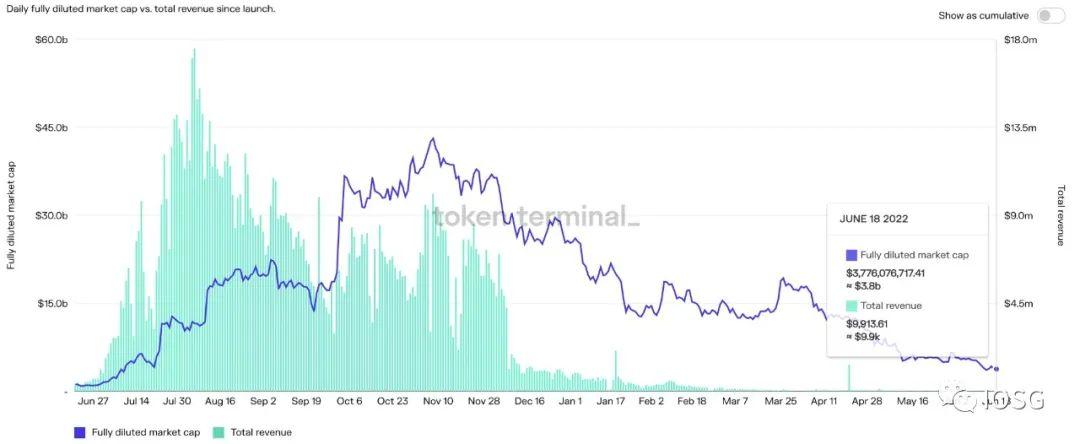
Source: https://tokenterminal.com/terminal/projects/axie-infinity
But we must also see the positive side: Axie Infinity's total profit reached $1.3 billion, with its token AXS FDV peaking at $43 billion. After the market downturn, it still has $3 billion. Without the cryptocurrency economy, Axie Infinity, developed using a web2 model, would never have achieved its current success.
Despite the explosive growth of the NFT industry in the past two years, we are still in the early stages of the industry. According to research by Hootie Rashidifard, data from June 2021 shows that only 13% of Americans had purchased cryptocurrency, and this figure is only 3% globally. The leading game Axie Infinity currently has about 300K DAU, and this number will be even lower after removing multi-wallet accounts. In contrast, the highest DAU game in web2, Roblox, has data as high as 8.6 million. This indicates that there is still a large space for blockchain.
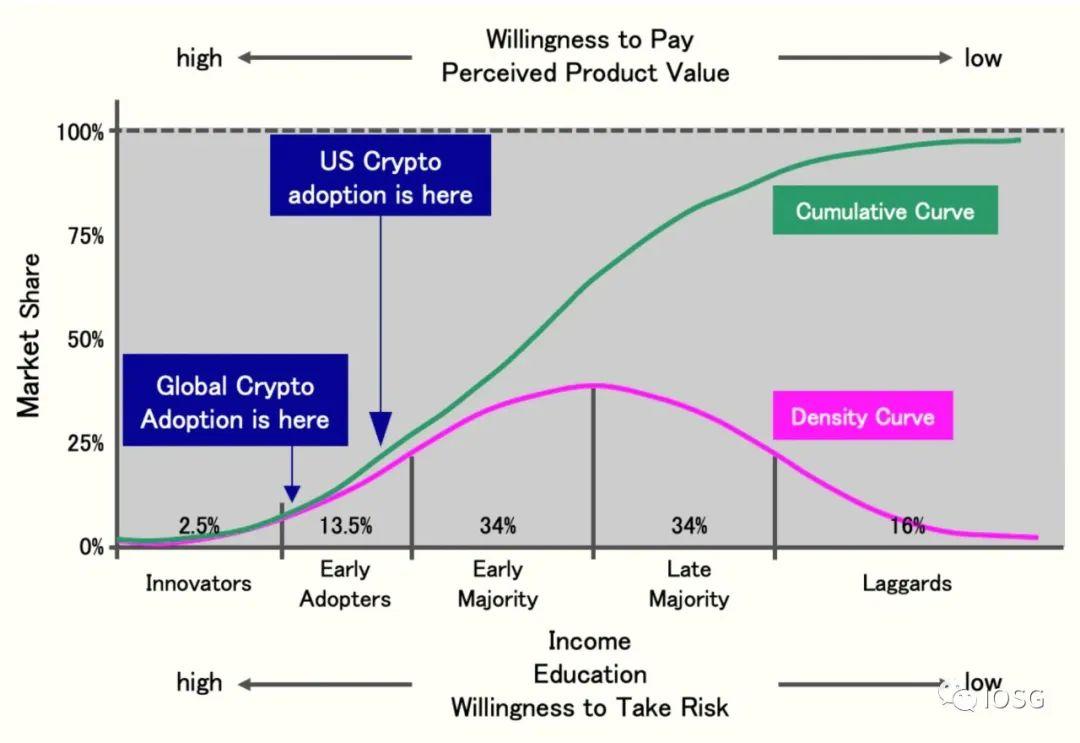
Source: Am I Too Late?
NFTs are the underlying elements of the metaverse and blockchain games, and NFT trading markets are the cornerstone of the digital asset economic system. Focused NFT trading markets are expected to become some of the first successful vertical platforms in the future. However, beyond basic trading functions, we can see that gaming NFT trading markets aspire to become the discovery layer within the gaming ecosystem. How web3 games acquire users has been a hot topic of discussion.
The user acquisition methods and profit calculations for web2 games are clear: advertising → acquiring users → user retention → comparing LTV and CAC to calculate ROI. However, web3 games face heavy challenges in user acquisition due to regulatory compliance pressures on advertising, low conversion rates on the user acquisition side, and difficulties in estimating LTV on the profit side. Using current web2 promotional methods to promote web3 games will encounter exorbitant CAC, making it hard to recoup costs (unless free-to-play, embedding blockchain at the bottom without users noticing). Currently, the mainstream promotional methods and profit sources in web3 are: community seed user accumulation → airdrop diffusion → promotion within the crypto circle → INO/IDO financing → NFT secondary trading fees + token value (LTV).

Source: https://flow-with-heart.notion.site/Web2-Web3-075e6dc8b0a04afe9e46e13db8aa858c
This web3 promotional method relies on community virality, placing high demands on project founding teams, making it hard to quickly replicate across other projects. To exaggerate, this has CX attributes. The non-reusable production and promotion processes also do not align with the gaming industry's production processes, which involve a large number of project launches, rapid iterations, testing, optimization, or elimination, coupled with a business model primarily relying on uncertain secondary market trading fees, ultimately leading to difficulties in estimating CAC and LTV.
The fact that the blockchain gaming business model has not yet been established indicates that the market landscape is far from being set, leaving plenty of opportunities for entrepreneurs. Unlike the business models of web2 platforms that charge advertising shares and game commissions, gaming NFT platforms can maintain operations solely through primary and secondary NFT trading (or focus on secondary trading), significantly reducing the burden on game developers. With the large-scale adoption of blockchain games, the future gaming NFT trading market can occupy a richer ecological niche, taking on functions such as user acquisition, user discovery, user retention, cross-promotion between games, and user migration, thereby leading industry development.
 Risk warning
 Risk warning