



The fine-tuned competition path of the wallet track in the era of Web3

 As the entry-level super application, the wallet is not only a heavyweight track where capital is successively invested, but also a gathering place for future innovation, evolving from assets to social interactions, and ultimately into a new lifestyle under the Web3 landscape.
Author: OKX
In 2018, discussions about the Web3.0 era began, predicting that the importance of wallet entry points would even surpass that of existing exchanges.
Why is that?
Taking Alipay from the Web2 era as an example, its development path started with basic payment functions, followed by the introduction of Yu'ebao and various financial features, ultimately leading to an increasing number of entry points, including bike-sharing, food delivery, and movie bookings. As the Web3 era approaches, wallets first help users securely store assets, then gradually add trading and financial functions, ultimately becoming the super entry point of Web3. Especially since the beginning of this year, disclosed single financing rounds for crypto wallets have been at least tens of millions of dollars, highlighting the importance of wallets in the Web3 world!
1. Wallet 1.0 Era
Looking back, the development of wallets can be simply divided into two stages.
The first stage dates back to the early development of Bitcoin, when users were all crypto punks, and the entry barrier was extremely high; as non-geek users joined, developers began to simplify the high barriers, leading to the emergence of brain wallets. This type of wallet allowed users to choose memorable mnemonic phrases, which were then converted into private keys through hash algorithms, eliminating the need to write them down. However, one drawback was that if users forgot their mnemonic phrases or passed away, the assets in the wallet would be lost forever. Another drawback was that if the chosen mnemonic phrases were not sufficiently random, they could easily be predicted, leading to asset theft.
Based on this, wallet development entered the second stage, giving rise to the prototype of the wallets we commonly use today—wallet software (referred to as wallets). This type of wallet mainly provides services to users via web and mobile platforms, allowing users to interact without directly handling private keys. Users can complete transactions such as sending and receiving digital currencies through a simple user interface, and then back up the wallet by securely recording the private key.
In the early days of the second stage, around 2018, the crypto industry was in a previous cycle of bull and bear markets. Bitcoin's hash power was still concentrated in China, and the Ethereum ecosystem was just beginning to take shape. The immaturity of the ecosystem and users made the wallet sector less attractive compared to exchanges, with no clear competitive landscape emerging. Common wallets in China at that time included Cobo, imToken, and Bitpie, which could basically meet users' needs for securely storing cryptocurrencies, sending and receiving cryptocurrencies, and buying and selling cryptocurrencies.
2. Wallet 2.0 Era in Progress
The two development stages outlined above constructed the Wallet 1.0 era. With the industry's development, DeFi and NFTs exploded in 2019 and 2021, respectively, leading to a flourishing on-chain ecosystem. The narrative of Web3 gradually gained traction, with more people and money entering this new world.
According to the 2022 Global Web3 Talent Report recently released by OKX and LinkedIn, preliminary statistics show that in the first quarter of this year, Web3.0 startups have received over $173 million in investments, with more than 15 venture capital firms launching dedicated Web3.0 funds totaling over $4 billion. Major companies like Microsoft and YouTube have also launched corresponding recruitment plans to promote related business development. All these data indicate that Web3 may soon enter a period of explosive growth, and wallets, as the entry-level track of Web3, have obvious potential competition.
According to incomplete statistics from the OKX Research Institute, there have been an average of 1 million unique visitors on-chain daily this year, with mobile traffic accounting for two-thirds. Among them, Metamask and Trust Wallet dominate the traffic, accounting for about 80%, showing a clear head effect.
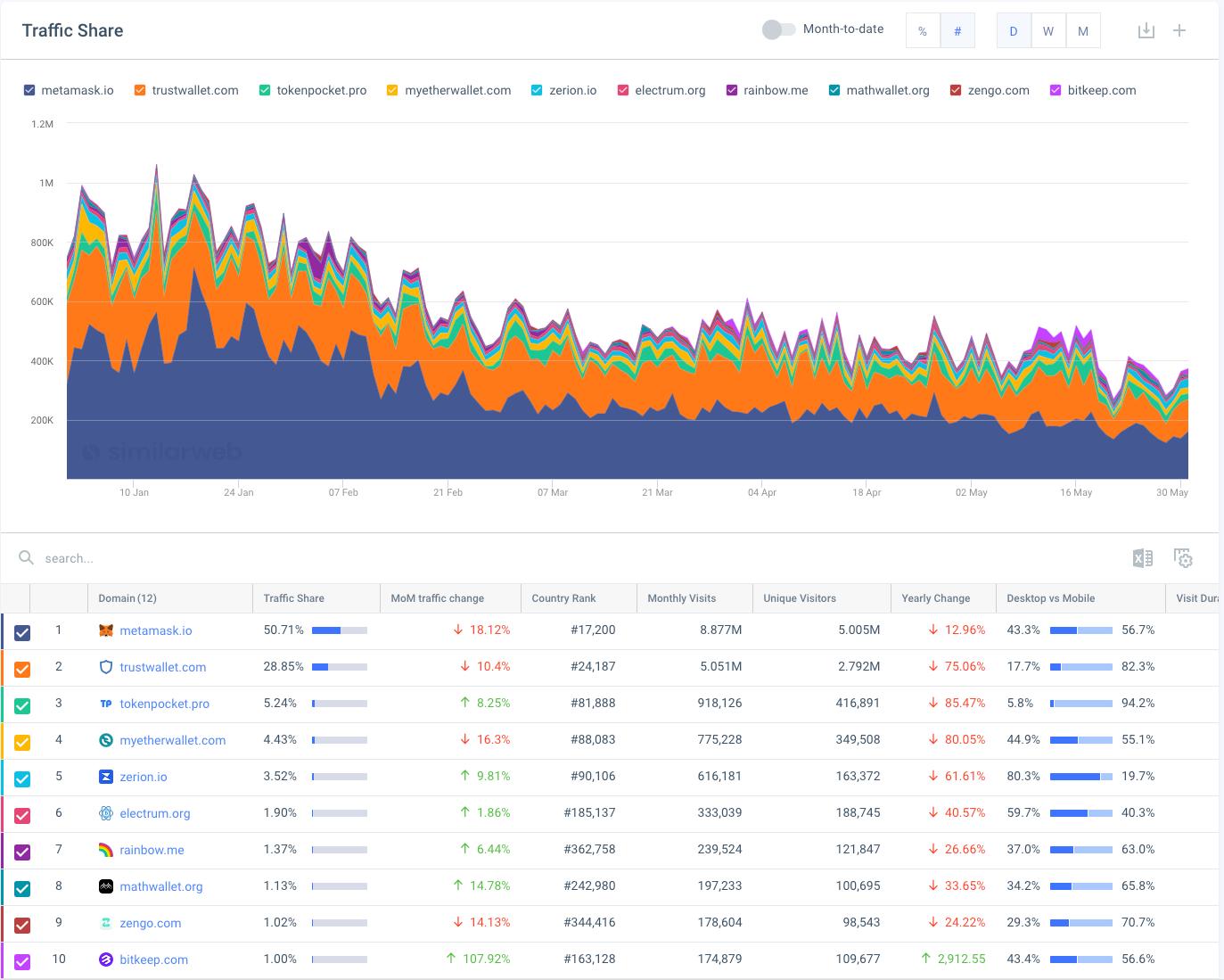
Image source: OKX Research Institute
Although the head effect is evident, the growth in demand has accelerated competition in the wallet sector to some extent. While the variety of products has increased, the segmentation of functions has also become more refined. Development teams like Metamask, Trust Wallet, TokenPocket, Bitkeep, Debank, Rabby, and Zapper are all combining market demands with their own advantages and characteristics, reflecting their ambition to seize the "throne" of Web3 entry.
Metamask, often regarded as a unicorn, aims to be a crypto wallet and a gateway to blockchain applications; TokenPocket defines itself as a multi-chain, secure, and convenient DApp portal; Trust claims to be the most trusted and secure crypto wallet; Bitkeep promotes that users can find the hottest assets within BitKeep; Rainbow focuses on creating an Ethereum wallet that integrates NFTs and offers an interesting, simple, and secure way to explore the new world of Web3; Debank's slogan is to keep up with all important matters in the Web3 world, while its sub-wallet Rabby's mission is to provide better extension wallet services for DeFi users; Zapper simplifies it as your Web3 homepage.

Comparison of features of commonly used wallets
Overall, each has its own advantages. However, in addition to these wallets that have gained traffic through first-mover advantages, unique features, and popular projects, exchanges with substantial user traffic and development funds are also laying out wallet services, which will undoubtedly stimulate competition in the wallet market and may even change the current competitive landscape of wallets in the future.
For example, mainstream exchanges like OKX, Binance, and Coinbase have all taken corresponding actions.
According to official information from various parties, the OKX Web3 wallet aims to become the most comprehensive heterogeneous multi-chain wallet in the market, covering four major areas: digital currency wallet, on-chain trading, NFT market, and DApp exploration. It currently supports over 30 public chains and more than 1,000 DeFi protocols. Multi-chain, secure, simple, and user-friendly, the goal is to meet all of users' Web3 needs; Coinbase's wallet also focuses on heterogeneous multi-chain and supports exchange account linkage; Binance Wallet is a compatible EVM plugin wallet that supports exchange account linkage, allowing users to transfer assets through their exchange accounts and supports Google account login.
Overall, wallet products led by exchanges exhibit the following characteristics:
- They are all trying to enter the decentralized ecosystem through wallets, defining themselves as decentralized/Web3/DeFi entry points;
- The direction includes the association of exchanges and wallets, independent decentralized wallets, and simultaneous management of CeFi and DeFi;
- Product architectures are becoming similar, covering wallets, cross-chain DEX, NFTs, etc.;
- They can acquire some users from the exchange's own traffic;
Among them, in addition to meeting the above four conditions, the OKX Web3 wallet places a strong emphasis on security and has been tested in the market. Relevant personnel stated that this is part of OKX's vision driven by technology, especially in the current context of frequent on-chain asset theft, where user asset security is the top priority.
3. Challenger - OKX Web3 Wallet
According to reports, there was a large-scale theft incident on the Solana public chain, where many users unknowingly had their assets transferred, with over 9,000 wallets compromised and total losses exceeding $4 million, most of which belonged to Phantom and Slope wallets. As a multi-chain wallet, the OKX Web3 wallet's users did not suffer any losses.
The reason lies mainly in the fact that the OKX Web3 wallet did not involve Slope's code, and the operations related to the wallet's private keys and mnemonic phrases are isolated from third-party services, eliminating supply chain attack risks; moreover, private keys or mnemonic phrases are stored locally with encryption, and only users can decrypt them, ensuring no network exposure and no leakage risks.
It is evident that whether in CeFi or DeFi, risk control has always been a core aspect of OKX's entire product line, which undoubtedly adds depth to the slogan "One entry point for Web3 is enough," while providing users with real security.
In fact, compared to the leading unicorn Metamask or exchange wallets like Binance and Coinbase, the OKX Web3 wallet can be considered a latecomer, but this latecomer has been aggressively pursuing, making it a "challenger" in the Wallet 2.0 era.
The relevant person revealed that the helm has repeatedly emphasized that regardless of how much funding and manpower are invested, the goal is to create the simplest Web3 entry point. We need to have what others have, and we also need to have what others do not, with the aim that users can navigate Web3 in the fastest and safest way once they arrive at the OKX Web3 wallet. This fully demonstrates the attitude of a challenger.
Currently, among the 30+ public chains integrated by the OKX Web3 wallet, there are 16 leading ecological chains (15 of which are EVM leading ecological chains), 8 transfer chains, and 4 small chains. According to the relevant person, the team plans to complete the integration of over 40 public chains by the end of August, at which point the richness of assets will far exceed that of other wallets on the market.
Of course, in addition to security and the largest aggregation of other chains, the OKX Web3 wallet has many advantages compared to other competitors. During my experience, I found that this wallet has designed a guest mode, which is very friendly for novice users, indicating that the designers have put considerable effort into lowering the user entry barrier. More importantly, compared to other similar products on the market, the OKX Web3 wallet also has its own unique features:
- Integration of CeFi & DeFi.
- Heterogeneous multi-chain.
- The wallet aggregates multi-chain DEX, NFT markets, and DApp exploration.
- KYT security alerts.
- Comprehensive transaction history display.
The 4th and 5th features rely on the support of OKLink's technology and data. In addition to these features, the OKX Web3 wallet continues to innovate in functionality:
Innovation 1: Multi-mnemonic import *supports derived addresses, allowing users to create/import multiple mnemonic wallets and supports derivation, providing a unique experience in the market. Simple and easy to use, professionally secure.
Innovation 2: Aggregated currencies, displaying the same currency across multiple chains clearly showing the aggregated balance of a single currency across chains.
Innovation 3: Integration of the KYT system, warning against scam coins and suspicious transactions: based on 200 million address labels, alerts are triggered based on risk detection, and common scam case examples are provided to protect user asset security.
It can be seen that exploring its own advantages and characteristics while continuously innovating may be the underlying driving force of the OKX Web3 wallet. After all, in an increasingly competitive industry where product homogenization is evident, only by continuously innovating can one create good products in the 2.0 era and become a qualified "challenger." We also hope that under the backdrop of the Wallet 2.0 era, latecomers can jointly promote the birth of a new pattern.
Conclusion:
If we go back to 2018, no one knew when the prophecy at the beginning would come true, but the reality is that four years later, Web3 is in high demand globally. As a super application serving as its entry point, wallets are not only a heavyweight track where capital is continuously invested but also a gathering place for future innovations. From assets to social interactions, it ultimately evolves into a new way of life under the Web3 landscape, just as the CTO of Mirror said: "It's time to start building communities around the new identity elements of the internet—Web3 wallets."
 Risk warning Risk warning
Popular articles