Why did Helium abandon building its own blockchain and switch to Solana?

 This article will focus on analyzing why core developers recommend using Solana as Layer 1 to support the Helium network, and how this change will impact the entire ecosystem.
Original Title: 《HIP 70: Helium Core Team Proposes to Migrate to Solana》
Author: Helium Foundation
Compiled by: Jordan, PANews
At the end of August, the decentralized wireless communication network Helium, which had previously received $365 million in investment, made a significant announcement: it will abandon the construction of its own custom blockchain network and migrate to Solana.
According to the proposed HIP 70 proposal, Helium's core developers hope to transfer Proof of Coverage ("PoC") and Data Transfer Accounting to Oracles, which will not only greatly simplify the existing system architecture and improve operational efficiency but also allow the use of more composable developer tools, features, and applications from Solana, ultimately achieving greater economies of scale.
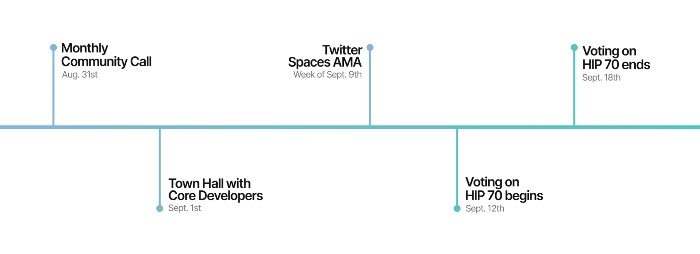
It is worth noting that since the approval of HIP 51, 52, and 53, the Helium Foundation and Nova Labs, the development company behind the Helium network, have spent several months designing and formulating the HIP 70 proposal. If all goes as planned, the community vote will start on September 12 and finalize the results on September 18. This article will focus on analyzing why core developers recommend using Solana as Layer 1 to support the Helium network and how this change will impact the entire ecosystem.
Content Overview
- Migrate Proof of Coverage to Oracle;
- Migrate Data Transfer Accounting to Oracle;
- Migrate the Helium network to the Solana blockchain, including tokens, governance, and the entire economic ecosystem built for HNT, DC, IOT, and MOBILE. After migrating to the Solana blockchain, 6.85% of HNT tokens will be returned to the staking pool to "feed back" the hotspot owners of subDAOs.
Why Are Helium Core Developers Pushing the HIP 70 Proposal?
Despite crypto investor Liron Shapira criticizing that the Helium network's monthly revenue is only $6,500, with each miner earning just $20 a month, it is undeniable that against the backdrop of the accelerating development of the Internet of Things, the Helium network has indeed achieved remarkable growth, having deployed nearly one million hotspots globally. Moreover, as IoT use cases continue to expand (such as monitoring food storage temperatures and using drones to track crop growth), more and more people are using the Helium network daily, connecting their devices and sensor data to the internet, leading to a continuous increase in data transmission on the Helium chain.
To expand the network, Helium's core developers and community members have spent a lot of time supporting the rapid growth of the current network, focusing on two key areas:
- Reliable Proof of Coverage ("PoC") activities (proportional and fair reward distribution);
- Reliable data transmission activities (ensuring accounting consistency).
In fact, due to the impact of network scale and blockchain/verifier load, the Proof of Coverage activities of Helium users have significantly decreased in recent months. On the other hand, the management of data flow on the Helium chain and the complex subsequent accounting mechanisms have also led to issues with data packet transmission. As the on-chain protocols, users, and use cases grow, these issues must be resolved. Helium urgently needs a Layer 1 that can meet the requirements for network processing speed, reliability, and scalability to support on-chain transactions and settlements, which is why the HIP 70 proposal has emerged.
Oracle Migration: Proof of Coverage and Data Transfer
In fact, it is not necessary to process certain specific transactions on-chain (including handling Proof of Coverage and Data Transfer Accounting), but under the current Helium architecture, these transactions are completed on the blockchain, leading to serious data bottlenecks, such as slow device addition speeds, data packet communication delays, network load inflation, and slow processing times. The HIP 70 proposal aims to transfer the Proof of Coverage and data transmission processes to Oracles, which will not only solve these problems but also further enhance the stability of the native Helium network.
1. Migrate Proof of Coverage to Oracle
Migrating Proof of Coverage to Oracle can support more beacon activities and witness activities. By using more traditional big data pipelines, it can transmit receipts outside of on-chain block creation and processing while providing relevant rewards, which means that the transaction "receipt" processing will be further simplified. Currently, there are three roles in Helium's Proof of Coverage:
- Challenger
The challenger is selected by the system to verify the authenticity of coverage by issuing instructions to nearby hotspots. A challenge can be initiated approximately every 300 blocks (about 5 hours), and initiating a challenge earns corresponding HNT rewards. - Transmitter (sometimes referred to as Challengee): The challenged hotspot (i.e., the hotspot being queried for coverage) will, upon receiving the challenge information, initiate a indiscriminate radio frequency beacon (RF Beacon) based on the challenge information. Nearby hotspots that receive the beacon act as witnesses and can relay the information back to the Helium network for verification. Each challenge requires valid witnesses for the challenged party to receive corresponding rewards. The rewards earned depend on the frequency of direct participation in Proof of Coverage activities.
- Witness: The hotspot that receives the beacon becomes a witness and relays the challenge information back to the Helium network. Witnesses monitor and report the coverage activities of other hotspots, and the specific number of hotspot rewards they receive depends on how many activities they witness and the reward ratio of the coverage provider.
If Proof of Coverage is migrated to Oracle, hotspots will not be informed when a "challenge" will be initiated; the verification process will be automated, and challengers and hotspot witnesses will not send their confirmation information back to potentially online or synchronized verifiers but will send confirmation information to active cloud servers that are always synchronized. In this case, the Helium network will be more fault-tolerant than ever in increasing the Proof of Coverage system's resilience, and it can also release more historical receipt datasets and reduce development and deployment time.
Another additional benefit of migrating Proof of Coverage to Oracle is that the challenger rewards in Proof of Coverage (currently accounting for 0.85% of the total HNT token release) will be returned to the hotspot owners' staking pool, benefiting all hotspot owners in subDAOs, as verifiers will no longer need to handle such traffic.
2. Migrate Data Transfer Accounting to Oracle
To support hotspot owners in building a larger network, HIP 70 also proposes to transfer Data Transfer Accounting to Oracle.
Currently, Helium's data delivery mainly relies on the blockchain, as well as on-chain tracking entities such as verifiers and routers, which can lead to serious data transmission issues and affect applications using LoRaWAN hotspot networks. Transferring Data Transfer Accounting to Oracle will allow the Helium network to achieve better scalability, meeting the growing data delivery and related incentive demands of the network.
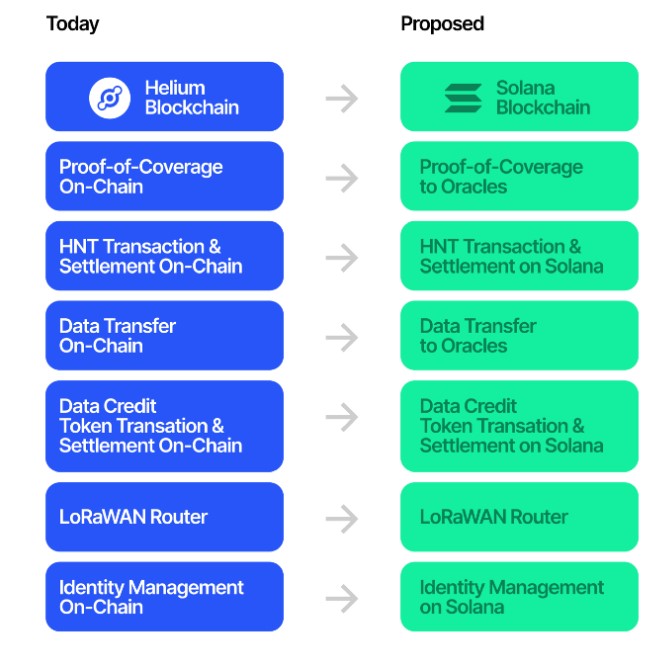
In summary, transferring Proof of Coverage and Data Transfer Accounting to Oracle can further simplify the architecture, allowing the Helium network to focus on handling payments, transactions, settlements, and identity management.
Why Choose the Solana Blockchain?
1. The Blockchain Industry Has Changed Dramatically
When Helium began exploring decentralized wireless networks, there were far fewer blockchains available for construction than there are now, and the number of blockchains capable of supporting the Helium network was even fewer. Therefore, Helium's only option at that time was to build a blockchain from scratch.
However, over the past few years, the Helium community has actually been overloaded with a large number of events, such as consensus rule updates, bug fixes, and on-chain governance. More importantly, the blockchain and crypto ecosystem has become increasingly mature, with many Layer 1 blockchains available in the market. Rather than investing a significant amount of time and effort to optimize Helium's own blockchain, it is more beneficial to leverage existing market resources.
2. Simplifying Blockchain Requirements
Transferring Proof of Coverage and data transmission to Oracle means that the Helium blockchain only needs to focus on payments (P2P transactions and rewards) and identity (accounts, hotspots, routers, etc.), further simplifying business forms. The main chain can also focus on building a more scalable architecture that meets the speed, cost, governance, payment, and identity management needs of the Helium decentralized hotspot network.
Based on this simple standard, along with a large developer ecosystem and cross-project composability, Helium's core developers believe that migrating the blockchain to Solana is in the best interest of the entire network.

What Benefits Will Migration to Solana Bring to Helium?
By using the Solana blockchain, the Helium community can access a larger developer ecosystem made up of thousands of developers worldwide, supporting business areas including: NFT applications, B2B and B2C markets, lending, hardware (Solana Saga hardware phone). Solana developers will also be able to use the Helium IoT hotspot network both on-chain and in the real world.
Helium will also benefit from Solana's rich composable and open-source community. Currently, the Helium blockchain is developed using the Erlang language, which, although it has attracted a number of core developers and contributors (especially in the blockchain community), is relatively small compared to the Helium developer community using Solana's Rust language. As more Helium applications are integrated on the Solana blockchain, an increasing number of talented and creative blockchain developers will benefit from the Rust open-source library, making the deployability, scalability, and security of Helium applications easier.
According to data disclosed by Coindesk, as of June 2022, Solana had approximately 32 million daily active users, a 56% increase compared to the same period in 2021. Unlike Ethereum or other EVM-compatible chains, Solana can process hundreds of thousands of transactions per second at relatively low transaction costs. Moreover, recently, the high-frequency trading giant Jump Trading's crypto investment division, Jump Crypto, announced a partnership with the Solana Foundation to build a second validator client for Solana called Firedancer, which will be based on the C++ programming language and designed to coexist with Solana Labs' existing Rust-based validator client. Helium is likely to follow Jump Crypto's approach.
What Impact Will Migration to the Solana Blockchain Have on the Helium Ecosystem?
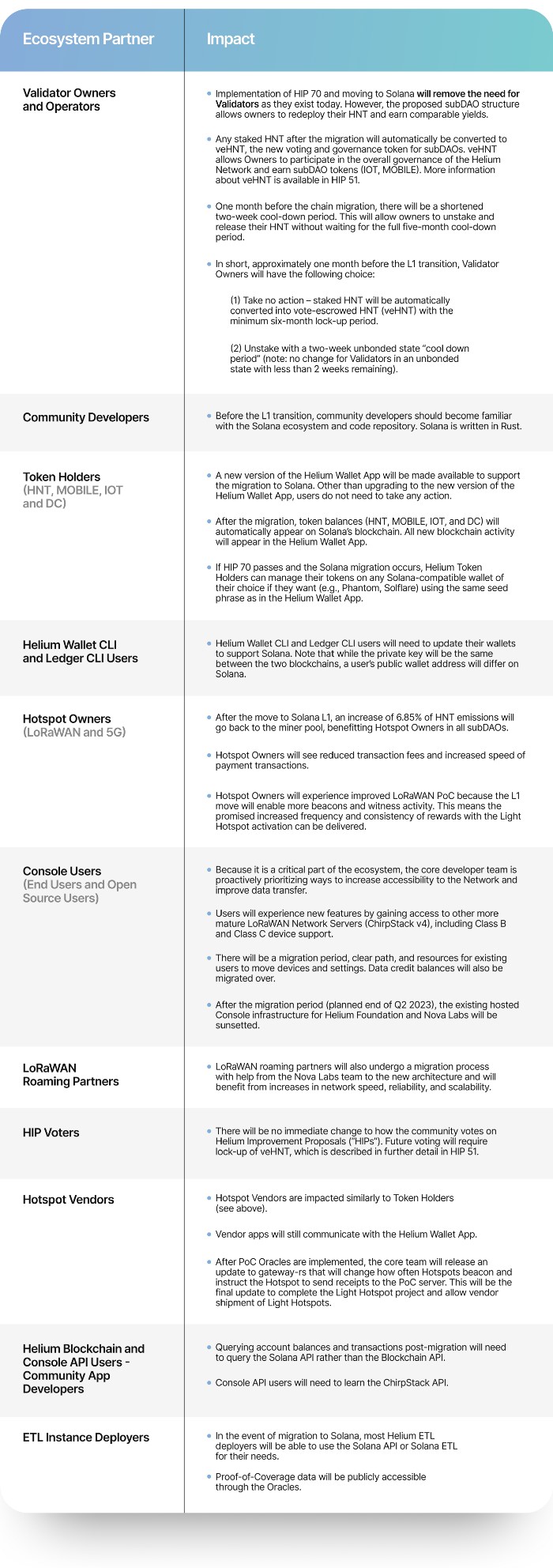
The proposal in HIP 70 will bring significant changes to the Helium ecosystem. If the proposal is approved, it will undoubtedly have a major impact on every partner, especially the owners and operators of validators, as shown in the table below:
Conclusion
Migrating to a new chain will have a significant impact on the Helium network and its users' interests. During this transition, thoughtful discussions and analyses regarding the technical, community, and blockchain impacts are necessary. The Helium Foundation will hold multiple discussions within the community to raise questions and share feedback, with the specific timeline shown in the image below:
As the Helium network continues to grow globally, the core developers and the Helium Foundation have reached a consensus after extensive research—Solana is the best blockchain to meet the needs of the Helium network. Solana can provide Helium with more benefits, including but not limited to expanding the network and community scale and enhancing composability. If HIP 70 is successfully approved by the community, then Proof of Coverage and Data Transfer Accounting will be transferred to Oracle, and the Helium network will be supported by the new Layer 1 Solana, significantly improving transaction processing speed, reliability, and scalability.
 Risk warning
 Risk warning

Popular articles