








The founders of the three major public chains engage in dialogue on stage, discussing new trends in the development of blockchain technology
 Web3 is not about decentralization; decentralization is a tool that helps us achieve our goals. What Web3 truly represents is the freedom of choice, with almost zero switching costs.
Author: Wanxiang Blockchain
Source: DeFi Dao
On September 21, at the 8th Blockchain Global Summit hosted by Wanxiang Blockchain Lab, during the "Golden Age" themed forum, under the moderation of HashKey Capital CEO Deng Chao, Protocol Labs founder Juan Benet, Dfinity founder and chief scientist Dominic Williams, and NEAR Protocol co-founder Illia Polosukhin shared their insights via video link on the "Development of Blockchain Technology," providing in-depth introductions to the future trends of blockchain technology.
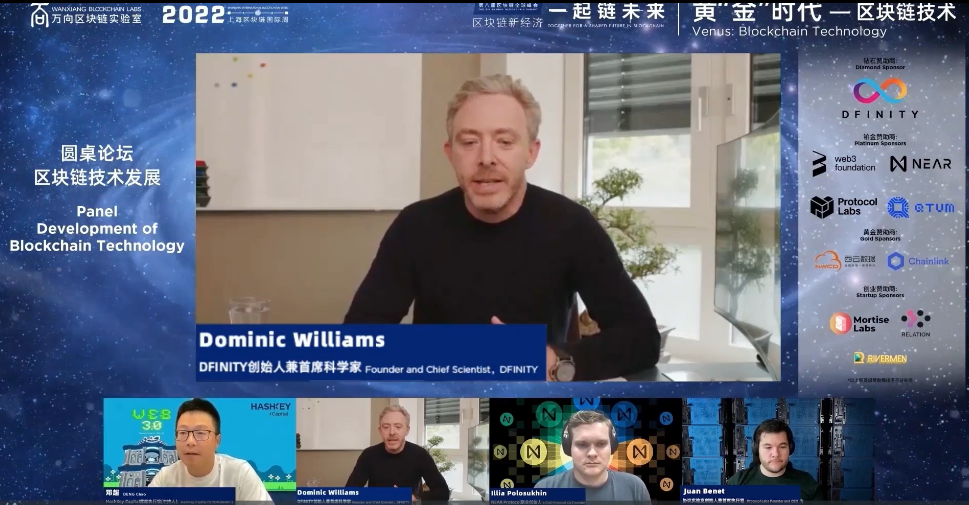
Here are the highlights from the guest speakers (edited):
Host: Can you give an overall review of the past year?
Dominic Williams:
The most exciting progress has been the various projects developed on IC, where we see a whole new set of Web3 services running entirely on the IC blockchain, rather than being deployed on some cloud computing servers.
Moreover, I see that people really enjoy these Web3 applications, which represents a turning point for the blockchain industry. One of the goals of the IC blockchain is to allow developers to build all systems, ecosystems, services, and applications entirely based on blockchain, running and deploying on the blockchain. When deployed on the blockchain, carbon emissions are also lower than those from cloud deployments, so the IC blockchain has an order of magnitude advantage compared to existing blockchains. In addition, chain key cryptography has also been developed over many years. Without chain key cryptography, it would be difficult to achieve the goals I just listed.
Now, this has been further expanded, and many people are building ecosystems based on IC, using IC as the orchestration layer for Web3. Specifically, you can run code on IC, and this code can directly call the Bitcoin ledger without needing any cross-chain bridges.
Additionally, I see some projects based on the IC blockchain creating the next generation of DeFi, Social Fi, Game Fi, and metaverse projects.
Illia Polosukhin:
Last year was an unusual year for the crypto world. For NEAR, we just held the NEAR hackathon in Lisbon, with a total of 3,000 participants, which was a grand event. There were many interesting projects and applications emerging. So I want to share some key developments from the past year.
First, EVM smart contracts. You can directly deploy contracts from other blockchains, such as Ethereum, on NEAR. Compared to Polygon, the fees are ten times lower. This protocol has been running for 8-10 months, and there is also Aurora +, which allows users to trade for free, also built on NEAR.
We are also very focused on decentralized ecosystems. For example, we have regional centers in different areas, deploying regional centers in China, Portugal, Ukraine, the Balkans, Kenya, India, and Vietnam, which will gather more developers and users from different regions.
You will see various new technologies in some already mature markets, representing real-world applications rather than mere speculation. Just at the hackathon in Portugal, Sweatcoin officially launched and introduced its own token, with 200,000 users already very active on their chain, creating 10 million accounts. I am very pleased to see such applications achieve large-scale adoption, which is also a goal the crypto ecosystem hopes to achieve.
The reason Sweatcoin can achieve this is mainly due to its very simple user experience; users do not need to understand the underlying logic of blockchain or the complexities of other technologies to use the application. So I think this is a great example that demonstrates our global strategy to build a decentralized network, but not around nodes or technology; rather, it is around people collaborating globally to contribute to the ecosystem.
Juan Benet:
We focus on two things/two areas: storage and usage.
At the beginning of last year, we had 20 TB of data, but now it has reached 180 TB, achieving several times growth in just 9 months. We are very excited about this data usage, as many applications utilize our data. People are building various new applications and organizations based on IPFS, with over 5,000 startups built on IPFS, some of which have already secured Series A funding or even more, which is a very good thing.
In addition, we are constantly looking for ways to bridge the gap with Web2, such as collaborating with universities like Berkeley, which use IPFS to store their valuable data and datasets. Cities like New York also use IPFS to store their public data.
The second area is combining computation with data, enabling developers to create better applications.
Our first milestone, the WASM-based HelpWeather FVM virtual machine, allows other smart contracts to call it. This will launch user-related smart contracts in the first quarter, which is our first goal.
Additionally, IPFS will have a large-scale data loading plan and computation projects. All of this is mainly in the testnet phase, and we hope to better utilize GPUs.
Furthermore, we have a series of exciting developments, such as people scheduling large-scale tasks based on IPFS.
Overall, we are first connecting a large amount of data, continuously expanding data, and combining data with computation.
Host: What areas do you focus on in your ecosystem and applications, and why did you choose these areas?
Juan Benet:
Now people are building various applications in the Filecoin ecosystem, such as daily apps for storing daily or enterprise data, etc. At the same time, we also see many experiments in the Social Fi area, such as video distribution and applications like TikTok, which I think is an exciting field.
In addition, we must solve many problems in cross-chain before we can achieve applications at the level of TikTok or other large-scale fully decentralized Social Fi applications. Perhaps in the coming years, we will see this, but developers are exploring extensively.
We are now connecting a large number of datasets, allowing people to conduct data science research based on these datasets and perform various data science experiments and big data analysis.
Recently, I have discussed this extensively in many forums, focusing on building machine learning models based on data. Once data and machine learning are combined, it will lead to explosive growth, and we expect to see such growth in the coming year.
Currently, applications mainly revolve around using our services, retrieving our services, and having related applications for storage and retrieval. We also see some other applications using our data for data science.
Additionally, we see some other common crypto applications, such as NFTs, DeFi, GameFi, Social Fi, etc., which already exist in the blockchain field and also in the IPFS ecosystem, but there are also some unique applications.
For me, I am very excited about the possibility of eventually integrating all Web2 data into Web3.
Dominic Williams:
I believe the goal of the IC project is to become a "world computer." Currently, we are the only true world computer blockchain, where you can build various applications entirely based on the IC blockchain, capable of handling HTTP requests and directly providing content to end users (from the chain).
At the same time, we can build social networks on IC, which is fundamentally different from other blockchain systems and decentralized systems.
Currently, if we look at Web3 services, they claim to be deployed on a certain blockchain, but in reality, they are often deployed on AWS services, with only some tokens processed on the blockchain or some sporadic data placed on the chain.
We see various systems and services continuously emerging on the IC blockchain, so for us, the long-term goal is for IC to replace all traditional IT, which is not just about Web3.
Undoubtedly, entrepreneurs and startups have always been most focused on Web3. There is an application on the IC blockchain called OpenChat, which is a messaging service that runs directly on smart contracts in the browser, allowing all smart contracts to interact. All messages sent by users are processed by smart contracts, including media information such as images and videos, and all this data is stored on-chain within the smart contracts, which is revolutionary.
The revolution of OpenChat lies in the fact that this service assigns control to DAO organizations. The question is, if you want to have Web3 services, you can achieve this with the cloud, because DAO organizations are created by smart contracts. Smart contracts can be updated and configured, but they cannot transcend the blockchain itself or control such accounts. Additionally, paid accounts like AWS are inherently vulnerable to hacking.
Moreover, we see a significant increase in the number of developers on the IC blockchain, with hundreds of projects currently running on the IC blockchain. We see the most advanced point is that many projects will directly assign control to DAO organizations or further decentralize, which I believe showcases the potential of Web3. In the world of Web3, users will become partial owners of the services and also part of the development team, and this phenomenon is currently happening.
If anyone is interested, you can check out the OpenChat website (OC.App), which is a Social Fi service.
The website looks like a decentralized version of a signal or messaging service. If you explore further, you will find that each chat account on OpenChat is also a crypto wallet, allowing you to send ICP through chat messages. In the future, we will also allow you to send other tokens. For example, as I mentioned earlier, we utilize chain key cryptography, enabling smart contracts on IC to create transactions on other blockchains. This means you can interact directly with the Bitcoin ledger without needing a cross-chain bridge. In other words, you can send messages through OpenChat, and this message allows you to directly modify the Bitcoin ledger, enabling you to send Bitcoin based on the Bitcoin ledger, which also applies to modifications to the Ethereum ledger.
If you want to send Ethereum or ERC20 tokens to someone, you just need to create a message, and that is Social Fi. This is the possibility of social media ledgers or social media DeFi, Web3, all integrated on a true world computer. Moreover, you can control it directly with smart contracts and protocols, which is a very critical step.
Additionally, traditional blockchains face a problem. Since most data storage, processing, and content provision are based on cloud computing services, the providers of these computing services may encounter issues. For example, if you build this messaging engine on AWS, as a developer, you will also face related risks.
Of course, to solve such risks, the answer is to build Web3 services that should run entirely on the blockchain and be controlled by DAOs, governed by protocols. This is the direction we are truly interested in.
I find it difficult to categorize such a brand new Web3 field because people often make various classifications. This brand new field is actually all-encompassing, including GameFi, Social Fi, DeFi, and the metaverse, all of which are merging together. All of this means that developers on the IC blockchain will produce many surprising applications in the future.
Illia Polosukhin:
We believe that at the application layer, blockchain applications have three main pillars: finance, social, and the third pillar—creators. The interaction and convergence between these three pillars will generate truly interesting applications, such as "finance + creators," where creators enter and see a suitable business model, forming a positive and constructive cycle through collaboration with the community and the use of financial tools.
From the ecological perspective, the mission of the NEAR ecosystem is to provide various tools for people, allowing developers to continuously unleash creativity and combine in various ways.
This includes key areas such as how we combine DeFi with traditional finance. We have services like NEAR Pay, which allows you to transfer directly from your NEAR account to your bank account or link it to your credit card. Because we have different account models and key models, you can authorize others, have real-world assets, and link enterprises to the chain. For example, many markets can currently be placed on the chain, thereby enhancing market efficiency and liquidity. I believe this is also a direction we will see more economic development in the future.
Additionally, we see many vast fields, from GameFi, digital art, videos, etc., where we see these creators continuously entering and bursting forth with various ideas. For example, we have models like "Listen To Earn" and other related models, as well as different markets.
In terms of social aspects, DAO organizations are great, but they are merely tools; ultimately, it is the community that governs. These social applications integrate with blockchain and NFTs, ultimately forming new and more interesting applications, leading to fully end-to-end on-chain functionalities. This is also a vertical direction I am very focused on in the social field. Not only can you build smart contracts, but you can also provide services using JavaScript, which is what people hope to continuously create in the Web3 experience. Moreover, many Web2 elements can migrate to Web3.
We see these components integrated with real-world applications, and JavaScript will also facilitate this innovative explosion.
We see that in the NEAR ecosystem, applications are now achieving a growth rate of 20% every month, with around 800 different projects currently. I believe this number will soon experience explosive growth.
Host: Can you share what types of developers are primarily in your ecosystem? Recently, a large number of Web2 developers have flooded into the Web3 field. How can you better assist developers in entering your ecosystem?
Illia Polosukhin:
From the perspective of tools, I just mentioned JavaScript, which is the best tool to attract developers. This is also a key area of focus for NEAR, as we aim to make the developer experience as simple as possible. We want to be the simplest blockchain.
From the developer's perspective, we have a series of tools that have gradually advanced after development. Now we have JavaScript, and we just held a hackathon where one-third of the programming languages used were Solidity, one-third of the applications were written in JavaScript, and one-third were primarily integrated with existing smart contracts and called using JavaScript, resulting in these one-third of projects.
Currently, there are about 20 million developers using JavaScript, which is a large market with a significant developer base. We believe this is a very promising area.
Additionally, we have indexers, data lakes, and various tools. From the developer's perspective, when building in the NEAR ecosystem, you do not need to think about the infrastructure layer. Furthermore, we continuously enhance the user experience. For new users entering NEAR, they do not need to understand the complex logic of Bitcoin and blockchain. For users coming from other ecosystems to NEAR, they do not need to set up a NEAR account immediately; they can first try NEAR using their existing accounts from other chains and gradually familiarize themselves.
I believe from the developer's perspective, the usage and number of users of JavaScript have seen significant growth. The reason developers are reluctant to join Web3 is mainly that they do not know what applications they can develop. There are many ideas and much education being provided to developers in universities worldwide.
On the other hand, they do not fully understand; they see entering blockchain and becoming a blockchain developer as very difficult. Therefore, we hope to make the development experience simpler. We will soon launch a related service that will provide templates and packaged function blocks in NEAR, allowing you to directly call these function blocks to build a very complete app. The entire process is very simple; you can develop your app in just 15 seconds and continuously explore these apps.
Additionally, we will introduce a security sandbox that allows you to launch your app within the sandbox, which will have an overflow threshold to avoid significant losses in case your app encounters issues. Because we know that initial ideas are often not perfect, products require extensive design to truly optimize them. We make the entire process fast and safe, as many developers are concerned and hesitant to launch smart contracts due to fears of hacking.
Thus, we aim to make the NEAR blockchain as simple as possible and provide many good developer tools for developers.
Juan Benet:
In the past year, a large number of developers have joined the Filecoin ecosystem, and we have seen a series of applications entering the Filecoin ecosystem, with nearly 1,000 different apps now.
Filecoin attracts developers through a builder network, which helps developers create new applications, from developer tools to hackathons, to grant funding, supporting accelerator projects, and investor networks to help entrepreneurs develop their projects and create their projects.
Additionally, there are a series of developer tools supporting development, and these tools have been very successful.
We see a lot of innovative potential emerging, and the numbers are continuously climbing. For us, key work involves participating in industry events, which allow us to meet people from different communities worldwide. For example, events like the Filecoin Summit are very important large-scale events that bring many new faces into the blockchain community, where we can get to know each other, exchange ideas, and come up with new ideas. We also organize workshops to share how to develop and help some promising individuals become professionals in this area.
Filecoin is a very productive network where different people participate and provide different resources, thus earning rewards. So many people from different parts of the world have joined as miners.
We have also seen growth in many regions, such as Korea, Japan, Singapore, Australia, South America, and Europe, all experiencing rapid growth. Of course, North America has always been a growth area.
The African region is also a focus area for us, and we are trying to create communities in different parts of Africa. Singapore is an excellent example that shows us how to bring different communities together to promote mutual growth.
Dominic Williams:
We are seeing more and more people joining, including Web2 developers and other blockchain developers, who see the characteristics and efficiencies offered by IC and choose to join. We will continue to work to make it easier and faster for new developers to get started. Recently, we are also involving the community in this effort.
For example, there are 158 samples on IC to help developers get started quickly, and there is a lot of educational work to be done, along with many technical documents to prepare. But I believe the key is to help people understand the significant differences between IC and other blockchains.
On IC, smart contracts are called Canisters, which are deterministically immutable in parallel with smart contracts. Of course, Canisters can handle HTTP requests and provide services to network users in a cryptographically secure manner.
Blockchain developers will gradually begin to understand IC and Canisters, and once they do, they will abandon the cloud.
Moreover, it will not face re-entrancy attacks. However, there will be other challenges, such as asynchronous issues. We are about to launch a series of new features, such as online batch processing, allowing people to edit videos on the blockchain. There will also be display features, enabling the creation of smart contracts that can be called by the blockchain. Additionally, there is persistent memory. In fact, on IC, each smart contract is a collection of WASM and persistent memory pages, so there is no real storage API; you can create one yourself or store data persistently in variables.
There are many differences, and we are continuously working to improve technical documentation to help people understand this cutting-edge blockchain and the functionalities it can offer more quickly and effectively.
Host: What stage is blockchain mass adoption currently at? What gaps need to be filled, and what are the disparities?
Juan Benet:
Of course, we see mass adoption in many areas, and all areas related to static distribution have already seen mass adoption. For example, IPFS sees 10 million unique visits weekly, which is astonishing and absolutely mass adoption. This achievement was unattainable a year or two ago, but it has not yet reached the level of billions, so there is a gap to reach that level.
In the blockchain space, all applications that require Web2 interfaces have adopted blockchain. For currencies, financial tools, property rights, etc., blockchain is extremely useful, providing significant advantages by integrating standard Web2 user interfaces. We have already seen mass adoption, with millions of users using cryptocurrencies for payments and engaging in financial tools like microloans and NFTs, incurring various GAS fees and forming different property rights.
We have already seen tremendous adoption, but the real gap lies in consumer applications, which are fully decentralized, operating entirely on Web3 infrastructure and scalable to the demands of traditional Web2. There is a significant gap there. These gaps exist because Web3 systems have not yet operated at such a scale, and there are various vulnerabilities that need to be addressed. We are working hard to solve these issues.
Including the three of us here today and hundreds or perhaps thousands of other blockchain developers and protocol designers are working to address these issues, currently clearing these gaps. The problem is that large-scale infrastructure cannot use social structures from Web2 because it carries various assumptions about traditional centralized models from Web2. Therefore, you must rebuild every layer of the tech stack under a completely decentralized paradigm and be able to support fully decentralized applications and services while scaling to the throughput we need.
As we close the gaps and fully realize end-to-end applications, I believe it will be possible to build applications like Twitter and TikTok that achieve mass adoption in data usage and distribution, providing information streams and pushing tagged content abuse, etc. All computing layers must be built in a fully decentralized manner. Of course, different people can freely choose the parts they develop.
If we need community-oriented policies, we need policies to govern the system. There is still much work to be done, and we will see the first batch of billion-scale consumers in 2-3 years. At least I do not believe we will see this next year, but if we do, that would be great. The underlying infrastructure is still running on Web2 clouds, so we must abandon Web2 clouds to become fully decentralized applications, which I believe will not happen in the next 2-3 years. We will see applications scaling larger and larger, but it will take time until we have complete consumer-grade applications.
Dominic Williams:
The "blockchain singularity" has been reached, meaning that everything is based on the blockchain without the need for any traditional IT. Imagine a social network on the blockchain; this is already running on the IC blockchain. Looking at most current Web2 services and applications, you can see similar ones on the IC blockchain, but they are the Web3 versions, such as fully 100% blockchain-based social media applications that do not require cloud services and directly provide content to users through smart contracts. This is the current user base. So, I think this is the good news for the first part of user mass adoption.
Regarding mass adoption, people often overlook another dimension. The "magic" of Web3 lies in its ability to bring billions of users. What gives it such magic? My answer is tokens, which give users real control over the services.
I want to reintroduce OpenChat, a messaging service based on the IC blockchain, which also serves as your crypto wallet. Your chat messages or your OpenChat account can act as your crypto wallet.
It looks like WhatsApp or Signal, a Web3 version of a Web2 application, providing a certain degree of DeFi functionality. This means you can store crypto in your account while also sending it through chat messages. However, I believe this is not enough for OpenChat to achieve hundreds of millions of users. To achieve hundreds of millions of users, network effects are needed—not just any network effect, but a special network effect that can challenge the network effects of tools like WhatsApp, which already has billions of users. The key tool is to give users ownership.
To explain further, Facebook (Meta) is currently expanding its campus in the Bay Area to accommodate thousands more employees, primarily for content cultivation and sales personnel. Imagine if, on an application like OpenChat, we could randomly airdrop DAO-related rights to users to reward certain behaviors, such as users helping to promote and advertise. This way, we could build a decentralized team of millions of people very quickly.
However, to achieve this, your service must be a protocol. If a decentralized messaging service is deployed on AWS cloud, and you are only using the blockchain to store some data while your main body is based on AWS, you will likely encounter various issues, such as governance problems or other community issues.
To achieve a truly Web3 strategy, users and communities must have ownership and control, realizing truly "viral" expansion. Everything must become a protocol, meaning everything must run on the blockchain, with control assigned to smart contracts, creating services through smart contracts, and having community DAO organizations with some autonomous operations.
Once this is achieved, we can truly leverage the potential of relevant blockchain technologies, achieving real viral growth and breaking through to realize network effects, just like the Web2 applications currently enjoy. This is also why I believe we will see fully decentralized on-chain social media services with millions of users next year, and we have already seen signs and trends emerging on the IC blockchain.
Illia Polosukhin:
I fully support the points made by Juan and Dominic. We have done a lot, but there is still much to do. From the perspective of control, there is a lot of potential. For example, the Sweatcoin project mentioned earlier has now reached 20 million downloads, achieving several million downloads within just three days of its launch. So what you see here is mass adoption, regardless of how you measure it; it is mass adoption.
This means everything is decentralized and functioning well. Furthermore, Web3 is not just about decentralization; decentralization is a tool that helps us achieve our goals. Web3 truly represents the freedom of choice, with almost zero switching costs.
So there are many things that do not necessarily need decentralized servers because, with zero switching costs, your costs are very low, even if our current servers are merely data-providing nodes. Why are there so many RPC providers, so many wallets, and so many infrastructure and application layer providers? It is mainly to provide users with the freedom of choice.
We have not achieved mass adoption yet, but we are getting closer to that goal, and I look forward to seeing more users next year as we continue to move toward that goal. This is also why I am very pleased to see projects like Sweatcoin. Users do not need to understand the complex underlying logic of blockchain; they just need a little bit of game-like assets to start playing this game.
Currently, there are 60 million users in the blockchain ecosystem who can be recruited. I believe we have the potential for mainstream adoption, meaning that those without any technical background, who are not from the blockchain industry, can also enter this field through these popular applications.
I also want to share a very important issue: privacy. We have not done enough in terms of privacy, especially considering social networks or enterprise data. Ultimately, it all depends on how well we handle network privacy. For example, TikTok's content is public, so privacy is not an issue. However, if you use a messaging service and all messages sent to friends lack privacy protection, it becomes very complicated. If you build with current high transparency technologies, privacy will be a problem to solve in the future. Therefore, I believe privacy and the transparency of blockchain should be well integrated.
Host: What exciting developments do you anticipate in your respective ecosystems and in the entire blockchain field?
Juan Benet:
For us, the most important future developments are FVM and user-defined smart contracts, which will be launched in the first quarter of next year, bringing various possibilities, as well as developer builder projects, allowing everyone to experiment in a sandbox environment.
Second, once an app is deemed to run well, it can be migrated to the mainnet.
Third, layer two networks, which I have been mentioning, focus on combining computation and data, with layer two primarily responsible for computation.
Fourth, sub-second CDN delivery, which will also be launched soon.
The most important point is that the first part will first go on the testnet. If anyone is interested, you can download and try it on the IPFS Center. This is what we are very much looking forward to in the next year.
All of this would not be possible without the support of developers. Various activities will bring the community together, so I invite everyone to meet us at our offline meetup in Singapore. If you are a developer yourself, you can also pay attention to various project investment institutions.
Next year, we will hold more offline activities in different continents and regions to have direct communication opportunities with more communities. This is our outlook for the future development of IPFS in the coming year.
Illia Polosukhin:
In the coming days, we will enter the next phase of sharding, achieving a higher degree of decentralization, and throughout next year, we will continue to push for more functionalities to go live. For example, in sharding and continuous scalability, there will also be ongoing projects to support users.
The activities of developers in the entire ecosystem are exciting, and many ecological funds support projects to ensure that anyone with innovative ideas can join the community, find relevant community contributors, and have the opportunity to develop and build their projects based on NEAR, achieving project growth. This is my outlook for next year.
I expect at least a tenfold growth next year, regardless of how you measure it, even at least tenfold growth, or even more, which is what I hope for.
Additionally, with the introduction of JavaScript, we have provided immense and unimaginable flexibility, and we are seeing many unique applications and functionalities launched on NEAR. For example, you can directly import JavaScript modules into existing smart contracts, or JavaScript smart contracts can dynamically execute other JS contracts, etc.
I am very much looking forward to the future development, growth, and sustainable experimentation of the ecosystem.
Dominic Williams:
I expect further growth next year and more communication with the community.
The IC blockchain itself is a blockchain with immense potential. If you look at the data, you can see that it can handle 500 million transactions throughout the day, some of which are state-updating transactions, while others are query transactions. This means that the state is already determined before you formally call the contract, and I also look forward to seeing further growth in user numbers next year.
Additionally, there are two very exciting areas and new features:
First, the SNS network, which is equivalent to a DAO organization. Currently, there are hundreds of projects in the IC ecosystem using SNS, enabling projects based on IC to be fully decentralized. Decentralized protocols will also have other decentralized attempts, including sales, which will attract more attention in the future.
Second, the Bitcoin integration testnet, which is entirely based on cryptographic verification without any cross-chain bridges involved. It allows smart contracts on IC to operate directly on the Bitcoin ledger. This means we can allow people to create Bitcoin-native DeFi and create many possibilities for them.
For example, there are more activities on Ethereum, NEAR, and Avalanche. Additionally, we see some security guarantees for transactions on the IC blockchain, which is also a very interesting development direction. I believe we will see IC become the orchestration layer for Web3, where many decentralized exchanges can be seen based on IC, allowing various transactions without needing to leave their own chain. In other words, you do not need to use Swap; these are revolutionary features that have already become a reality.
Moreover, there are also some self-made time slices on IC. The IC blockchain is the only "integrated blockchain" without any slicing or sharding, and smart contracts run in parallel. Currently, some functionalities still need further development due to GAS limitations. However, we have also introduced some innovative models, such as reverse GAS fees, and deterministic time slicing allows for multi-block focus, which is very important. If you want to build a social media/social network like INS based on IC, your smart contracts need to be able to do image filtering, which currently faces GAS limitations, but this is very important.
At the same time, further flexibility is needed. Compared to the current situation, we have already created an infinitely scalable blockchain that is live on the mainnet, capable of directly handling HTTP requests and providing services and content to users without relying on traditional architectures or traditional clouds, achieving several orders of magnitude of efficiency improvement.
So far, the IC blockchain will greatly reduce carbon emissions for users, developers, and the ecosystem compared to fully cloud-based setups like AWS, which is also a very important revolution. Because currently, the energy consumed and carbon dioxide produced by blockchains is too much.
For example, Ethereum has 400 validators to perform merges, meaning the data is replicated 400 times, which is necessary for security. However, mathematically, to achieve security, 400 validator nodes are excessive and unnecessary. From this perspective, Ethereum is not environmentally friendly. However, the IC blockchain allows people to deploy front ends directly on the IC chain without relying on traditional IT architectures or traditional clouds, using IC cryptography instead.
All of this will be launched in the coming months and the next year, and I am very much looking forward to it.
 Risk warning
 Risk warning

Popular articles





