Forbes exposes Helium insider: false advertising, difficulty in self-sustainability, executives profiting

 The crypto darling, touted as "network revenue sharing," has been slapped in the face, led by a16z.
Original Title: “Crypto Darling Helium Promised A 'People's Network.' Instead, Its Executives Got Rich”
Author: Alex Konrad, Forbes
Translation: Katie Gu, Odaily Planet Daily
Helium was touted as the best real-world use case for Web3 technology. However, as the project struggled to generate revenue, a Forbes investigation found that Helium executives and their friends quietly hoarded much of the wealth at the project's inception.
The $1.2 billion market cap Web3 company Helium received funding from a16z and Tiger Global, claiming to be building a "People's Network," a global network providing wireless internet connectivity for items like parking meters and dog collars. All users had to do was spend $500 on a machine that looked like a Wi-Fi router, plug it into the wall, and earn Helium's cryptocurrency in return (a cyclical passive income stream). A Helium investor claimed that owners could recoup their investment within weeks.
If demand for the Helium system increased, driving up the value of its Helium Network Tokens (HNT), the company suggested that the network's profits would be shared by everyone. But after being exposed by Forbes, this claim was met with skepticism.
The Founding of Helium and Internal Bugs
In 2013, Napster co-founder Shawn Fanning and then-renowned game designer Haleem founded a startup called Skynet Phase 1, referencing the genocidal computer system from the Terminator film series. This company, later renamed Helium Systems, claimed to be creating a wireless network for the Internet of Things, one of the hottest areas for venture capital.
With Shawn Fanning's fame, Helium secured $15 million in funding in 2014 from big-name investors like Khosla Ventures and Salesforce founder Marc Benioff. However, after a failed product launch five years later, driven by a $50 million investment, Helium turned to the booming crypto market, unveiling the "People's Network" in August 2019. (According to three sources, Shawn Fanning left the company before the launch.)
Meanwhile, Helium discovered that its new system was riddled with cheaters. To artificially inflate rewards, some users purchased multiple hotspots, sometimes dozens, and manipulated their locations to make them appear dispersed across a city or town, while in reality, they were all in one place. When machines verified each other, this created clear signals, resulting in more tokens. Employees of Helium stated that this phenomenon was widespread.
Although the community now manages a blacklist of over 70,000 hotspots that may belong to cheaters, Helium claims to have implemented anti-cheating measures. However, it is well-known that employees were also involved in this behavior, as three former Helium employees said, "When you see customers doing this, you think, why shouldn't I get in on it too?"
Haleem stated that he had been focused on how to address the cheating issue, and nearly 12 months after the launch, Helium claimed its hotspots covered over 1,000 cities in North America. Soon after, its tokens were listed on major crypto exchanges Binance and FTX, allowing people to buy, trade, and sell HNT. By July 2021, there were over 100,000 online hotspots, although HNT rewards were steadily declining. Like other cryptocurrency projects, Helium initially issued the largest number of tokens, with over 60 million HNT issued in the first year. According to project documents, to protect the cryptocurrency's value, this number would be halved every two years.
In August 2021, a16z led a $110 million token financing round, and Helium's token price continued to rise, reaching $55 in November. At the time of the sale, three a16z partners wrote in a blog post that Haleem's dream of "creating a more connected world" had become a reality.
An article in The New York Times in February of this year almost encapsulated Helium as a success story for Web3. A few weeks later, Helium announced that after raising another $200 million, its valuation reached $1.2 billion. In February, Helium established a new company called Nova Labs. Haleem wrote in a blog post announcing the funding, "This is the fastest global wireless network launch in history."
When Helium first launched, it created a special token—Helium Security Tokens, or HST—which guaranteed that about one-third of Helium tokens would be transferred to investors and company executives as compensation for supporting the network. While users complained about their rewards decreasing, CEO Haleem praised it on Discord as "the fairest token distribution of any project I know of so far."
The Profits Flow to a Few Insiders
In the first three months of the network, Helium hotspots earned the most tokens, during which insiders accounted for a large portion of the Helium mining community.
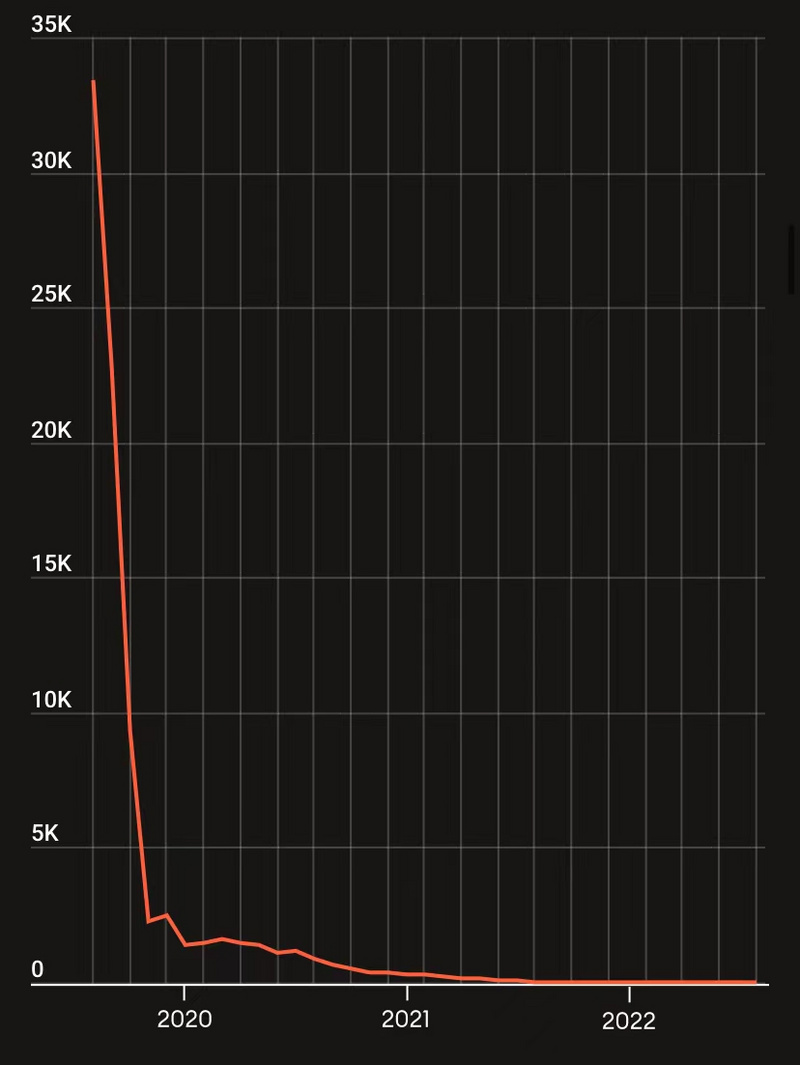
Average monthly income per Helium hotspot
But what the community didn't know was that Haleem and several Helium executives, along with their friends and family, as well as some investors, received undisclosed windfalls in addition to these guaranteed dividends—before the revenue plummeted, they secured the largest share of tokens. They quietly accumulated most of the tokens earned during the project's early and most profitable days.
Forbes discovered 30 digital wallets that appeared to be linked to Helium employees, their friends, family, and early investors. According to analysis confirmed by blockchain forensics firm Certik, this group of wallets mined 3.5 million HNT, nearly half of all Helium tokens mined in the first three months after the network launched in August 2019. Within six months, over a quarter of HNT had been mined by insiders. When HNT prices peaked last year, this was worth about $250 million. Even after the cryptocurrency price crash, these tokens are still valued at $21 million today.
This means that at the peak of Helium's hotspot rewards, insiders claimed that most tokens flowed to Helium's community, with only a little over 30% going to them. According to blockchain data, in August 2019, the average income per hotspot was 33,000 HNT. Today, each hotspot can only earn about 2 HNT per month. Some insiders exploited known vulnerabilities in the company to further increase their gains.
Lee Reiners, a professor of cryptocurrency law at Duke University School of Law, said, "This is a recurring pattern in the cryptocurrency economy. The project is designed to make the founders and early supporters richer at the expense of ordinary people who buy hotspots, thinking they will bring value."
Helium Struggles to Generate Revenue
In addition to issues with miners and the token system, Helium seems to face a more severe problem— the company appears to struggle to generate revenue from its network. Forbes found that over the past year, from June 2021 to August 2022, according to Helium's own data, the revenue generated from data moved through the network was only $92,000, a stark contrast to the $250 million raised from investors by the parent company. In contrast, the vast majority of Helium's revenue ($53.3 million during the same period) came from people registering their new hotspots and certifying other devices on the network.
In an interview with Forbes, Haleem stated that generating revenue from network data "is not something that can be achieved overnight," adding, "Helium's network has only become viable in the past nine months. We expect it will take a few more years to truly realize."
Monsur Hussain, research director at Fitch Ratings, told Forbes that the cryptocurrency space "is full of fundamentally half-baked projects because the ultimate promise does not yield basic economic returns." Hussain added, "To make Helium's network profitable, you actually need to cover the entire planet with devices to consume enough data."
Helium is not the first cryptocurrency project to "paint a big picture," but it has left buyers feeling deceived. During the crypto winter, there are signs that the U.S. Securities and Exchange Commission is preparing to crack down on crypto companies listing unregistered securities products, and Helium's cryptocurrency price has plummeted, meaning that the few tokens mined by users are worth less than $5 each, just a small fraction of the $55 peak in November 2021.
The following chart reflects the number of data points consumed monthly in dollars, representing hotspot data transmission (the primary source of the company's demand-side revenue).
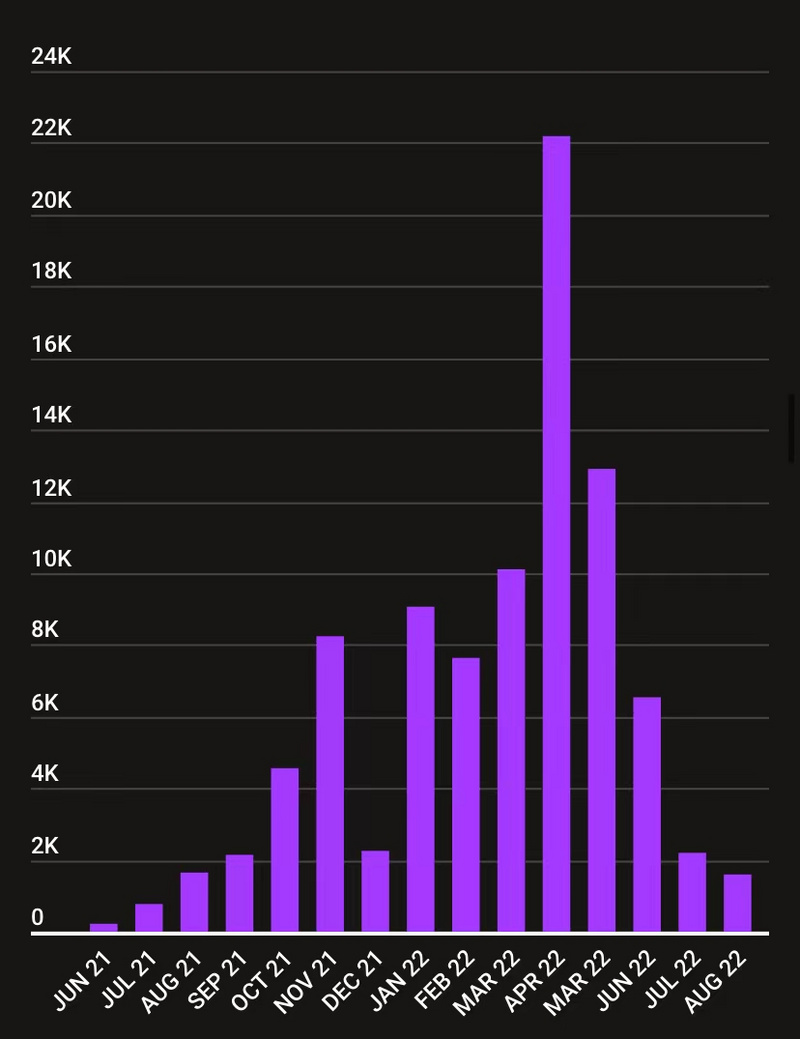
Revenue generated from wireless data using Helium
Helium Exaggerates Its Partnerships
In August, the city of San Jose, California, decided not to renew its pilot project partnership with Helium because it failed to provide internet subsidies for low-income families through HNT mining. The city purchased 20 hotspots last year, and the amount of HNT generated per miner decreased. Clay Garner, the chief innovation officer of the mayor's office, told Forbes, "The decline in HNT generated can be attributed to a lack of data transmission on the network. San Jose cannot afford projects that do not significantly scale."
The company also seems to have exaggerated the nature of some partnerships. In July, internet news blogs Mashable and The Verge accused Helium of overstating its relationships with corporate clients Salesforce and electric scooter-sharing company Lime. Both companies confirmed to Forbes that they do not use Helium, despite being listed as clients on the company's website (Helium has since removed Salesforce and Lime from its website).
John Stark, a former SEC official who led the agency's internet enforcement office, stated, "Helium's apparent exaggeration of these business partnerships, combined with revenue reliance on login fees rather than actual use of its network, could invite regulatory scrutiny."
Three years after its blockchain debut, Helium users seem increasingly disappointed with the company's failure to deliver on its promises. In addition to complaining about low revenues, community members report that they have to wait a year to receive their hotspots. Some players claim that once their hardware arrives, random variables negatively impact their rewards. Canadian hotspot owner Jonathan Newman told Forbes, "I realized it would take many years to break even." Eight months later, Jonathan Newman's "hotspot" finally arrived, with hopes of earning about $150 a year, a far cry from the returns he was initially sold.
Conclusion
Due to low network usage, community dissatisfaction, and declining cryptocurrency prices, Helium is now trying to expand its community on an entirely new network. (Odaily Planet Daily Note: On September 22, the proposal vote for Helium to migrate its network to Solana was passed.)
The company stated that its next step is to build a Helium 5G network to provide decentralized connectivity for the latest cellular devices. This includes partnerships with the two largest wireless carriers in the U.S., DISH and T-Mobile. Helium will pay the latter for access to its network. Last month, the company announced the launch of a new token, MOBILE, to reward hotspot owners building its 5G ecosystem. Currently, crypto enthusiasts need to participate in the network by purchasing an upgraded hotspot costing between $1,000 and $2,600.
 Risk warning
 Risk warning




Popular articles