In-depth dialogue: Which is more important between Ethereum and Cosmos's different theories, monetary premium, and openness?

 David Hoffman and Zaki Manian explained the differences between the Ethereum and Cosmos ecosystems using biology.
Authors: Ryan Sean Adams, David Hoffman, Bankless
Compiled by: The Way of DeFi
Recently, the two co-founders of Bankless, Ryan Sean Adams and David Hoffman, engaged in a dialogue about Cosmos theory with two OGs from the Cosmos community, Sunny Aggarwal and Zaki Manian. In my opinion, this podcast is very interesting, as the participants represent the Ethereum community and the Cosmos community, showcasing the differences between these two ecosystems.
In this podcast, they focused on the following topics:
The core theory of Cosmos
Ethereum VS Cosmos
Thoughts on monetary premium
Osmosis and liquidity premium
Stablecoins in the Cosmos ecosystem
L2 VS Cosmos
Cosmos VS Polkadot
MEV issues and solutions
ATOM 2.0
Mesh & interchain security
The future of Cosmos
Since this podcast lasts about 2 hours, a complete transcript would be quite lengthy, so I have distilled some key points.
1. The Core Theory of Cosmos
According to Sunny Aggarwal, the Cosmos community believes that the future of blockchain will not be dominated by a few blockchains, but rather consist of a variety of blockchains, most of which will be application chains. Just as there is no ultimate settlement layer in the real world, the blockchain world will also have many settlement layers, with each blockchain serving as a settlement layer for its native asset, granting them sovereignty. Rollups or other systems do not possess the sovereignty of a main chain. Overall, the core theory of Cosmos is not to attempt to build a world computer like Ethereum, but to establish various community computers and enable interconnectivity among them.
Zaki Manian added that the emergence of Cosmos aims to kill the fat protocol theory, which posits that the token of the underlying blockchain protocol captures the value of applications built on it, and that the protocol token with network effects will be the most valuable. In contrast, the core theory of Cosmos argues that the layer capturing value should be the application layer, the layer closest to the user. Therefore, Cosmos has established a technology stack to help developers build the best possible application layer.
2. Ethereum VS Cosmos
Regarding the differences between the Ethereum and Cosmos ecosystems, David Hoffman and Zaki Manian explained using biology.
David Hoffman: Ethereum initially existed as a single chain, but now there are many Layer 2 networks built on top of it, and various Layer 3s will emerge in the future. Thus, the entire Ethereum ecosystem resembles a giant tree, where L1 serves as the core underlying layer, while L2 and L3 are the branches, and the final applications are like the leaves on these branches, absorbing sunlight to provide the necessary organic matter for the branches and the underlying L1. Therefore, according to this theory, the Ethereum beacon chain will be the core of the entire ecosystem.
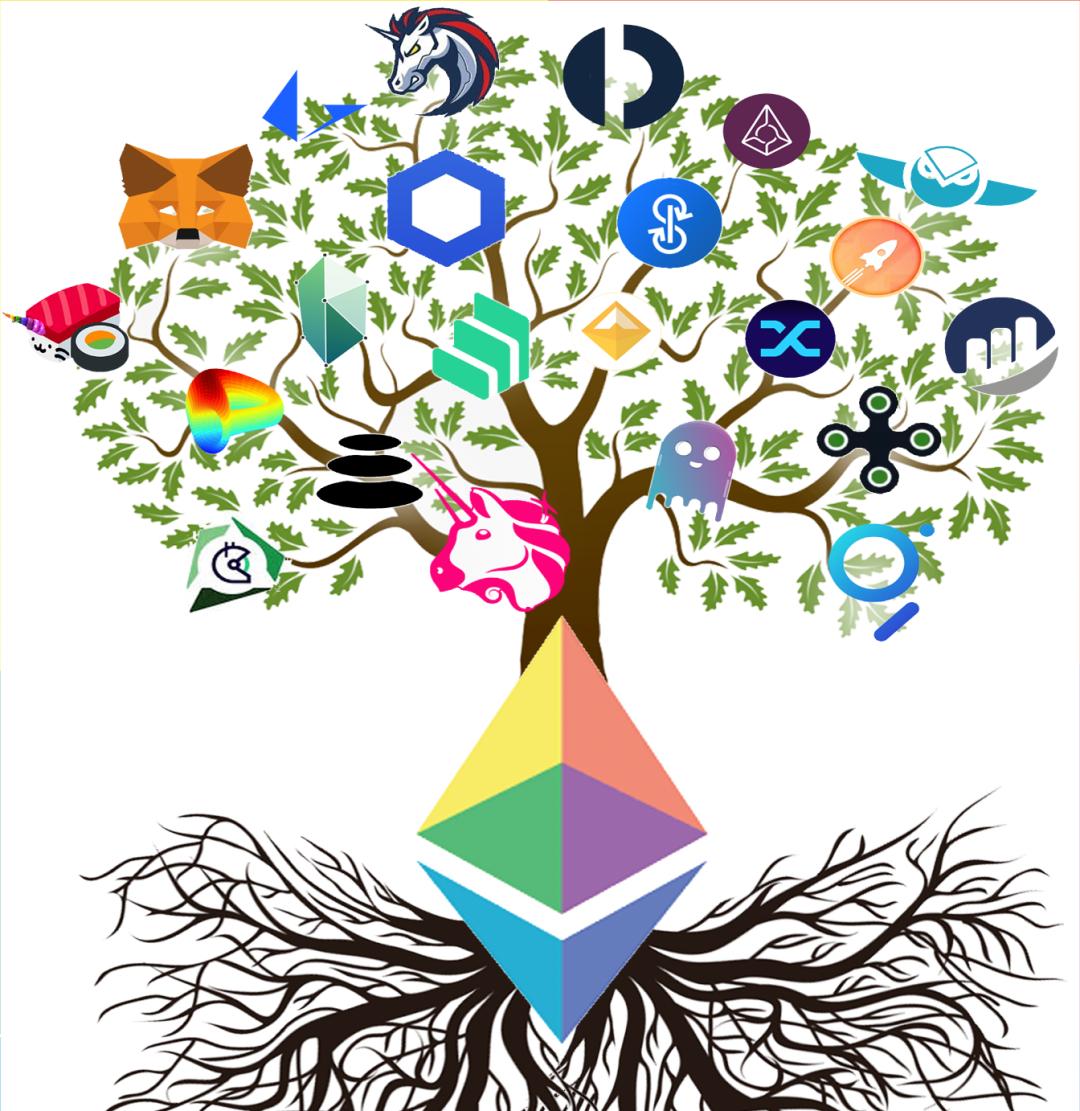
(Image from David Hoffman)
Zaki Manian: The model of the Cosmos ecosystem is different; it is mesh-like, similar to a mycelial network spread across forests and land. This network coexists with the trees in the forest (referring to Ethereum, etc.). From a conceptual perspective, Ethereum focuses on monetary premium, which is difficult to establish as it requires creating a secure, decentralized, and censorship-resistant system. The Ethereum beacon chain serves as the root of the monetary premium chain, and everything built on it relies on it for security. In contrast, the mesh security model proposed by Sunny allows Cosmos ecosystem chains to provide security to each other.
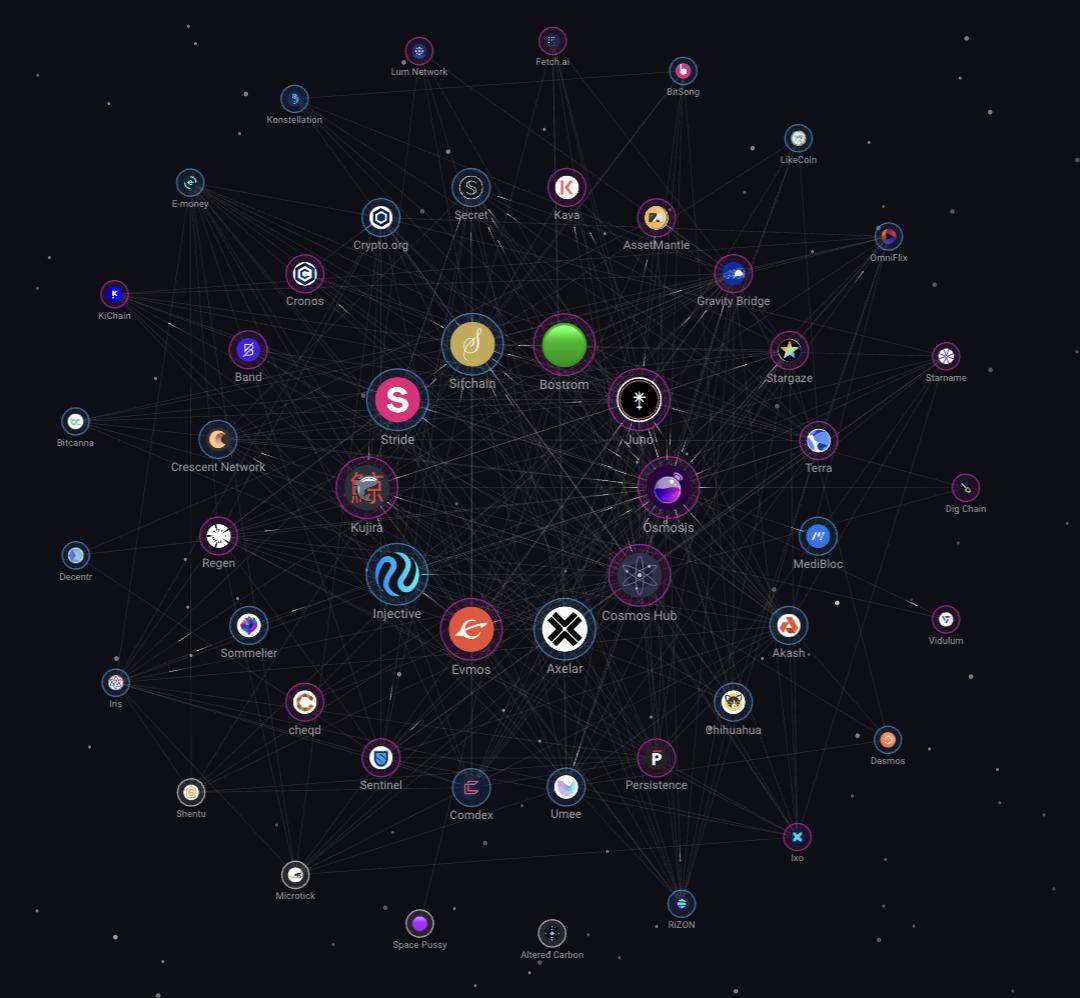
(Image from: mapofzones)
Note: When explaining the bidirectional mesh security model, Sunny Aggarwal used the real-world example of NATO, where each member country has its own sovereignty and governance system without interfering in the political affairs of other member countries, yet they have a mesh security system in place.
3. Trade-offs Regarding Monetary Premium
Ryan Sean Adams: The Cosmos ecosystem chains sacrifice monetary premium, especially the design of the Cosmos hub, which avoids capturing monetary premium. In contrast, the Ethereum community places great importance on monetary premium, viewing it as a protective force. The previous fat protocol theory is gradually transforming into a fat money theory.
The key to this thought is that if you can create a monetary premium in the foundational layer asset, you can gain free security, thus resisting other competing Layer 1s.
Sunny Aggarwal: The Cosmos ecosystem is essentially a hidden Bitcoin maxis branch. We want to build an application layer for Bitcoin. In my view, Bitcoin is an application chain, and the entire Cosmos ecosystem is about creating various application layers for Bitcoin, connecting Bitcoin and the Cosmos ecosystem through a protocol called Babylon, leveraging the Bitcoin network to provide security for the Cosmos ecosystem and any PoS chains (solving long-range attack issues, etc.). From this perspective, Bitcoin will be the beneficiary of the monetary premium in the Cosmos ecosystem.
The design of the mesh security model within the Cosmos ecosystem is a non-rent-seeking way to obtain free economic security.
Ryan Sean Adams: Connecting Bitcoin to the Cosmos ecosystem requires trusting the validators of the application chains, thus losing the original security of the Bitcoin network, which poses a challenge for monetary premium.
Sunny Aggarwal: Establishing a secure bridge between Bitcoin and the Cosmos ecosystem is currently a focus. We are also trying to help Jeremy Rubin improve things like OP_CTV, so that cross-chain bridges can be more trustless like IBC. Additionally, regarding mesh security, gold (Bitcoin) has the highest monetary premium, with its single market value being the highest, while the combined market value of the top 10 companies in the world exceeds that of gold. Therefore, in my view, economic security does not need to come from monetary premium, but rather from productive assets.
4. Osmosis and Liquidity Premium
David Hoffman: Regarding the design of the mesh security model, what can prevent one of the Cosmos chains from becoming the core of the entire network, thereby gaining network effects and liquidity premium, thus deviating from the goal of the mycelial network (for example, Osmosis is currently the liquidity center of the entire Cosmos ecosystem)?
Sunny Aggarwal: IBC, as a communication protocol, allows each Cosmos chain to communicate with each other. Osmosis, as an early successful application chain, is currently the activity and liquidity center of the entire ecosystem, but in the future, there will be more successful application chains that will also become centers in various application domains, forming a mesh network. The mesh security model allows the application chains in the entire ecosystem to collaborate with each other, preventing any single application chain from becoming a security center.
David Hoffman: The OSMO token currently has the best liquidity in the entire Cosmos ecosystem, so it is starting to become the currency of the Cosmos ecosystem, while Uniswap's UNI has not done this (has not become a monetary premium asset). Does this mean that Osmosis's liquidity premium is too high, potentially undermining the vision of the mesh network?
Sunny Aggarwal: Currently, the OSMO token is the pairing asset for most pools, but I actually don't think this will be a lasting situation, as we are moving towards more concentrated liquidity and order book-style systems. Stablecoins will become more of the foundational pairing assets rather than the volatile OSMO, and we are connecting more ecosystems and bringing in different assets.
5. Stablecoins in the Cosmos Ecosystem
Ryan Sean Adams: The Cosmos ecosystem is introducing stablecoin assets, such as Circle's recent announcement to launch a native USDC in the Cosmos ecosystem. What are your thoughts on this development?
Zaki Manian: I think one of the biggest differences between the Ethereum and Cosmos ecosystems is that the core developers in the Cosmos ecosystem are mostly also building applications, while the core developers in the Ethereum ecosystem focus on the underlying blockchain. At developer conferences, you can see that the core developer community and the application developer community are two different groups. Therefore, my own Agoric project is working on stablecoins, and I am also working on the USDC chain, which is the universal asset issuance chain for USDC. This is something I helped facilitate, making the entire system mesh-like rather than centered around one hub, as we all have our own applications and economic incentives. Now, USDC is issued on a consumer chain in the Cosmos ecosystem and connects to the entire ecosystem through the IBC communication protocol, allowing any member chain within the ecosystem to obtain native USDC stablecoins without paying rent.
Ryan Sean Adams: I think this is very significant. Compared to Bitcoin, I prefer the idea of USDC on Cosmos because USDC itself is a centralized dollar IOU. It does not aim to provide sovereign-level security; it is not a crypto-native asset. So placing it into the Cosmos ecosystem seems reasonable, as it does not truly sacrifice any monetary sovereignty.
6. L2 VS Cosmos
Ryan Sean Adams: Regarding the future of multichain, there are currently two theories: one is the Ethereum-style vision, and the other is the Cosmos-style vision. I am not sure if these two visions can coexist. I will first present the Ethereum-style vision I am familiar with, which is that various application chains will be built on top of various L2s in the future, using Ethereum L1 as the source of security. This does not require establishing its own validator set to enjoy Ethereum's economic security.
Sunny Aggarwal: In my view, this is an imperial and colonial model; Cosmos establishes a sovereign system.
Zaki Manian: Of course, this is a very meme-like statement. As early as 2014, early participants in the Cosmos ecosystem were trying to persuade the Ethereum ecosystem to shift towards the Cosmos vision, but developers were more focused on infrastructure like sharding. The entire ecosystem has only recently begun to pay attention to the application layer. From a technical perspective, blockchains can roughly be divided into three parts: execution environments, data availability systems, and bridge systems. Ethereum is trying to build an integrated system through fraud proofs, zero-knowledge proofs, and then provide a data availability layer called danksharding, ultimately connecting all execution environments.
In contrast, the vision of Cosmos is to provide an IBC cross-chain communication protocol, allowing you to go anywhere you want. For example, Celestia is, in a sense, part of the Cosmos ecosystem; it is an application chain focused on data availability (DA), and through it, a rollup-type ecosystem can also be established. We provide a toolkit that allows developers to build execution environments.
Thus, one of the biggest differences between the Ethereum and Cosmos ecosystems is that most of the execution environment toolkits in the Ethereum ecosystem are not free. This is also one of the important reasons why dydx left Ethereum and migrated to the Cosmos ecosystem, as the latter provides free public goods for everyone.
Sunny Aggarwal: Compound once tried to launch an application chain in the Polkadot ecosystem. They chose the substrate architecture and spent a year working on it, but ultimately decided to abandon it. Robert Leshner said that if they had chosen the Cosmos SDK architecture, the outcome might have been better. From the perspective of application builders, building with the Cosmos SDK architecture would be faster. The Ethereum ecosystem focuses more on cutting-edge underlying technologies, such as zero-knowledge proofs, but their implementation is slower, while Cosmos focuses more on higher-level aspects, such as state machines. We are more concerned with the composability between chains and the user experience and functionality of application chains, and then later add elements related to fraud proofs and validity proofs; this is a trade-off.
7. Cosmos VS Polkadot
Ryan Sean Adams: Back in 2017-2018, there were two projects focused on interoperability in the market: Cosmos and Polkadot. You also mentioned that Compound once tried to launch an application chain in the Polkadot ecosystem but ultimately chose to abandon it. Do you think that in the competition between the two ecosystems, Cosmos has already won?
Zaki Manian: From a market capitalization perspective, DOT is currently leading, and USDC will also launch native assets in the Polkadot ecosystem first. However, Polkadot does not have an application that can handle 1 billion USDC in the short term, while Cosmos has dydx, which can do that. This is what happens when you bring the best applications into your ecosystem.
Ryan Sean Adams: Polkadot seems to have adopted a strategy that is between Ethereum and Cosmos. It does not provide smart contract functionality but is only responsible for the consensus of the entire network, providing shared security for the entire ecosystem, while Cosmos adopts a non-dominating model. From this perspective, Ethereum is one extreme of the crypto ecosystem, while Cosmos is another extreme; these are two parallel ideas (with no intersection).
Note: This statement reminds me of Vitalik's "convexity" theory, where he believes that in certain decisions (such as technical direction), adopting convex decisions is more reasonable, while a compromise approach may lead to unnecessary complexity.
8. MEV Issues and Solutions
David Hoffman: Speaking of application chains, Daniel Elitzer recently wrote a great article about Uniswap, mentioning that only about 1/3 of the economic value is captured by liquidity providers (LPs), another 1/3 is consumed in gas fees, and the remaining 1/3 is leaked to forms of MEV such as front-running. In other words, using Uniswap, you leak a lot of economic value. Can you discuss how application chains address some of these MEV issues from the perspective of Cosmos?
Sunny Aggarwal: This is what we are doing with Osmosis. We use a threshold encryption mempool approach, which can eliminate bad MEV extraction, such as sandwich trading. In the case of a public trading pool, someone reads all the other submitted transactions and copies that strategy, then arbitrages through front-running. This is a problem brought about by public trading pools. Of course, there is also some good MEV that does not extract value, such as arbitrage opportunities between Osmosis and other centralized exchanges. Additionally, in the future, the Mars protocol will launch a lending platform on Osmosis, so triggering liquidations will also be MEV arbitrage opportunities. These are all good MEV. Therefore, our strategy is to eliminate bad MEV and then realize good MEV (through automated on-chain bots) and distribute the profits to OSMO stakers.
9. ATOM 2.0
Ryan Sean Adams: We have discussed a lot about Cosmos theory. Now let's talk about the recently released ATOM 2.0 white paper, which discusses changes in the economic aspect.
Zaki Manian: We have the application chain theory, so what is the application of the Cosmos hub itself? It seems to have no applications. After long discussions, we believe that to make ATOM a better ecosystem asset, we need to create an application for it. Therefore, we have seen changes in the economic model; it is no longer an exponentially inflationary token, but rather resembles a monetary asset.
10. Mesh Security & Interchain Security
Ryan Sean Adams: Regarding the application of the Cosmos hub itself, it should be something called "interchain security." Does this mean that the validators of the Cosmos hub help validate other application chains and provide them with security?
Zaki Manian: There are two models for shared security: one is called "interchain security," and the other is called mesh security. Some application chains have highly valuable users, such as USDC, but they do not want to consider token economics. These applications have a strong motivation to become consumer chains, renting the validators of the Cosmos hub and providing value to the Cosmos hub and the entire ecosystem. Another scenario with high demand for interchain security is application chains that are very sensitive to security, such as liquid staking. These application chains will also have a high demand to connect to the Cosmos hub.
Sunny Aggarwal: Regarding the vision of mesh security, historically, credible neutrality has been very important. For example, Switzerland, the wealthiest country in the world, is neutral. I initially thought that the role of the Cosmos hub was to be a credible neutral system that can rent out security and earn income. This is also the role I believe the Cosmos hub will play in this vision of mesh security.
David Hoffman: Is the idea of interchain security here in the early stages, and as the product-market fit of application chain products occurs and value increases, they will be able to bear the security burden and then switch to this credible neutral army system (mesh security)?
Zaki Manian: I believe the uniqueness of our shared security vision lies in the fact that we designed the entire system to be seamlessly upgradeable. Just like the standard application upgrade process we use in Cosmos, you can join interchain security without taking on too much technical burden, or you can choose to leave interchain security. We want to ensure that this is a diverse ecosystem.
11. The Future of Cosmos
Ryan Sean Adams: In the next 5-10 years, what do you think Cosmos will look like, and what will the entire crypto ecosystem look like?
Zaki Manian: My expectation is that when the vision is realized, most people using cryptocurrencies will not know what they are using, whether it is something from Cosmos, Ethereum, or Solana. The entire market will not have attacks or front-running, but rather a true digital market. I do not care about other things; I just hope that the tools we build for Cosmos can become an important part of reaching this goal. I also believe that Ethereum plays a very important role in the entire vision. So if we succeed, we will have an open-source digital market that provides economic collaboration for all humanity. This is the utopia I envision.
Sunny Aggarwal: As I mentioned earlier, I really like the organic Hayek system. About a month or two ago, over 50% of the market capitalization of the crypto market was supported by PoS systems, which is great. But now I am thinking about the next thing. I believe we can achieve something better than Proof of Stake (PoS). I truly believe we can build a consensus protocol based on network trust that is more decentralized than Proof of Stake (PoS). I don't know; I just want to continue dismantling centralized systems and build more organic mesh systems.
 Risk warning
 Risk warning


Popular articles