Analysis of the zkEVM Battle: zkSync, StarkNet, Scroll, and Challengers

 Different projects are exploring different directions, which may be the most beneficial development model for the industry.
Original Title: 《The Race for zkEVMs Explained》
Author: Grant Griffith
Compiled by: Azuma, Odaily Planet Daily
On October 28, Matter Labs officially launched the first phase Baby Alpha of zkSync 2.0, an Ethereum scaling solution. Although the network will not be open to external participants for testing purposes, the launch of zkSync 2.0 as the first EVM-compatible zk-rollup is still a significant milestone in the "Long March" of scaling the entire Ethereum ecosystem.
In the following text, analyst Grant Griffith explains the importance of zkEVM in simple terms and compares several projects, including zkSync 2.0, that are dedicated to achieving zkEVM. This will help readers easily understand the landscape and latest developments in the zkEVM race.
zk-rollup, especially EVM-compatible zk-rollup (zkEVM), has long been regarded as the holy grail of Ethereum scaling. While we have not yet fully traversed this path, the latest developments from several projects indicate that what once seemed years away now appears to be within reach. The race has begun; let us witness it together.
Why is zkEVM Important?
First, let's revisit a question: why is it that optimistic-rollup currently has a higher TVL, yet the market generally recognizes zk-rollup more?
The answer is that while both forms of rollup can bring significant improvements in scalability and TPS, zk-rollup has distinct advantages in transaction confirmation (no challenge period) and security. Compared to optimistic-rollup, zk-rollup is generally considered more secure because its security relies on trustless cryptographic techniques rather than on network participants honestly submitting fraud proofs. Of course, optimistic-rollup has its own advantages, such as not requiring complex computations on dedicated machines to generate proofs (which incurs other costs).
Aside from these differences, zk-rollup and optimistic-rollup are theoretically not very different, but that is only in theory. In reality, only optimistic-rollup can currently achieve good compatibility with EVM, which means that the ecosystem development progress of optimistic-rollup projects is temporarily ahead of that of zk-rollup projects.
All public blockchains (including rollups) share a common goal— to achieve network effects as early as possible for ecological adoption, which requires quickly attracting developers and users—this is precisely the convenience that EVM compatibility can bring.
EVM compatibility is a concept related to the way smart contracts are written and deployed. If a blockchain is considered EVM-compatible, it means that its smart contracts are generally written according to specific EVM rules. In simpler terms, if you copy and paste a set of code that is readable on the Ethereum network and deploy it on another chain, if that chain supports and can process these transposed codes, it will be considered EVM-compatible. Given Ethereum's unparalleled developer friendliness, EVM compatibility is seen as a way to reduce barriers for developers, effectively accelerating the ecological development of new chains.
Another new concept to mention is EVM equivalence. In short, EVM equivalence goes a step further than EVM compatibility, meaning that the writing and deployment of new chain smart contracts fully comply with EVM specifications, achieving true "plug and play." In contrast, the EVM compatibility emphasized by the early market did not require achieving the most precise EVM "equivalence" (some minor rewriting of code might still be necessary).
The Competitors
Given the complexity of zero-knowledge technology and proofs, Ethereum's initial design did not consider ZK friendliness, which has led to the need to overcome numerous challenges in developing a general zkEVM. However, the door to innovation is being opened; let’s take a look at which projects are leading the way.
Polygon zkEVM
On October 10, Polygon announced the launch of the public testnet for Polygon zkEVM. This is the latest achievement following Polygon's aggressive moves in zero-knowledge proof technology (including the acquisition of Mir Protocol and the merger with Hermez, etc.). The testnet is currently in stress testing mode, and Polygon encourages users to deploy contracts on the network and help discover potential bugs.
According to previous reports from CoinDesk, Polygon zkEVM is expected to launch its mainnet sometime in early 2023.
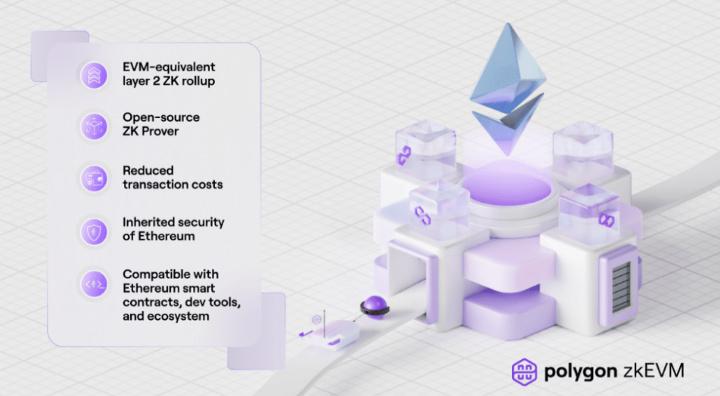
In terms of EVM compatibility, although Polygon is striving to reach the level of EVM equivalence, it has not yet fully achieved it. As of the time of writing, while it supports all EVM opcodes, the project's GitHub repository shows that it has only achieved 97% compatibility coverage so far. On this point, Polygon's branding efforts around "EVM equivalence" have also drawn some criticism, as the community is increasingly concerned about the distinction between "fully equivalent" and "highly compatible."
zkSync
Similar to Polygon, zkSync, created by Matter Labs, has recently made significant promotional efforts regarding zkEVM (zkSync 2.0). On October 28, zkSync 2.0 just launched the first phase Baby Alpha of its mainnet, becoming the first zkEVM solution to deploy a mainnet. However, the mainnet currently does not support any external projects, and the team is continuing stress testing to ensure everything operates as expected.
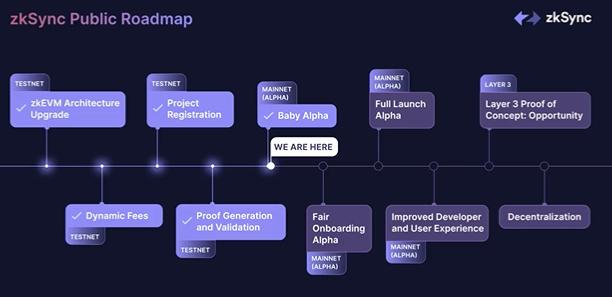
According to the roadmap disclosed by zkSync, the next phase after the first phase will be Fair Onboarding Alpha, where developers can port to zkSync and start building applications on the network. Currently, over 100 projects, including Uniswap, have expressed interest in deploying their applications on zkSync 2.0. The subsequent phase is Full Launch Alpha, at which point the network will be fully open to everyone, expected to occur around the end of the year.
In terms of EVM compatibility, zkSync 2.0 is developing towards EVM compatibility (not equivalence). At present, the compatibility level of zkSync 2.0 may be lower than that of Polygon, as Polygon has achieved "opcode-level equivalence" by supporting all EVM opcodes, while zkSync 2.0 has not explicitly supported this yet. Although this deviation may bring some other advantages to zkSync 2.0 (such as faster proof generation times, lower costs, etc.), a lower overall compatibility may cause more friction in developer migration.
Scroll
When Scroll announced its commitment to achieving zkEVM at EthCC 2022, its recognition may not have been as high as some other competitors. However, this does not mean we can overlook this project. A few weeks ago, Scroll announced an upgrade to its alpha testnet, supporting the deployment of smart contracts, giving developers their first opportunity to interact with Scroll's infrastructure. It is expected that Scroll will launch a larger-scale alpha testnet and open it to all users soon.
In terms of EVM compatibility, like Polygon zkEVM, Scroll is also striving for full equivalence with EVM, which includes direct support for every EVM opcode. However, Scroll has not yet completed all core work.
StarkNet
When it comes to ZK-STARK technology, Starkware is undoubtedly a pioneer. StarkNet alpha was launched on the Ethereum mainnet as early as November 2021, and over 100 projects are already building on the platform.
In terms of EVM compatibility, unlike some other rollup projects, the underlying smart contract language used by StarkNet is not Solidity but Cairo, so it is not inherently EVM-compatible. However, the team is actively building methods to improve compatibility, and Nethermind's Warp project is constructing a Solidity-Cairo "compiler" that allows projects written in Solidity to "one-click" translate their codebase into Cairo for deployment on StarkNet. This "compiler" is still under development, and once operational, it will enable StarkNet to achieve a level of EVM compatibility similar to that of zkSync 2.0.
Notably, a few days ago, Starkware launched a new product called Kakarot, which is an EVM written in Cairo. It will be able to run Ethereum smart contracts on StarkNet, raising the level of EVM compatibility to that of Polygon and Scroll. There are still few details about this product, but Starkware has been emphasizing the number 9000, although its specific meaning remains unclear, it likely refers to TPS.
New Projects like Taiko
Not all projects dedicated to zkEVM have produced tangible results like the aforementioned projects. For example, Taiko is one of the latest projects working in the zkEVM field, which shared its white paper for the first time a few weeks ago (on October 7). Its vision is to build an EVM-equivalent zk-rollup, creating the smoothest path for developers, users, and infrastructure providers in terms of adoption.
Clearly, many other projects, including Taiko, are still in the true "early stages."
Conclusion
One point to note at the end of the article is that after Polygon, zkSync, and Scroll announced their latest progress at EthCC 2022, Vitalik Buterin published an article distinguishing different types of rollups based on compatibility levels, which broadly covered the major rollups mentioned earlier.
One of Vitalik's core points is that differences in EVM compatibility do not necessarily mean that one rollup is better or worse than another. We need to consider other trade-offs; rollups with lower compatibility may face certain disadvantages in attracting developers, but at the same time, this may also bring other flexibility advantages. It is essential to keep this in mind when analyzing different rollups: when a zkEVM does not seek EVM equivalence, can it still present other advantages to justify this trade-off? What is the best path? The market currently does not have an answer; different projects are exploring different directions, which is beneficial for the entire industry.
In fact, as pioneering projects gradually move towards the mainnet, I expect countless more projects to enter the market with their own solutions in the coming months and years. Considering that the development of zkEVM is still in its early stages, there remains much space for new projects to enter the market. Observing how this track develops and who the winners will be in the near future will be an intriguing endeavor.
 Risk warning
 Risk warning