








After tracking the UNI airdrop for 2 years, I found that effective airdrops are too difficult

 The idea of transferring governance rights of the protocol to early users through airdrops seems to have failed.
Source: Dune,
Author: jhackworth
Compiled by: Katie, Odaily Planet Daily
In the past few years, the airdrop craze has captured the attention of the crypto community. Airdrops are seen as a killer marketing strategy for Web 3, a good way to promote projects, encourage adoption, and facilitate cold starts.
In the past few months, we have also seen high-profile airdrops and enthusiastic responses from projects like Optimism's OP, Hop Protocol's HOP, and Aptos's APT. But here’s a question: Did the airdrops really achieve their goals?
Are Airdrop Incentives Still Effective?
This question is complex and largely depends on how we define "effective." To conduct research, we need to delve into on-chain data.
Typical goals of airdrops include:
Rewarding loyal users, as some airdrops can help projects profit;
Marketing—creating a buzz, gaining attention, and increasing adoption;
Decentralizing the platform by distributing governance rights to the community.
We will take a closer look at one of the largest airdrops in history—the UNI airdrop by Uniswap in September 2020. This was the largest and most well-known airdrop in the industry's history, spawning countless imitators, reigniting enthusiasm for the model, helping Uniswap dominate the market, and evolving into a fixed pattern. Two years later, Uniswap seems to have fallen short of expectations; let’s explore why.
Uniswap Airdrop
On September 17, 2020, Uniswap airdropped UNI to over 250,000 addresses that had previously interacted with the protocol. Eligible addresses had interacted with the platform before September 1, 2020, and were granted at least 400 UNI tokens.
The distribution was quite skewed. The vast majority of addresses (93.8%) received less than 412 UNI. On the other hand, over 250 addresses received 250,000 UNI. These addresses were mostly high-level users, major partners, and SOCKS holders.
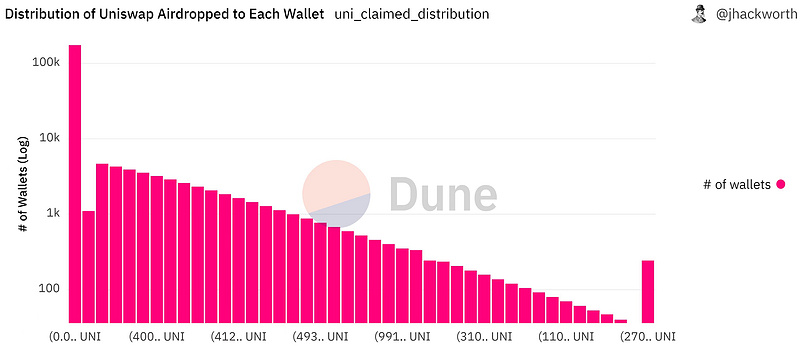
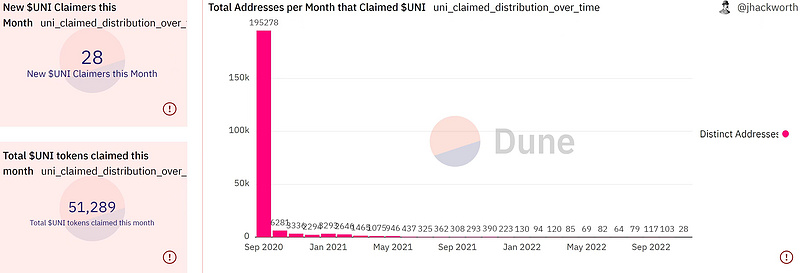
Most eligible users were able to claim the airdrop. 90.8% of wallets claimed their tokens within the first month.
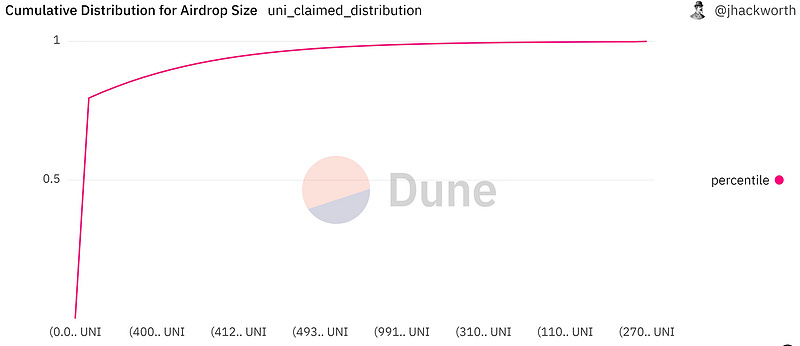
However, not all users claimed so quickly. Throughout 2022, about 70-100 addresses claimed UNI each week. Additionally, there were still 30,000 users who never claimed their tokens. More than two years later, over 84 million UNI remain unclaimed.
Did Early Users Who Received UNI Airdrop Still Hold?
One of the goals of airdrops is to distribute tokens among the user base, improve user retention, and lay the groundwork for their use in governance and community.
In the case of Uniswap, while most wallets claimed the airdrop, whether the airdrop's goals were achieved remains debatable. Only 7% of wallets that received the airdrop still hold UNI.
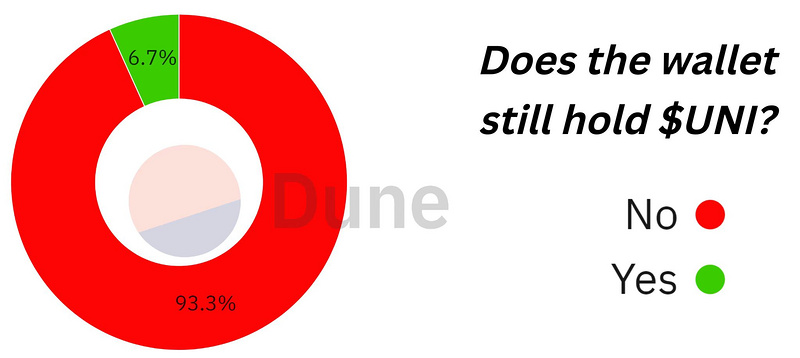
Among the remaining approximately 7% of users, most sold some, with only 1% of wallets increasing their UNI positions.
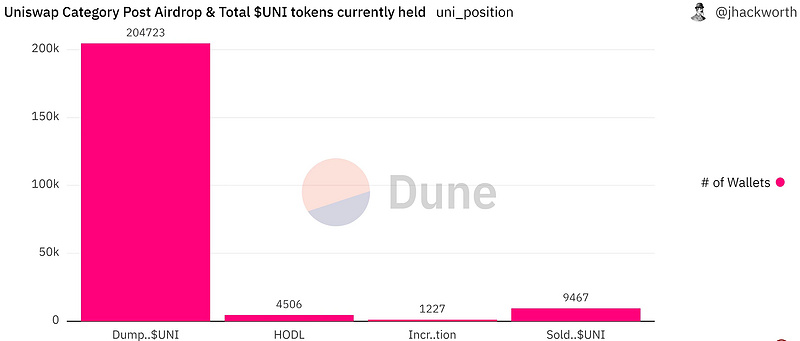
The vast majority directly sold their tokens, with only 3% not selling any tokens. The governance rights in the protocol and the potential future value of the tokens seem less appealing than "free money" (airdrop tokens).
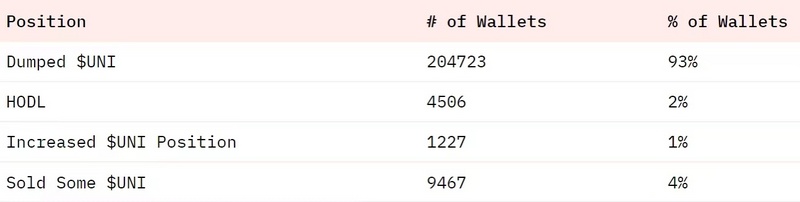
There are also some on-chain behaviors of UNI that we cannot explain, such as users transferring their tokens to another wallet. After the airdrop, over 75% of wallets sold all their UNI within the first 7 days. The sell-off rate reached 80% within the first 30 days and 85% within the first 90 days. Currently, 93% of airdrop recipients have sold all their UNI.
Of course, selling airdrop tokens may be due to some users needing the money, being more interested in other investments, or lacking confidence in the platform, wanting to cash out as much as possible.
However, with the right airdrop, continuing to hold the tokens could be more beneficial. Most Uniswap users cashed out when the UNI price was between $2 and $4 early on. However, they might regret it, as the price soared to a peak of $41 in early 2021. The average airdrop was worth up to $12,000. Wallets that retained their initial airdropped UNI are still profitable.
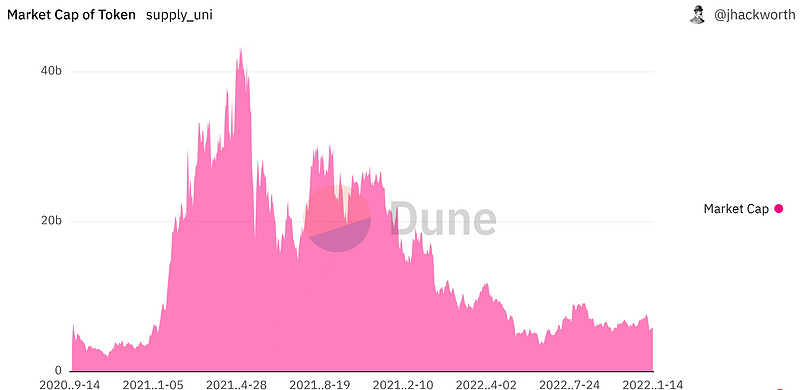
According to the data, many users sold their airdrop tokens. Did the users who retained their tokens become influential pillars of the Uniswap community as envisioned?
Among the top 5,000 UNI wallets today, only 10.5% are from airdrops. To enter this group, you need to hold at least 780 tokens, worth about $5,000, which is double the average airdrop.
Over 230,000 wallets retain UNI, but the top 5,000 wallets account for 56% of the total supply. Airdrop whales still dominate, but retail investors have no place.
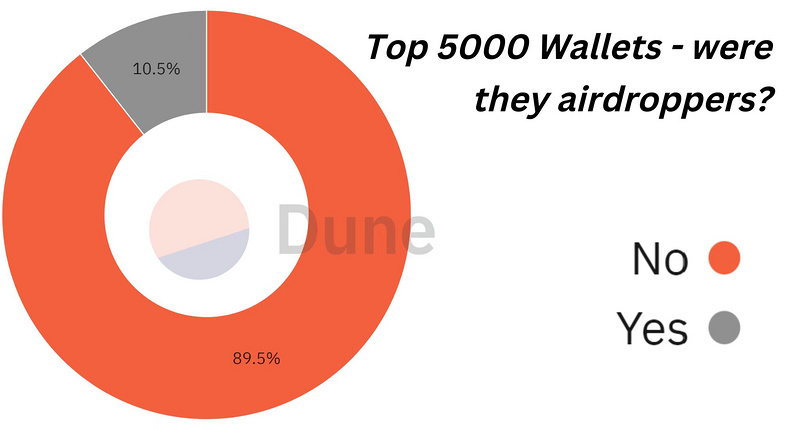
If the goal of the airdrop was to grant shares and governance power of the protocol to early adopters, then the Uniswap airdrop seems to have failed.
What Is the Current Activity Level of Users Who Received the UNI Airdrop?
The proportion of users who received the airdrop and still hold their UNI is low, and a small portion of them increased their positions. Are they active users of the platform itself?—Yes, but the proportion is small.
At the time of the airdrop, users who received the airdrop made up a significant portion of the platform's active user base, accounting for about 40% of weekly trading volume and 60% of active traders. This number significantly declined in the following 6 months, dropping to below 10%. About a year after the decline, this proportion fell to 5% and has remained at that level.
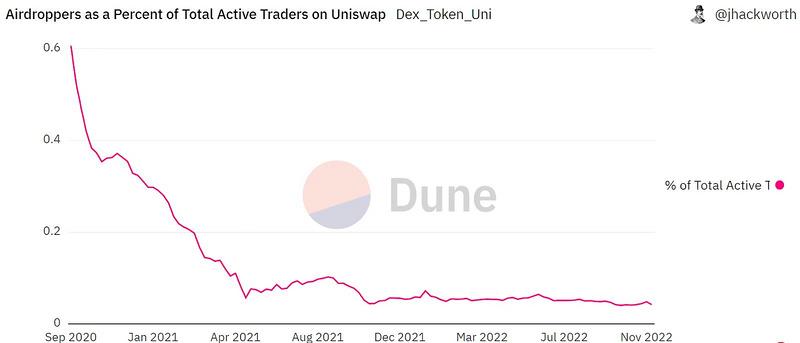
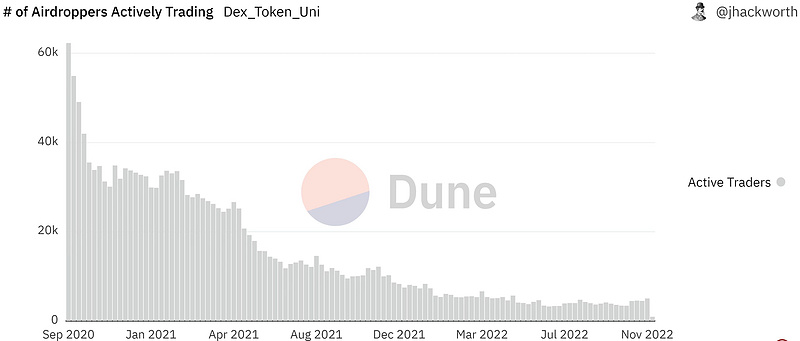
Due to explosive growth, the proportion of original users was small. In the weeks and months following the decline, the number of active airdrop traders decreased from over 62,000 traders per week in mid-September 2020 to about 10,000 a year later.
This situation persisted into 2022, dropping to only 4,000 by September.
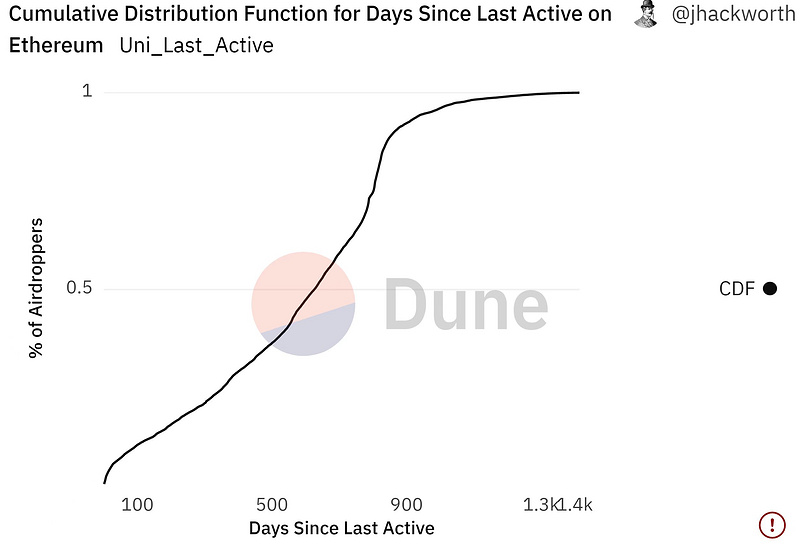
Upon further analysis, most of these wallets are inactive on Ethereum, with 50% not active in the past 610 days.
In the past year, only 25% of airdrop recipients have been active. The issue seems not to be how to get these airdrop wallets to contribute to Uniswap, but how to keep these wallets active on Ethereum.
If most of these wallets are inactive, with only 5% being active traders, how much of their trading volume do they account for?
Surprisingly, airdrop wallets conducted some large-scale trades, accounting for 15-40% of weekly trading volume among less than 10% of users. However, in August 2022, the situation changed, with the total number of users who received airdrops now being less than 4%.
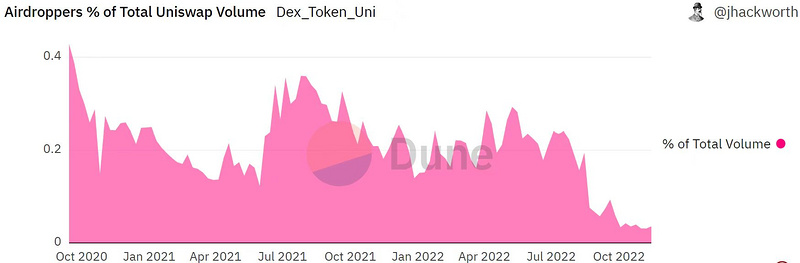
The most likely reason is the reduced activity of big-spending whales. The exact reason for these wallets stopping activity is unclear, but based on timing, it may be related to the merge. While airdrops seem not to have achieved high user retention, they did establish connections with some early users and rewarded them, who remain core platform users to this day.
Can we achieve such results through airdrops?
What About Non-Airdrop Wallets Holding UNI?
Most users who received airdrops neither held their UNI nor continued to use the protocol. They sold off at will. How did those who took over interact with the protocol?
Over 825,000 wallets that did not receive airdrops held UNI at some point. As the price of UNI began to rise, new wallets started buying frantically. At the peak in May 2021, 2.93 million new wallets purchased UNI.
However, as the price began to decline, the number of new wallets holding tokens also decreased. The price of UNI never rebounded. In 2022, only 1,500-3,000 wallets made their first purchase of UNI each week.
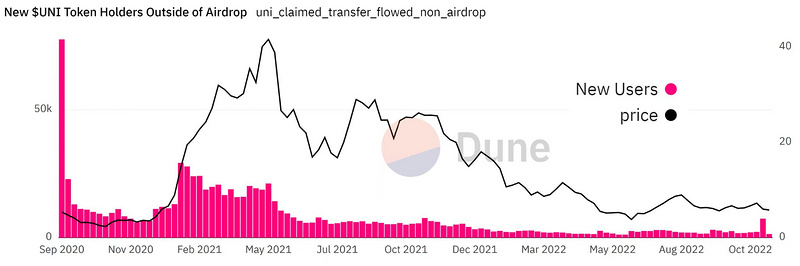
Thus, as prices fell, many crypto users began to lose interest. Would wallets that purchased UNI on the secondary market continue to hold their UNI? For most, the answer is no.
74% sold all their UNI. Interestingly, 26% retained their tokens.
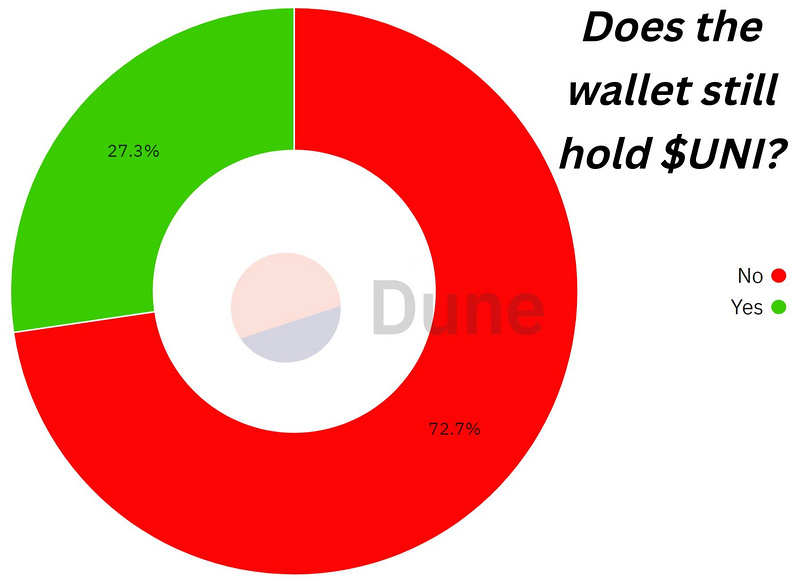
This is significantly higher than the proportion of airdrop wallets themselves (about 7%). This may be because secondary buyers view UNI as an investment, while airdrop recipients see it as "money falling from the sky." Many secondary buyers may have unrealized losses and are unwilling to sell, hoping to hold out for the next bull market of DeFi "blue chips."
Participation of Users Who Received UNI Airdrop in Project Governance
What is the value of these tokens? Some refer to them as "utility tokens," in this case, the utility is the ability of UNI holders to participate in protocol governance. One of the intentions of the airdrop was to decentralize the protocol and allow the community to establish a DEX. This gives early adopters some control over the future direction of the protocol.
Was the goal of governance through airdrops successful? According to the data, nearly 98% of users who received airdrops did not participate in the governance process at all. This is likely due to early sell-offs and a general lack of interest.
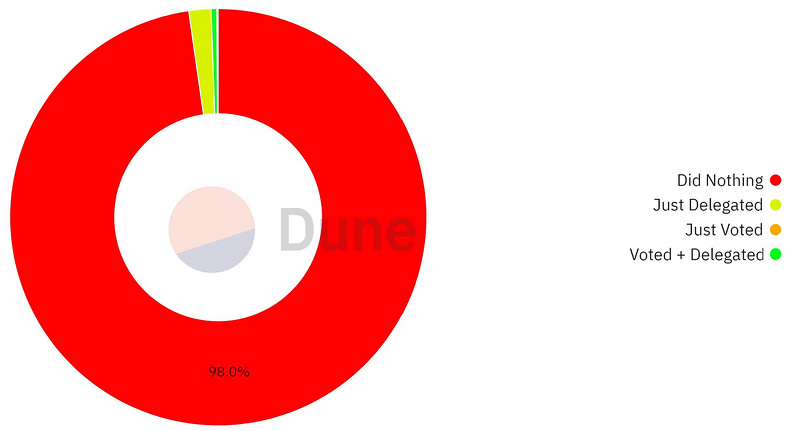
Nonetheless, some airdrop recipients still participated, sometimes accounting for up to 25% of the total votes. Thus, many of the airdrop whales directly engaged with the project, while retail investors were few.
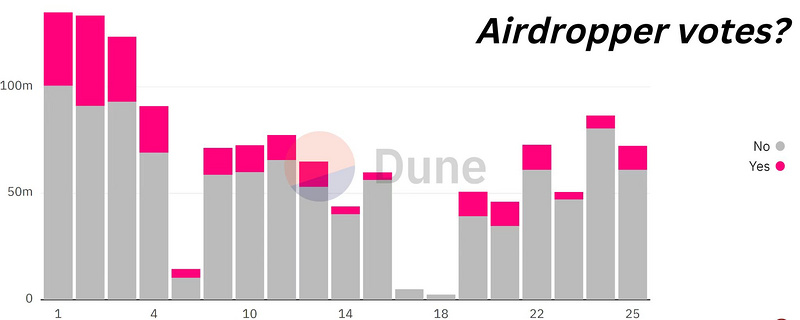
Wallets that did not receive airdrops also exhibited similar participation rates. Even among the top 5,000 wallets, only 15% participated in the governance process.
Therefore, in this case, the airdrop does not seem to have successfully "decentralized" the protocol by encouraging widespread user participation in governance. However, it did allocate power to early prominent users who were encouraged to participate in the future development of the project. Ultimately, it is not what UNI can do for the protocol, but what the protocol token can do for the users.
How Are Airdrops of Other Projects Performing?
Is it really bad that only 7% of users who received airdrops currently hold UNI? Are other projects' airdrops performing similarly?
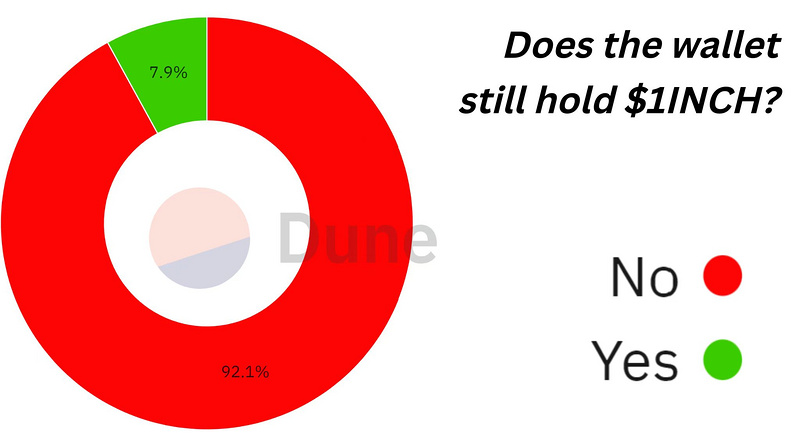
Airdrops that occurred within a similar timeframe to UNI also seem to show similar results. For example, only 7.9% of 1Inch airdrop wallets still hold the tokens.
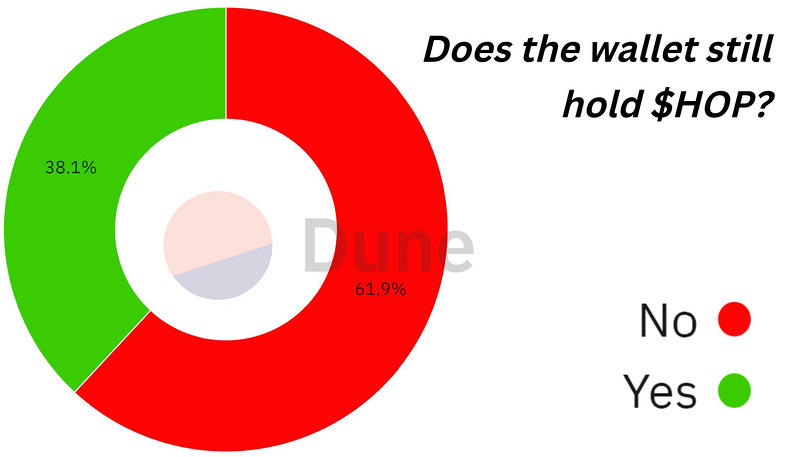
In terms of the most recent three airdrops, the situation seems to have improved. For instance, after the HOP airdrop, 38.7% of users still hold the tokens.
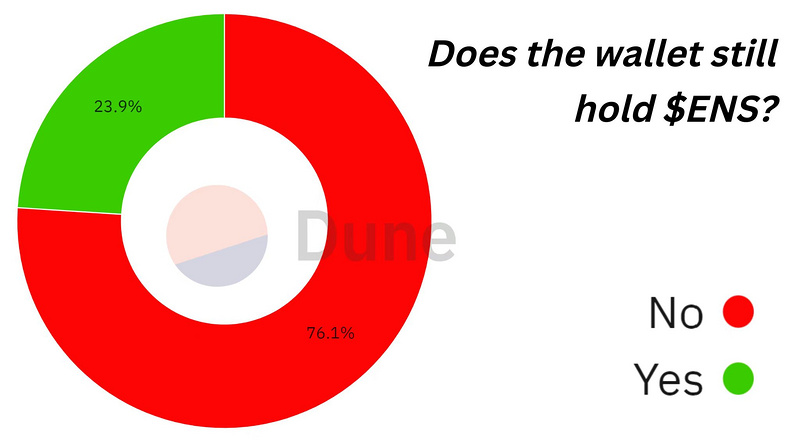
Next is ENS, with 23.9% of ENS airdrops still being held. Since HOP is the most recent airdrop, the holding proportion is higher.
LOOKS provided high-profile staking incentives but ultimately still saw an 85% sell-off rate.
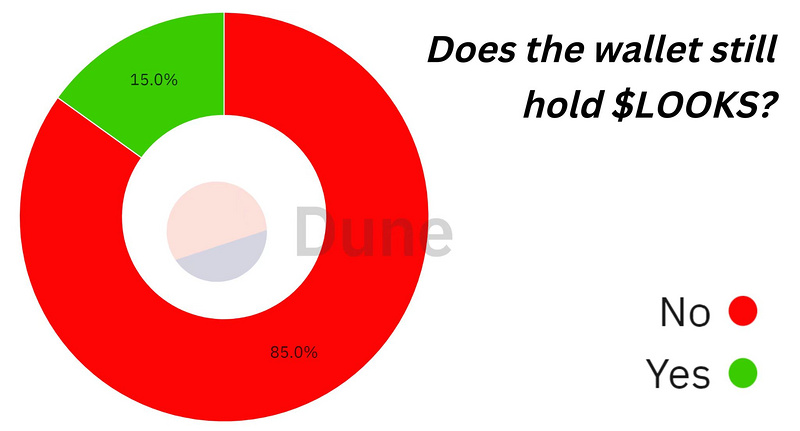
While some of these airdrop methods have improved, the trend of users selling airdrops continues. If compared on the same timeline, the user retention rate of these projects' airdrops may actually be lower than that of Uniswap. There are currently no significant examples of airdrop users still holding their tokens.
Is it because users do not value the utility of the tokens and see airdrops as just "free money"?
Flaws in the Airdrop System
The current airdrop system is flawed. From a marketing perspective, airdrops do help bring more users to the protocol and trade tokens after the airdrop. They helped Uniswap gain visibility a few years ago. However, when it comes to decentralization and democratizing the protocol through the distribution of governance tokens, it seems to fall short.
For UNI and most users, the ultimate choice is to sell the tokens and not participate in the governance process. They quickly sold off after the airdrop, which, from a profit perspective, is a poor decision.
Did the project team have too high expectations for the airdrop? Did the Uniswap airdrop prove this point—most people may just want a tool?
A small portion of airdrop wallets still play a significant role in protocol governance. They actively conduct large transactions on the DEX, have influence in governance, and represent some of the largest holders of the tokens. But these players are mostly whale players who have a significant impact across all areas.
If the true goal is decentralized governance, then we cannot call the airdrop a success. UNI is one of the first and largest airdrop projects, and the situation of other airdrop projects is not much better. The rampant farming and ubiquitous witch attacks further undermine the reputation of airdrops and increase sell-off pressure.
Each airdrop provides valuable lessons for the next one. With unprecedented transparency in on-chain data, these lessons are available for the entire community to learn from. They promote the iteration and improvement of the protocol on the current model. This not only helps the project itself but also better incentivizes community participation in decentralized and democratic governance.
 Risk warning
 Risk warning



Popular articles





