With the launch approaching, understand the core components of Polygon zkEVM in one article

 The consensus contract, zk Node, zk Prover, and zk Bridge work together to enable secure and decentralized transaction processing in Polygon zkEVM.
Original author: Salazar.eth
Original compilation: 0x11, Foresight News
zkEVM is considered the holy grail of Ethereum scalability. Polygon is one of the leading explorers in this field, with its zkEVM set to launch soon. Before that, you need to understand some information about Polygon zkEVM technology.
Polygon zkEVM is a decentralized scalability solution that uses zero-knowledge proofs (ZKP) to provide validity proofs for verifying transactions and achieving finality on Ethereum, while being an EVM-compatible scalability solution.
In this tweet, we will focus on these components of Polygon zkEVM:
Consensus Contract
zk Node: Synchronizer, Sorter, Aggregator, RPC
zk Prover
zk Bridge
Consensus Contract
Previously, Polygon Hermez 1.0 used Proof of Donation (PoD) as its consensus mechanism, which is a decentralized auction mechanism for coordinators to create transaction bundles.
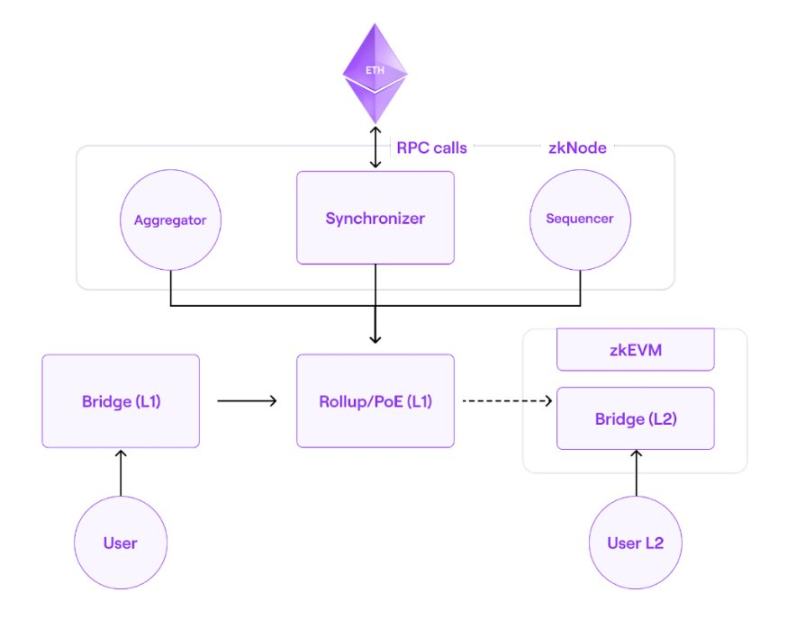
The latest version of the contract, PolygonZkEVM.sol, adopts Proof of Efficiency (PoE), which draws on the experience of PoD and supports multiple coordinators to create transaction bundles in a permissionless manner on L2.
The contract ensures decentralization, efficiency, protection against attacks, and a balance between verification work and network value.
On-chain data availability adopts a hybrid model, where data is stored off-chain and only validity proofs are published on-chain.
PolygonZkEVM.sol (deployed on L1) is used to ensure correct state transitions. The smart contract uses zk-SNARK circuits to verify validity proofs.
To perform the above operations, the participation of sorters and aggregators is required.
zk Node
Sorters propose transaction bundles, and aggregators validate them. The smart contract calls the sorter to receive transaction bundles and calls the aggregator to validate them.
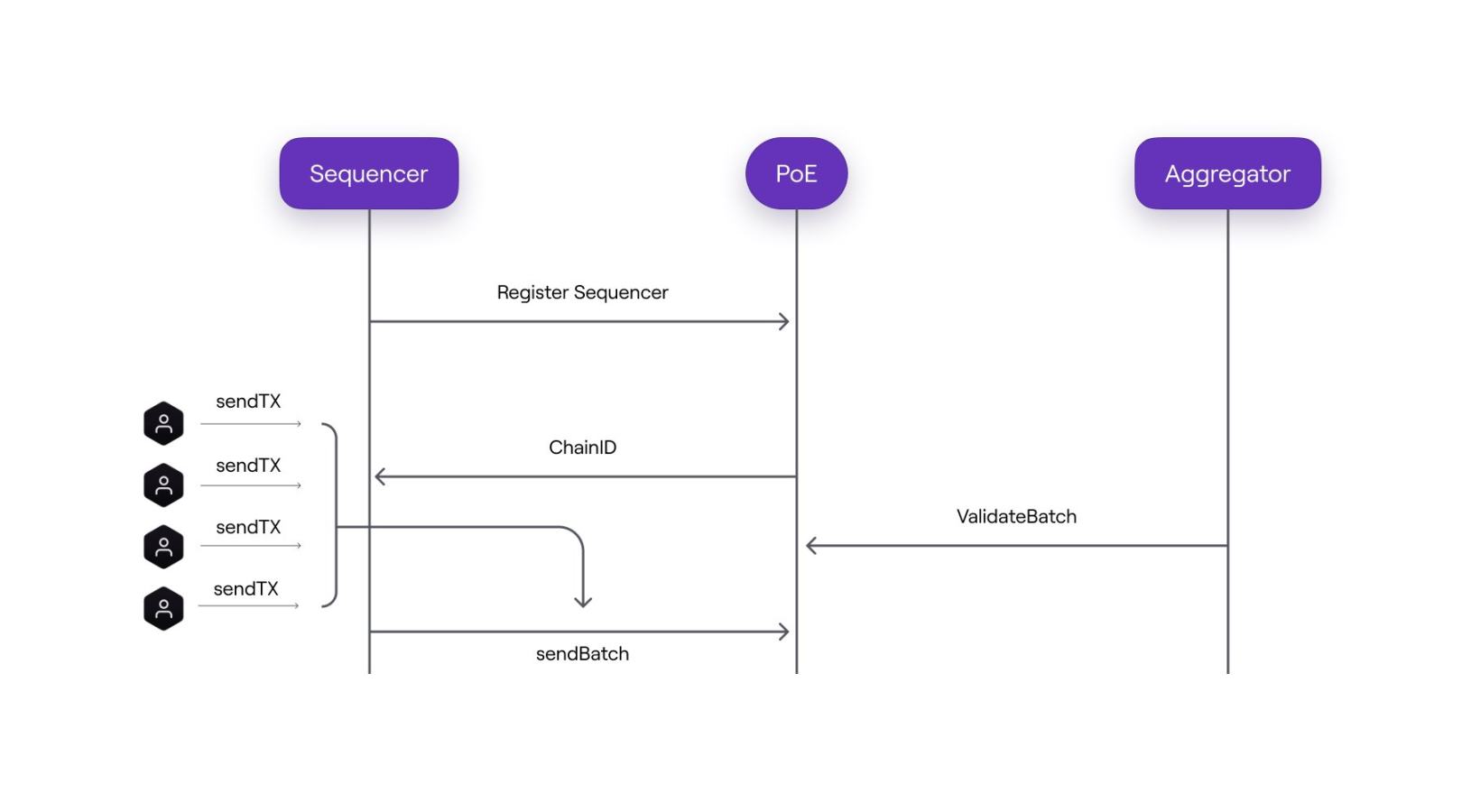
zk Node is the software required to run zkEVM nodes, managing the roles of participants in the Polygon zkEVM network. To track the network state, participants can be nodes or participate in transaction bundle production as sorters or aggregators.
Sorters preprocess L2 transactions, submit transaction bundles to the PoE smart contract, and pay fees. Aggregators receive transaction information, send it to the prover, receive zero-knowledge proofs, and send the results to the smart contract for verification.
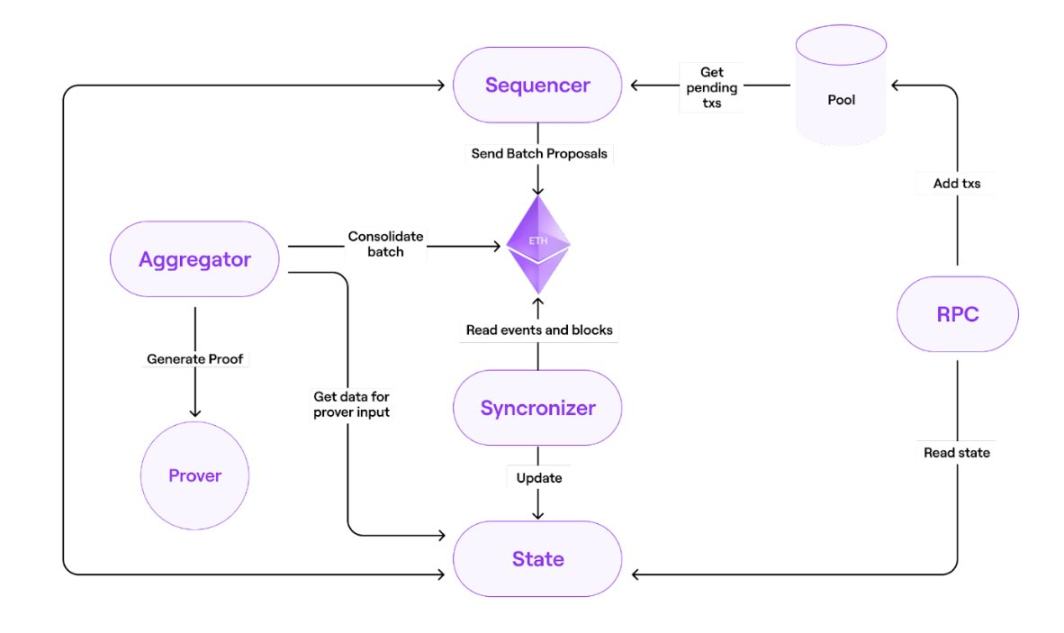
The synchronizer synchronizes transaction bundles and their validity proofs, while RPC facilitates integration with existing tools.
State implementation uses a Merkle tree to check block-level integrity and some transaction-related information.
zk Prover
zk Prover is a crucial component of the Polygon zkEVM architecture. It is responsible for generating zero-knowledge proofs to verify the correctness of zkEVM execution computations.
To generate zero-knowledge proofs, zk Prover receives inputs from the aggregator, which collects transaction information from the sorter. The proof is then sent back to the aggregator, which sends it to the smart contract for verification.
Given its high efficiency and scalability, zk Prover can process a large number of transactions with minimal latency.
zk Bridge
zk Bridge allows users to securely and decentralized transfer assets between layers LX and LY.
It consists of two identical contracts, one deployed on the Ethereum mainnet and the other on a specific Rollup network.
In the L1 contract, assets can be transferred between Rollups; while in the L2 contract, assets can be transferred between the mainnet and Rollups.
Through smart contracts, zk Bridge also supports local interoperability between different L2 networks.
Conclusion
In summary, Polygon's zkEVM is a promising solution that can improve the scalability issues of the Ethereum network.
By leveraging zk-SNARK circuits for validity and a hybrid model for data availability, it provides decentralization, efficiency, and protection against attacks while maintaining EVM compatibility. The consensus contract, zk Node, zk Prover, and zk Bridge work together to achieve secure and decentralized transaction processing.
As the launch approaches, Polygon zkEVM is expected to make significant contributions to the growth and adoption of Ethereum.
 Risk warning
 Risk warning