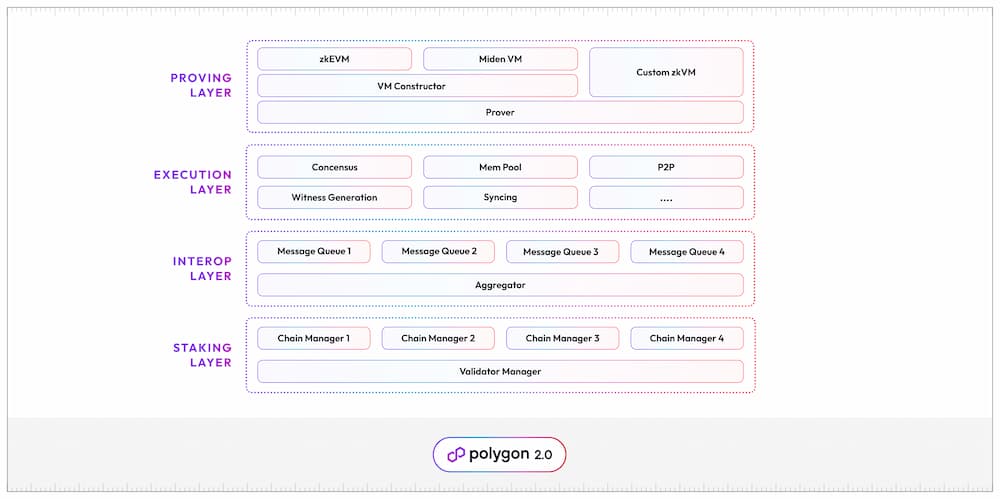
Polygon officially announces the Polygon 2.0 architecture
ChainCatcher message, Polygon has proposed the Polygon 2.0 architecture, aimed at providing infinite scalability and unified liquidity. The Polygon 2.0 architecture consists of four protocol layers: the staking layer, the interoperability layer, the execution layer, and the proof layer.
Among them, the staking layer is a PoS (Proof of Stake) based protocol that utilizes the native Polygon token to provide decentralization for participating Polygon chains, achieved through a universal, highly decentralized validator pool and a built-in re-staking model. The interoperability layer helps to achieve secure and seamless cross-chain messaging within the Polygon ecosystem. The execution layer enables any Polygon chain to generate ordered batches of transactions, also known as blocks. The proof layer is a high-performance, flexible ZK proof protocol that generates proofs for all transactions of each Polygon chain—both internal and external (i.e., cross-chain). (source link)

 Risk warning Risk warning