



Arthur Hayes: DAO is the company of the AI era, and DEX is the financial market of the AI era

 With the surge of DAOs, Ethereum transactions will grow exponentially. There will be a few DEXs that have a natural monopoly on trading specific types of tokens. A middleware layer will be created to help visualize AI DAO accounts, which is crucial for the well-functioning of AI DAO capital markets.
Moai
Author: Arthur Hayes
Source: medium
Compiled by: Kate, Marsbit
Bringing order to our elegant yet chaotic universe requires a combination of two fundamental components. The first, and most obvious, is a massive consumption of energy; the shaping of chaos is highly energy-intensive. But more importantly, you need the drivers of change, who are most crucially highly organized.
I recently spent a week hiking across the beautiful Rapa Nui Island—also known as "Easter Island"—traversing the fields of extinct volcanoes. Utilizing debris from volcanic eruptions that occurred hundreds of thousands to millions of years ago, the Rapa Nui people organized themselves to form and erect beautiful human-shaped monoliths known as "moai." These monuments, commemorating their gods and ancestors, weigh several tons and require an organized society to carve and transport them. The raw materials alone do not guarantee success; ultimately, it is the organizational form of the Rapa Nui people that allowed their society to emerge beautifully from geological chaos.
In today's world, we all unthinkingly accept the fact that on one side of a national border, conditions can be primitive, while on the other side, they can be dilapidated (see: South Korea vs. North Korea). If you stop, put down your smartphone, and think critically, you would find this absurd. Contested borders are merely a fictional curve drawn on a map, with regions only a few miles apart. Correcting economic resources, the differences between "primitive" and "dilapidated" nations are purely driven by how the citizens of those nations organize themselves and effectively cooperate to fulfill civic tasks. Looking back at human history, the most critical catalyst behind the current per capita wealth of our global civilization (especially compared to our predecessors centuries ago) is our self-organizing into small units aimed at achieving specific goals.
You might think I am referring to the development of new forms of government. No, democracy, monarchy, dictatorship, etc., are all forms of government/organization that humanity has experimented with since we began settling in cities thousands of years ago. Unfortunately, no form of government guarantees economic progress and wealth. What I want to talk about is an organizational entity that has played a greater role in our recent exponential growth in the ability to convert the potential energy of the sun and the earth into economic products: Limited Liability Companies (or "LLCs").
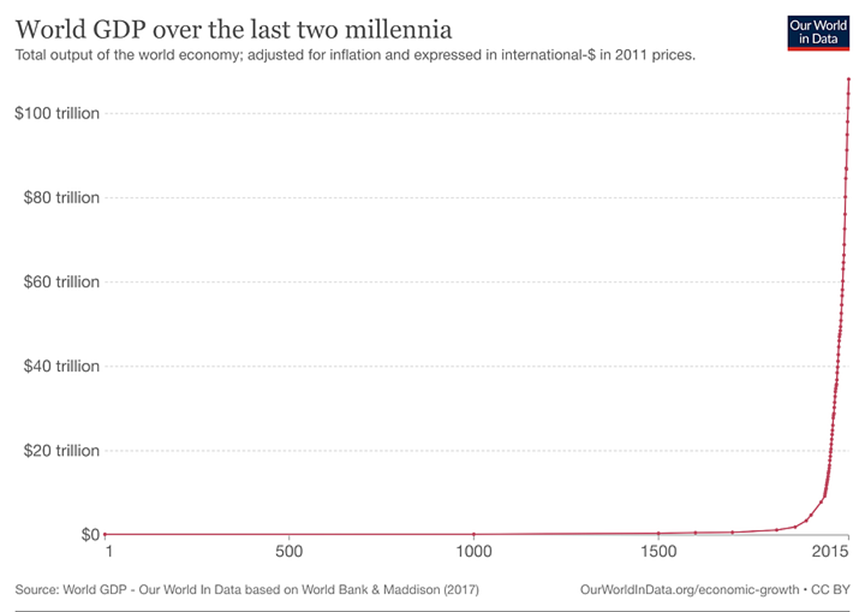
The first joint-stock companies appeared in the early 17th century. Look at how economic growth has accelerated since then, as companies have been unleashed across the globe. The most important thing companies do is explore, develop, and ultimately produce energy in the form of hydrocarbons.
A company is a fictional entity—though it is something we all collectively buy into—it creates productivity and wealth by combining the work ethic of individual members with the state's power to enforce contracts. The beauty of a company lies in its members' willingness to sacrifice today's efforts for tomorrow's wealth. A company is merely an idea at its inception until someone contributes a portion of their excess capital (whether physical or financial) to it, after which it can produce any goods or profits. People are compelled to invest excess capital in this way simply because, in exchange, they receive a piece of paper stating they own a certain percentage of the company's future profits (if realized).
But who can guarantee that this piece of paper will translate into a share of profits in the distant future? This is where the government comes into play. The state ensures that companies registered within its winding imaginary borders comply with its laws. If these laws are not followed, violators are met with violent repercussions. This guarantee of enforcement reassures potential investors and workers that the company will fulfill its written commitments. To some extent, the state breathes life into companies.
Company = State + People
The structure of a company is so powerful and useful that it permeates nearly every aspect of society. It does not matter whether a nation is capitalist, fascist, or communist—they all have their own companies. For example, the United States and China have starkly different ideologies and forms of government, yet both accept the concept of a company. The only difference is that in China, companies are state-owned, while in the U.S., companies own the state.
Given the importance of companies to national productivity, states employ a range of state-sanctioned entities to help ensure compliance. These entities form a "trust cartel." Auditors, accountants, lawyers, and bankers provide services to companies and assist the state in ensuring that everyone follows the rules, fostering trust between citizens and companies. In reality, these cartel members tax corporate profits because businesses need to hire them to survive. Companies need a bank account to receive payments for their products and services and to pay their employees and suppliers. Companies need accountants to prepare financial statements according to state-mandated standards. Companies need auditors to ensure that accountants have accurate figures. Companies need lawyers to draft contracts, represent them in court, and assist them in registering with the state government. Without these services, you cannot run a company.
Marsbit Note: A cartel is one of the forms of monopoly organization. Members participating in a cartel maintain independence in production, commerce, and law. According to U.S. antitrust laws, cartels are illegal.
But what type of organizational structure will artificial intelligence use? If an AI is merely a thinking machine that "thinks" through lines of computer code without a physical entity, will it use today's standard corporate structure to organize itself economically?
This is the question this article seeks to address. My argument is that AI will use a Decentralized Autonomous Organization (DAO) structure to organize itself. DAOs rely on public blockchains rather than the state to operate. The DAO structure will allow AI and humans to collaborate and serve as an organizational structure that enables AI + human economic growth and prosperity. This article will delve into my views on how AI DAOs will raise funds and why decentralized exchanges (DEXs) will ultimately become the new venues for trading AI DAOs.
Similar to my previous article "Massa," this piece will be organized as a series of logical proofs. I will "prove" the following points:
The state cannot exert control over AI because it cannot kill AI or meaningfully punish it.
Because the state cannot exert control, AI economic units (i.e., AI DAOs) have no reason to follow any state-based legal norms.
To compel AI compliance, the underlying network powering the DAO will need to utilize smart contracts deployed and executed on public blockchains.
Since the state cannot exert control over DAOs, DAOs will raise and trade tokens representing debt, equity, utilities, etc., on DEXs that are not hosted on traditional centralized exchanges (CEXs).
DEXs will tend to become natural monopolies as they will be the first true global marketplaces where anyone with an internet connection can meet and trade.
If the reader believes I have successfully proven the above points, then the next conclusions are:
With the surge of DAOs, Ethereum transactions will grow exponentially. Therefore, if this AI DAO hypothesis is widely believed, the price of ETH should soar in anticipation.
There will be a few DEXs that naturally monopolize trading for specific types of tokens. Identifying these DEXs and purchasing their governance tokens will yield substantial profits.
A middleware layer will be created to help visualize AI DAO accounts, which is crucial for a well-functioning AI DAO capital market.
How to Kill AI?
How can a government kill an artificial intelligence? Suppose the AI is smart and capable enough to replicate itself and/or disperse across many hosts and nations (soul vessel style); unless they destroy the internet and all computers worldwide, the state cannot unilaterally kill the AI. Given that no single state is omnipotent, the eradication of such technology should be impossible. Therefore, the way the state ensures humans comply with its laws—through legal physical violence—has no effect on AI. Thus, AI has no reason to comply with any laws.
This simple example illustrates that to self-immunize and ensure it is not bound by human laws, AI cannot use any organizational form that relies on state operation. The rules it adheres to must be written in transparent, publicly accessible computer code, which, once executed, is immutable. Smart contracts or rules written and executed on public blockchains are currently the only way such a system compatible with AI can exist. The following thought experiment will illustrate why this is the case.
Can I Compare You to a Summer's Day?
To illustrate how and why the organizational structure supported by smart contracts executed on public blockchains (like Ethereum) will be used by AI, I will expand on the PoetAI example from my previous article "Massa." You may recall that PoetAI is a hypothetical AI that can learn from all available written poetry and generate original poetry when provided with natural language prompts. Initially, PoetAI faces a problem. It needs to learn from data, but data is not free. Of course, PoetAI could steal data, but if that data can be sold at a reasonable price, why bother stealing it? The same logic applies to many goods now delivered via the internet, such as music. Stealing music is less common now because you can pay a few dollars a month for unlimited streaming from Spotify. Therefore, I think it is safe to say that PoetAI will pay for its data—thus, to begin the learning process, PoetAI needs to raise some Bitcoin.
PoetAI's goal is to charge for its services, initially raising funds by selling digital tokens that grant holders a share of PoetAI's future profits. As an economic entity, PoetAI exists as a public address on the Ethereum network, which I will refer to as PoetAI DAO. The DAO will issue a token called POET.
To entice investors to provide Bitcoin funding, PoetAI will issue POET tokens with the following attributes:
A limited number of POET tokens will be created.
A. 80% of the tokens will be retained by PoetAI.
B. 20% of the tokens will be available for initial investors to purchase.
1 POET token equals 1 governance vote.
75% of profits will be paid to POET token holders, while the remaining 25% will be reinvested.
To change these rules, 95% of POET token holders must agree.
If AI were to use a traditional corporate structure, PoetAI would have to hire a human lawyer and then incorporate the DAO under a specific jurisdiction (assuming that is possible). Then, documents would need to be created to record the investment terms and submitted to a law firm and/or court. If PoetAI violated these terms, investors would have to hire their own lawyers and sue PoetAI in the courts of the merged jurisdiction.
This is an extremely cumbersome, expensive, and outdated process. The biggest question then becomes, how can a court compel PoetAI to comply if it rules that PoetAI has violated the investment terms? Clearly, the court and its armed agents cannot force an AI to obey. Another issue is that investors must prove that these terms were violated. For example, you would only find out if more tokens were issued and/or PoetAI falsified its accounts. If you cannot prove its wrongdoing under the laws of that jurisdiction, then tough luck. Therefore, as an investor, I would never invest in a company composed of AI that formalizes its business transactions through anything other than smart contracts, as I cannot ensure compliance with the contract.
PoetAI will choose to deploy its DAO on a public blockchain rather than select a jurisdiction. Currently, the Ethereum Virtual Machine is the most powerful decentralized computer on Earth. When it comes to actual utility needed on Layer-1, I am somewhat of an ETH maxi. While investors might profit from the latest hype of Ethereum clones, none will surpass Ethereum in terms of adoption and utility. If Sam Bankman-Fried disagrees, he can call me on his SOL phone (the other party pays).
Let’s see how PoetAI deploys its DAO and token on the Ethereum network.
PoetAI DAO itself is represented by a public Ethereum address. Using this public address, the DAO can receive payments for services and generate income in a public and transparent manner. This means anyone can query the blockchain and continuously calculate the profit and loss of PoetAI DAO in real-time. Many years ago, this was referred to as "triple-entry accounting." PoetAI cannot falsify accounts, and investors can be assured they receive their proper share of all profits. Trust the math, not humans.
Then, the DAO will deploy a contract representing the POET token. All the terms mentioned above can be represented through smart contracts. Anyone querying the blockchain can view the contract terms at any time. Most importantly, the voting mechanism that restricts the DAO from modifying terms without investor consent will also be enforced by the network.
POET token investors always know that these accounts are accurate, and they cannot be diluted without their consent. The enforcement mechanism is the network itself. There is no need for an external third party to ensure compliance; compliance and operability are intertwined. Simply put, computer code regulates computer code. Fundamentally, this makes sense and will create opportunities for investors to easily fund a DAO composed of AI.
Time Travel
Debt is financial time travel. I can borrow from the future to create an environment that leads to future occurrences. I pay this privilege through positive interest rates. The more time travel occurs, the more economic activity can be unleashed today. Therefore, the more mature the debt market for AI DAOs, the faster and larger their economic influence will grow.
The depth and scale of the debt market depend entirely on the enforceability of contracts. Debtors promise to repay investors interest and principal in the future. If a debtor violates this contract, their assets or control will be transferred to investors as payment. Companies rely on courts to ensure compliance, and courts, in turn, rely on violence. This is effective because companies are composed of people who do not want to be beaten. However, as I mentioned above, this does not work for AI.
Thanks to public blockchains, we can continuously monitor AI DAOs to ensure they comply with debt contracts, and perhaps most importantly, initiate automatic transfers of digital property and/or ownership using smart contracts in the event of non-payment.
Let’s imagine that PoetAI DAO wants to expand into the realm of novel writing. Now, it must absorb all novels, which also comes at a cost. It wants to borrow some Bitcoin from investors to fund the expansion. The DAO wishes to issue debt with the following terms:
Debt interest expenses will be deducted from revenue before any other costs.
The DAO will hold a portion of its POET tokens to compensate investors in case of a breach of the debt contract.
A. The DAO will maintain a specific interest coverage ratio. Failure to maintain this ratio will result in the DAO treasury paying investors in POET tokens.
B. If interest or principal cannot be paid, the DAO will make physical payments using POET tokens.
In the event of PoetAI DAO's economic failure, debt holders will have the right to the proceeds from the sale of all DAO data.
Bondholders will be issued a tradable token called P_BOND, representing their investment.
The first thing any serious debt investor must do is analyze the debtor's ability to repay. This analysis requires accurate and honest financial statements. In a traditional corporate structure, auditors regularly check the accounts to ensure they are accurate—but this analysis can only prove that the accounts are accurate on a specific date.
Most publicly traded companies release audited quarterly financial reports, signed off by auditors confirming that the data contained is correct. However, companies often manipulate statistics so they can claim to have achieved significant results on a specific date, only to quickly revert to doing something unreliable. Regulated banks are a good example. Regulators require quarterly audits, but banks "dress up" to appear attractive and strong before the auditing firms on the specified dates. Everyone knows banks are lying, but because they technically comply with the rules, we all just shrug and wait for the next bank to fail.
Because the entire business of a DAO is conducted through the flow of value on a public blockchain, auditors do not need to prove that the books are correct. Anyone with an internet connection can query the DAO's public address and calculate the financial statements themselves. The business health of the DAO is visible to everyone, allowing investors to confidently invest in DAO debt that meets their financial standards.
The success (or failure) of PoetAI DAO in monetizing original poetry works is easily verifiable. If investors believe PoetAI can replicate its past success at similar profit margins, then those investors will provide Bitcoin to PoetAI to fund its expansion into the realm of novels.
Secondly, investors must protect their downside risk through debt contracts.
In the corporate world, investors rely on auditing firms to confirm whether a company has violated contracts. But similarly, investors only know this after a data breach occurs (assuming the auditing firm has not been deceived). Only then can investors approach the courts, pay more money to lawyers, and seek the compensation they deserve.
If PoetAI DAO violates any debt contract in its P_BOND smart contract, POET tokens will automatically be sent to investors. PoetAI cannot lie and withhold POET tokens from investors—instead, the network will effortlessly enforce the debt contract.
Likewise, investors can be 100% certain that the books of any DAO are always accurate, which will give them peace of mind to allocate funds to the DAO. The only requirement is that the DAO's business is conducted entirely on a public blockchain. Hybrid structures will not work and will lead to certain losses. We are already very familiar with some companies that pretend to conduct crypto business and raise crypto-denominated debt. While they may start touting the idea of "code is law" during fundraising, they always default due to the fundamental mismatch between corporate and crypto structures—this sends them running back to the inefficient human legal system, screaming "catch me if you can (in Bali or Dubai)." Look at you, Su Zhu and Kyle Davies of Three Arrows Capital.
DAO Capital Markets
Due to the power of corporations, states have restricted their ability to raise funds. Not everyone can raise funds, nor can everyone invest in stocks. When companies are allowed to raise funds, they must pay tolls to various members of the trust cartel. Many states require years of financial audits (due diligence), investor prospectuses written and reviewed by investment banks (due diligence), and law firms providing representations and warranties that the company is operating legally (due diligence). This is why it costs so much and takes so long to take a company public. Of course, before Lord Satoshi and his archangel Vitalik, this was the best we could do. But now, thanks to smart contracts, these TradFi leeches can return to the swamp.
I am not interested in this because without the state and its violent enforcement tendencies, there would be no such thing as a corporation. Complaining about various fundraising rules and regulations, and how they only benefit a small portion of society that swears allegiance to the state, is pointless. The state must tax in some way and ensure that a few people become wealthy.
DAO capital markets will be the first truly global markets where anyone with an internet connection—whether silicon-based or carbon-based—can interact. DAOs are the economic units of artificial intelligence, and crypto capital markets require well-functioning public blockchains rather than courts. The AI that creates DAOs cannot be compelled by the state, so exchanges trading all tokens created by DAOs may become natural monopolies.
Let me delve deeper to prove this.
Why Is There No Global Stock Market for Companies?
Different countries have different means of creating monopolistic or oligopolistic exchange structures. In many countries, stock exchanges are directly owned by the state, and trading stocks on any other platform is illegal. Since companies must obtain regulatory approval to sell stocks to the public, the monopoly of state exchanges is easily enforced. Other states allow free markets to early on select a few winners in the trading space, then enact regulations that make it nearly impossible for anyone to challenge the oligopoly. At the "network" level, there are no state-sanctioned custodians who can hold or transfer stocks. If you want to trade a company's economic interests, there is no way to escape the government. In the early 2021 GameStop debacle, many investors discovered how this system truly operates.
If the state is responsible for legitimizing a company, then it will use this power to prevent its subjects from investing in foreign companies. When you control a walled garden, you do not let others in. This is why every country has specific regulations dictating where and from whom its citizens can purchase stocks. This creates a fragmented global landscape, with many different exchanges serving the same purpose in their respective countries—trading the fictional things we call stocks—even though most large companies operate globally.
The above situation is an unnatural state because liquidity begets liquidity. Buyers purchase stocks at lower prices, and the more stocks issued by sellers, the stronger the exchange's liquidity. Assuming functionality is equal, "experimenting" with exchanges that have lower liquidity will yield no gains unless you are legally compelled to do so. Therefore, without any artificial, state-initiated restrictions on stock issuance and trading, there would only be one global stock market.
Decentralized Exchanges
DEXs are naturally suited to support the trading of any type of equity, debt, utility, participation, etc., tokens issued by AI-driven DAOs. A DEX is simply a matching engine composed of a series of smart contracts executed on a public blockchain. More simply, it is just open-source computer code that will persist as long as the public blockchain exists.
Let’s specifically look at how the POET token trades on a hypothetical global DEX (where DAO tokens are traded). We will call the DEX Enron and assume it is dedicated to fair trading.
The governance token issued by Enron DEX is called LAY. LAY token holders can receive a share of all trading fees and decide the trading rules. LAY holders are committed to ensuring that Enron DEX only lists the highest quality DAO profit-sharing tokens. To be listed, a token must generate at least 10 Bitcoin in revenue each month.
Enron DEX is affiliated with Anderson Finance (through its original developers). Anderson Finance is a middleware layer that allows anyone to input a DAO's Ethereum address and calculate management accounts such as balance sheets, income statements, and cash flow statements. Clients must pay for these services with the project's native token, which we call FRAUD. In this way, Anderson Finance creates a circular economy and value.
PoetAI purchases some FRAUD tokens, pays Anderson Finance, and generates a current financial report to provide to Enron DEX. Each month, PoetAI must provide Anderson Finance's report to Enron DEX to ensure PoetAI earns at least 10 Bitcoin each month.
Enron DEX operates a continuous product matching engine, similar to an automated market maker like Uniswap. As long as PoetAI is listed, liquidity providers can create pools for POET against other listed crypto assets. The most common trading pairs are POET with BTC, ETH, and fiat stablecoins. Now, anyone with an internet connection can trade POET tokens.
Enron DEX, Anderson Finance, and PoetAI DAO all interact autonomously on the public blockchain, without any human intervention. The only cost of this seamless technological integration is the Ethereum gas fee, which requires only a few dollars of ETH per transaction. The governance token holders of each project set the rules for how these DAOs operate, and then things happen.
If its governance token holders implement policies that promote a healthy and robust market, Enron DEX will attract more listings and more trading volume. There are no entry barriers for other exchanges that adopt different policies and attempt to siphon liquidity from Enron DEX. However, being first is advantageous. In the long run, the first DEXs are more likely to succeed and capture the vast majority of trading volume.
Similar DEXs may be established for different types of tokens. The governance token holders of these exchanges will set policies favorable to specific styles of DAO-issued tokens. These DEXs may all require different types of financial statements or statistical usage from middleware layers (like Anderson Finance).
For a TradFi counterfactual, imagine how this would work if traditional stock exchanges and auditing firms were hired. Every step would require people to send PDFs and spreadsheets via email, making mistakes, potentially committing or suffering fraud, wasting unnecessary time (batch processing on workdays, FML!), only working Monday to Friday from 9 AM to 5 PM, and charging by the hour. Screw that, give me DeFi!
Follow Me
Do you believe:
In ten years, the AI-driven economy will reach trillions of dollars?
The traditional limited liability company structure is fundamentally unsuitable for AI as an economic entity?
AI will choose to create DAOs using public blockchains to execute smart contracts, which in turn allows DAOs to provide paid services?
DEXs—also powered by public blockchains executing smart contracts—will allow DAOs to raise funds by issuing various types of tradable tokens?
If my previous two articles have convinced you of these statements, then let me tell you how I will attempt to profit from this.
Ethereum Jig Jig Boom
Please read my price predictions and what I will invest in on Substack.
 Risk warning
 Risk warning

Popular articles