RWA DeFi will open new growth points for on-chain finance

 With the development of DeFi, we expect "real-world DeFi" to take up a larger share in DeFi.
Article Authors: TIOGA CAPITAL, TZEDONN, MICHIEL LESCRAUWAET, NICOLAS PRIEM
Original Compilation: Block unicorn
If software is eating the world, then cryptocurrency is eating the capital markets.
Tokenization is not a new concept; startups, banks, and stock exchanges have been exploring this idea since before 2017. However, the current moment presents an unprecedented opportunity for mass adoption. With stablecoins proving their efficacy as a medium of exchange and the DeFi infrastructure demonstrating its reliability after the DeFi summer of 2020, we stand at the forefront of a massive inflow of real-world assets onto the blockchain.
In the Web3 space, RWA refers to "real-world assets" such as equity, debt, and real estate that are tokenized. This should not be confused with "RWA" in traditional finance, which stands for "risk-weighted assets."
In fact, stablecoins currently account for 0.7% of the U.S. M1 money supply (approximately $130 billion), while the total M1 money supply is $18.6 trillion, with a peak market share of about 1.0%. In comparison, Tesla currently holds a market share of 0.63% in the U.S. automotive market.
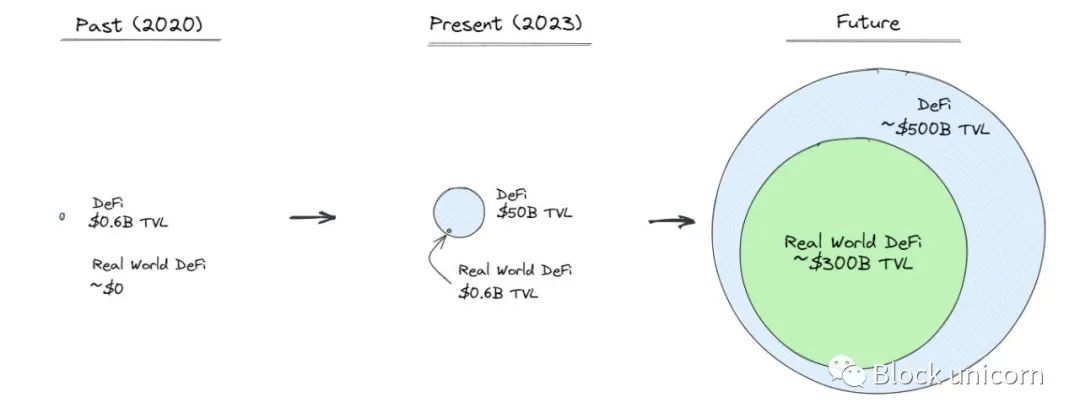
On the other hand, the total value locked (TVL) in DeFi surged from just $6 billion in 2020 to approximately $50 billion today, an astonishing 80-fold increase. This remarkable performance has outpaced the 8-fold increase in Ethereum's price.
During the market turmoil of 2022, centralized finance (CeFi) platforms like FTX, Celsius, BlockFi, and Voyager Digital faced failures, while DeFi demonstrated strong resilience. DeFi protocols—including Aave, Compound, Uniswap, and MakerDAO—operated seamlessly around the clock, showcasing the effectiveness of DeFi.
Thus, we are ready to welcome an era that brings traditional financial assets onto the blockchain. With the development of DeFi, we expect "real-world DeFi" to occupy a larger share within DeFi.
Three Arguments for Real-World DeFi
1: Real-world DeFi allows you to unlock all financial assets and use them as collateral for any DeFi application.
In traditional finance (TradFi), obtaining a loan secured by equity is a long and arduous process involving multiple parties. It begins with your equity custodian sending a PDF to the bank to verify that you own assets in their isolated database. The bank then guarantees your loan, the custodian transfers your equity to the bank, and you receive a cash transfer. Finally, the loan terms are manually assessed to check for any violations, all of which takes several days.
These high operational requirements and costs mean that typically only banks can offer such services to high-net-worth clients.
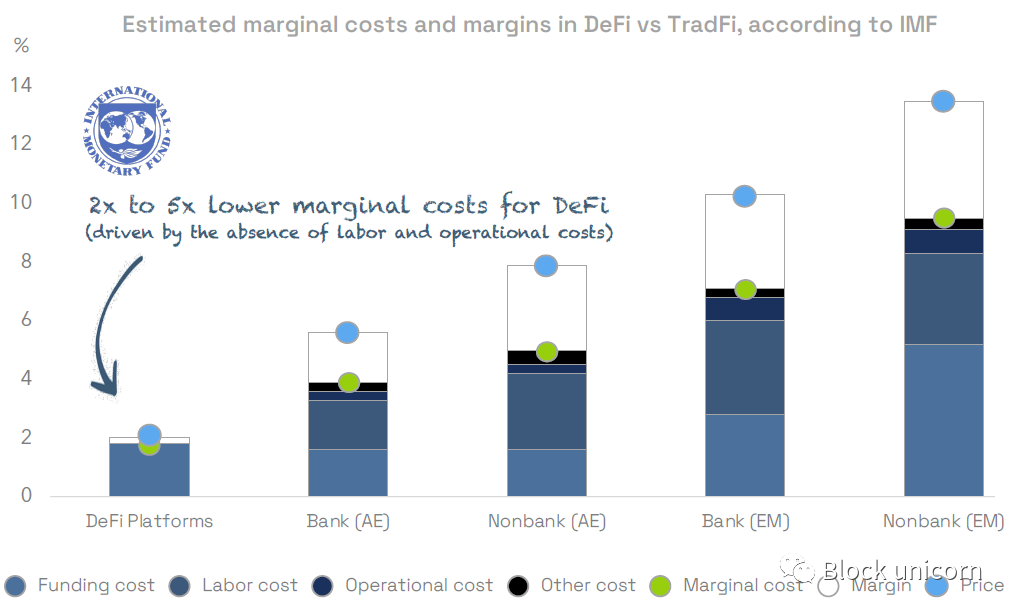
More generally, the International Monetary Fund estimates that the marginal cost of DeFi platforms is reduced to about 2 times compared to banks and non-bank institutions in advanced economies, and about 4-5 times compared to emerging markets.
In real-world DeFi, this process takes just seconds. You press a few buttons, your equity tokens are cryptographically verified on a public blockchain, and then collateralized through smart contracts, with transactions settling instantly. You receive digital cash (stablecoins) immediately, and the loan terms are executed via code.
Moreover, in a world where one can control all tokenized assets (fiat, equity, real estate, art, etc.) through a wallet, this unlocks a diverse range of potential collateral, improves liquidity through global and round-the-clock trading, automates portfolio management, and more.
Take PV01 (a Tioga portfolio company) as an example; they are exploring tokenized bearer bonds issued on-chain. These bearer bonds will be natively composable on the blockchain, allowing users to easily use them as collateral.
From the entrepreneur's perspective, DeFi enables developers to access a global customer base from day one. Entrepreneurs can also leverage existing DeFi infrastructure, which is essentially a natively open API. For customers, low switching costs drive competition among entrepreneurs, leading to the development of the best possible products.
Interestingly, as interest rates rise, ING Bank's profits have increased nearly fourfold, while they continue to pay depositors a 0.75% interest rate, whereas the yield on Euro government bonds is 3.4%. However, this is an extremely profitable business for ING Bank due to high switching costs. Banks are sticky and tend to offer the best rates only to their high-net-worth clients.
DeFi presents an alternative where you can switch from one service to another with just a click, without any restrictions. Additionally, DeFi makes a clear distinction between cash (no credit risk) and savings accounts, ensuring that private losses arising from banks taking on excessive risk do not need to be socialized afterward.
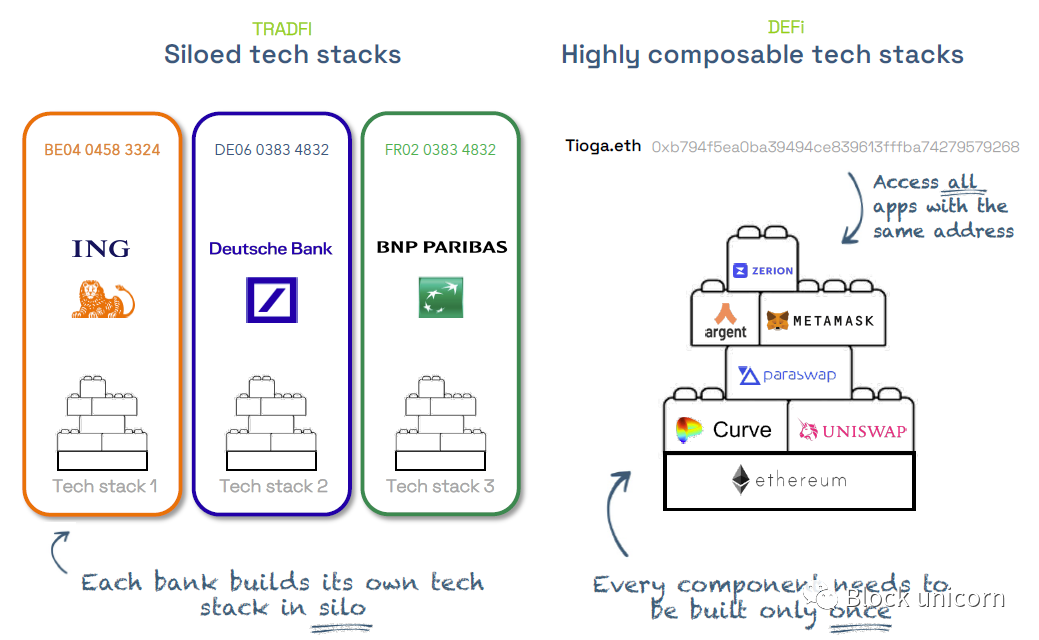
While traditional finance (TradFi) operates in isolated tech stacks, entrepreneurs can leverage the natively interoperable DeFi infrastructure.
2: Real-world DeFi provides a seamless channel for financial products for everyone.
Today, anyone can start their own private credit fund due to the efficiency gains from DeFi applications (like Maple or Atlendis, which are part of the Tioga portfolio) running on the blockchain.
For established companies like Blackstone (with a 35% operating profit margin) that already have economies of scale, these backend cost savings may be minimal, but emerging private credit funds can leverage DeFi infrastructure to increase their operating profit margins from about 20% to 35-40%.
In the words of Jeff Bezos, "The profit margins of traditional finance are the opportunities for DeFi."
If you are Argentine, due to the rapid devaluation of the Argentine peso, you do not need to wait for banks to "support the dollar" or allow you to buy dollars at the "official exchange rate." You simply deposit any tokenized currency (like USDC) directly into your wallet.
Banks and brokers can no longer act as gatekeepers for financial products, as consumers are no longer confined to their systems. Instead, they can leverage the range of tokenized financial products to make their own decisions.
Real-world DeFi allows you to search for the best interest rates within DeFi, thanks to its native composability and the universal verifiability of assets. Unlike in the past, where one had to open accounts at each bank and then use their respective isolated systems to apply for loans or purchase financial products, now anyone with internet access can obtain any financial product.
3: Self-custody reduces counterparty risk, and transparency enhances risk management.
Self-custody is a safeguard against counterparty risk. Although self-custody may still seem daunting at present, account abstraction, social recovery, and hybrid recovery methods will make the experience not much different from current bank logins.
During the banking crisis at Silicon Valley Bank (similar to Lehman Brothers in 2008), there was almost no transparency. No one really knew if they were healthy, risks could not be monitored, let alone externally verified.
Today, if Silicon Valley Bank operated on the blockchain, we would have complete transparency regarding their assets and liabilities, and we could create Dune dashboards to "monitor the chain." We could also monitor liquidity through risk management suites like Chaos Labs from Tioga portfolio companies.
The collapse of Terra is a good example. Due to the drop in Luna's price, the Anchor Protocol experienced a bank run. While during the 2008 Lehman Brothers collapse we were left in the dark, now we have transparency on-chain every minute, with retail users having access to the same information as institutions to make optimal decisions. But where are we now on the adoption curve?
The Trojan Horse of RWA DeFi—Private Credit and Government Bonds
At the beginning of 2020, the total value locked (TVL) in DeFi was about $600 million, which then soared to over $150 billion. Currently, the TVL in DeFi is stagnating around $50 billion.
DeFi in 2020 is akin to today's on-chain real-world assets (RWA DeFi). Currently, its TVL has reached a historical high of $600 million, with $340 million coming from private credit and $260 million from on-chain government bonds.
DeFi was able to take off due to a unique combination: the liquidity tide brought by COVID stimulus checks, the time people had to experiment during the COVID outbreak, and new crypto primitives (like AMM, liquidity mining) that were ready for alpha testing.
We believe that today's $50 billion TVL provides strong evidence that DeFi can serve as a blueprint for the next paradigm shift in the financial industry.
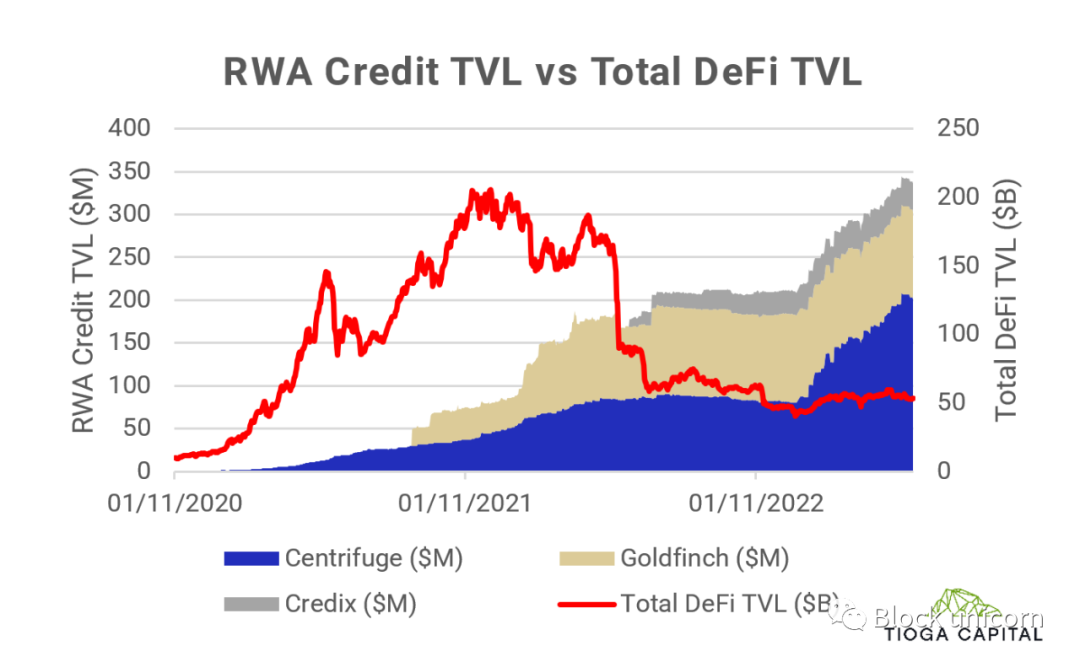
The stable growth of RWA credit is unrelated to the fluctuations in cryptocurrency prices, indicating that blockchain technology does not have to be used solely for speculation but can simply serve as a technology for value transfer. Hence the term "internet money"—we can now transfer self-sovereign value over the internet for the first time.
Centrifuge is a pioneer in RWA, having closely collaborated with MakerDAO since 2020 to fund RWA credit in areas such as financial transactions, structured credit products, revenue-based financing, and emerging market credit. Goldfinch and Credix primarily focus on emerging market credit in Latin America, Africa, and Southeast Asia.
Meanwhile, many other credit protocols have also launched, focusing on credit in Africa and Southeast Asia, such as Atlendis (a Tioga portfolio company), Bluejay Finance, and Jia.
Recently, tokenized government bonds have gradually emerged as another asset class of significant interest. In the first half of 2023, several protocols for tokenized government bonds have emerged, such as Ondo Finance, Matrixdock, Backed Finance, Swarm Markets, Franklin Templeton's Benji app, OpenEden, and Maple's cash management pool.
The momentum behind this trend is strong, as approximately $135 billion in on-chain stablecoin funds may be seeking a more convenient way to access risk-free rates in traditional finance without undergoing complex withdrawal processes, driving the government bond space to thrive.
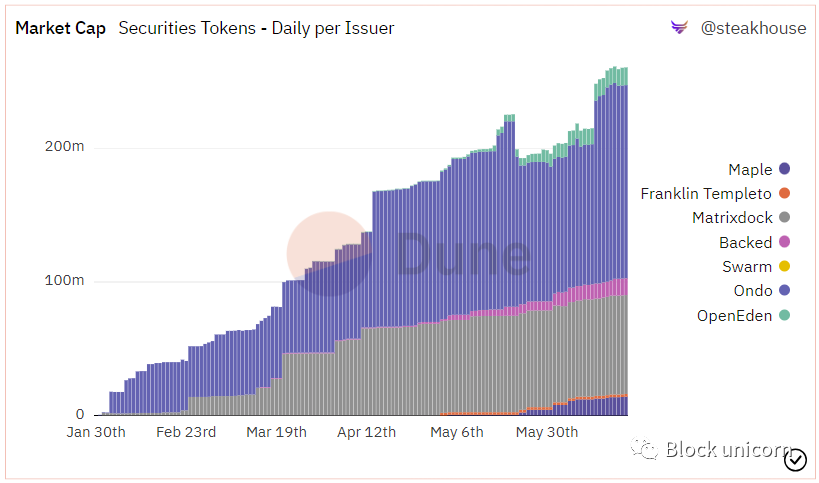 Tokenized government bonds have grown from zero to a $260 million asset class in just five months (data source: Steakhouse Finance on Dune)
One might question the rationale for using tokenized government bonds—if I am a high-net-worth individual, can't I just buy government bonds through traditional brokers? The answer lies in two subtle distinctions.
First, tokenized government bonds are not designed for the average user (though they allow anyone to purchase government bonds from any country) but are aimed at high-net-worth individuals (HNWIs), traders, or hedge funds who prefer to avoid the friction costs associated with transitioning from the on-chain world to the off-chain world.
Tokenized government bonds are also beneficial for DAOs and startups' treasury reserves, especially for institutions located outside the U.S. and DeFi protocols that require permissionless composability to realize RWAs.
For example, Ribbon Finance recently placed a $2 million order for Backed tokenized government bonds to utilize the generated yield to purchase ETH options. On the other hand, Angle Protocol is working on a proposal to use Backed tokens as collateral for their euro stablecoin.
Second, for many established institutions, government bonds serve as a marketing strategy, and due to the current interest rate arbitrage between DeFi and CeFi, they appear very attractive, showcasing the technical and legal feasibility of tokenized assets.
In essence, tokenized government bonds could serve as the "Trojan horse" for bringing traditional bonds and other financial assets on-chain.
Conclusion
Real-world DeFi has matured and is poised for disruptive opportunities.
The real-world DeFi space is still in its infancy, but signs of early product-market fit are beginning to emerge. We see adopters starting to seek low-risk yields (government bonds) from on-chain capital (crypto-native users, non-U.S. crypto companies, unbanked populations), gradually increasing risk (trade finance, bonds, private credit).
Next, we expect capital from traditional finance to be attracted by the unique capabilities of blockchain technology, such as collateralizing fully tokenized assets, better liquidity and capital management, and new investment products (bond issuance). Finally, institutions will also join in due to efficiency gains and the provision of these blockchain-based services to customers.
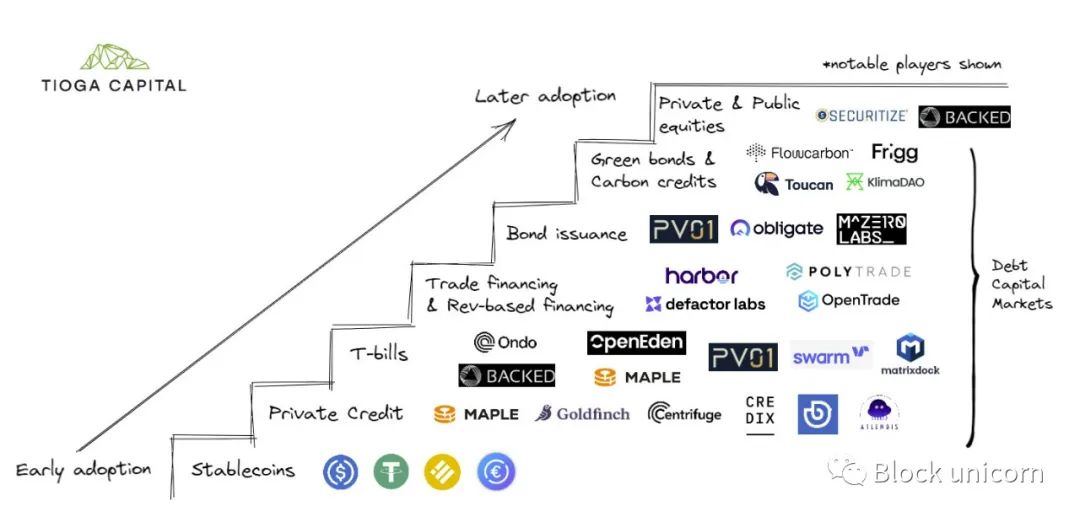 A gradient overview of the adoption trends in real-world DeFi
Real-world DeFi is still in its early stages. Besides tokenizing real-world assets, there are many areas we need to improve in blockchain scalability, privacy, and security before the inflection point for DeFi adoption arrives.
Disclaimer: This article does not constitute investment advice, and users should consider whether any opinions, views, or conclusions in this article align with their specific circumstances and comply with the relevant laws and regulations of their country or region.
 Risk warning Risk warning