The interoperability protocol Wormhole has been quiet for a long time. Can recent major updates help it "make a comeback"?

 Wormhole's investment and market-making backed by Jump can be deeply tied to certain public chains and ecosystems, but it fell into silence after the collapse of Terra. Can the recent updates help Wormhole achieve greatness again?
Author: Jiang Haibo, PANews
Wormhole is one of the most well-known cross-chain interoperability protocols. It was acquired by Jump Trading in 2021 and, after being hacked in 2022, Jump Crypto invested 120,000 ETH (approximately $326 million) for compensation. In the competition for the official governance bridge of Uniswap, it has also surpassed competitors like LayerZero.
After the collapse of Terra, Wormhole's development has been relatively tepid. In fact, the Wormhole team has been updating the project, and there have been some recent advancements, such as the announcement of the establishment of the Wormhole Foundation, support for new public chains like Aptos, Sui, and Sei, and the development of automated relayers to help developers build dApps. Wormhole hopes these measures will break the deadlock.
Supporting 23 Chains, TVL Stabilized Around $324 Million
According to data from the Wormhole official website, as of August 31, Wormhole has supported 23 chains.
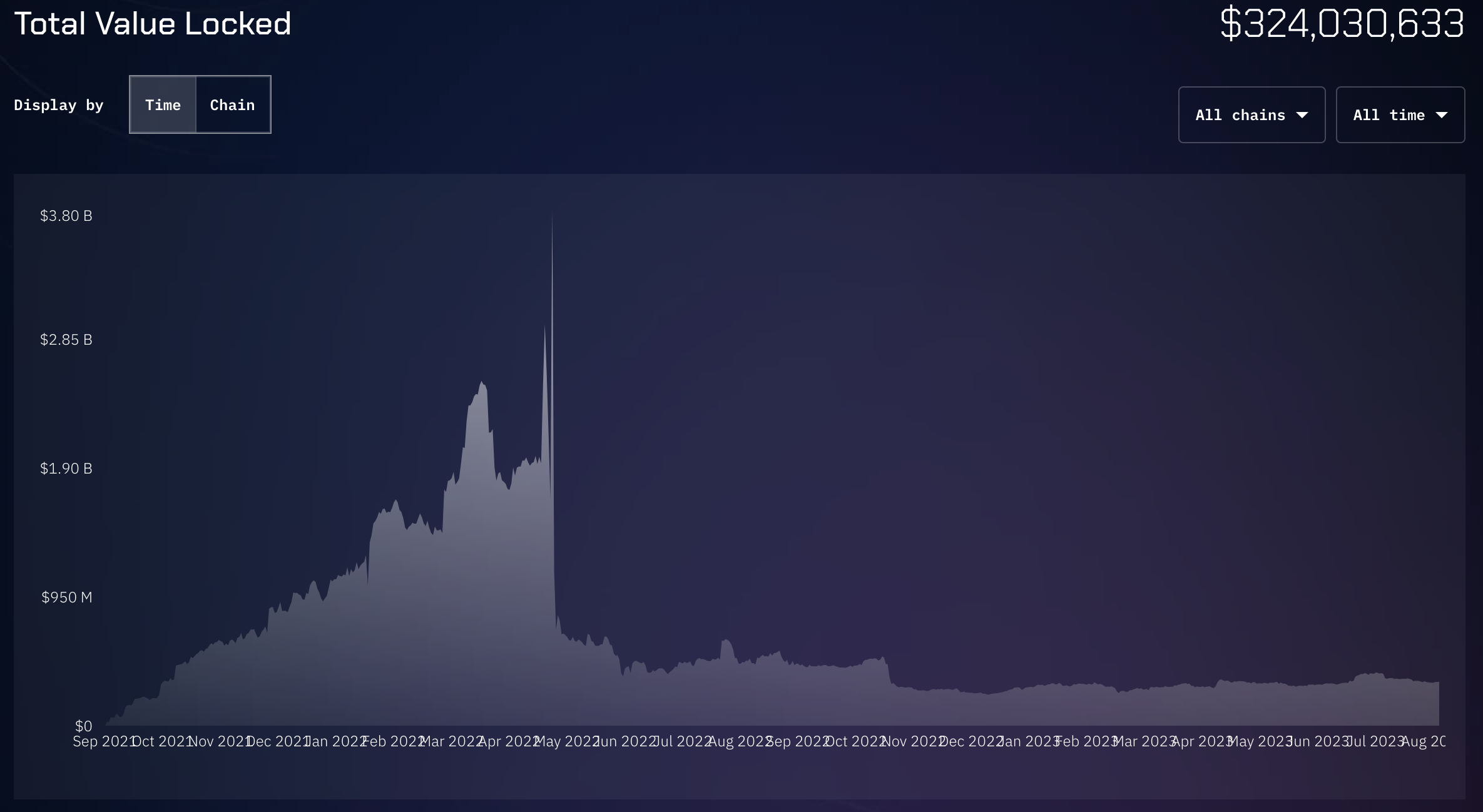
Since Wormhole uses a lock-and-mint method for cross-chain transactions, it is meaningful to track Wormhole's TVL on the source chain. As of August 31, the total TVL across all chains supported by Wormhole was $324 million, with a historical peak of $3.8 billion on May 12, 2022. Recently, the TVL has remained relatively stable.
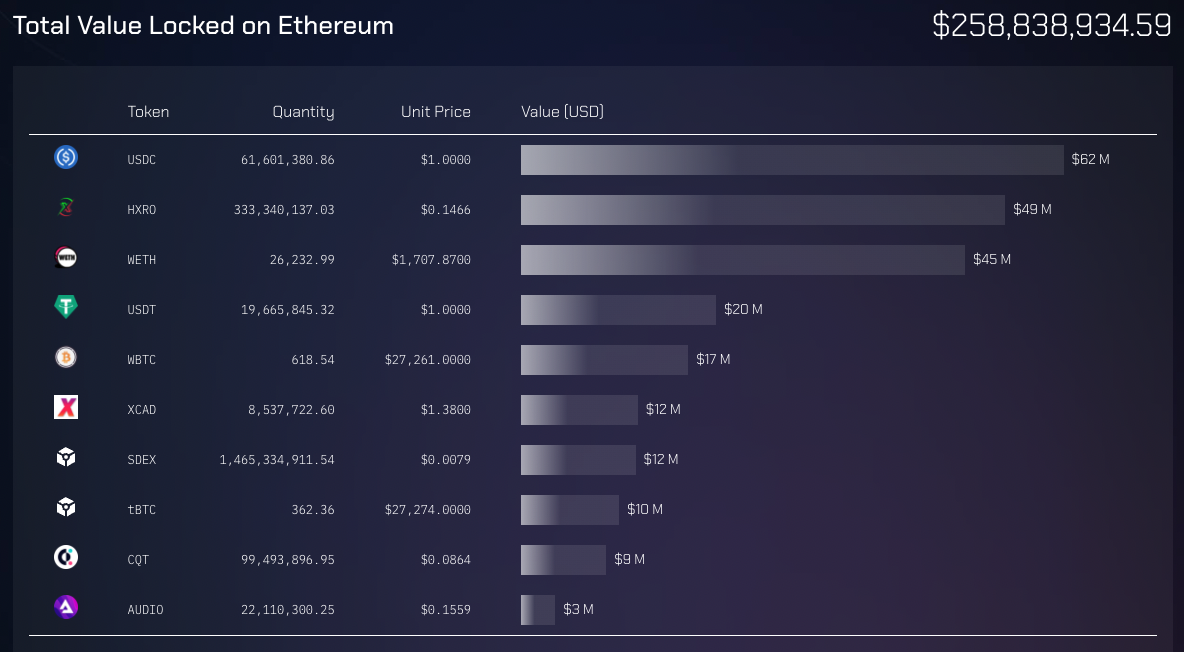
Breaking it down by each chain, the chains with the highest locked underlying assets are Ethereum at $259 million, Solana at $23 million, BNB Chain at $16 million, Terra Classic at $8 million, and Near at $8 million. The highest locked assets on Ethereum include USDC at $62 million, HXRO at $49 million, WETH at $45 million, USDT at $20 million, and WBTC at $17 million. The vast majority are mainstream coins, which is relatively credible.
Looking back at the historical data of Terra Classic, at its peak on May 12, 2022, Wormhole's total TVL of $3.8 billion included $3.25 billion from Terra Classic. The collapse of LUNA/UST began on May 8, so the spike in TVL on May 12 may have been due to the oracle not updating the price of UST in time, leading to inflated data. Interestingly, the surge in Wormhole's TVL on the Terra Classic chain before May 8 is noteworthy; on May 6, the TVL was $1.13 billion, remaining stable prior to that; on May 7, it rose to $1.71 billion; and on May 8, it surged again to $2.18 billion. Subsequently, due to the decline in LUNA's price, the TVL dropped to $1.84 billion on May 9 and further down to $988 million on May 11.
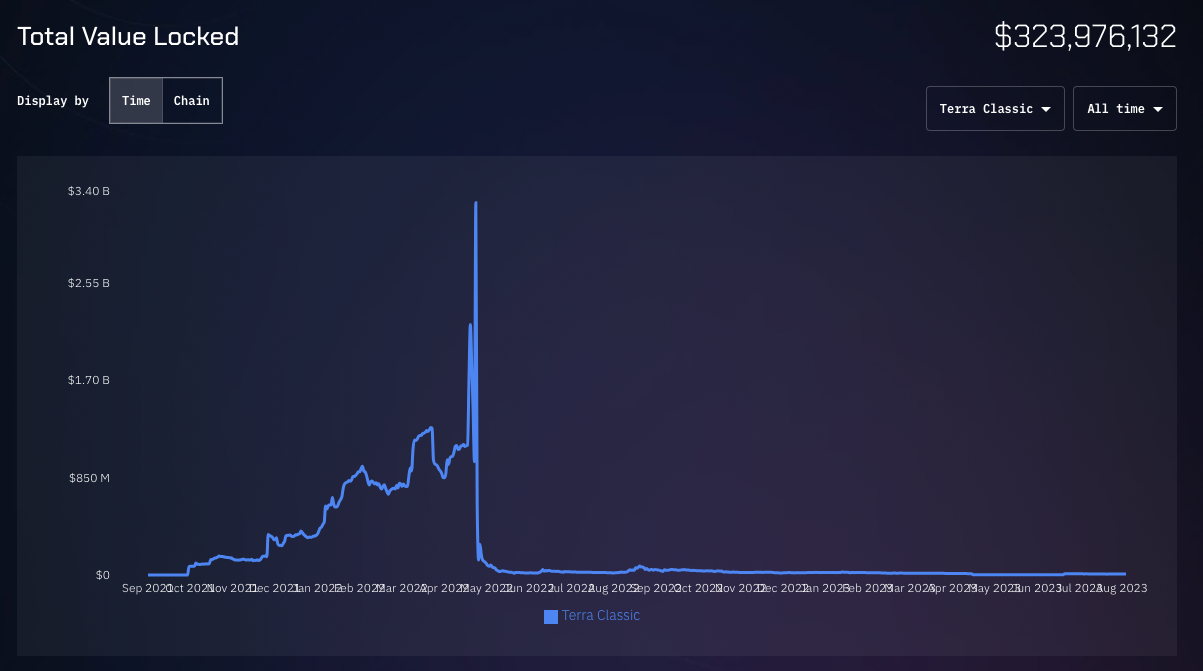
Could the abnormal surge of cross-chain funds from Terra Classic just two days before the LUNA/UST collapse be the culprit behind the collapse? This is quite possible.
Recent Developments of Wormhole
The development of interoperability protocols is not achieved overnight. With the continuous launch of new public chains, it is necessary to support these chains as quickly as possible to capture the market. In terms of functional iteration, beyond the initial asset cross-chain, there is a need for cross-chain messaging and cross-chain apps, while simplifying these functions as much as possible. According to recent updates from Wormhole, the team has made the following progress.
Establishment of the Wormhole Foundation
On August 15, the Wormhole Foundation was officially announced, co-led by Robinson Burkey and Dan Reecer from the Wormhole team. The foundation's plans include three directions:
- xGrants: Providing resources for open-source software development and research, with a particular focus on cross-chain protocols and applications.
- Cross-chain Ecosystem Fund: Initiating a $50 million fund to support Web3 applications that integrate Wormhole.
- Wormhole Association: Establishing a global active community for Wormhole, contributing to technology, building educational content, translation, and organizing online and offline events.
Additionally, although not mentioned officially, such foundations typically launch governance tokens and retain some tokens to promote ecosystem development, which also suggests that Wormhole may issue governance tokens. Currently, Wormhole lacks revenue and provides free services to users. When Uniswap evaluated cross-chain bridges, the Uniswap cross-chain bridge evaluation committee also suggested that Wormhole implement "in-protocol mechanisms" to address the "passive validator" issue. Incentivizing validators (the Guardians in Wormhole) through governance tokens is a common practice.
Launch of Automatic Relayers
Current cross-chain protocols are no longer limited to asset cross-chain but also include cross-chain information transmission and cross-chain apps built on cross-chain protocols. Wormhole has also begun applying in cross-chain apps, such as Wombat using Wormhole's relayer for cross-chain messaging, creating a cross-chain liquidity pool, which is expected to launch on September 6.
Wormhole has also launched Automatic Relayers. To build cross-chain apps, developers typically need to create on-chain components and off-chain relayers to transmit messages from one chain to another. Building, managing, and maintaining off-chain relayers can be challenging, so Wormhole has separated this work and developed automatic relayers. Developers can use a pre-configured relayer network without the need to set up, run, or maintain relayers, simplifying the development of cross-chain apps.
Support for Cosmos, Polkadot, Base, and Others
For application chains in the Cosmos and Polkadot ecosystems, while XCMP and IBC facilitate cross-chain operations internally, there are still security issues when crossing from other chains like Ethereum to Cosmos and Polkadot. Several projects in the Polkadot ecosystem have been affected by the transfer of Multichain funds.
For the Cosmos ecosystem, Wormhole recently launched the Wormhole Gateway to connect liquidity from supported blockchains to Cosmos via IBC; for Polkadot, Wormhole launched the Moonbeam liquidity router to transfer Wormhole assets to the Polkadot ecosystem with one click.
Current Issues: Daily Cross-chain Fund Limits and Inconsistent Cross-chain Liquidity
After being acquired by Jump Trading, Wormhole relies on Jump's investment and market value management, allowing it to deeply bind with certain emerging public chains or projects on public chains, but it has still been relatively tepid in recent developments.
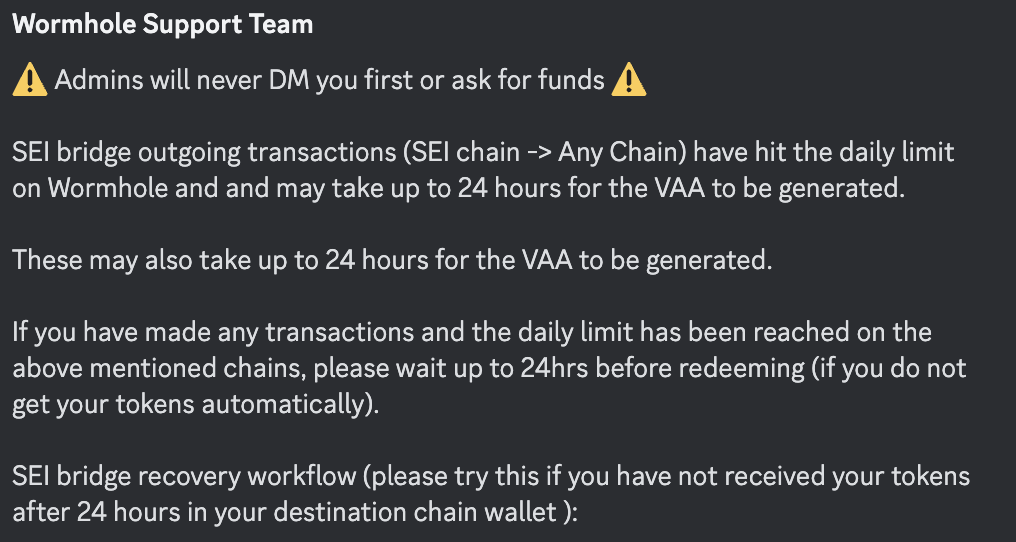
With the launch of Sei Network and the establishment of airdrop rules, issues with both Sei and Wormhole have emerged. According to Sei's airdrop rules, the more assets transferred cross-chain to Sei, the higher the probability of receiving rare treasure chests and more SEI airdrops. As a result, many users choose to transfer over $100,000 to Sei via Wormhole in a single transaction, but Wormhole has imposed daily fund limits for each chain, which has caused many users' attempts to withdraw funds from Sei via Wormhole to be stalled, requiring them to wait over 24 hours.
According to the Wormhole 2022 Year-End Review, a security feature called Governor was launched in August 2022 after the hack, allowing Wormhole Guardians to limit cross-chain value for each chain. Currently, the daily withdrawal limit for underlying assets from Ethereum is set at $50 million, $25 million for Solana, and even less for other chains.
In the Wormhole community, reminders about reaching the cross-chain amount limit occur frequently, as shown in the image below. For cross-chain protocols, the speed of fund arrival is also an important evaluation metric. Generally, the daily limits set by Wormhole can meet demand, and the arrival speed is fast. However, due to the surge in cross-chain demand caused by Sei's airdrop rules, the experience of having to wait 24 hours to exit is poor.
Additionally, the cross-chain assets on Wormhole are overly complex. For example, while USDC on various chains can be transferred to Aptos, only USDC that has been transferred from Ethereum to Aptos is supported on Pancakeswap and Thala on Aptos. Does this mean that one must use the Ethereum mainnet to meet the conditions?
Not necessarily. There is also a Wormhole-minted cross-chain asset USDCet from the Ethereum mainnet on Solana, and the USDC/USDCet trading pair on DEX has sufficient liquidity. For ordinary users, withdrawing USDC to Solana, then exchanging it for USDCet through an aggregator, and transferring USDCet to Aptos can achieve the same effect at a lower cost.
It is also important to note that while Aptos supports USDC minted cross-chain from Ethereum or USDCet from Solana, Sei requires the use of native USDC on Solana for cross-chain calculations, which can easily confuse different assets. Competitor LayerZero performs better in this regard, as the front end only shows supported assets.
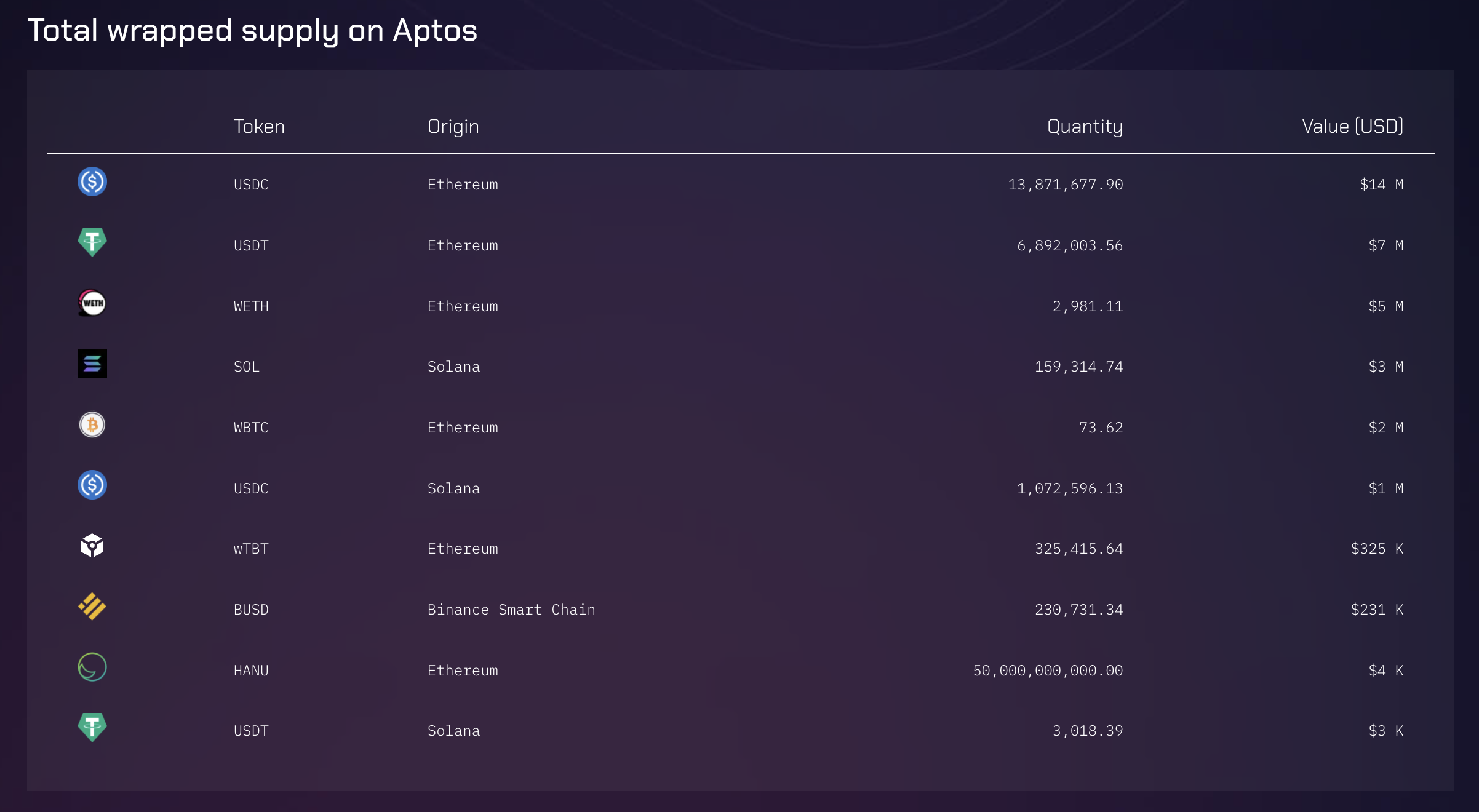
In March of this year, Wormhole integrated Circle's Cross-Chain Transfer Protocol (CCTP), theoretically allowing the underlying assets transferred cross-chain from USDC on different chains like Ethereum and Solana to Aptos to be the native USDC officially issued by Circle. If Wormhole can unify liquidity, the user experience will improve.
With the collapse of Terra, Wormhole's glory also faded. The ecological project Swim Protocol, which provided cross-chain liquidity, announced a pause after a series of subsequent events. However, the Wormhole team continues to frequently update product features. Although there are still many issues with the project, there is hope that Wormhole can achieve greatness once again.
 Risk warning Risk warning