The Evolution and Challenges of BTC Scalability from the Perspective of Asset Issuance

 This article will combine the new normal brought to the BTC ecosystem by Ordinals, examine the current challenges faced by BTC expansion from the perspective of asset issuance, and finally predict that RGB & Taproot Assets, with asset issuance and application scenarios, have the potential to lead the next narrative.
Author: Infinitas, AC Capital
Summary (TL;DR)
- Ordinals ecosystem explodes: opening up new possibilities for Bitcoin asset issuance
- Ordinals brings a new normal: competition for block space, UTXO expansion
- Evolution and challenges of BTC scaling from the perspective of asset issuance
- Huge growth potential for scaling solutions with asset issuance + application scenarios
Ordinals Explodes: Opening Up New Possibilities for Bitcoin Asset Issuance
As digital gold or currency, the Bitcoin community has become conservative since the hard fork in 2017, with no new narratives in recent years. The Ordinals protocol, launched in early 2023, has turned the wheels of Bitcoin's fate, leading to a massive explosion of users in the Ordinals ecosystem. For the first time in six years, Bitcoin's on-chain transaction fees have surpassed Ethereum's, and the narrative imagination of the crypto industry has returned to the Bitcoin blockchain. 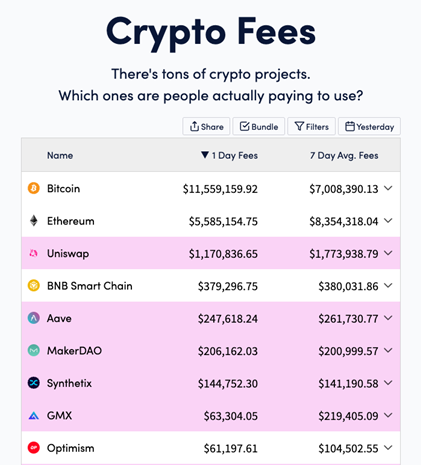
Source: https://cryptofees.info/
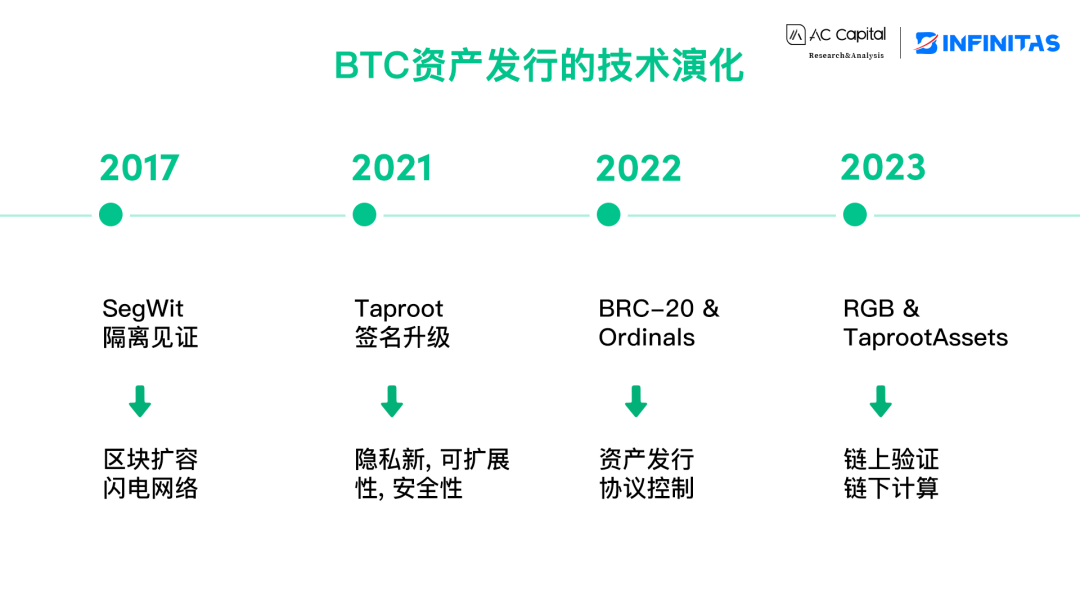
Before the emergence of the Ordinals protocol, there were several significant upgrades on the BTC technical side. In 2017, the SegWit (Segregated Witness) upgrade was activated, expanding block space to 4 MB and increasing transaction throughput. Following that, developers introduced the Lightning Network, bringing Bitcoin Layer 2 into the public eye. The Taproot upgrade in 2021 provided a more secure, efficient, and private Bitcoin, introducing programmability to Bitcoin.
However, these technical improvements did not address real pain points until the arrival of Ordinals, which completely opened the door for the BTC ecosystem to take root. In December 2022, Casey launched the Ordinals protocol, which is an extension protocol for the Bitcoin network that allows data to be inscribed on Bitcoin Satoshis (sats). The Ordinals protocol achieves this by assigning a unique number to each sat and adding annotations.
Inspired by the Ordinals protocol, Domo created the experimental Bitcoin token standard BRC-20 on March 8, 2023, utilizing JSON data's ordinal and Inscription to deploy token contracts, mint, and transfer tokens. It uses sats to store and manage various information about the tokens.
Previously, there were ways to mint and issue assets on Bitcoin, such as colored coins in 2012 and Counterparty in 2014, but none captured user pain points. The adoption of Fair launch + protocol-controlled assets on BRC-20 sparked genuine user demand, and the explosive growth of BRC-20 has opened up new possibilities for asset issuance on Bitcoin.
As of now, the Ordinals ecosystem has produced over 41 million inscriptions, which are digital inscriptions etched on the world's oldest and most secure distributed ledger, including images, text, audio, and even applications. Among these, text inscriptions (BRC-20) account for the largest share. The Ordinals ecosystem has already spawned several innovative branch protocols such as BRC-20, ATOM, PIPE, and RUNES. The explosion of Ordinals has brought new traffic to the BTC ecosystem while also laying new groundwork for it.
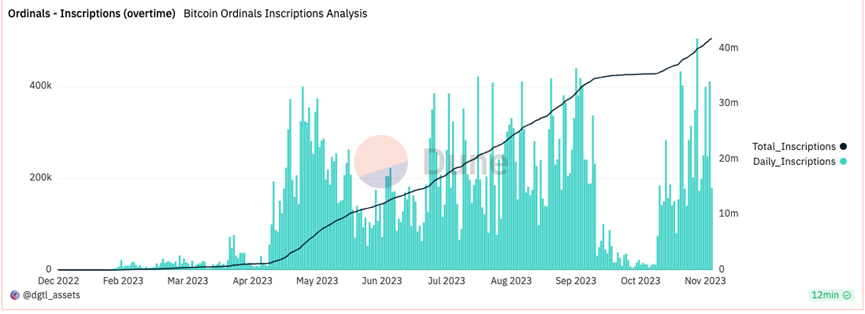
Source: https://dune.com/dgtl_assets/bitcoin-ordinals-analysis
Ordinals Brings a New Normal On-Chain: Competition for Block Space, UTXO Expansion
The explosive trend of Ordinals is also reflected in the high transaction fees paid by users. Text inscriptions occupy little data, and BRC-20 users are willing to pay high transaction fees. Miners are filling block space with record transaction numbers, and excessive BRC-20 transactions are occupying transaction bandwidth, leading to longer transaction confirmation times and higher fees.
In 2022, miners earned a total of 5,374 BTC from transaction fees, and since the minting of Ordinals, transaction fees have consumed 2,886 BTC. The emergence of Ordinals has allowed miners' earnings to no longer rely solely on Bitcoin rewards, significantly increasing the proportion of transaction fees, which has also brought a second curve to miners' income.
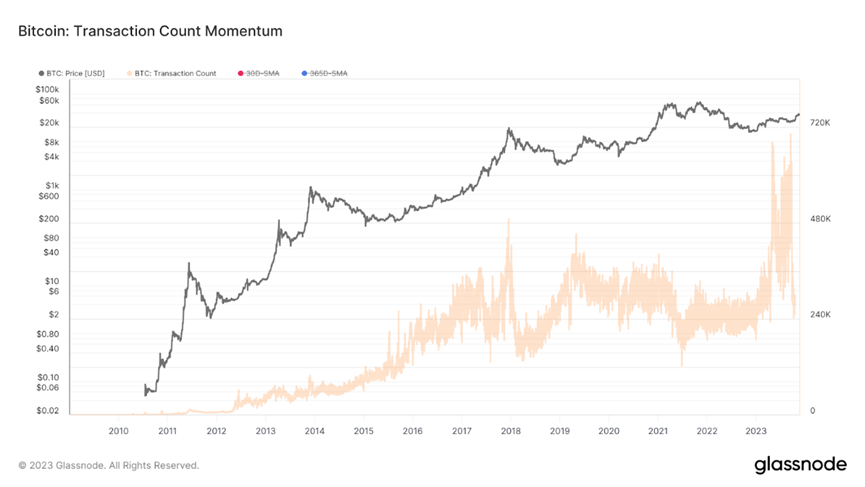
Source: https://studio.glassnode.com/workbench/btc-transaction-count-momentum
After the rapid growth of inscriptions in the Ordinals ecosystem, a heated debate has erupted within the broader Bitcoin community regarding its impact on Bitcoin. Opponents argue that Bitcoin is sacrificing financial transactions, claiming that Ordinals transactions will only increase the Mempool backlog of the Bitcoin network, raise transaction fees, and ultimately hinder peer-to-peer transactions.
Casey, the founder of the Ordinals protocol, stated in September that currently 99.9% of the homogeneous token protocols on the Bitcoin blockchain are scams and memes. However, they do not seem to be disappearing anytime soon, just as casinos do not "disappear" quickly. He aims to establish a better asset issuance protocol, Runes, so that gamblers can continue to gamble without creating a large number of UTXOs that increase the burden on nodes.
BTCStudy founder Ajian also expressed concerns, stating that from a technical perspective, BRC-20 is an outdated technology. The minting and transfer of BRC-20 do not require UTXO associations, yet it limits the number of tokens that can be minted from a single UTXO. They are likely to remain concentrated in UTXOs, resulting in UTXO expansion and increasing the burden on Bitcoin full nodes, which significantly impacts the Bitcoin network's censorship resistance and trustlessness.
Since the launch of BRC-20 trading in April 2023, Bitcoin's UTXO set has expanded from 5 GB to 8.16 GB. The Bitcoin development community has been debating whether to use technical means to block inscription transactions, as the UTXO expansion caused by inscription transactions is eroding the Bitcoin network.
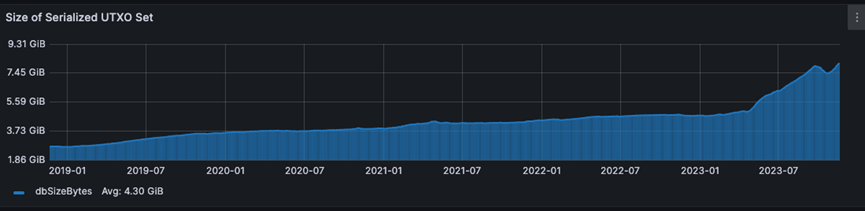
Source: https://statoshi.info/d/000000009/unspent-transaction-output
Supporters of the Ordinals ecosystem argue that the explosion of Ordinals has brought new traffic and user habits to the Bitcoin ecosystem, which must adapt to the new normal brought by Ordinals. The next narrative of the Ordinals ecosystem should focus on addressing UTXO expansion, as ultimately better asset issuance methods will enable the Bitcoin ecosystem to have more native application ecosystems and promote sustainable development.
Evolution and Challenges of BTC Scaling from the Perspective of Asset Issuance
The BTC ecosystem currently lacks asset issuance protocols, but it lacks smart contracts and scalability. Scalability determines the potential direction and lifecycle of BTC scaling. The complexity of Bitcoin Layer 1 scaling solutions is high, and the community is more accepting of building new Layer 2 solutions based on Bitcoin Layer 1, which are compatible and do not affect the Bitcoin system while solving on-chain congestion issues.
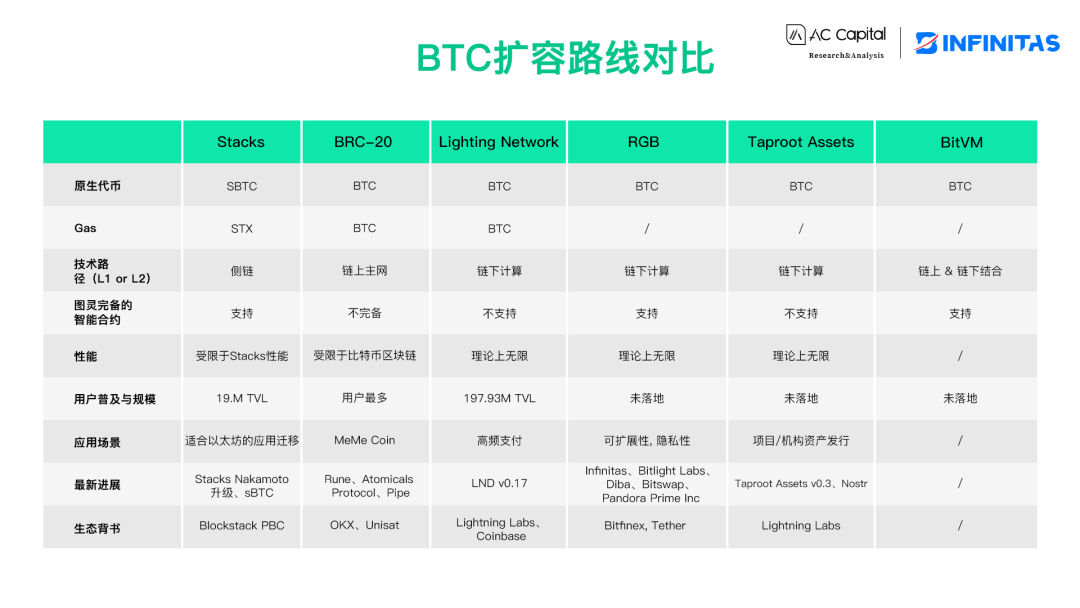
After completing SegWit, the Bitcoin ecosystem is fully focused on developing Layer 2 solutions such as the Lightning Network and sidechains. Whether it is the Lightning Network, sidechains, or the RGB protocol, the development of Bitcoin Layer 2 is in full swing. Here, we will not discuss the Liquid alliance chain, but from the perspective of better asset issuance, there are significant challenges in terms of Turing completeness, decentralization, and scalability when comparing BRC-20, Stacks, BitVM, Lightning Network, RGB, and Taproot Assets:
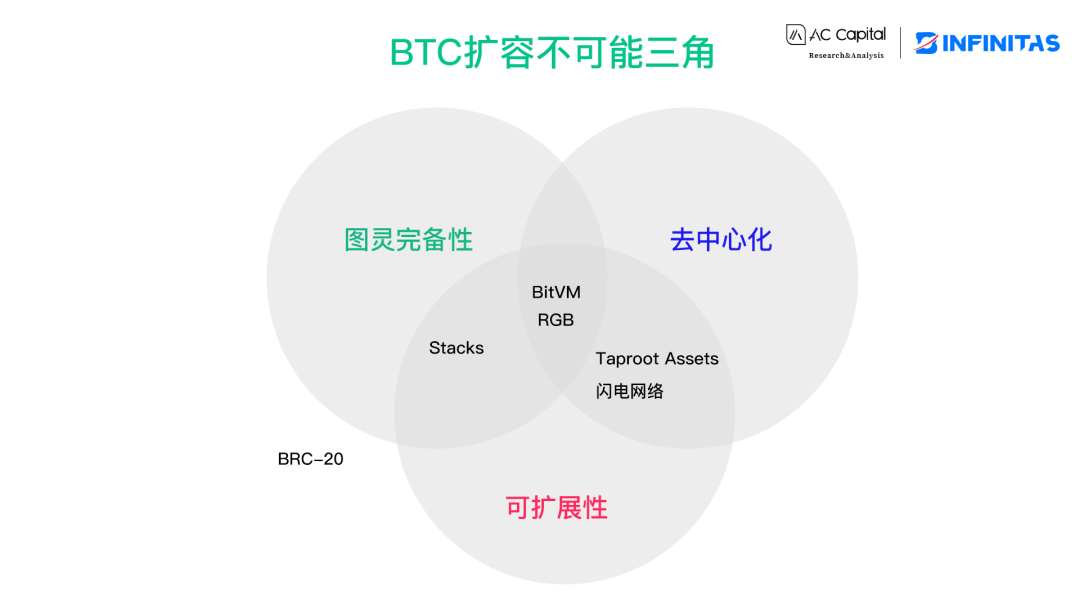
- Sidechain Stacks: The leading sidechain Stacks currently has 19.3 MTVL on-chain. Stacks has many advantages, especially the ability to directly migrate existing Ethereum applications. However, sidechains like Stacks and RSK face centralization issues. The Stacks Nakamoto upgrade is coming in Q4, and sBTC as a smart contract is about to go live.
- BRC-20: The leading inscription ecosystem, BRC-20 is a Bitcoin script that is not fully Turing complete. It has a large user base and a simple protocol but occupies too much on-chain space. Additionally, BRC-20's security is overly centralized, lacking scalability and Turing incompleteness, which limits its further development. Currently, Rune, Arc-20, Pipe, and BRC-20Swap are working to address related issues.
- Lightning Network: The Lightning Network is the largest Layer 2 in terms of scale and influence within the Bitcoin ecosystem. More and more companies are entering the Lightning Network ecosystem, which allows off-chain payments through specific state channels and final settlement on the Bitcoin chain. However, the Lightning Network cannot issue tokens, is only suitable for high-frequency payments, and lacks smart contract functionality. Its Turing completeness is poor, and the number of users and use cases remains limited. However, protocols developed based on the Lightning Network, such as Taproot Assets and RGB, have more room for imagination.
- RGB: Inspired by Peter Todd's concepts of single-use seals and client-side validation proposed in 2016, RGB introduces smart contract functionality to the Lightning Network. The GRB v.010 was released in April 2023, but its technical complexity has prevented the ecosystem from taking root. Projects such as Infinitas, Bitlight Labs, Diba, Bitswap, and Pandora Prime Inc. are gradually opening up the possibilities for RGB implementation. The CEO of Tether has also stated that RGB is the best choice for issuing stablecoins on the Bitcoin chain, and Tether is considering the possibility of issuing USDT through RGB.
- Taproot Assets: Also a client-side asset verification protocol, the Taproot Assets v0.3 mainnet alpha version was released in October 2023, aiming to expand Bitcoin into a scalable multi-asset network. However, the asset issuance of Taproot Assets is distributed, with the project party distributing rather than users actively minting. The application scenarios of Taproot Assets are more suitable for asset issuance aimed at project parties and institutions. Currently, a new protocol based on Taproot Assets, Nostr Assets Protocol, is bringing assets into the Nostr social protocol.
- BitVM: The white paper for BitVM was released in October 2023. BitVM adopts a Rollups-like approach to execute complex programs off-chain and then place key evidence on-chain. It also aims to bring Turing-complete smart contracts to Bitcoin, but BitVM has extremely high requirements for computational power, with only theoretical executability. Its scalability and commercial implementation require further understanding.
Huge Growth Potential for BTC Scaling Solutions with Asset Issuance + Application Scenarios
As the infrastructure of the Bitcoin ecosystem continues to improve, various scaling routes are gradually being explored. The next stage of BTC scaling faces two core issues that need urgent resolution:
From the perspective of asset issuance: Is the technical route adaptable to practical application scenarios? Is it decentralized? Is it Turing complete? Does it have scalability?
From the perspective of asset circulation: Can the progress of the protocol gain adoption and support from the industry's infrastructure and users?
From the perspective of asset issuance, BTC still has a considerable gap compared to Ethereum in terms of asset issuance. First, there is a lack of well-known projects, and second, the user base is not as large as Ethereum's. However, as the current highest market cap blockchain network, BTC Layer 2 has huge growth potential for asset issuance protocols + application scenarios in the future.
Currently, Ordinals has completely opened up the possibility of asset issuance on Bitcoin, but Ordinals cannot support on-chain computation like Ethereum. The BTC ecosystem needs to figure out how to complete asset settlement like Ethereum. From the perspective of the technical evolution of BTC asset issuance, client-side validation paradigms like RGB & Taproot Assets have the potential to take over Ordinals inscriptions and become a new important narrative ecosystem.
At the same time, in the future multi-asset era of Bitcoin, the explosion of the BTC ecosystem will also require diversified application scenarios. The premise of diversified application scenarios is the use of stablecoins as a foundation, and the Lightning Network is the best platform for stablecoin issuance. However, there are not enough stablecoins currently available. Taproot Assets and RGB have the potential to accelerate development in high-frequency payments, stablecoins, DeFi, NFTs, and other fields, covering more tracks and users, and expanding the diversified application scenarios of the Lightning Network.
Conclusion
The Bitcoin ecosystem is currently experiencing the first wave of the Ordinals windfall. Beyond asset issuance, the Bitcoin ecosystem also needs more complex and sustainable application scenarios for sustainable empowerment. From the evolution of asset issuance technology, client-side validation paradigms like RGB & Taproot Assets are driving change, with less on-chain computation and more on-chain validation, giving rise to a more reasonable asset issuance method in the Bitcoin ecosystem.
If you are a developer in the RGB & Taproot Assets-related fields and believe in the potential of the client-side validation paradigm for mass adoption, please feel free to contact AC Capital and Infinitas. If you have different viewpoints, you are also very welcome to leave comments for discussion.
References
- https://github.com/tylev/awesome-bitcoin-layer2
- https://github.com/bitcoin/bips
- https://www.binance.com/en/research/analysis/a-new-era-for-bitcoin
- https://blog.lopp.net/bitcoins-security-model-a-deep-dive/
- https://dune.com/dgtl_assets/bitcoin-ordinals-analysis
- https://rodarmor.com/blog/runes/
- https://mirror.xyz/0x5CCF44ACd0D19a97ad5aF0da492AC0388469DfE9/_k3vtpI7a5cQn5iISH7-riECpyudfI4BTeeeBMwNYDQ
- https://twitter.com/AurtrianAjian/status/1686379305520234497
 Risk warning
 Risk warning