Will Coinbase benefit from Binance's penalties?

 Coinbase's stock price hits an 18-month high. What will Coinbase face after Binance reaches a settlement with U.S. regulators?
Original Title: Does Coinbase benefit from Binance's guilty plea?
Original Author: Joanna Wright, DLNews
Original Translation: Kaori, BlockBeats
Editor’s Note: Coinbase (COIN) stock recently hit an 18-month high. According to TradingView data, on November 27, Coinbase closed at $119.77, the highest level since May 5, 2022. Bloomberg ETF analyst James Seyffart's analysis shows that Coinbase is the custodian for 13 of the 19 spot crypto ETFs currently awaiting review by the U.S. Securities and Exchange Commission. Many believe that Binance's settlement with U.S. regulators is a positive event, and as the leading trading platform in the U.S., Coinbase seems to be seen as gaining room for growth from Binance's penalty incident. However, the future entry of BlackRock and regulatory trends also add unpredictability to Coinbase's development prospects.
With the legal uncertainties surrounding Binance resolved, Coinbase, as the largest cryptocurrency trading platform in the U.S., finds itself in a compelling position.
On one hand, it has the opportunity to capture a portion of Binance's market share in the U.S. On the other hand, legal experts point out that the regulatory ripples from Binance will pose challenges to Coinbase's business model.
Before delving deeper, let’s take a brief look back:
Binance, the world's largest cryptocurrency trading platform, pleaded guilty to U.S. criminal charges for failing to establish anti-money laundering protections. Under the settlement agreement reached with authorities, Binance will pay a $4.3 billion fine and undergo a three-year intensive monitoring program, with its CEO and founder CZ resigning.
What does this have to do with Coinbase?
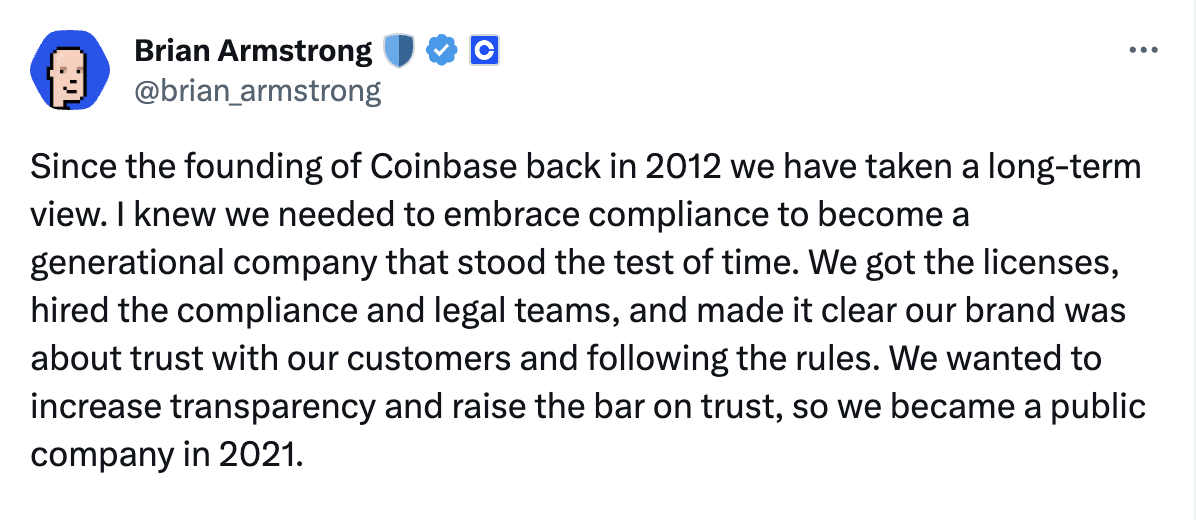
Brian Armstrong, a veteran in Silicon Valley, founded Coinbase in 2012. The trading platform chose a compliant path—registering state licenses, conducting strict reviews and restrictions on listed cryptocurrencies, and even going public in 2021.
This approach cost Coinbase when Binance emerged in July 2017.
As Armstrong recently wrote on X, going public meant Coinbase "couldn't always move as quickly as other companies."
"Taking a compliant approach is harder and more expensive. When it comes to illegal activities, you can't launch every product that customers want," Armstrong said.
Regulators accused CZ and Binance executives of knowingly violating securities laws for illegal gains. Binance also operated under layers of obfuscation, making its corporate structure elusive— for example, it did not list a board of directors or headquarters in any country. At its peak, Binance accounted for 60% of global cryptocurrency trading volume and still holds about 43% market share.
Coinbase will face a more resilient market
Last week's events proved that Armstrong's cautious approach was correct.
Binance has begun delisting trading pairs and assets, including the token TORN from the sanctioned cryptocurrency mixer Tornado Cash.
It now must strengthen compliance and can no longer act quickly and break rules. This will cost Binance dearly. After speaking with most legal experts, I found that they generally expect Binance to completely exit the U.S. market.
This is good news for competitors in the U.S., especially for companies like Coinbase that are striving to meet regulatory standards, XReg Consulting's Managing Director Aron Unterman told me. "For those businesses, this is a good situation, although it has been a disadvantage in terms of market share for quite some time," he said.
Moreover, the penalties against Binance have left Coinbase facing a more resilient market.
"If this had happened a year ago, it would have had significant ripple effects, severely damaging the cryptocurrency market," Unterman said. "But this impact did not cause panic or concerns about other failures. It was predictable and created opportunities for other participants in the market."
Competitors beyond Binance
However, the ruling against Binance will also put Coinbase in a more complex situation.
Cryptocurrency investors are eagerly awaiting regulatory approval for spot Bitcoin exchange-traded funds (ETFs) submitted by heavyweight asset management firms like BlackRock.
According to some market observers, the fact that the world's largest trading platform is no longer a charged entity lends legitimacy to the industry and increases the likelihood of ETF approvals.
However, for Coinbase, this is not purely an advantage. Competition from BlackRock could drive fees down to nearly zero, which is a blow for a trading platform that charges between 0.6% and 3%.
Additionally, Coinbase's ongoing litigation with the U.S. Securities and Exchange Commission is also a significant issue, hinging on interpretations of technical securities laws rather than criminal charges.
However, Unterman noted that the Binance case could bolster the SEC's claim to be the primary regulator of cryptocurrencies—this claim underpins its lawsuit against Coinbase.
 Risk warning Risk warning