The Department of Justice intervenes, the founder is on the run, and the small "Binance" KuCoin struggles to take off in the U.S.?

 The cryptocurrency exchange KuCoin has been sued simultaneously by the U.S. Department of Justice and the CFTC.
Written by: Tuo Luo Finance
After Binance, another cryptocurrency exchange has faced criminal action from the United States.
This exchange is not an unknown entity; it is KuCoin, which was once referred to as the "little Binance" in the industry.
On the evening of March 26, the U.S. Department of Justice disclosed on its official website that the cryptocurrency exchange KuCoin and its two founders, CHUN GAN (alias "Michael") and KE TANG (alias "Eric"), have been charged with conspiring to operate an unlicensed money transmission business, conspiring to violate the Bank Secrecy Act by failing to maintain adequate anti-money laundering procedures to prevent KuCoin from being used for money laundering and financing terrorism, failing to maintain reasonable procedures to verify customer identities, and failing to submit any suspicious activity reports. The prosecution is led by the U.S. Commodity Futures Trading Commission (CFTC).
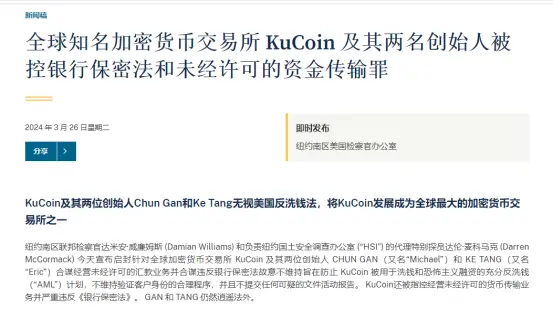
Department of Justice discloses KuCoin's criminal allegations, source: U.S. Department of Justice official website
Since its inception, KuCoin has been following in Binance's footsteps, and its smooth product experience has helped it successfully rise to become the fourth-largest exchange globally. Following Binance's legal troubles, the founders have fled, which raises questions about the integrity of the exchange. Nevertheless, KuCoin is once again in the spotlight.
Let's first take a look at the development history of KuCoin.
KuCoin officially launched in September 2017. Those familiar with cryptocurrency history know that this was just after China's strict regulations against ICOs on September 4. At that time, even some insiders were heavily skeptical about the future of cryptocurrency. In the exchange arena, aside from Binance, which had not yet launched, many exchanges like Huobi, OKCoin, Bit-Z, BitEra, and Yuanbao were competing fiercely.
KuCoin's founder Michael had previously worked as a technical expert at Alibaba's Ant Financial and was an early investor in NEO and ETH. As a result, KuCoin quickly secured angel funding in the industry, but the September 4 event was undoubtedly very unfavorable for exchanges. Perhaps because of this, KuCoin established its goal of going global early on, focusing its customer base on Europe, Southeast Asia, and the Americas. This strategic decision proved to be correct, as just three months after its launch, KuCoin's user base surpassed one million, maintaining traffic among the top five in the industry.
In 2018, as the bear market set in, KuCoin faced difficulties, but it secured $20 million in Series A funding from IDG and Matrix Partners that year, successfully weathering the winter. After replenishing its resources, its globalization plan accelerated, and KuCoin began establishing local language communities in over a dozen countries, quickly capturing the minds of users in Europe, Latin America, and Southeast Asia, achieving a level of recognition comparable to the rapidly growing Binance.
In 2019, with the launch of Binance Launchpad, the market began to improve, and KuCoin became increasingly aggressive, launching almost all popular spot + futures + OTC businesses at the time, firmly establishing its foothold in the cryptocurrency space. According to a Tokeninsight report, in 2019, KuCoin was the fastest-growing exchange in terms of trading volume, ranking sixth globally in monthly visits in Q1 and seventh in Q2.
Since then, KuCoin's scale has continuously expanded, and the number of countries it operates in has increased, earning it the title of "little Binance." According to data from the U.S. Department of Justice, KuCoin has now become one of the largest cryptocurrency trading platforms in the world, with over 30 million customers and daily trading volumes worth billions of dollars.
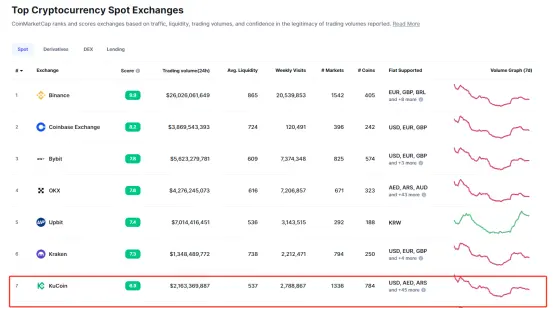
Even facing lawsuits, KuCoin remains at the forefront, source: Coinmarketcap
Of course, this is the glamorous part, but from a compliance and regulatory perspective, KuCoin has a poor track record.
First, the global development of exchanges must be based on compliance licenses, but KuCoin, which has this vision, clearly does not have it. Before the U.S. action, it had already been warned by multiple regions for not being legally registered. As early as June 2022, the Ontario Securities Commission in Canada took enforcement action against KuCoin, stating that it had not complied with Ontario's securities laws. In December 2022, the Dutch Central Bank also warned KuCoin for violating the Anti-Money Laundering and Terrorist Financing Act.
In March of last year, the New York Attorney General also filed a lawsuit against it, claiming that KuCoin was not registered in the state, yet users could still buy and sell cryptocurrencies on KuCoin in New York, which violated New York's Martin Act. The lawsuit demanded that KuCoin's parent company, Mek Global Limited, and PhoenixFin Pte. Ltd. be permanently banned from illegal activities in New York, including offering, selling, and purchasing securities and commodities. This lawsuit was settled by KuCoin in December last year with a $22 million payout, exiting the New York market.
However, according to announcements from the U.S. State Department, KuCoin clearly engaged in deceptive practices. From the timeline, until at least July 2023, KuCoin did not require customers to provide any identity information and did not conduct KYC operations. It was only after learning about the federal criminal investigation into its activities that KuCoin began to implement KYC for new users, even concealing the reality of U.S. users by stating that it did not support their use. However, during the investigation, authorities found that KuCoin had a large number of customers located in the U.S. KuCoin also never registered as a futures commission merchant with the CFTC and had not registered as a money transmission business with FinCEN by the end of 2023.
This data is not fabricated; previously, media outlet Wu Shuo reported in 2022 on platform X that, based on data analysis, KuCoin's traffic from the U.S. reached 24%, making it the largest regional traffic source for the exchange, and KuCoin was the only major offshore exchange that did not completely block U.S. IPs.
Data indicates that due to KuCoin's intentional failure to maintain the required AML and KYC procedures, it has been used as a tool for money laundering, including proceeds from dark web markets, malware, ransomware, and fraud schemes. Since its establishment in 2017, KuCoin has received over $5 billion and sent over $4 billion in suspicious and criminal proceeds.
Interestingly, KuCoin dares to operate without a license in the U.S., Europe, and other regions, but has indeed prohibited KYC for mainland users, leading many to believe it is a compliant exchange, which can be seen as a case of "hanging a sheep's head while selling dog meat."
Even excluding compliance issues, KuCoin has never ceased its questionable operations on the user side.
During the bear market in 2022, multiple users reported that KuCoin intentionally restricted withdrawals, experiencing prolonged malicious delays. At the same time, users discovered that KuCoin was engaging in "arbitrage" with users' UST by exploiting time differences, falsely claiming congestion when users attempted to withdraw, while it was actually conducting arbitrage operations, ultimately causing users significant losses while KuCoin reaped excessive profits, with some claiming profits nearing ten million in a single night.
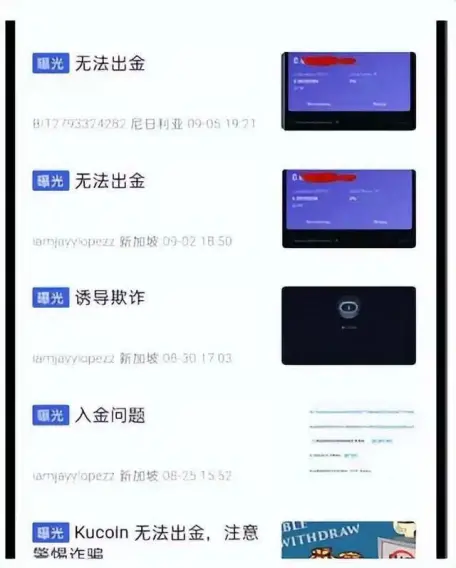
Multiple users report KuCoin's withdrawal issues, source: public information
Even more outrageous, some users revealed that Michael, the CEO of KuCoin, openly promoted trades in the official Telegram group, misleading users into purchasing through false promotional activities. After investors were misled and suffered losses, the account claimed it was not operated by Michael himself but by employees, which led to dissatisfaction among many users.
Such behaviors are not isolated incidents; a quick search reveals numerous complaints, such as users questioning why the price of Dock fell below its issuance price, with price differences exceeding 60% compared to other platforms, yet users were prohibited from withdrawing funds.
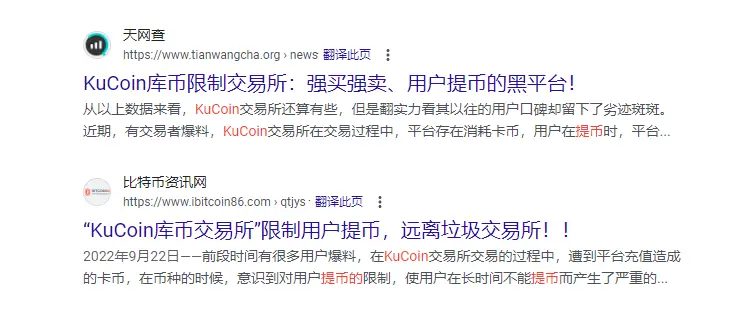
KuCoin faces negative publicity on search engines, source: public information
Due to various questionable operations, rumors circulated as early as June last year on platform X that over 30 people from KuCoin's legal and marketing departments had been arrested in Chengdu. Although the authenticity of this news is uncertain, it coincided with the timing of the U.S. Department of Justice beginning its investigation. With regulatory pressure mounting alongside the bear market, KuCoin could not avoid thoughts of fleeing.
According to Wu Shuo, three independent sources confirmed that in 2023, KuCoin considered halting operations and selling the exchange. Relevant personnel from multiple exchanges, including Binance, received information about the sale, and many of KuCoin's operations accelerated divestment to reduce risk in 2023. Naturally, it is impossible to expect others to come to the rescue, and the sale plan seems to have ultimately fallen through.
Returning to the lawsuit, given all these operations, it was only a matter of time before the U.S. Department of Justice took notice. As for the final outcome, if we take Binance as a precedent, violations of the Bank Secrecy Act and conspiring to operate an unlicensed money transmission business will likely result in hefty fines. However, KuCoin's scale is clearly smaller than Binance's, raising questions about its ability to pay. The only fortunate aspect is that it has not been mentioned in connection with U.S. national security red lines.
After the incident, although KuCoin quickly stated on platform X that funds were still safe, it still faced a bank run. As of noon on March 27, KuCoin had seen outflows of $1.197 billion in the past 24 hours, including 274 million USDT and 19,886 ETH (approximately $72 million). According to Lookonchain monitoring, multiple whale addresses are transferring assets from KuCoin to other exchanges, totaling 86 million USDT. As of now, KuCoin holds cryptocurrency assets worth a total of $6.137 billion.
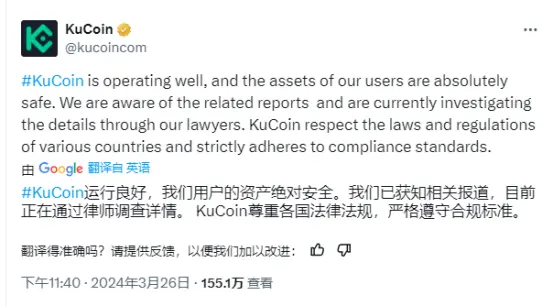
KuCoin's official account responds, source: platform X
As for whether KuCoin will affect the current cryptocurrency bull market, it is still difficult to determine, but based on the current situation, it seems unlikely. The overall market is not affected by this news, and the cryptocurrency fear and greed index still shows "extreme greed," with Bitcoin firmly around $70,000. In contrast, after the news of the FTX collapse, Bitcoin's price dropped over 20% within a week.
Ki Young Ju, founder and CEO of cryptocurrency analysis service CryptoQuant, also confirmed this viewpoint, stating, "The surge in BTC and ETH withdrawals is mainly driven by retail users, with minimal impact on overall reserves. From an on-chain perspective, it seems they have not mixed customer funds and have sufficient reserves to handle user withdrawals."
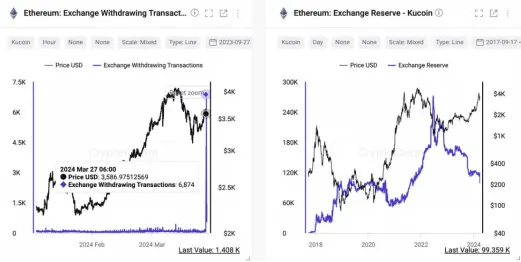
KuCoin reserves, source: Ki Young Ju
However, unlike CZ in the Binance incident, both founders are currently on the run, which will undoubtedly strengthen the penalties. Each charge could carry a maximum prison sentence of five years. In response, some users on platform X began reminiscing about Huobi's Li Lin's departure, lamenting, "I didn't expect Li Lin's bold move to be true wisdom."
Regardless, running in the gray area inevitably leads to a halt in the spotlight. For cryptocurrency, compliance has become paramount; the past era of rough and secretive operations is over. Future exchanges should take this as a warning; otherwise, losing money is minor, but losing freedom would be a tragedy.
On the other hand, there is also rare good news; the U.S. Commodity Futures Trading Commission reiterated in the lawsuit its stance that Bitcoin, Ethereum, and Litecoin are commodities, giving Ethereum spot ETFs a glimmer of hope.
Coincidentally, Republicans, led by Patrick McHenry, Chairman of the House Financial Services Committee, and Glenn Thompson, Chairman of the House Agriculture Committee, recently sent a letter to SEC Chairman Gary Gensler, requesting further clarification on the agency's stance on Ethereum, specifically whether it qualifies as a security.
If the Ethereum spot ETF is approved, the continuation of the bull market is a given, but whether KuCoin can once again share in the spoils as a leading global exchange remains uncertain.
 Risk warning Risk warning