







Vitalik's new article: Don't decide your political stance just because someone "supports cryptocurrency"

 Do not just support cryptocurrencies themselves, but support the deeper goals and the policy implications they bring.
Author: Vitalik Buterin
Compiled by: ShenChao TechFlow
In recent years, the importance of "cryptocurrency" in political policy has been increasing, with various jurisdictions considering different bills to regulate participants in blockchain activities. For example, the EU's Markets in Crypto-Assets Regulation (MiCA), the UK's regulatory efforts on stablecoins, and the complex legislative and enforcement attempts by the U.S. Securities and Exchange Commission (SEC). In my view, most of these bills are reasonable, although there are concerns that the government may take extreme measures, such as treating almost all tokens as securities or banning self-custody wallets. Due to these concerns, an increasing number of cryptocurrency practitioners have begun to actively engage in politics and almost entirely decide whom to support based on political parties and candidates' attitudes toward "cryptocurrency."
In this article, I oppose this trend, particularly because I believe that this decision-making approach carries high risks and may contradict the original intentions and values that led you to enter the cryptocurrency space.

(I took a photo with Vladimir Putin in 2018. At that time, many Russian government officials expressed a willingness to adopt an open attitude toward "cryptocurrency.")
"Cryptocurrency" is More Than Just Cryptocurrency and Blockchain
In the cryptocurrency space, there is often a tendency to overemphasize the importance of "money" and the freedom to hold and use money (or "tokens"), considering it the most important political issue. I agree that this is indeed a critical battle: in modern society, anything significant requires money, so if someone's funding source can be cut off, political opponents can be suppressed at will. The right to spend privately, as tirelessly advocated by Zooko, is equally important. The ability to issue tokens can significantly enhance people's capacity to create digital organizations with collective economic power. However, it is difficult to justify a nearly exclusive focus on cryptocurrency and blockchain, and importantly, this is not the original idea that gave rise to cryptocurrency.
The original creators of cryptocurrency were the cypherpunk movement, which embodies a broader spirit of technological libertarianism advocating for the universal protection and enhancement of individual freedom through free and open technology. In the 2000s, the main theme was to combat restrictive copyright legislation driven by corporate lobbying organizations such as the RIAA and MPAA, which the internet referred to as "MAFIAA." A notorious legal case that sparked considerable outrage was Capitol Records, Inc. v. Thomas-Rasset, where the defendant was forced to pay $222,000 in damages for illegally downloading 24 songs via a file-sharing network. The primary tools of the battle were peer-to-peer networks, encryption, and internet anonymization. One lesson learned early on was the importance of decentralization. As Satoshi Nakamoto explained in one of the few public political statements:
A detailed explanation of the system's vulnerability to the monopoly of violence is omitted.
You won't find political solutions in cryptography.
Yes, but we can win an important battle in the arms race and gain a new realm of freedom within a few years.
Governments are good at decapitating centralized networks like Napster, but pure P2P networks like Gnutella and Tor seem to be able to stand on their own.
Bitcoin is seen as an extension of this spirit into the realm of internet payments. There was even an early equivalent of "regenerative culture": Bitcoin is a very simple online payment method, which can be used to organize compensation for artists' work without relying on restrictive copyright laws. I was involved in this activity myself: in 2011, when I wrote for Bitcoin Weekly, I developed a mechanism where we would publish the first paragraph of two new articles I wrote and "ransom" the remaining parts; when the total donations reached a specified amount of BTC, we would release the content.
Bitcoin is viewed as a way to extend this spirit into the realm of internet payments. There was even an early phenomenon similar to "regenerative culture" where Bitcoin, as an extremely convenient online payment method, could be used to organize compensation for artists' works without relying on strict copyright laws. I was also involved in this: when writing for Bitcoin Weekly in 2011, I designed a mechanism where we would publish the first paragraph of two new articles I wrote and then release the remaining part as "ransom"; the complete content would only be published when the total donations to a public address reached a specified amount of BTC.
All of this serves to illustrate the mindset that originally created blockchain and cryptocurrency: freedom is crucial, decentralized networks excel at protecting freedom, and money is an important area where these networks can be applied, but it is just one of many important areas. In fact, there are several important areas that do not require decentralized networks at all: you just need to apply cryptography and one-to-one communication correctly. The view that payment freedom is at the core of all other freedoms emerged later—cynics might say it is an ideology formed post hoc to justify "digital appreciation."
I can think of at least a few other technological freedoms that are as "fundamental" as the freedom to use cryptographic tokens:
Freedom and privacy of communication: This includes encrypted messages and pseudonymity. Zero-knowledge proofs can protect pseudonymity while ensuring important authenticity claims (such as messages being sent by real people), so supporting the application of zero-knowledge proofs is very important.
Privacy-friendly digital identity freedom: While there are some blockchain applications here, particularly in allowing revocation and decentralized "proof of denial," the use of hashes, signatures, and zero-knowledge proofs is actually more common.
Freedom and privacy of thought: As our activities increasingly interact through AI in deeper ways, this will become increasingly important in the coming decades. Without significant changes, our thoughts will increasingly be mediated and read directly by centralized AI companies' servers.
Access to high-quality information: Social technologies can help people form high-quality opinions in adversarial environments. I personally see promise in prediction markets and community notes; you may have different solutions, but the key is that this issue is important.
These are just the technological aspects of freedom. The incentives for people to build and participate in blockchain applications often also have influences beyond technology: if you care about freedom, you may want the government to respect your freedom to choose your family type. If you care about building a more efficient and fair economy, you may focus on its impact on housing. And so on.
My core point is: if you are willing to read this article, your involvement in cryptocurrency is not just because it is cryptocurrency, but because of deeper goals. Do not just support cryptocurrency itself, but support those deeper goals and the policy implications they bring.
The current "support cryptocurrency" initiatives, at least as of today, do not think this way:

(StandWithCrypto tracks "key bills." There is no attempt to judge freedoms related to cryptography and technology beyond cryptocurrency.)
If a politician supports your freedom to trade tokens but does not mention the topics above, then the thought process that leads them to support trading token freedom is very different from mine (and possibly yours). This means there is a high risk that they may reach conclusions different from yours on issues you care about in the future.
Cryptocurrency and Internationalism

(Ethereum node map, source ethernodes.org)
Internationalism has always been a social and political cause that I and many cypherpunks value highly. There is a key blind spot in national egalitarian politics: they implement various restrictive economic policies in an attempt to "protect workers" domestically, but often overlook that two-thirds of global inequality actually occurs between nations rather than within nations. A recently popular strategy to protect domestic workers is to impose tariffs; but even if tariffs achieve the goal of protecting domestic workers, unfortunately, this is often at the expense of workers in other countries. One important liberating feature of the internet is that, in theory, it does not distinguish between the richest and the poorest countries. Once most people can access the basic internet, we can have a more equal and globalized digital society. Cryptocurrency extends these ideals into the realm of money and economic interaction, which has the potential to significantly promote balanced global economic development, and I have personally witnessed many such cases.
But if I care about "cryptocurrency" because it benefits internationalism, then I should also evaluate politicians based on their concern for the external world and their policies. I won't give specific examples, but it is clear that many fail this standard.
Sometimes, this is even closely related to the "crypto industry." Recently, when attending EthCC, I received messages from several friends telling me they couldn't come due to the increased difficulty of obtaining Schengen visas. The accessibility of visas is one of the key considerations when choosing locations for events like Devcon; in this regard, the U.S. also does not perform well. The crypto industry has a unique international nature, so immigration law is, to some extent, also crypto law. So, which politicians and countries can recognize this?
Being Crypto-Friendly Now Does Not Mean Being Crypto-Friendly in Five Years
If you see a politician being friendly toward cryptocurrency, you can look up their views on cryptocurrency from five years ago. Similarly, look for their views on related topics from five years ago, such as encrypted messaging. In particular, try to find a topic where "supporting freedom" is inconsistent with "supporting corporations"; the copyright wars of the 2000s are a good example. This can help you predict potential shifts in their views over the next five years.
Decentralization vs. Acceleration: Divergence of Goals
One situation where divergence may occur is when the goals of decentralization and acceleration conflict. Last year, I conducted a series of polls, primarily asking people which one they valued more in the context of AI. The results showed a clear preference for the former:
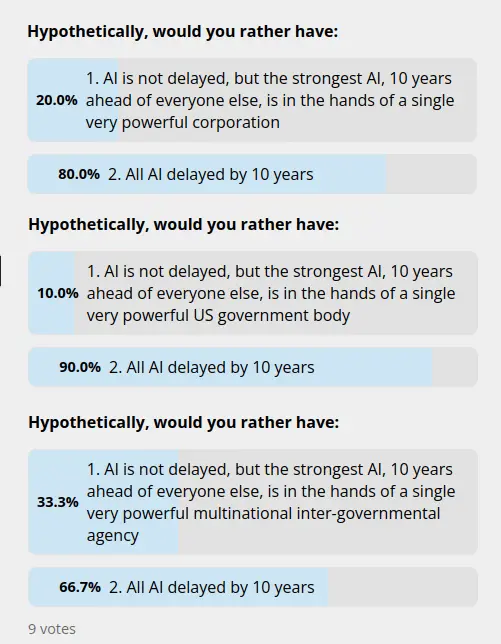
Generally, regulation is detrimental to both decentralization and acceleration: it makes the industry more centralized and slows its development. Many of the most harmful cryptocurrency regulations (such as "mandatory KYC for all transactions") undoubtedly move in this direction. However, these goals can sometimes diverge. For AI, this situation may already be occurring. Decentralization-focused AI strategies emphasize running small models on consumer hardware, thus avoiding a dystopia of privacy and centralized control, where all AI relies on centralized servers that can see all our actions, and the biases of their operators affect AI outputs, leaving us with no escape. One advantage of small model strategies is that they are more conducive to AI safety, as small models are inherently more limited in capability, functioning more like tools rather than independent agents. Meanwhile, acceleration-focused AI strategies are enthusiastic about everything from the smallest models running on tiny chips to Sam Altman's dream of a $7 trillion cluster.
As far as I know, we have not yet seen such a significant divergence in the crypto space, but it is likely to happen in the future. If you encounter a "crypto-supporting" politician today, it is worth exploring their fundamental values and observing which side they prioritize when conflicts arise.
What "Crypto-Friendly" Means to Authoritarians
There is a common "crypto-friendly" style among authoritarian governments that is worth being wary of. The best example is modern Russia.
The recent Russian government's policy on cryptocurrency is quite simple and has two aspects:
When we use cryptocurrency, it helps us avoid others' restrictions, so that is good.
When you use cryptocurrency, it makes it harder for us to restrict or monitor you, or to imprison you for 9 years for donating $30 to Ukraine, so that is bad.
Here are examples of each type of action by the Russian government:

Another important conclusion is that if a politician supports cryptocurrency today but is very power-seeking themselves or willing to appease power seekers, then their advocacy for cryptocurrency is likely to evolve in that direction over the next decade. If they or the people they appease truly consolidate power, this is almost inevitable. Additionally, it is worth noting that the strategy of trying to get close to dangerous figures to "help them become better" often backfires.
But I like a politician because of their overall platform and views, not just because they support cryptocurrency! So why shouldn't I feel enthusiastic about their stance on cryptocurrency?
The game of politics is far more complex than "who wins the next election," and your words and actions can influence many aspects. In particular, when you publicly express support for a "crypto-supporting" candidate solely because they support cryptocurrency, you are actually helping to create an incentive mechanism that leads politicians to believe they can gain your support simply by supporting cryptocurrency. Even if they also support banning encrypted messaging, even if they are power-seeking narcissists, or if the bills they promote make it harder for your friends from China or India to attend the next crypto conference—these politicians just need to ensure you can easily trade cryptocurrency.

("A person tossing coins in a cell," generated using locally run StableDiffusion 3)
Whether you are someone ready to donate millions of dollars, someone ready to influence millions of Twitter followers, or an ordinary person, you can help create a more honorable incentive mechanism.
If a politician supports cryptocurrency, the key question is: Are their motives correct? Do they have a vision for 21st-century technology, politics, and economic development that aligns with yours? Do they have a positive vision that goes beyond short-term interests (like "fighting opposing factions")? If so, great: you should support them and clearly state that this is why you support them. If not, then you should either completely disengage or look for more suitable allies.
 Risk warning Risk warning




Popular articles