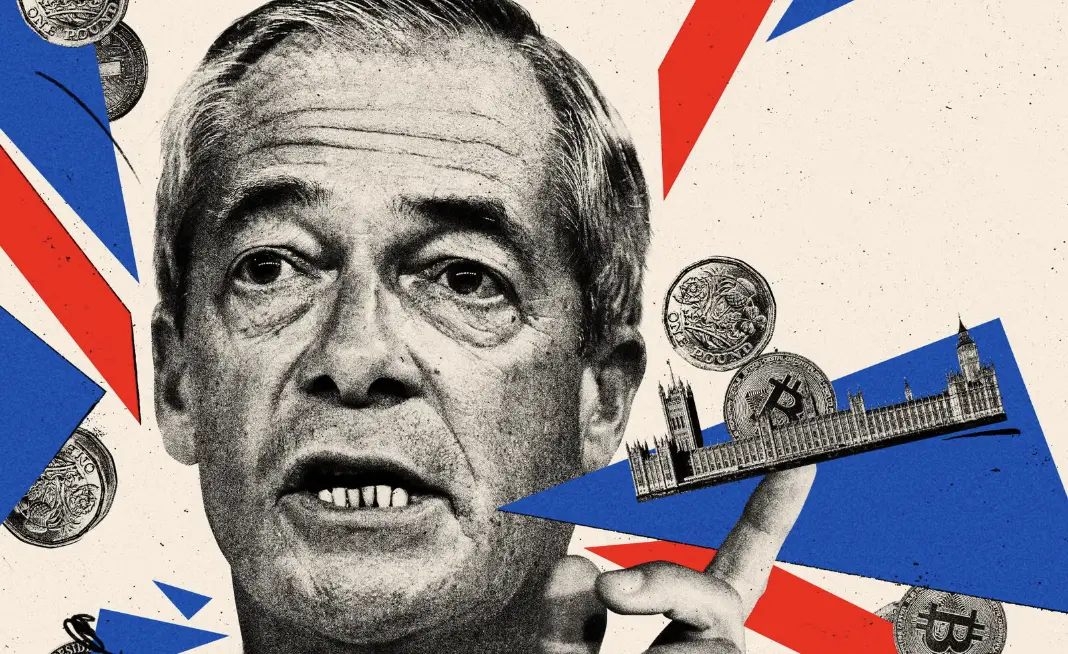
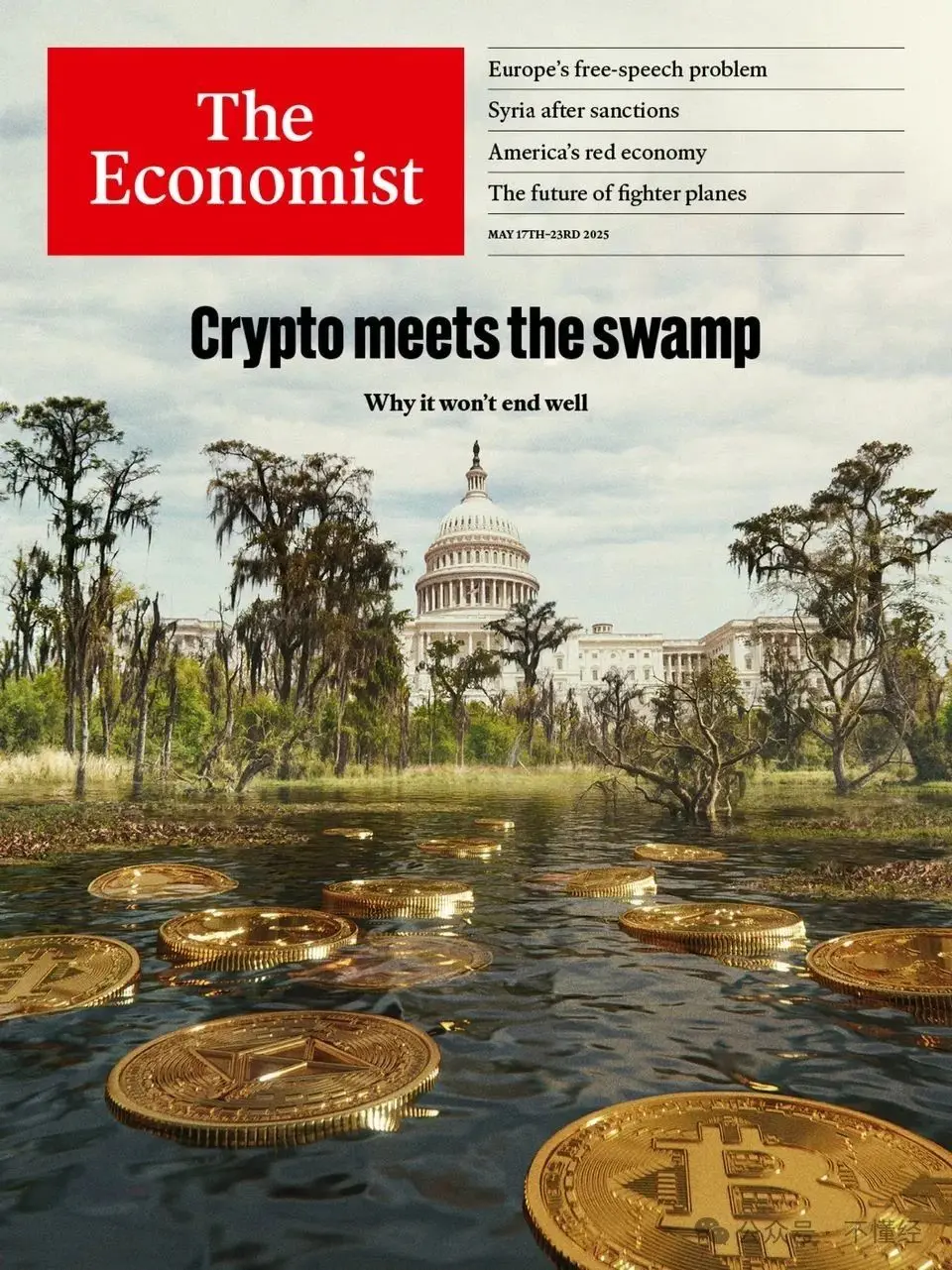
The Economist: Cryptocurrencies have become the ultimate "swamp assets."

 If you can't beat them, join them.
If you can't drain the swamp, become the swamp.
If you can't beat them, join them.
If you can't drain the swamp, become the swamp.Author: Uncle who doesn't understand the classics' Rust, doesn't understand the classics
"Drain the Swamp" is Trump's core campaign promise, meaning to eliminate political corruption and special interest groups in Washington. However, on the issue of cryptocurrency, he seems to be digging a new, more hidden, and potentially more dangerous "digital swamp" himself.
Once, the protagonist of the crypto world was Satoshi Nakamoto; today, the protagonist is the U.S. president who claims "no one understands it better than me." Trump once asserted that cryptocurrency is "extremely volatile and has no support"; now he has transformed, calling the crypto community "full of the spirit of the founding era, exciting."
This dramatic turn reflects not only a change in personal attitude but also the fact that cryptocurrency—once a "dragon-slaying youth" carrying subversion and ideals—has gradually become "swampified," even alienated into a "philosopher's stone" that some power players can turn into gold.
We are at a paradoxical moment: a technology that claims to be "decentralized" and free from power control is now flirting with the highest levels of political power, even deeply intertwined. This is not only a betrayal of its original intent but could also lead to an existential crisis that goes beyond the financial realm.
The latest cover article of The Economist states that cryptocurrency has become the ultimate "swamp asset." In a sense, is this a victory of the revolution?
Today, let's discuss why the domineering president has fallen in love with crypto, the reversals, the game of money and power, and the crises behind it.
I. Trump's "Crypto Feast": A Carefully Orchestrated "Gold-Plated Game"
The climax of the story was the planned dinner on May 22, 2025. A few weeks earlier, Trump personally launched the meme coin—$TRUMP, which was on the verge of collapsing to zero and almost became a joke in the crypto world.
However, the president's personal "endorsement" acted like a shot of adrenaline, instantly giving it some "real value." The founding team of $TRUMP coin initiated a "pilgrimage" invitation: holders of coins ranked in the top 220 could enjoy the "honor" of dining with Trump, and those in the top 25 could participate in a VIP reception for "intimate contact" with the president.
Once the news broke, the crypto community went wild, and a buying frenzy ensued. The final list of "lucky winners" formed a bizarre array of characters: wealthy crypto moguls, fervent MAGA (Make America Great Again) supporters, and pure speculators.
One planned to fly from Asia to the U.S. hoping to attract investment for his blockchain project that "promotes the next generation of meme culture"; another, a Trump supporter from New York, had previously splurged on a Trump-branded watch with cryptocurrency; there was even a mysterious figure wearing a mask, presenting himself as a "cyber detective," specializing in tracking stolen digital assets. Blockchain data ruthlessly revealed that foreign individuals were not uncommon among the VIP seats.
This seemingly star-studded feast was undoubtedly filled with controversy. U.S. government oversight organizations condemned it, pointing out that it might violate federal laws prohibiting officials from accepting gifts. Moreover, if individuals connected to foreign governments were present, the dinner could even violate the Emoluments Clause of the U.S. Constitution, which strictly prohibits federal officials from accepting any gifts from foreign governments. A former special advisor on ethics and government reform in the Obama administration sharply commented, "This is a moral nightmare."
Just four months into Trump's re-election, his family was rapidly expanding private business interests at an unprecedented speed and breadth. The meme coin dinner was just the tip of the iceberg. Their involvement in the crypto space goes far beyond this: a Bitcoin mining company and a project called "World Liberty Financial," prominently launched by his son, clearly bear the Trump family's mark.
Critics have pointed out that against the backdrop of Trump's significant relaxation of cryptocurrency regulation, these actions constitute a serious conflict of interest. The White House spokesperson downplayed the situation, claiming that the understanding king always prioritizes the interests of the American people, and that the meme coin dinner was a "private business activity" unrelated to the official White House. If anyone believes that, one can only say that Americans are naive.
This is not just a dinner; it resembles a carefully orchestrated "gold-plated game." The transaction fees of $TRUMP coin, along with the approximately $10 billion worth of tokens reportedly still held by close associates, illustrate the true winners of this game.
Data from blockchain analysis company Chainalysis shows that while 58 investors profited over $10 million from this coin, approximately 764,000 wallets suffered losses, most of which were likely retail investors attracted by the "get-rich-quick" myth. As the powerful divide the spoils amid the clinking of glasses, the dreams of countless ordinary investors may turn to dust.
II. The "Swampification" of Cryptocurrency: From "Dragon-Slaying Youth" to "The Evil Dragon Itself"
(1) A Broken Utopia: The Fading of Ideals and the Departure from Original Intent
Looking back at the origins of cryptocurrency, how many inspiring declarations have we heard? Bitcoin burst onto the scene in 2009, and a movement filled with utopian colors and shining with anti-authoritarian light arose. Early cryptocurrency believers harbored lofty, even great goals: they yearned to completely disrupt the existing financial system, protecting personal property from the erosion of inflation and unjust confiscation. They dreamed of reclaiming power from large financial institutions and handing it over to every ordinary investor.
In their eyes, cryptocurrency was not just an asset but a liberating technology, a tool that could bring about a fairer and more transparent world. Crypto evangelist Andreas Antonopoulos passionately declared, "Bitcoin is disruption. The impact it brings is so great that most people still find it hard to imagine… a complete disruption. A fully decentralized currency, without borders… Bitcoin is born for the six billion unbanked people globally."
At that time, the crypto world was filled with a "techie" idealism. It attempted to play multiple roles: a value storage tool, a high-return investment, and a financial technology that allowed people to transfer money peer-to-peer without government and bank-controlled channels. It promised a certain degree of anonymity and privacy, allowing people not to feel like "Uncle Sam" was watching them all the time. It fundamentally provided an option to escape the traditional system, as early supporters were filled with extreme distrust of the existing financial system.
However, over the course of more than a decade, reality has drifted further from the initial ideals. It is evident that the ideals of cryptocurrency are continuously "shrinking." Unless you are a die-hard crypto believer, you probably no longer think that cryptocurrency can replace the global financial system, end the dominance of the dollar, euro, and yen, or make the banking system disappear entirely.
(2) The Mixed Reality: The Birth of "Swamp Assets"
Today, cryptocurrency often presents a different picture. It has become a highly speculative tool; people buy and hold, expecting it to rise in price; or short it, expecting it to fall; or invest in certain crypto companies, hoping they can outperform the market.
It has also been widely criticized for playing a fundamental role in black market transactions, being extensively used in human trafficking, drug trade, and terrorism financing. Many crypto activities choose to operate outside the U.S. jurisdiction precisely because related companies are unwilling or unable to comply with U.S. securities and banking regulations.
The concept of "swamp assets"—proposed by The Economist—accurately summarizes the awkward predicament of cryptocurrency today. An industry that once dreamed of "staying away from politics" has now become synonymous with "using power for personal gain," developing a "dirty relationship" with the U.S. government that far exceeds Wall Street or any other industry. This is undoubtedly a huge irony.
Crypto industry giants are pouring hundreds of millions of dollars into political lobbying to maintain friendly legislators and ruthlessly attack those who attempt to regulate them. The president's sons are peddling their crypto projects around the world, while the president himself engages in interest exchanges with the biggest investors through events like the crypto dinner.
The cryptocurrency held by the first family is now worth billions of dollars, which may even become the family's largest single source of wealth.
This trend of "swampification" sharply contrasts with other major economies in the world.
In recent years, countries and regions such as the European Union, Japan, Singapore, Switzerland, and the UAE have successfully provided new regulatory clarity for digital assets without experiencing similar rampant conflicts of interest. In developing countries where government expropriation is common, inflation is high, and the risk of currency devaluation is real, cryptocurrency still plays a role that somewhat aligns with the expectations of early idealists.
Ironically, all of this is happening against the backdrop of increasingly mature underlying technologies for digital assets. Speculative behavior remains rampant, but mainstream financial companies and tech giants are beginning to take cryptocurrency more seriously. The process of "tokenizing" real-world assets is accelerating, with traditional financial institutions like BlackRock and Franklin Templeton becoming major issuers of tokenized currency market funds. The application potential in the payment sector is also enormous, with companies like Mastercard and Stripe embracing stablecoins.
However, in the U.S., a country that should lead innovation, the cryptocurrency industry seems to have chosen a shortcut to dance with power. They argue that during the Biden administration, due to SEC Chairman Gary Gensler's tough stance and frequent enforcement actions, they had no choice but to "fight by any means." Banks are afraid to provide services to cryptocurrency companies due to regulatory pressure and are hesitant to venture into the field.
This argument has some merit; clarifying the legal status of cryptocurrency through the courts rather than Congress is indeed inefficient and not entirely fair. But now, with Trump's rise to power, the regulatory pendulum seems to be swinging violently to the other extreme, with most cases against cryptocurrency companies being dropped. Is this a victory for the industry, or does it lay the groundwork for a greater crisis?
III. Why Does Trump Love Crypto: A Sugar-Coated Bomb or Pandora's Box?
Trump's 180-degree turn in attitude towards cryptocurrency is one of the most striking phenomena in American politics in recent years. From once saying, "I don't like Bitcoin and other cryptocurrencies; they are not currency, extremely volatile, and have no substantive basis," to now claiming he wants to make America the "global crypto capital" and "the undisputed Bitcoin superpower," is this a well-considered policy shift or a carefully calculated political and business marriage?
(1) "Under the Sugar Coating": Why Does Trump Embrace Crypto?
Trump's "crypto preference" is not without reason; the driving forces behind it are complex and direct:
1. Naked Economic Interests: This is the most direct and unvarnished motive. Trump and his family members have deeply engaged in the investment and operation of cryptocurrency. Whether it's the $TRUMP meme coin that has made him and his partners rich or the Bitcoin mining company his two sons invested in, as well as their majority stake in World Liberty Financial, all point to personal wealth growth. The president and his family are directly profiting from this emerging industry.
2. Real Political Considerations: The crypto community is described by Trump as "full of the spirit of the founding era, exciting." Behind this is a desire to tap into the political energy of this group. Cryptocurrency advocates are often young, passionate, and financially capable. Securing their votes and campaign donations is highly tempting for any politician. Trump's promise to introduce crypto-friendly legislation and portray the Biden administration as the "executioner" of emerging industries is precisely to cater to this group's demands.
3. Consistent Anti-Regulatory Stance: One of the core policies of the Trump administration is deregulation. The cryptocurrency industry's challenge to the existing financial regulatory system and its desire for a more lenient environment align perfectly with Trump's governance philosophy. Liberating cryptocurrency from the "shackles" of agencies like the SEC fits into his overall strategy of weakening regulatory powers.
4. Self-Reinforcing "Disruptor" Image: The anti-establishment and traditional-challenging nature of cryptocurrency somewhat aligns with the "outsider" and "disruptor" image Trump has always tried to cultivate. Embracing this field, which is viewed as an "outlier" by mainstream finance, may further solidify his appeal among certain voter groups.
(2) "Bombs" and "Boxes": Potential Huge Risks
However, beneath the sugar coating of Trump's "crypto preference" may lurk "bombs" capable of blowing up the entire financial system or releasing countless disasters from a "Pandora's box." The risks are multidimensional and deep-seated:
1. Systemic Risks to the Financial System:
Volatility Contagion: The essence of cryptocurrency's "extreme volatility, narrative support" has not changed. In the absence of regulation, if it is allowed to deeply integrate into the mainstream financial system, its inherent instability may transmit through various channels to traditional financial markets, triggering a systemic crisis. Insiders warn that Bitcoin could become today's credit default swaps (CDS) or subprime mortgage securities (MBS)—those complex and under-regulated financial instruments that ignited the 2008 financial crisis.
Widespread Regulatory Arbitrage: Financial institutions inherently have an impulse to evade regulation. If the crypto space becomes a new "lawless land," Wall Street firms are likely to exploit this wave of "crypto-friendly policies" to "reshape" their businesses as crypto businesses, thereby circumventing existing regulatory frameworks aimed at protecting financial stability.
The Absurdity and Danger of "Strategic Bitcoin Reserves": The Trump administration's proposal to establish so-called "strategic Bitcoin reserves," planning to use up to $100 billion of public funds to purchase Bitcoin, Ethereum, and other cryptocurrencies, has been dismissed by experts as "meaningless and even downright foolish."
Unlike oil or pharmaceutical reserves that have actual strategic value, Bitcoin reserves provide enormous benefits to the crypto industry but have almost no strategic significance. This essentially puts taxpayers' money into highly speculative assets, with risks fully socialized.
Replaying the 2008 Crisis: Once these risks explode, their impact will far exceed just "crypto traders" and will affect all ordinary Americans with mortgages, retirement accounts, or those hoping to start a business through loans. Because the entire financial system is built on a foundation of "trust," when opaque risks are quietly embedded and regulation is deliberately weakened, the collapse of trust is merely a matter of time. Even more frightening is that the "firewalls" established to respond to the crisis, such as the Dodd-Frank Act, are now being gradually dismantled by the Trump administration.
2. Risks to Ordinary Investors: Just Out of the Fire, Into the Swamp
Fraud Rife, Total Loss: The cryptocurrency space is rife with various scams and Ponzi schemes. Many companies spring up overnight, targeting those who are less knowledgeable about finance and technology with extravagant promises. Once defrauded, due to the anonymity and traceability issues of cryptocurrency, losses are nearly impossible to recover.
Compared to the layered risk alerts and anti-fraud mechanisms in traditional banking systems, the cryptocurrency world resembles a "dark jungle." Elderly individuals, veterans, startup founders, and even those simply looking for partners on dating apps can all become victims of scams, with losses amounting to billions of dollars.
The Illusion of "Democratization" and the Lament of Retail Investors: Events like the $TRUMP dinner, while seemingly providing ordinary people with opportunities to connect with top power, often result in the wealth of a few insiders and losses for many retail investors. The frenzy around meme coins is particularly pronounced, with their volatile nature causing most latecomers to become "bag holders."
3. National-Level Corruption and Crisis:
Trump once used "Drain the Swamp" as one of his core campaign promises, intending to eliminate political corruption and special interest groups in Washington. However, on the issue of cryptocurrency, he seems to be digging a new, more hidden, and potentially more dangerous "digital swamp."
This once-liberating idealistic "unicorn" is transforming into a "swamp beast" entrenched at the center of power.
Unprecedented Conflicts of Interest: The president and his family are directly profiting from an industry they are actively promoting deregulation in, a naked conflict of interest that is rare in the modern political history of the U.S. This is no longer just about "opening a Trump hotel next to the White House," but rather a "large-scale corruption version" of privatizing national public assets, even evoking thoughts of "banana republic" governance dysfunction.
Institutionalization of "Bribery Channels": The $TRUMP dinner and negotiations for equity with certain crypto giants with criminal records essentially put a price tag on political influence, providing interest groups with a "buying" pathway to the core of power. This severely erodes the integrity of politics and the fairness of decision-making.
A Breeding Ground for Terror Financing and Cyber Theft: The anonymity and cross-border fluidity of the crypto system have made it an ideal tool for state-level hacker organizations (like North Korea's "Lazarus Group") and terrorist organizations to conduct fund theft and terror financing.
Conclusion: Reflections on the "Me, Me, Meme" Era
"I, I, Meme"—this pun mimicking "Me, me, me" accurately captures the selfish nature of the current combination of cryptocurrency and political power.
A technology that once claimed to empower the masses now seems more eager to serve a few powerful elites. Cryptocurrency has gained an unprecedented role at the policymaking table, but its reputation and fate are now closely tied to the rise and fall of its political benefactor.
Trump's "preference" for cryptocurrency may bring enormous economic benefits to him and his family in the short term and secure a lenient regulatory environment for the crypto industry. However, as The Economist warns, the benefits of this deal may ultimately flow in only one direction. When the political winds shift or when risks accumulate to a critical point and finally explode, the once "honeymoon" may instantly turn into a "nightmare."
The technology of cryptocurrency itself is not original sin; it still shows positive innovative potential in areas like payments and asset tokenization. But when this potential is hijacked by political speculation and bottomless pursuit of interests, and when "innovation" degenerates into a pretext for "rent-seeking," the consequences could be catastrophic.
What people need is genuine financial innovation that can benefit the masses and promote social progress, rather than a "swamp carnival" ultimately paid for by ordinary people.
 Risk warning
 Risk warning