



The "DNA Airdrop" of the Telegram founder, who has set a will for a hundred children at the age of 40

 This is the longest interview Pavel Durov has given, a conversation about politics, power, and democracy.
Author: Guillaume Grallet, Le Monde
Translation: angelilu, Foresight News
Editor's Note: Pavel Durov, founder and CEO of Telegram, was sued by France and banned from leaving the country in August 2024. After 10 months, he was granted permission to leave France for 14 days starting July 10, but only to Dubai (where his family is) and must continue to be under judicial supervision.
French magazine Le Point interviewed Pavel Durov, co-founder and CEO of the encrypted messaging app Telegram, in what is his longest interview to date. In this interview, he shared his feelings about being interrogated in France, revealed information about several national authorities and intelligence agencies, including the FBI and the French Directorate-General for External Security (DGSE), expressed his struggle for freedom of speech and concerns about the future of democracy, firmly rejected selling Telegram, and shared his deep feelings for France. He also shared his views on Elon Musk, Mark Zuckerberg, and Sam Altman, the creator of ChatGPT.
Pavel Durov also revealed that at just 40 years old, he has made a will, distributing his wealth "equally" among his six biological children and over 100 children conceived through sperm donation, and requiring his children not to inherit his property for 30 years. His "secret" to looking so young is staying away from anything potentially addictive, not drinking alcohol, coffee, or tea, not smoking, avoiding sugar, and doing 300 push-ups and 300 squats every morning without interruption.
Pavel Durov stated that Telegram is a source of expenditure for him, not income, and that his liquid assets are much less and not from Telegram, but from his investment in Bitcoin in 2013. He believes that current large models of AI are not intelligent, while his brother Nikolai is developing truly "intelligent" AI.
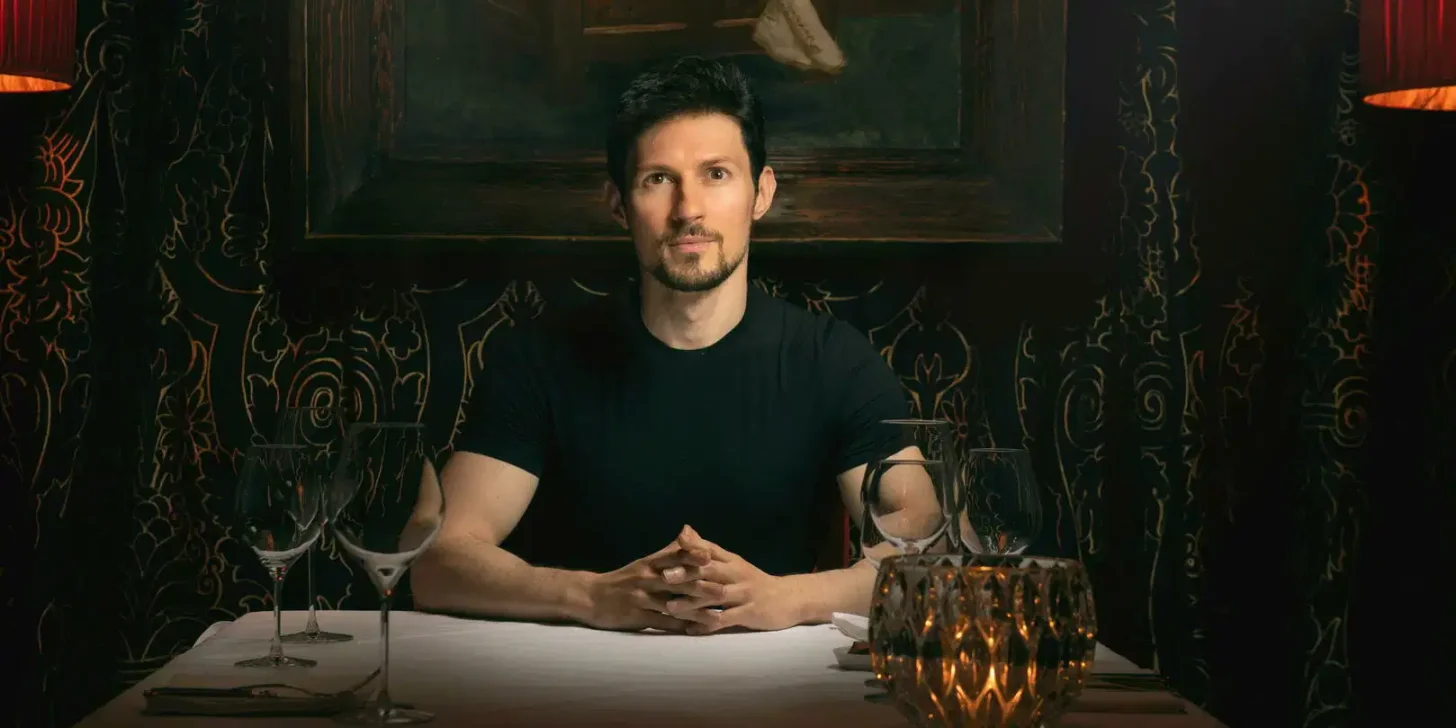
Here is the full interview:
You are accused of 17 very serious charges, including child pornography, drug trafficking, and money laundering… Do you understand the charges against you?
Pavel Durov: This is completely absurd. Just because criminals use our messaging service among many platforms does not make the person operating it a criminal… There has never been any evidence that I have committed any crime, even for a second. But it seems I have already been punished at this stage by being banned from leaving the country. It seems that the French judge, realizing there is not enough substantive content for a real conviction, wants to punish me today. They say Telegram refuses to cooperate. This is wrong. It is the French police that did not properly follow international procedures. The Telegram team even had to show them how to operate correctly.
Have you been summoned by the judicial system?
I met with the judge responsible for my case twice, in December 2024 and February 2025. There is another appointment in July. But this is crazy… I understand that things take time. But why must I stay in France waiting? My lawyers have submitted all the documents requested by the judicial system.
The first few days were difficult…
I was constantly interrogated in a judicial customs facility. Within four days, I answered all questions. At night, a bright light illuminated my 7-square-meter room where I slept on a concrete bed. The room was clean but had no pillow. The mattress [he gestures with his thumb and index finger to indicate thickness] is no thicker than a yoga mat.
You seem very affected by being banned from leaving French territory…
Yes, very affected. My parents have very serious health issues, and statistically, they only have a few years left to live. I have lost precious time with them. Additionally, I have a newborn son, and I missed the first few months of his life. He still does not have a passport because I could not attend his birth in Dubai. I also have a teenage son in a boarding school in Dubai who just broke his arm and has no parents to support him.
Does this situation affect your activities?
Yes, it does. For example, I was supposed to speak at the Oslo Freedom Forum last May. The forum's chair is Yulia Navalnaya [Note: Yulia Navalnaya is the wife of the late Russian opposition leader Alexei Navalny], and I wanted to meet her and activists from around the world to learn how they use Telegram and what we can improve. The judge prohibited me from going there. We had to conduct the live interview via video conference. I have fought for freedom of speech for nearly twenty years. Navalny sometimes expresses views I agree with and sometimes makes statements I do not agree with—but he has the fundamental right to express himself, which I have always upheld. Faced with the Russian authorities, I had only two choices: either yield to their demands or sell my shares and leave the country.
A frequently mentioned question: Are you closely related to Vladimir Putin?
I have only met a senior Russian official once in 2013. At that time, I was in charge of VKontakte (the "Russian Facebook"), and I refused to provide information about regime opponents. The meeting lasted no more than 15 minutes. This senior Russian official insisted that, in his view, social networks should be tools of the government. Then I had two choices: either I do exactly what the Russian authorities expect of me, or I sell my shares and leave the country. The Russian regime gave me the freedom to choose. So I told them, "I understand, thank you very much." Two months later, I sold my shares in VKontakte. I have not set foot in Moscow for over a decade.
Have you ever cooperated with the Russian authorities in any way?
No. We handle reports from Russia and other countries to remove obviously illegal content (such as public promotion of illegal drugs), but we have never complied with requests related to political censorship or political persecution. During my time at VKontakte, I publicly refused to cooperate for this purpose. I was even summoned by Russian justice. In 2014, I left everything behind.
According to media reports from Important Stories, you continued to travel to Russia. Some say: if you are still alive, it is because you have an agreement with the Kremlin…
I visited Russia between 2015 and 2017 to see my family in St. Petersburg—this was never a secret, and I even posted about it on social networks. I also went there during the COVID pandemic to support my father. But I haven't been back for four years, since the first articles mentioning a possible war with Ukraine appeared in 2021.
Before coming to France, you were in Azerbaijan…
Before arriving in Paris last August, I passed through Kazakhstan, Uzbekistan, and Kyrgyzstan before reaching Azerbaijan. I stayed in Baku, and President Putin arrived there two days after I left the mountains. I neither met him nor anyone in his entourage. During this trip, I only met the President of Azerbaijan, and we discussed the role of Telegram in the country. You know, in three years, I have met 16 heads of state. I do not always agree with their views.
Does this mean you support the policies of Ilham Aliyev, who is considered authoritarian?
You know, in three years, I have met 16 heads of state. I do not always agree with their views. Just like Paul Kagame in Rwanda. You can criticize his methods, but what he has done in Rwanda is impressive. I realized this when I visited villages. I saw that despite the country's poverty and history, people still smile and want to survive.
In your view, how has the war in Ukraine affected people's perception of Telegram?
In Russia, they say Telegram supports Ukraine. In Ukraine, they say Telegram spreads Russian propaganda. In reality, we have a neutral responsibility. Telegram is a platform where different ideas can collide, and everyone can access different viewpoints and freely decide what they want to believe. I will never comment on geopolitical conflicts because it would immediately be interpreted as supporting one side or the other, and a neutral platform cannot do that if it wants to remain fair and apply the same rules to everyone. But I will always fight for fair access to free and independent information. Once you legitimize censorship, it is hard to turn back.
You have expressed concerns about the European Digital Services Act, which aims to combat misinformation, hate, or illegal content on online platforms…
These laws are dangerous because they can be used against the very people who create them. Today, they target so-called conspiracy theorists. Tomorrow, they may target their own authors. These precedents weaken democracy in the long run. Once you legitimize censorship, it is hard to turn back.
You are sometimes compared to Elon Musk…
Yes, but we are very different. Elon manages several companies at the same time, while I only manage one. Elon can be very emotional, while I try to think carefully before acting. But that may also be the source of his strength. One person's advantage can often become a weakness in another context.
What do you see as the strengths and weaknesses of Mark Zuckerberg (founder of Facebook)?
Mark is adaptable and can quickly follow trends, but he seems to lack the fundamental values that remain loyal regardless of the political climate or trends in the tech industry. Similarly, Mark's strengths and weaknesses may have the same root. By removing weaknesses, you also remove strengths.
And what about Sam Altman, the creator of ChatGPT and the parent company OpenAI?
Sam has excellent social skills, which allow him to build alliances around ChatGPT. But there are doubts about whether his technical expertise is still sufficient after his co-founder Ilya [Sutskever, editor's note] and many other scientists left OpenAI. In an increasingly competitive environment, it will be interesting to see how they track the development of ChatGPT and maintain their lead. I want to point out that I do not treat my children differently.
You often mention your family. What place does it hold in your life?
It is very important. I recently wrote my will… I decided that my children would not inherit my property until thirty years from today. I want them to live like normal people, grow up on their own, learn to believe in themselves, and be able to create without relying on a bank account. I want to emphasize that I do not treat my children differently: some are naturally conceived, and some are from my sperm donation. They are all my children and will have the same rights! I do not want them to fight with each other after I die.
How many children do you have?
I have six children with three different partners. The others are from my anonymous donations. I started donating sperm to a clinic 15 years ago to help a friend, and the clinic told me that over 100 babies have been conceived this way in 12 countries.
Why write this will now? It is rare at 40…
My work involves risks—defending freedom will earn you many enemies, including powerful enemies within the state. I want to protect my children and the company I created, Telegram. I want Telegram to always remain true to the values I defend.
You look very young…
I follow a strict lifestyle and exercise, doing 300 push-ups and then 300 squats every morning—also continuously. I do not drink alcohol, coffee, or tea, do not smoke, and avoid sugar. In short, I stay away from anything that could be addictive. I enjoy swimming in cold water. Sometimes I swim in Finland or Lake Geneva in the dead of winter—this may raise eyebrows (he smiles).
What will happen to Telegram after you…?
If I disappear, a non-profit foundation will take over. My goal is to ensure the continuity of the platform: I want it to continue to exist independently, respecting privacy and freedom of speech.
In the past, you were targeted by Pegasus spyware. However, you managed to avoid using a phone…
I do not carry a phone with me. I manage the Telegram app and video conference work meetings using an iPad. I prefer reading, thinking, and writing rather than staring at a phone. This gives me freedom. My team knows how to contact me, and I can stay focused. Attention is our most valuable asset today. Notifications are parasites in our lives.
Is this a form of digital asceticism?
Absolutely. I prefer to protect my thoughts. This is also a form of respect for the people I interact with: I am there, with them, truly together.
Should people under 15 be banned from using social networks?
Such initiatives seem ineffective to me. Children can easily use VPNs. It is not feasible. The most important thing is to instill discipline. We must show them that achieving success through effort brings invaluable confidence. If adults do not set an example, prohibitions are meaningless.
Do you consider yourself an entrepreneur involved in politics?
I am not involved in politics. I have never voted. But I tirelessly defend freedom.
Is Donald Trump fueling global unrest?
I am not a fan of everything he does, but I think banning Donald Trump from using social networks is a mistake, even a very dangerous one. It sets a precedent. If we allow ourselves to treat a former U.S. president this way, it means everyone is vulnerable.
Is this why you defend freedom of speech?
Absolutely. Today, perhaps it is the bad guys being censored. But tomorrow, it could be you. Freedom cannot only be defended halfway.
How do you explain Telegram's strong growth without advertising?
Our starting point is betting on human wisdom. If we provide consumers with a better experience than our competitors, they will test and adopt it. Additionally, people often use multiple applications: one for work, another for personal life, another for learning… Moreover, our app consumes very little memory or bandwidth, making it very popular in countries like Afghanistan and Iran. Despite being banned by the Iranian government since 2018 for refusing to block protesters' channels.
Even if this part is through Russian-based infrastructure or data centers?
We have no infrastructure in Russia, nor have we ever had any.
Do you feel that some competitors are copying you?
WhatsApp always imitates our innovations with a five-year lag… but this does not bother me; rather, it validates the correctness of our choices. I once met with Mark Zuckerberg. I respect his business leadership, but to be honest, with such abundant resources, I think they could show more originality. I recently learned that WhatsApp has set up a dedicated team internally to monitor our movements…
You hold Signal Communications in higher regard…
Yes, I met its head, Meredith Whittaker, in Paris last year. She struck me as a smart, rational person. Of course, we will debate who uses the best encryption technology. I continue to ponder why all American messaging services (Signal, WhatsApp, Facebook Messenger, Google Messages) use exactly the same encryption technology, as if using other technologies is prohibited. But fundamentally, Telegram and Signal are on the same side when facing the challenges we must overcome.
Telegram has received several acquisition proposals…
Google attempted to acquire Telegram when we were just starting out. In 2017, I met with Sundar Pichai (CEO of Google) in Mountain View, and he made a $1 billion acquisition offer. Google was eager to acquire an instant messaging service because they missed out on WhatsApp, which was eventually acquired by Facebook. They had tried to develop their own messaging app but found it exceptionally difficult. Creating a successful messaging app is like nurturing a tree; it takes time and careful attention.
Why did you refuse?
I did not hesitate for a second. It is not a matter of price; Telegram is simply not for sale. Because Telegram is not a commodity, but a project. An idea. A promise of independence, confidentiality, and freedom to users. If you sell, you betray that promise. It is impossible, and I will never do that.
Are you still the sole shareholder of Telegram?
Yes, I own 100% of the company. There are no external shareholders, so there is no interference. This is the only way to ensure Telegram's complete independence. I learned from the history of VKontakte. Once you share control, you lose your freedom.
Looking back, do you have any regrets about Telegram's development?
Not really. We have a team of about fifty people, headquartered in Dubai—that is enough. A small team can act faster. We also collaborate with over 1,000 service providers in other parts of the world (mainly content moderators), but the number of developers does not need to increase with the number of users. We sometimes hire new engineers from the winners of coding competitions we regularly organize. One of the engineers we recently hired won our competitions 17 times in eight years—he was only 22 at the time. My brother Nikolai is currently researching true artificial intelligence—AI that can think logically and understand the world.
Are you impressed by artificial intelligence?
The problem is that generative AI like LLMs (large language models) do not think today. They do not understand; they just read vast amounts of text and repeat a consensus version. It may seem credible, but it is not necessarily so. And we humans are fooled because we associate complex language with intelligence. But these models are not intelligent. They are just complex. My brother Nikolai [referring to Pavel Durov's brother Nikolai Durov] is currently researching true artificial intelligence—AI that can think logically and understand the world.
Will it replace certain jobs?
We are experiencing unprecedented technological acceleration. For teenagers, adaptation is natural. But for experienced professionals, such as lawyers or doctors, who have high salaries, the transition will be brutal. Even though they are excellent, their perceived value in the market may decrease. Yes, jobs will disappear. But history shows that other jobs will emerge. The important thing is the wealth created. Being able to live like a king without working like a slave is progress. As long as we want to create and contribute to society, everyone will have a place.
What about Telegram?
AI enables us to conduct effective moderation. Thanks to it, we can delete up to 99% of problematic content. Millions of posts every hour cannot be handled manually. Each user can also summarize discussion threads, documents, correct texts, translate, and seek writing assistance…
What role does your brother play beside you?
Nikolai is a genius, but he has not been involved in Telegram's operational activities for years. In recent years, he has focused on fundamental research, such as designing infinitely "scalable" blockchain architectures.
Telegram generates 500 million euros in profit, making you a billionaire…
Telegram has never paid me dividends, and I do not have a salary—Telegram is a source of expenditure for me, not income. I want this project to exist, so I spent almost all the money I obtained from selling my VKontakte shares (over $200 million) to build Telegram. Then we raised funds for Telegram's blockchain project, but after being banned by the SEC in 2020, we had to return investors' funds. We returned everything. But for that, we had to go into debt by $2 billion. Telegram still bears that debt.
In Paris, you mainly live in the Crillon Hotel, a palace. Have you developed an interest in this luxurious lifestyle?
I do not own a house, yacht, or private jet—even though I sometimes rent—I enjoy staying in beautiful hotels. I believe that owning possessions distracts me from my mission: building Telegram. Last October, I realized that I had been wearing the same few pairs of shoes for four years (my friends gave me a new pair for my 40th birthday). I only have one suit, but most of the time I wear sportswear—usually Adidas or Nike. The media estimates my wealth to be between $15 billion and $20 billion, but that is just a theoretical estimate of what Telegram might be worth. Since I will not sell Telegram, it does not matter. I do not have that money in a bank account. My liquid assets are much less—and they do not come from Telegram: they come from my investment in Bitcoin in 2013.
Did the poverty you experienced in childhood help you succeed?
I clearly remember the black jacket I wore as a teenager. I only had one, and I loved it. My mother bought it second-hand from a small community store in St. Petersburg. She had two jobs: a German translator and a legal assistant at an American law firm. My father taught for a long time without being paid. The Russian state went bankrupt in the 1990s. It was tough but very educational. Even when sick, I never missed school. My mother said, "You are not sick; you are going to school."
On May 18, you accused France of influencing the Romanian elections, which was denied by the French Foreign Ministry and DGSE…
This was a private conversation in the Battles salon of the Crillon Hotel, where I spoke with DGSE head Nicolas Leiner and a DGSE agent who had worked at the French embassy in the UAE. Nicolas told me, "We may have problems in Romania," and asked if I could delete Telegram channels operated by supporters of a conservative candidate in the Romanian presidential election—those that already existed and those that might appear in the future. I remember he mentioned that he thought these channels posed a risk of starting to organize protests. My response was very clear: I did not suppress protesters in Belarus, Russia, Iran, or Hong Kong, and I would not start doing so in Romania. I told them that if they thought I would comply with all requests because I was stuck in France, they were very mistaken. I would rather die than betray my values and my users.
Have you communicated with French intelligence services?
Yes, I have always been reachable by French authorities because my office is in the same building as the French consulate in Dubai. A DGSE agent working for the French embassy, sometimes accompanied by colleagues, would come to my office to ask Telegram to help them with counter-terrorism efforts in France—faster than the usual legal procedures allow because the situation was urgent. Last July, he asked me again to help prevent possible attacks during the Olympics. We provided assistance, and he expressed gratitude. A month later… I was arrested in Paris.
Does Telegram transmit data to the authorities?
Telegram employees cannot view or read users' messages, which explains why we have never disclosed a single private message throughout our history. If we receive a court order indicating that a certain identifier is under suspicion in a criminal investigation, we analyze the metadata, which allows us to provide IP addresses and phone numbers. That is all.
When was your last conversation with Emmanuel Macron (the French president)?
For a long time, he could message me on Telegram about various topics. The last time was the day I mentioned the Romanian elections and the DGSE statement. He sent me a message (he smiles). I did not respond to him.
What if he proposed to meet you?
I would refuse.
For what reason?
He understands certain things, but he could have done better. I had high hopes for him; he carried a real vision. But as his second term comes to an end, I see that he has not made the right choices. I am very disappointed. France is becoming weaker. There is an obsession with communication, while true power is not shown but proven. Reality has become an illusion, like in the village of Potemkin.
President Macron facilitated your French citizenship in 2021, just like Evan Spiegel, co-founder of Snap…
Yes, this makes my position more delicate. I deeply admire French culture and history. Being connected to France is an honor. But the direction the president is taking worries me.
Do you question his long-term vision?
Prosperity comes from competition between ideas, companies, and policies. And today, France does not encourage that. The country is losing competitiveness. This is paradoxical because the French have unique talents and the ability to do things in a balanced and beautiful way. They can contribute more effectively to the global economy.
Have they failed to do so?
Yes. Many of the best talents are leaving. We see more and more of them in Dubai, Abu Dhabi, the U.S., Milan… This is a real brain drain.
Why choose Dubai over Paris?
I chose Dubai because I can manage a global company more effectively there. Unlike bureaucratic France, Dubai offers a flexible environment. The procedures there are automated, supported by AI, and almost everything is done online. Even the judiciary is faster. In France, a simple tax investigation can freeze a company's accounts for years until it suffocates, even if later clarified. This burden stifles entrepreneurship.
Why not the U.S.?
One of the main reasons is the pressure the U.S. government may exert, especially on tech companies. Of course, the U.S. is not the only country wanting to control platforms. But I have already faced pressure from the FBI. Moreover, in the U.S., there is a legal procedure that allows the government to force an engineer to install a backdoor in software without the right to warn anyone, even their employer. This mechanism is called a "gag order." If an engineer discloses this to their boss, they could go to prison. Such laws provide the government with the legal means to turn your own employees into spies without your knowledge. Then there was that incident in San Francisco—the only time I was physically attacked. I will never forget it.
Back to France: Are there no political leaders you favor?
Politicians often lack courage. They are always looking for scapegoats to explain why they have failed. In France, a country with high demands and easy complaints, this attitude only makes things worse. They do not speak to citizens as adults, saying, "Everything depends on us. We need to roll up our sleeves and work," but instead blame Trump and his tariffs, the role of tech giants, immigration… Depending on which party is speaking, the culprit's name changes.
Is it too late to reform France?
If you raise one or two generations with a certain mindset, changing it takes decades. If we continue to waste time, the risk that the country will have to undergo very extreme changes will increase. Just like in the 1990s Soviet Union, we witnessed economic collapse, anarchy, crime, and drug abuse. Then, Russia emerged from this crisis with a vibrant private sector and strong growth. Then, 15 years later, everything deteriorated again for other reasons. When you delay necessary reforms for too long, you ultimately experience collapse. The French do not realize that freedom and prosperity are not gifts from heaven.
Do you think you are being monitored every day?
When I lived in Russia, I recognized the agents following me, even in the subway. Today, I do not even consider this issue anymore. Xavier Niel, with whom I once walked in Paris, jokingly told me, "Since intelligence agencies from different countries are tracking you, you do not need private security. They are everywhere, even on the rooftops, watching you!"
Do you believe in God?
I believe there is more to life than just the material. There is an intangible dimension that we sometimes feel deeply but cannot name. I was baptized as a Christian, but I am also very interested in Eastern traditions like Taoism or Buddhism. I have practiced meditation and yoga for a long time. For me, all religions attempt to express the same fundamental truth in their cultural language. I do not want to limit myself to a single path.
Some suggest we live in a simulation carefully crafted by aliens…
That is possible. Civilizations have always tried to explain the intangible world with the tools of their time. In the past, it was reincarnation and souls. Today, with technology, we talk about simulations. This is just a contemporary way of expressing ancient mysteries. A hundred years from now, we will use other metaphors. Perhaps more powerful metaphors.
Technology is so powerful, it can also pollute… yet you are concerned about the spread of microplastics…
These particles in water, air, and food, which are ubiquitous, could ultimately affect our civilization in a subtle way, somewhat like lead weakened the health of the Romans. History remembers their empire but does not forget the role of lead—in pipes and utensils—in weakening generations. Today, we observe a rapid decline in male sperm concentration in many regions, partly due to plastics. If we continue to ignore these invisible pollutants, we pose a threat not only to individual health but to our survival. The real danger is uniformity. The world has become too homogenized.
Do you speak Italian?
Every time I hear someone speak Italian, it touches me. It reminds me of my school days in Turin, where my father taught as a professor of classical philology when I was between 4 and 8 years old. A teacher from Calabria was particularly kind to me. Others teased me a bit, calling me "little communist" or "Soviet kid"… Northern Italians can sometimes be a bit arrogant and less welcoming to those from the south or foreigners. But the vast majority of residents are very warm.
Do you still believe in democracy, even though it has never been more threatened?
As long as different visions can collide and people can choose, democracy remains a good system. Some believe other systems can work—such as enlightened monarchy—but what if the successor is incompetent? The real danger is uniformity. The world has become too homogenized. Everywhere there are the same products, the same culture… This standardization makes us vulnerable. We must maintain diversity in systems, ideas, and methods.
 Risk warning
 Risk warning