4E Labs | A Guide for Ordinary People to "Get On Board" Under Hong Kong's Stablecoin Regulations

 In the past few years, the virtual currency market has experienced dramatic fluctuations globally, transitioning from rampant growth to strict regulation. As a bridge connecting digital assets with the real economy, the stability, compliance, and application value of stablecoins have garnered significant attention.
Introduction | Global First, Hong Kong Takes the Lead in Stablecoin Compliance Regulation
In the past few years, the virtual currency market has experienced dramatic fluctuations globally, transitioning from wild growth to stringent regulation. As a bridge connecting digital assets and the real economy, stablecoins have drawn significant attention regarding their stability, compliance, and application value.
In 2025, Hong Kong took the lead by officially passing the world's first comprehensive regulatory bill for stablecoins, the "Stablecoin Ordinance," which will take effect on August 1.
This means:
✅ Stablecoin issuance, circulation, and investment will be fully incorporated into a legal regulatory framework;
✅ Financial institutions and technology companies can launch stablecoin products under clear rules;
✅ For the first time, ordinary people will have the opportunity to invest in and use stablecoins in a compliant, safe, and transparent environment.
The implementation of stablecoin policies is not only a strategic move for Hong Kong to consolidate its position as a global digital financial hub but also opens a new window for ordinary investors, cross-border currency users, and asset allocators to participate.
I. Policy Overview | Comprehensive Interpretation of Hong Kong's "Stablecoin Ordinance"
1️⃣ Broad Scope
- Stablecoins pegged to fiat currencies (HKD, USD, RMB, etc.) issued in Hong Kong;
- Stablecoins issued overseas but pegged to HKD or promoted to the Hong Kong public.
Any involvement in the Hong Kong market or HKD pegging requires a license to prevent regulatory arbitrage.
2️⃣ Strict Regulatory Requirements
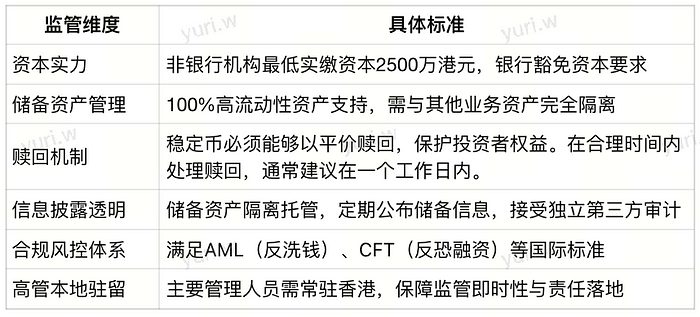
Three Pillars of the Regulatory Framework
- Issuance Access
- Non-bank institutions must have a paid-up capital of HKD 25 million (banks are exempt)
- Reserve assets must be 100% high liquidity assets such as cash/short-term government bonds
- Key positions (CEO, CFO, etc.) must be based in Hong Kong
- Technical Security
- Smart contracts must pass monthly audits by the Monetary Authority
- Reserve fund addresses must be monitored in real-time on-chain (e.g., using Chainlink oracles)
- Application Boundaries
- Interest payments are prohibited: to avoid becoming deposit-like products
- Cross-border promotion is restricted: "active promotion" to the Hong Kong public requires a license
3️⃣ Sandbox Mechanism
3.1 The Hong Kong Monetary Authority has established a "regulatory sandbox," allowing certain institutions to test stablecoin issuance and applications first, accumulate experience, and reduce market risks.
3.2 Participants
As of June 2025, there are:
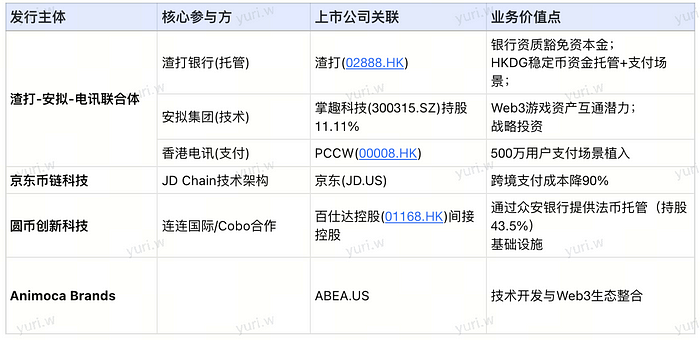
- JD Coin Chain Technology (HKD stablecoin JD-HKD);
- Standard Chartered Bank + Anxin Group + Hong Kong Telecom (HKDG stablecoin);
- Yuan Coin Innovation Technology (HKD stablecoin HKDR);
- Ant Group (Ant International, Ant Digital);
- Animoca Brands Limited
⚠️ Note: Sandbox testing does not equate to having obtained a license; full licensing will only occur after formal implementation.
II. Investment Dimension: Value Chain of Licensed Associated Enterprises
(1) Equity Perspective of Sandbox Participants
(2) Hidden Value Targets
▶ Baishida Holdings (01168.HK)
- Unique Advantage: Its subsidiary, ZhongAn Bank, has provided fiat custody for Standard Chartered and Yuan Coin, participating in the Monetary Authority's "Ensemble Sandbox Program."
- Undervalued: Current market capitalization is only HKD 1.97 billion, not fully reflecting its value as a "compliance channel" for stablecoins.
- Catalyst: If approved for stablecoin custody qualifications, valuation may be reassessed.
▶ Sifang Jingchuang (300468.SZ)
- Developed a cross-border clearing system for stablecoins for HSBC and Standard Chartered.
- Launched the FINNOSafe platform to provide issuance and custody services.
- Technical cooperation orders grew by 230% year-on-year in Q1 2025.
III. Application Revolution | Cross-Border Payment and RWA Practical Guide
(1) Cross-Border Payment Revolution: Instant Arrival, Drastic Cost Reduction
Liu Peng, CEO of JD Coin Chain Technology, disclosed in an interview with TECHHUB NEWS in May 2025 the three core application scenarios being tested for the JD-HKD stablecoin:
▶ Cross-Border Payment
- Traditional cross-border payments rely on the SWIFT system, with fund arrival periods of 2-4 days and fees as high as 1-3% of the transaction amount;
- The JD-HKD stablecoin can shorten transfer times to seconds and reduce costs by about 90%, greatly enhancing global capital flow efficiency;
- Focus on connecting high-frequency business scenarios such as cross-border e-commerce, supply chain payments, and B2B settlements.
▶ Investment Trading
- Currently collaborating with compliant cryptocurrency exchanges in Hong Kong to support institutional and retail investors in digital asset trading;
- JD-HKD, as a stable settlement tool pegged to HKD, reduces trading volatility and enhances asset circulation efficiency.
▶ Retail Payment
- Plans to integrate JD's Hong Kong and Macau sites and Southeast Asian business platforms to explore C-end payment scenarios;
- Consumers can directly use JD-HKD to pay for goods, eliminating currency exchange and traditional payment intermediaries.
Liu Qiangdong openly stated in a public sharing on June 17:
"After completing B-end cross-border payments, we will penetrate into C-end payments. In the future, everyone can use JD stablecoins for payments while consuming globally."
This means that stablecoins are not only efficiency tools for cross-border enterprises but are also expected to deeply penetrate the global consumer end, reshaping the traditional payment ecosystem.
(2) Pathways for Real Asset Tokenization (RWA)
Case Study
- Ant Digital's Jovay blockchain has completed a pilot for the tokenization of HKD 320 million in new energy charging pile revenue rights; investors can purchase yield-bearing stablecoins pegged to U.S. Treasury bonds through HashKey Exchange, with an annualized return of 4.2%.
Compliance Points
- Mainland residents can legally exchange currency using their annual personal foreign exchange quota of USD 50,000;
- It is strictly prohibited to use underground banks or gray capital channels to participate in investments.
IV. Risk Defense: Identifying Three Major Pitfalls
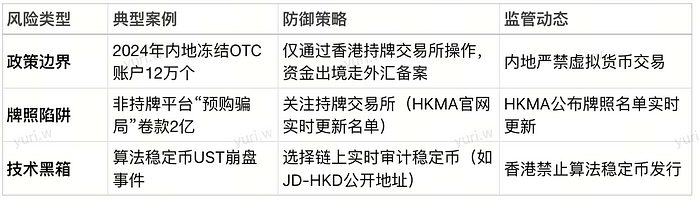
⚠️ The global daily trading volume of stablecoins has surpassed USD 100 billion. Hong Kong is reshaping the market with regulatory certainty, but caution is needed:
- Some illegal stablecoin projects that are "hanging sheep's heads while selling dog meat";
- Overseas promotional products that have not obtained licenses from the Hong Kong Monetary Authority;
- Fund flows that have not gone through formal financial channels.
- Never use unregistered payment channels (underground bank rates <1% are a high-risk signal)
- Non-licensed platforms claiming "high yield" must be scams (Hong Kong prohibits interest payments on stablecoins)
- Mainland bank cards should not involve any virtual currency transactions (to prevent accidental triggers of anti-money laundering controls)
V. Policy Window Period | Future Trends and Considerations
- Scarcity of First Batch Licenses: It is expected that only a few leading institutions will be approved, and ordinary people should prioritize following the progress of projects like JD, Ant, and Standard Chartered;
2. Comprehensive Restructuring of Hong Kong's Stablecoin Ecosystem:
- Formation of a multi-currency stablecoin matrix including HKD, USD, and offshore RMB;
- Applications in real scenarios such as cross-border payments, supply chain finance, and the digital economy;
- Further consolidation of Hong Kong's status as an international financial center, attracting global capital and technology;
- Ordinary people will see a significant increase in opportunities to legally, compliantly, and with low barriers participate in virtual assets.
3. Bright Prospects for Offshore RMB: Promoting the internationalization of RMB, reducing foreign exchange risks, especially beneficial for cross-border trade and asset allocation;
4. Acceleration of Cross-Border Payment Revolution: The "payment equals settlement" advantage of stablecoins is evident, and global cross-border capital flows will be reshaped;
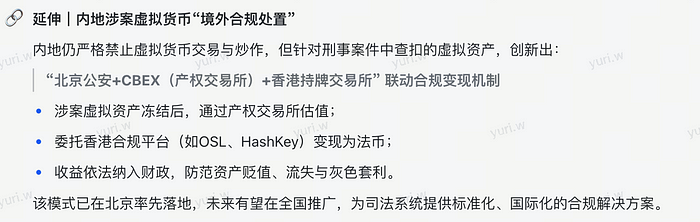
5. Improvement of Judicial Compliance Models: Standardization and transparency in the disposal of involved assets will enhance the governance capabilities of virtual assets in the mainland;
6. Caution in Assessing Policy Risks and Market Maturity: The ecosystem is still in its early stages, and ordinary people should cautiously test the waters and rationally allocate resources.
VI. Three Steps for Ordinary People to Enter Compliantly
✅ Step One: Policy Attention Follow the dynamics of the formal implementation of the ordinance on August 1 and the issuance of the first batch of licenses;
✅ Step Two: Account Preparation Open a Hong Kong bank account and a licensed exchange account, completing KYC certification;
✅ Step Three: Rational Testing Participate in stablecoin investments, payments, and asset allocation in small amounts to gradually familiarize yourself with the ecosystem structure.
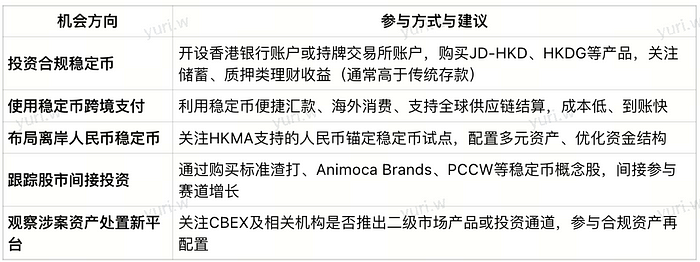
Tip: All operations must be conducted through compliant channels, paying attention to platform qualifications, KYC certification, and AML rules. Do not participate in unlicensed products or high-risk investments.
Conclusion
The virtual asset market is moving from the gray area towards institutionalization and transparency:
✅ Hong Kong's "Stablecoin Ordinance" has opened a new compliant participation window for ordinary people;
✅ Real demands for investment, payment, and asset allocation can safely land on compliant platforms;
✅ With technology-driven and policy support running in parallel, stablecoins are expected to become the next financial infrastructure.
The policy dividend has arrived, and ordinary people can also enter compliantly, provided you understand the rules.
 Risk warning Risk warning