



Hotcoin Research | The Era of On-Chain Stock Trading Has Arrived: Analysis and Outlook on the Tokenization of Stocks

 This article will provide a detailed analysis of the basic principles, advantages, representative platforms of stock tokenization, and its impact on the cryptocurrency market and traditional financial landscape. It will also explore the potential future development paths of stock tokenization, helping readers to fully understand the real value and challenges of stock tokenization, and better grasp the opportunities and risks behind this wave of financial innovation.
# Introduction
With the continuous development of crypto asset ETFs and the on-chainization of RWA, cryptocurrencies and traditional finance are gradually breaking down barriers. Recently, the innovation of stock tokenization has become a hot topic in the market. On June 30, Bybit and Kraken simultaneously launched the "xStocks" product provided by the Swiss compliant asset tokenization platform Backed Finance, covering approximately 60 stocks and ETF tokens. Kraken's co-CEO Arjun Sethi stated, "The market size for stock tokenization will ultimately far exceed that of stablecoins." On the same day, U.S. brokerage giant Robinhood announced the launch of stock token trading services based on the Arbitrum network for EU users, supporting trading of over 200 U.S. stocks and ETFs, including Nvidia, Apple, and Microsoft, enabling 24/5 uninterrupted trading on business days. The market responded positively, with Robinhood's parent company's stock price soaring 8% in a single day, reaching a new high since its IPO. Additionally, Dinari obtained the first broker-dealer license for stock token trading in the U.S., claiming to become the first compliant stock token platform in the country. The largest U.S. crypto exchange, Coinbase, also revealed that it has applied for regulatory approval to prepare for on-chain stock trading services for users.
This series of intense news clearly conveys a signal: stock tokenization is moving from concept to reality, gradually entering the financial mainstream from the margins. Will stock tokenization become the next trend to leverage the trillion-dollar traditional market's migration on-chain? Is tokenized stock a disruptive innovation for financial democratization, or just another fleeting speculative frenzy in the crypto market? This article will provide a detailed analysis of the basic principles, advantages, representative platforms of stock tokenization, and its impact on the crypto market and traditional financial landscape, while exploring potential future development paths for stock tokenization, helping readers fully understand the true value and challenges of stock tokenization, and better grasp the opportunities and risks behind this wave of financial innovation.
# The Mechanism and Advantages of Stock Tokenization
1. Definition and Implementation of Stock Tokenization
Stock tokenization refers to converting traditional securities like stocks into tokenized forms on the blockchain. Investors do not directly hold stock certificates but instead hold digital tokens corresponding to specific stocks, granting them rights equivalent to those of the original stocks, such as profits from price fluctuations and dividends.
Currently, there are mainly two paths for implementing stock tokenization in the industry:
Real Stock 1:1 Anchor Model: This involves a compliant custodian holding an equivalent number of stocks, issuing one token on-chain for every share of real stock held. These stock tokens are backed by real assets, similar to stablecoins supported by reserve assets. For example, the bAAPL and bTSLA U.S. stock tokens issued by the Swiss company Backed are backed by equivalent stocks held by regulated banks, which regularly disclose reserve proofs; similarly, the U.S. stock tokens issued by the Swarm platform are held by custodians and verified by trustees, with monthly public disclosures of reserves to ensure 100% physical backing.
Synthetic Token/Derivative Model: This does not hold the underlying stocks but simulates stock price performance on-chain through oracle price feeds and financial derivative structures. For instance, the decentralized exchange Helix in the Injective ecosystem launched iAssets synthetic assets, allowing traditional market assets like stocks, commodities, and foreign exchange to be traded purely as contracts on-chain. These synthetic stock tokens are not backed by custodial physical stocks and are more akin to perpetual contracts or contracts for difference, achieving price tracking entirely through on-chain contract mechanisms.
2. Advantages of Stock Tokenization
Compared to traditional securities markets, on-chain stock token trading has revolutionary significance in many aspects.
Breaking Time and Geographic Restrictions: Stock tokens can be traded 24/7, allowing for free buying and selling even on weekends or during traditional market closures; global investors can participate without barriers, needing only a smartphone or computer, unaffected by geography, time zones, or cumbersome cross-border procedures. For example, the U.S. stock tokens issued by Robinhood enable European users to trade U.S. stock tokens anytime and anywhere, just like trading cryptocurrencies, without needing to open a U.S. brokerage account or worry about time zone issues.
Significantly Optimized Settlement Efficiency and Trading Costs: Blockchain's peer-to-peer trading eliminates the need for central custodial clearing institutions, reducing intermediaries and manual reviews, allowing for real-time settlement and rapid fund availability. This is expected to lower trading fees and friction costs, with industry insiders generally believing that stock tokenization can significantly reduce the costs of securities trading and improve settlement speed.
Increased Asset Accessibility and Liquidity: Through tokenization, expensive blue-chip stocks can be divided into smaller token units, facilitating fractional ownership and small investments; simultaneously, on-chain tokens can be freely transferred and traded, not limited to a single exchange, thus potentially broadening liquidity pools. Especially for emerging market investors who previously could not participate in the U.S. stock market, stock tokens lower the entry barriers and remittance costs, allowing more people to share in the growth dividends of the global capital market.
Creating New Use Cases with DeFi: Users can utilize tokenized stocks like currency, enabling transfers, holdings, consumption, and even collateralized lending, all completed from their crypto wallets without intermediaries, borders, or delays. Scenarios unimaginable in traditional stock trading, such as using Apple stock tokens as collateral to borrow stablecoins on-chain or providing liquidity for Tesla stock tokens in DeFi pools to earn fees, are now becoming possible. These innovative uses are expected to unlock the dormant value of equity assets and enhance the operational efficiency of financial markets.
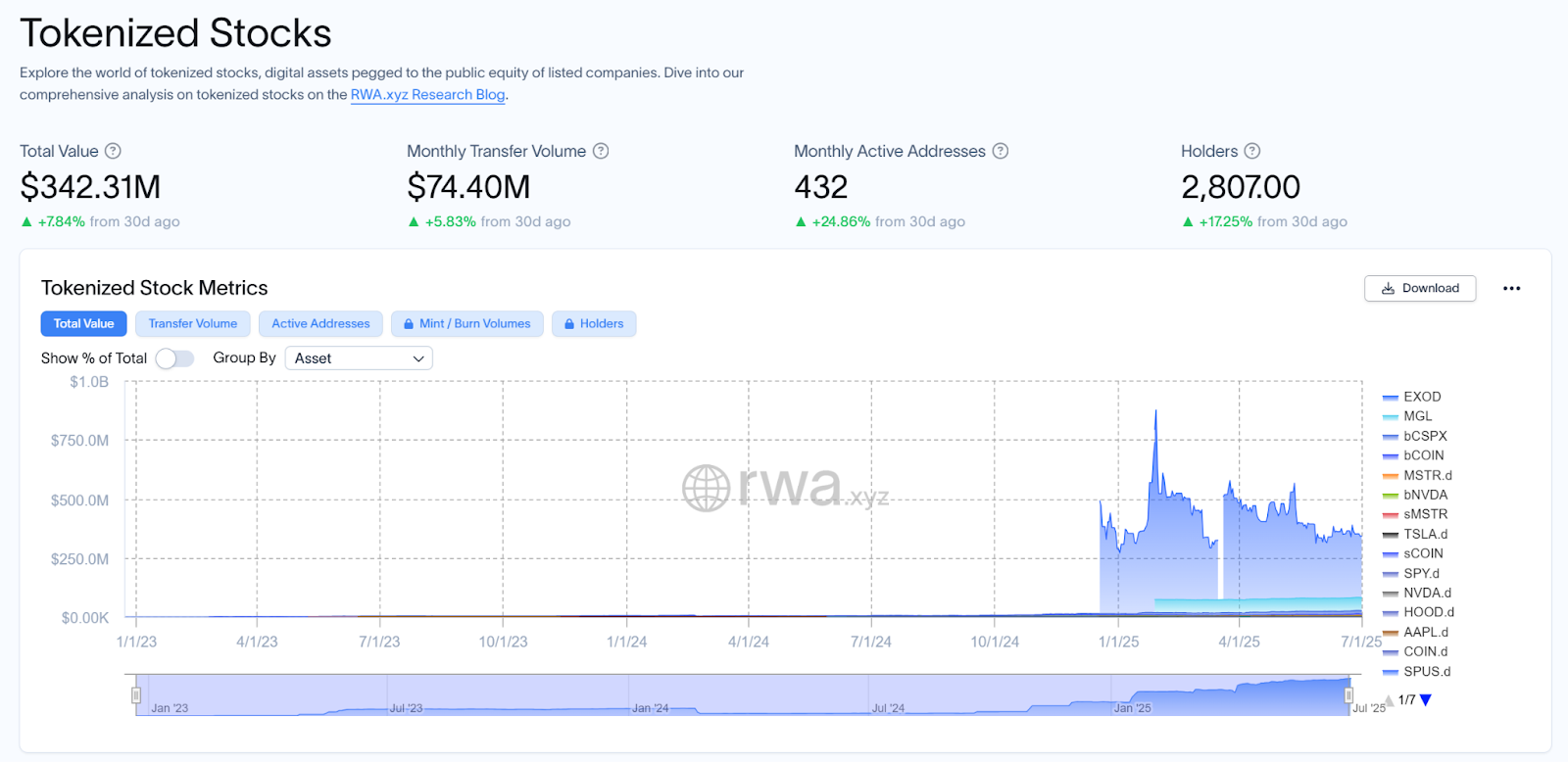
Stock tokenization combines the openness of crypto technology with the value foundation of traditional securities: it removes geographical and temporal barriers while granting assets higher circulation efficiency and financial Lego-like composability. According to RWA.xyz data, since the beginning of 2025, the stock tokenization market has seen significant growth, exceeding $340 million as of July 3, with future stock token market sizes expected to reach trillions of dollars.
Source: https://app.rwa.xyz/stocks
# Overview of Representative Platforms for Stock Tokenization
The concept of stock tokenization is rapidly moving from theory to practice, with various platforms emerging like mushrooms after rain. Below is an overview of recent representative stock tokenization trading platforms or projects:
1. xStocks
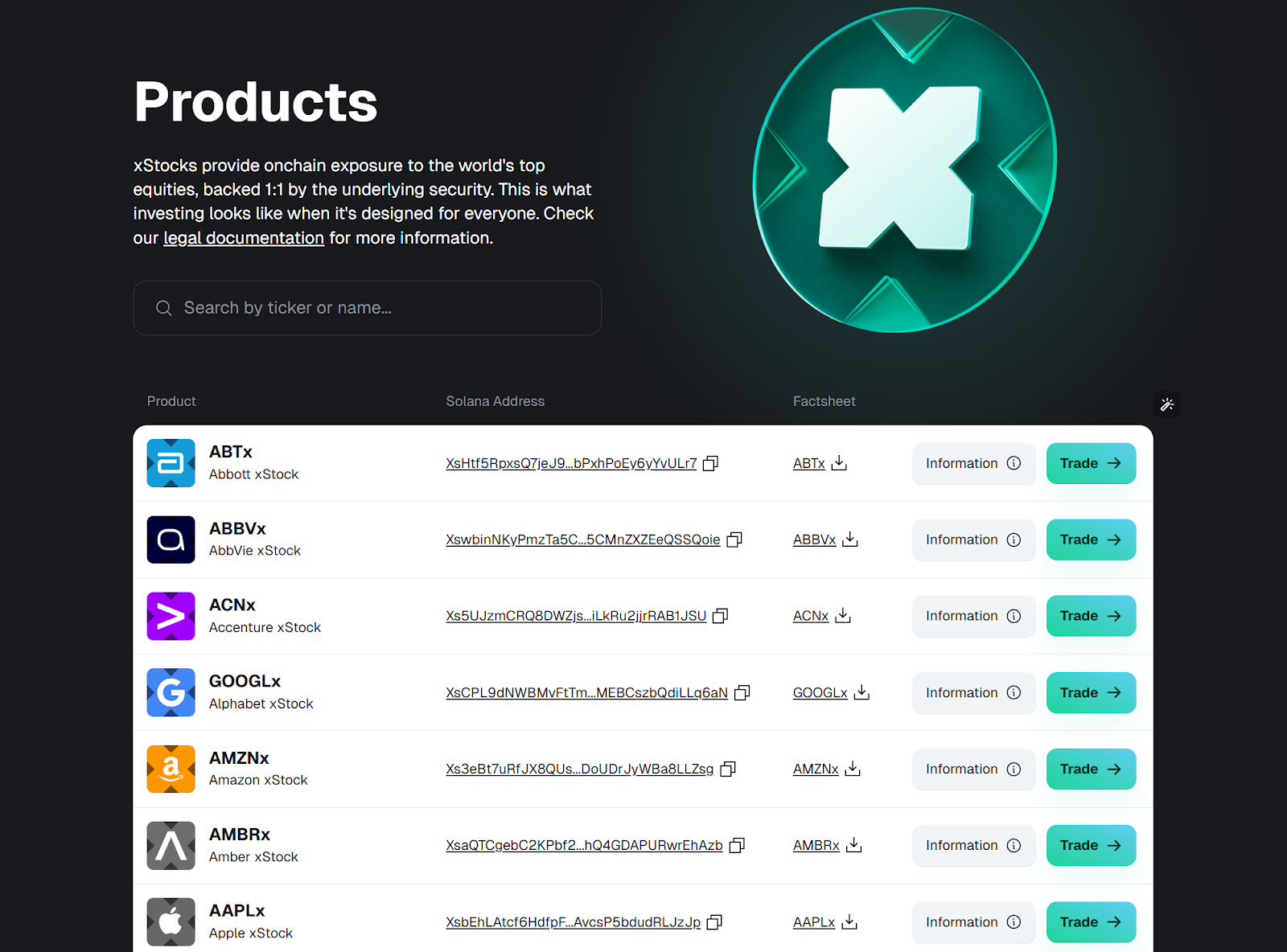
On June 30, Swiss asset token issuer Backed announced partnerships with Kraken, Bybit, Raydium, Jupiter, and Kamino to launch xStocks stock token trading services, initially supporting 61 well-known U.S. companies' stocks and ETF tokens, including Apple, Amazon, Tesla, and Nvidia, open for trading to non-U.S. users. As one of the few compliant token issuers, Backed adheres to the Swiss DLT regulatory framework, providing regulated stock token products for exchanges and DeFi protocols, accelerating the global rollout of stock tokenization. Backed employs a strict 1:1 physical collateral model: for every stock token minted on-chain, one corresponding stock is purchased on the secondary market, with related assets held by a Swiss licensed custodian bank, which regularly publishes reserve proofs to ensure transparency.
Source: https://xstocks.com/products
2. Bybit
Bybit launched stock and commodity CFD trading services for select users in 2023, but these were off-chain contracts. On June 16, Bybit officially launched an independent TradFi multi-asset trading platform based on the MT5 platform, allowing users to trade precious metals, oil, indices, stock CFDs, and forex directly on the Bybit platform without needing to install MT5 separately. TradFi supports up to 5x leverage, with all trades settled in USDT, eliminating the need for currency exchange or opening traditional brokerage accounts. On June 30, Bybit announced a partnership with Backed's xStocks to directly support on-chain stock token trading anchored 1:1 to real stocks. Bybit has announced plans to gradually launch trading pairs for multiple stock tokens, including Coinbase (COINX), Nvidia (NVDAX), Circle (CRCLX), Apple (AAPLX), Robinhood (HOODx), Meta (METAX), Google (GOOGLX), Amazon (AMZNX), Tesla (TSLAX), and McDonald's (MCDX).
3. Robinhood
On June 30, traditional brokerage giant Robinhood announced at a conference in Cannes, France, the launch of U.S. stock and ETF token trading services for European users, allowing users to buy and sell tokens of over 200 U.S.-listed stocks and ETFs directly using their cryptocurrency accounts. Robinhood promised "no additional commissions, support for dividend payments, and 24/5 uninterrupted trading." These stock tokens are issued on the Ethereum-based Arbitrum Layer 2 network, and Robinhood ensures that each token is backed by one share of real stock through partnerships with custodial brokers, synchronizing on-chain and off-chain settlement and rights updates, allowing token holders to receive the same dividends and stock split rights as stockholders. Robinhood also announced that it is developing its own Layer 2 blockchain, "Robinhood Chain," where the issuance and trading of stock tokens will gradually migrate to this dedicated chain. Robinhood Chain is built on Arbitrum technology and will be optimized for tokenized assets, supporting 24/7 trading, self-custody, and cross-chain bridging. Robinhood proposes "free tokenization of everything," aiming to build a global on-chain trading network covering real assets over the next decade.
4. Dinari
Dinari became the first stock token platform in the U.S. to obtain a broker-dealer registration in June 2025. Dinari's stock tokens, known as dShares, are issued on the Ethereum Arbitrum One Layer 2 network, and for every stock Dinari purchases from a stock exchange, an equivalent number of dShares tokens are minted, implementing a strict 1:1 collateralization. As a registered transfer agent with U.S. securities regulators, Dinari directly manages and holds these underlying stock assets, ensuring a one-to-one correspondence between tokens and stocks. To meet compliance requirements, Dinari implements strict identity verification (KYC/AML) for users: currently, only U.S. and Canadian users can register, and users must submit government-issued identification (driver's license, passport, etc.) and proof of address documents, which must be verified before trading. Dinari's platform already offers nearly a hundred U.S. stock token trading options, including popular stocks like Apple, Amazon, Microsoft, Nvidia, and Coinbase. dShares holders not only benefit from stock price fluctuations but also receive dividends: Dinari converts received stock dividends into the on-chain stablecoin USD+ and distributes them to users. In terms of fees, Dinari charges a fixed fee for each transaction: $10 for transactions on the Ethereum mainnet; $0.20 for transactions on Layer 2 networks like Arbitrum. Dinari has explicitly stated that it will not issue a platform token to avoid confusion with securities issuance. Dinari adopts a B2B2C model, preferring to integrate its compliant trading interface into other platforms rather than promoting it directly to end users on a large scale.
5. Swarm
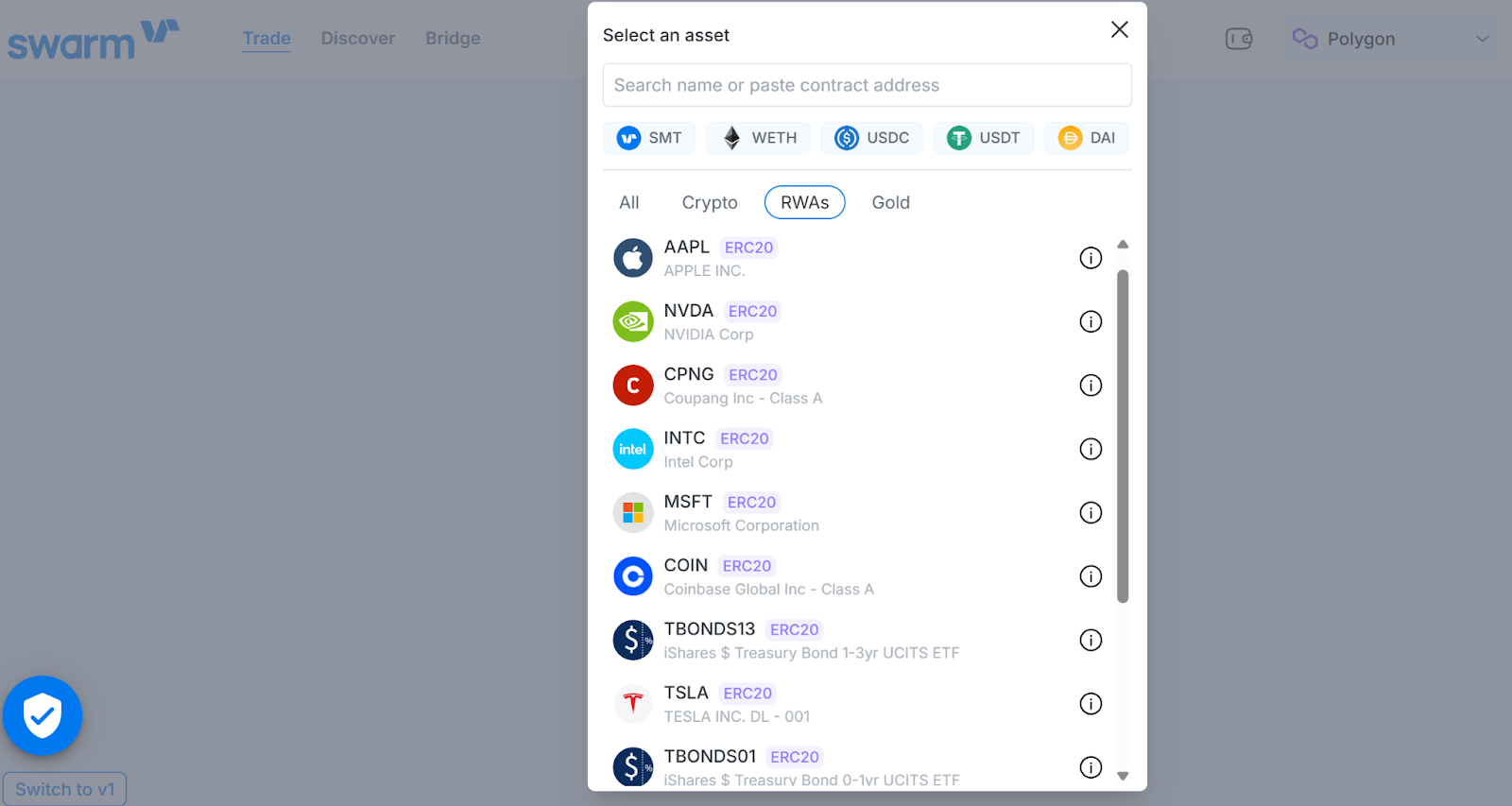
As a project providing compliant DeFi infrastructure for token issuance, liquidity, and trading, Swarm has gradually launched stock token and gold token trading services since 2023. Users can buy and sell 12 U.S. stock tokens, including Apple (AAPL), Nvidia (NVDA), Microsoft (MSFT), Coinbase (COIN), and Tesla (TSLA), as well as physical gold tokens, using stablecoins like USDC through Swarm's built-in decentralized trading application dOTC. Swarm supports Ethereum mainnet, Polygon, Base, and other networks, allowing users to obtain the best liquidity prices on any chain, with a trading fee of 0.25%. The stock tokens issued by the Swarm platform are managed by Swarm's subsidiary, SwarmX GmbH, and strictly adopt a 100% physical stock backing model: all tokens correspond to underlying stocks held by compliant custodians, and the trustee of the tokens verifies them, with related reserve asset information disclosed monthly. As a decentralized protocol, Swarm does not enforce mandatory KYC procedures, and users must comply with the laws of their respective countries, making it highly attractive to global users.
Source: https://swarm.com/
6. MyStonks
The decentralized protocol MyStonks is an emerging platform operating on the Base chain, launching a "Stonks 100" section that provides trading for 95 U.S. stocks and 5 crypto/stock ETF tokens listed in the U.S., including popular targets like Apple, Amazon, Disney, Google, Meta, Microsoft, and Nvidia. MyStonks employs an on-chain and off-chain linkage mechanism: whenever users buy or sell U.S. stock tokens on-chain, MyStonks synchronously buys or sells real stocks off-chain at a 1:1 ratio, with Fidelity acting as the custodian. When users purchase a U.S. stock token on MyStonks, the platform mints the corresponding token on the Base blockchain at a 1:1 ratio and sends it to the user's on-chain wallet; when users sell, the platform executes the opposite operation, destroying the token and returning the stablecoin to the user. The trading process is provided with on-chain price feeds by Chainlink oracles, and the platform charges a 0.3% trading fee.
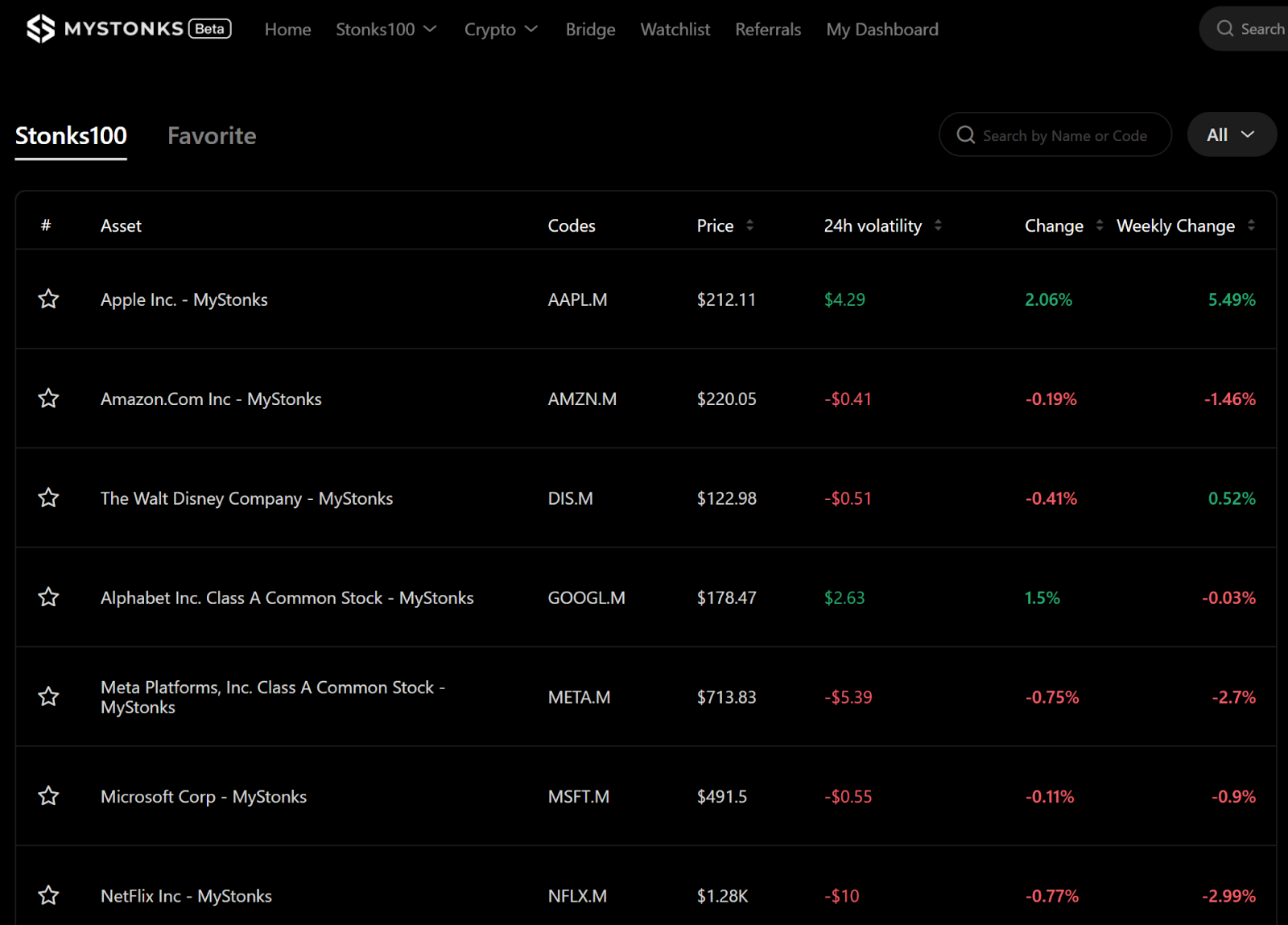
Source: https://mystonks.org/
7. Helix
Helix is a decentralized exchange built on the Injective public chain, natively supporting cross-chain spot and perpetual contract trading. Helix recently launched a synthetic asset trading market for 13 U.S. stocks, covering technology and crypto industry stocks like Meta (FB), Tesla (TSLA), Nvidia (NVDA), MicroStrategy (MSTR), and Coinbase (COIN). These synthetic stocks are referred to as iAssets on Helix and are essentially on-chain derivatives: there is no need to hold or custody the underlying stocks in advance, as price tracking of the underlying assets is achieved through smart contracts and oracle prices. Since there are no physical assets backing iAssets, their trading method is similar to traditional crypto perpetual contracts: users can trade with stablecoins like USDT as margin, with up to 25x leverage for 24/7 continuous contract trading, and all positions are settled in USDT rather than physical delivery. Helix offers competitive rates (0.005% maker fee, 0.05% taker fee) and has launched incentive programs like trading point rebates to attract high-frequency trading users. Helix's model represents a "purely on-chain" path for stock tokenization: it meets the preferences of crypto-native users for high volatility and leveraged trading, but its iAssets lack real stock backing, making them more suitable for short-term speculation and hedging tools.
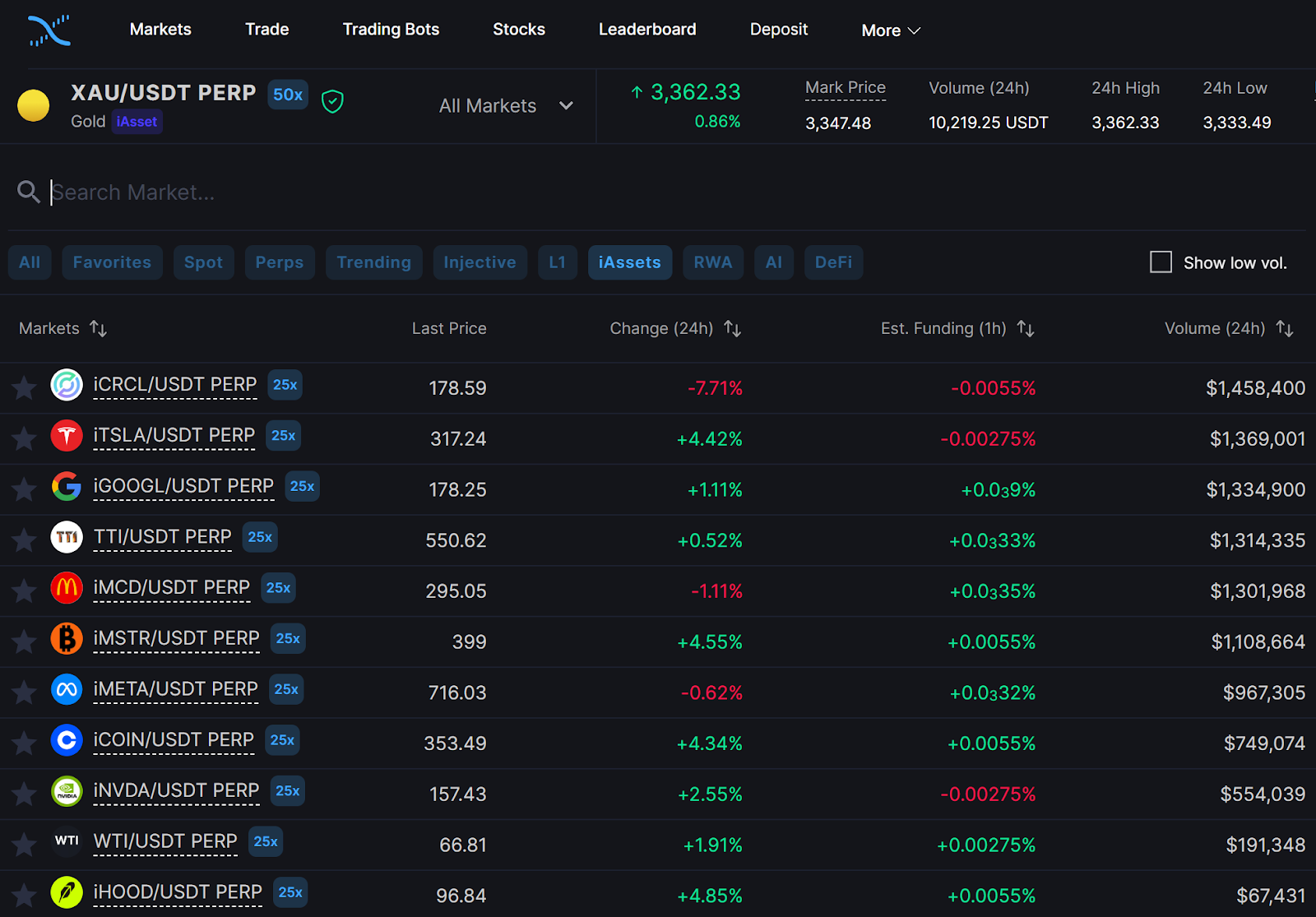
Source: https://helixapp.com/
8. Coinbase and Other Platforms
Coinbase has publicly stated that it is making "stock tokenization" one of the company's strategic priorities and applied to the U.S. SEC in June this year for approval to launch on-chain stock trading services. According to Coinbase's Chief Legal Officer Paul Grewal, if regulatory approval is granted, Coinbase plans to offer users the ability to trade publicly listed company stocks on the blockchain, directly competing with traditional brokers like Robinhood and Charles Schwab. In addition to Coinbase, Ondo Finance announced in February this year that it would launch a tokenization market called "Ondo Global Markets," allowing users to buy and sell stocks, bonds, and ETF tokens backed 1:1 by real assets, with all tokens issued on its proprietary Ondo chain (not currently open to U.S. users); Robert Leshner, founder of Compound, has also established a new company, Superstate, which plans to launch the "Opening Bell" platform, allowing compliant registered public companies to issue and trade stocks directly on the Solana blockchain, with the first pilot being the Canadian-listed company SOL Strategies, enabling cross-border stock circulation on-chain. It is foreseeable that more diverse players will join this "on-chain Wall Street" competition in the future, and the ecological landscape of stock tokenization will continue to expand.
# The Impact and Challenges of Stock Tokenization
1. The Impact of Stock Tokenization
The stock tokenization trend will have profound effects on both the crypto market and traditional finance:
For the Crypto Sector: This marks a transition for crypto exchanges from merely trading digital currencies to becoming one-stop financial platforms encompassing traditional assets like stocks. Companies like Robinhood, Coinbase, and Kraken are expanding their business boundaries, and the lines between crypto exchanges and internet brokerages are gradually blurring. Investors can allocate both Bitcoin and Apple stocks on the same platform, with both assets existing and trading in token form. This not only opens up a potentially vast revenue source for crypto platforms but also gives them the opportunity to compete for user bases traditionally held by conventional brokers. It is foreseeable that crypto exchanges and traditional brokers will engage in a new round of competition in terms of users, liquidity, and technology.
For Traditional Financial Institutions: This wave presents both challenges and opportunities. On one hand, the efficient model of blockchain directly connecting to securities trading poses a shock to existing stock exchanges and intermediary systems, forcing traditional institutions to embrace new technologies to enhance competitiveness; on the other hand, the on-chainization of real assets also brings innovative opportunities to Wall Street, with many large institutions already beginning to experiment. For example, JPMorgan developed a blockchain-based digital securities settlement network as early as 2020, and in 2023, Credit Suisse and Citigroup participated in a pilot to settle European bonds on Ethereum. Now, with the acceleration of stock tokenization, traditional investment banks and exchanges may hasten to launch their own on-chain trading platforms to avoid being overtaken by emerging tech companies.
For Investors and the Market as a Whole: The positive significance of stock tokenization is evident: the barriers for global investors to access securities from various countries are lowered, and the diversity of investment portfolio choices increases; market operational efficiency improves, with old issues like T+2 settlement delays and cross-border remittance costs likely to be alleviated.
2. Risks and Challenges Facing Stock Tokenization
As a nascent market, stock tokenization still faces numerous challenges and concerns to achieve substantial development:
Uncertainty of Regulatory Compliance: This remains a Damocles sword hanging overhead. Although a few platforms like Dinari have navigated compliant paths, most countries globally have yet to clarify the legal nature of stock tokens, lacking unified regulatory standards. Early attempts by exchanges like Binance and FTX to offer U.S. stock tokens were shut down due to regulatory pressure. Until a mature compliance framework is established, some stock token platforms may operate in gray areas, posing compliance risks. Relatedly, KYC/AML thresholds are a double-edged sword: completely threshold-free anonymous trading is unlikely to gain regulatory approval, while highly stringent real-name systems deter crypto users accustomed to anonymity. Finding a balance between user convenience and regulatory compliance is a long-term exploration issue for platforms.
Market Liquidity and User Demand Challenges: As of now, the overall scale of on-chain real-world assets (RWA) is approximately $23 billion, with stock tokens accounting for only about $313 million. In other words, stock tokenization is still at a very early stage, far from the expected "disruptive" scale. The following chart shows some key data of the current on-chain stock token market (total market cap of about $313 million, monthly trading volume of about $71 million, etc.), indicating that this scale is negligible compared to the global stock market.
Most Stock Tokenization Platforms Are Still Immature: Some platforms may lack transparency or necessary qualifications, causing investors to hesitate to invest heavily. The traditional stock market itself is already quite mature and efficient. For investors genuinely wanting to trade U.S. stocks, the barriers and costs of participating through traditional channels (opening accounts with overseas brokers, Shanghai-Hong Kong Stock Connect, etc.) are not prohibitively high; some compliant platforms may even have more cumbersome processes for on-chain trading. More critically, for crypto-native users who prefer high volatility and high returns, the price volatility of stocks is relatively limited. Compared to altcoins or DeFi tokens that can fluctuate dozens of times within a day, stocks like Apple and Microsoft appear "too mild," failing to provide the same thrill as the "crypto world."
It is evident that for stock tokenization to truly ignite the market, it still needs to find new product-market fit, explore differentiated value-added services, and unique on-chain financial play. For instance, integrating stock tokens into DeFi yield strategies, using them as collateral for lending, or forming LPs with other tokens to earn yields, could transform on-chain stock trading from mere hype into an organic bridge connecting the global capital market with the Web3 world.
# Conclusion
From stablecoins to stock tokens, the on-chainization of real assets is gradually changing the landscape of the crypto industry. In an era of loosening regulations and increasingly mature technology, stock tokenization demonstrates immense potential to leverage trillion-dollar traditional assets. As a Kraken executive stated, "We are not launching something novel; we are unlocking a fundamental transformation." Stock tokenization carries the vision of financial democratization: enabling individuals from any corner of the globe to fairly participate in wealth creation, free from geographical and financial barriers. However, achieving this vision remains a long and winding road. Issues such as regulatory compliance, market liquidity, and user education require collaborative efforts from all industry stakeholders to resolve. But one thing is certain: the tide has begun to change direction—when leading players like Robinhood and Coinbase are fully invested, the era of on-chain securities may have already begun.
Looking ahead to the next decade, we have reason to remain cautiously optimistic: perhaps stock tokenization will not replace the existing securities market but is likely to coexist alongside it, forming a new ecosystem of "on-chain + off-chain" dual-track integration. On one hand, traditional exchanges and financial institutions will embrace blockchain to improve efficiency and reduce costs; on the other hand, crypto-native platforms will continue to innovate, offering more diverse and interesting investment products. These two forces will drive the evolution of the financial industry through competition, providing global investors with a more innovative and efficient financial investment experience.
The current wave of stock tokenization is just the prelude to the fusion of Wall Street and the crypto world. It may not be long before we witness the emergence of a truly "all-weather, borderless, and intermediary-free" global capital market prototype taking shape on-chain. The era of on-chain stock trading is approaching us.
About Us
Hotcoin Research, as the core investment research hub of the Hotcoin ecosystem, focuses on providing professional in-depth analysis and forward-looking insights for global crypto asset investors. We build a "trend assessment + value excavation + real-time tracking" integrated service system, offering in-depth analysis of cryptocurrency industry trends, multi-dimensional evaluations of potential projects, and 24/7 market volatility monitoring, combined with weekly live broadcasts of "Hotcoin Selected" strategy and daily news briefings of "Blockchain Today," providing precise market interpretations and practical strategies for investors at different levels. Relying on cutting-edge data analysis models and industry resource networks, we continuously empower novice investors to establish cognitive frameworks and assist professional institutions in capturing alpha returns, collectively seizing value growth opportunities in the Web3 era.
Risk Warning
The cryptocurrency market is highly volatile, and investment itself carries risks. We strongly recommend that investors fully understand these risks and invest under a strict risk management framework to ensure the safety of their funds.
Website: https://lite.hotcoingex.cc/r/Hotcoinresearch
Mail: labs@hotcoin.com
 Risk warning Risk warning
Popular articles