Payment Revolution: When Stablecoins Start to Erode the Territory of Visa and Others

 Stablecoins disrupt the payment market through dual pathways, with cost and efficiency advantages challenging traditional card organizations.
Original Title: "When Stablecoins Target the Payment Market, Can Traditional Payment Giants Still Hold Their Throne?"
Original Author: 100y
Original Translation: Saoirse, Foresight News
Translator's Note: Nowadays, the presence of stablecoins is no longer limited to the realm of cryptocurrency trading. With the potential to change the backend of the financial system, they are quietly knocking on the door of the payment market. You may wonder how this emerging role will disrupt the traditional payment landscape? The article holds the answer: on one hand, attempts are being made to collaborate with card organizations like Visa and Mastercard to embed stablecoin functionality within existing networks; on the other hand, there are efforts to bypass card organizations and banks, creating a new payment system. PayPal's PYUSD and the USDC payment system jointly launched by Shopify are vivid examples of this transformation. Will stablecoins pose a threat to traditional payment giants, or will they give rise to a new industry ecosystem? This article will explore the context and direction of this payment sector transformation with you.
Although the current application of stablecoins is mostly concentrated in the cryptocurrency trading field, blockchain and stablecoins are expected to change traditional financial systems such as the securities market and payment systems, which are complex and large in nature.
In recent years, the application momentum of stablecoins in payment systems has been increasingly strong, and this trend is mainly advancing along two directions: 1) integrating stablecoin functionality centered around card organizations; 2) attempting to completely bypass card organizations and issuing banks.
In the latter direction, PayPal's PYUSD and the USDC payment system jointly launched by Shopify, Coinbase, and Stripe are typical cases. With the development of the stablecoin industry, it is expected that more companies with a large user and merchant base will build dedicated payment systems, which may pose a threat to banks and card organizations.
The Use of Stablecoins is Still Dominated by Exchanges
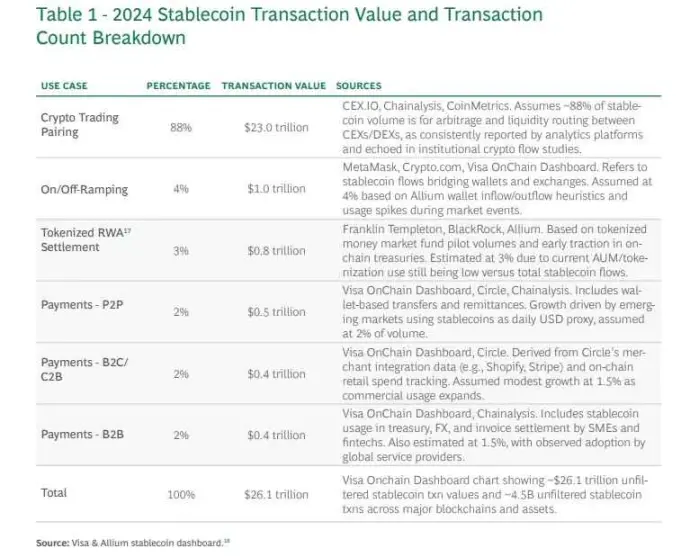
Whether in the United States or globally, stablecoins are receiving significant attention. Discussions are actively ongoing regarding their innovative potential in remittances, payments, real-world assets (RWAs), and interbank settlements. However, according to a report by Boston Consulting Group (BCG), in 2024, cryptocurrency trading will account for as much as 88% of stablecoin transaction volume. This data reflects the current limitations of stablecoin usage, which has not yet achieved the widespread application in the real world that we expect.
Stablecoins Can Fundamentally Change the Financial System
Although advancements in financial technology have significantly optimized user experience in the financial system, the backend systems handling actual transactions still suffer from inefficiencies and outdated technology. In this regard, blockchain and stablecoins are expected to bring innovation to the backend of the financial system. This is not merely a supplement to existing infrastructure but can provide a technology that can completely replace the current model, similar to historical transformations in the financial system.
Securities Market
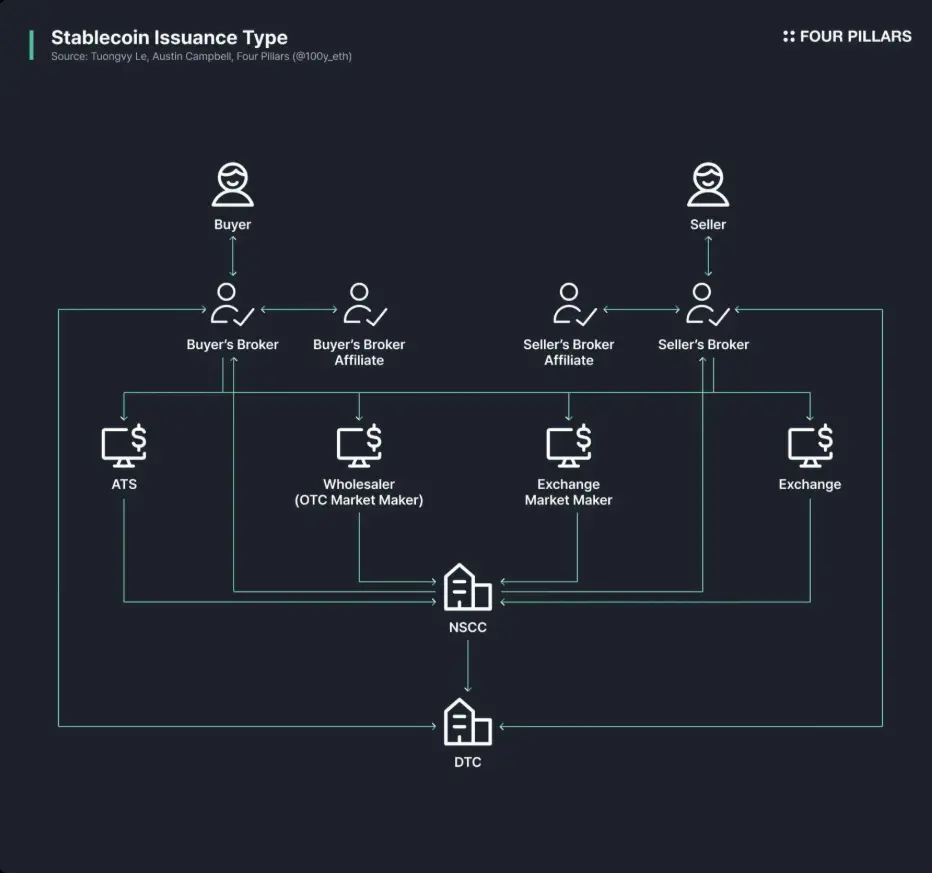
The complexity of the backend system in the securities market stems from the paperwork crisis that erupted in the U.S. securities market in the 1960s and 1970s, along with a series of policy measures introduced to address this crisis. At that time, securities trading relied entirely on paper documents, and with the surge in trading volume, the entire system nearly collapsed. In response, the U.S. Congress passed the Securities Investor Protection Act (SIPA) and amended the Securities Act, establishing a centralized clearing and settlement mechanism and an indirect securities holding system.
Initially, this system digitized securities ownership and improved settlement efficiency. However, it also made numerous intermediaries, such as brokers, clearinghouses, and custodians, indispensable, leading to structural complexity and cost issues. Today's securities market is essentially a product of policy compromise and gradual improvements to overcome technological limitations. This system has been in place for decades before the emergence of more advanced technologies like blockchain.
Cross-Border Remittances
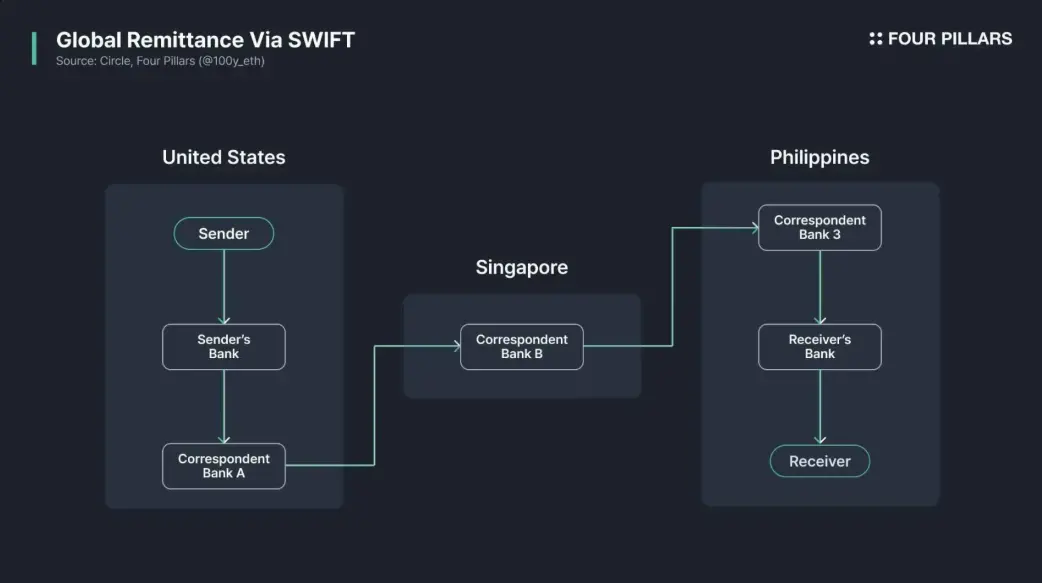
The Society for Worldwide Interbank Financial Telecommunication (SWIFT) is currently the most widely used system in the field of cross-border remittances. It was established in 1973 by 239 banks in Brussels as a global messaging network. Its inception aimed to replace the then-existing telegraphic international interbank communication system, which was slow and prone to errors, and where each bank adopted its own communication standards, leading to poor compatibility, low efficiency, and security risks. The emergence of SWIFT was to solve these problems by providing a universal communication standard and secure network.
However, SWIFT itself is only responsible for transmitting information; the actual flow of funds must be completed through the accounts of correspondent banks or central banks, and the settlement between accounts is handled separately. The entire process involves multiple intermediary banks, each of which can cause delays due to fees, KYC/AML reviews, currency exchanges, time zone differences, and holidays, ultimately resulting in high costs and low transparency for cross-border remittances. If blockchain and stablecoins had been available at that time, information transmission and fund transfers could have been completed on the same unified platform, leading to a qualitative leap in the efficiency of cross-border payment infrastructure.
Can Stablecoins Transform the Payment Market?
Although there is much discussion about the innovative potential of stablecoins in various fields such as the securities market and cross-border remittances, the next most anticipated application scenario outside of exchange trading is the payment system. In fact, in the payment field, not only Web3 companies but also mainstream Web2 companies like Visa, Mastercard, Stripe, and PayPal are actively exploring new business opportunities.
To determine whether stablecoins can truly change the existing payment system, we first need to understand how the current payment system operates, the root causes of its inefficiencies, and whether stablecoins can address these issues.
How the Existing Payment System Operates
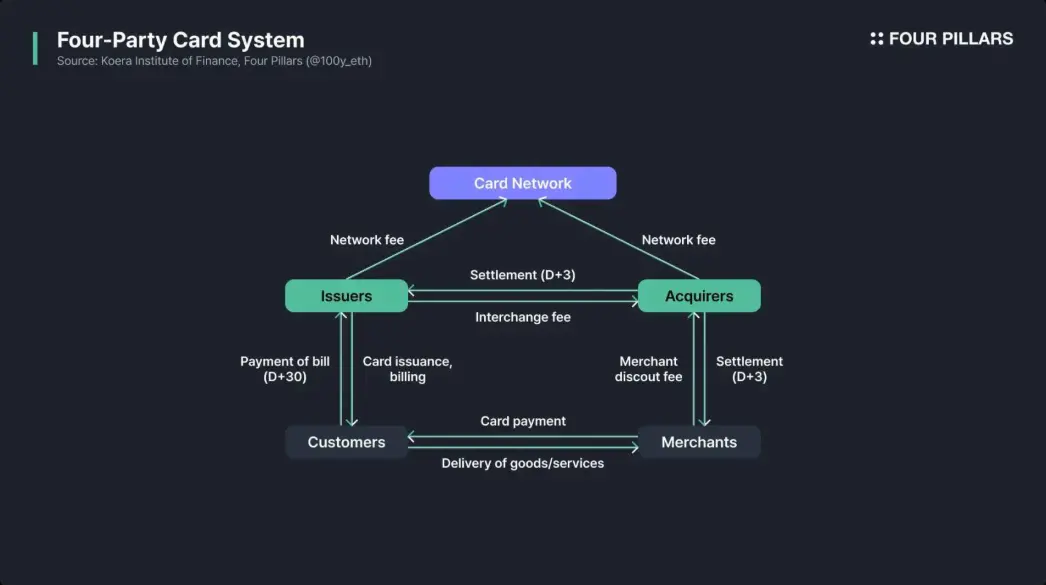
First, let's understand the payment system's operational flow. When a customer makes a payment to a merchant, the process is as follows:
Authorization
The customer attempts to complete the payment using a bank card.
The POS terminal or online payment gateway sends an authorization request containing payment information to the acquiring institution.
The acquiring institution forwards the request to the card organization (such as VisaNet or Mastercard's banking network).
The card organization passes the request to the issuing bank.
Verification
The issuing bank verifies the validity of the bank card, account balance, credit limit, and whether the transaction poses any suspicious risk.
After verification, the approval or denial result is returned to the acquiring institution via the card organization.
If the transaction is approved, the corresponding amount will be temporarily frozen in the customer's account.
If the transaction is denied, the merchant will receive feedback containing the reason for the denial.
Capture
- In certain industries such as gas stations, hotels, and online shopping, the final amount is confirmed only after the initial authorization. Therefore, the moment the merchant sends the "capture request" is the point at which the transaction is actually completed, and this request is sent to the acquiring institution.
Batching
- Throughout the day, authorized transactions will be aggregated into a batch and sent to the acquiring institution in one go after business hours.
Clearing and Interchange
The acquiring institution sends the batch transaction data to the card organization.
The card organization sends each transaction to the corresponding issuing bank and calculates the interchange fee in the process.
Settlement
- Funds are transferred from the issuing bank's settlement account to the acquiring bank's settlement account. The card organization summarizes daily transactions and generates settlement files to coordinate settlements between both parties, but the actual transfer of funds must be completed through the interbank payment network.
Funding
- The acquiring institution deposits the payment amount, after deducting relevant fees, into the merchant's account, usually completed through Automated Clearing House (ACH) or wire transfer.
Reconciliation
- Finally, the merchant verifies whether the funds received match their own records, checking for discrepancies, transaction omissions, or duplicate charges.
What Problems Exist in the Current Payment System?
The two major issues often criticized in traditional bank card systems are high fees and slow settlement speeds. Are these defects unavoidable, or can they be resolved?
Regarding Payment Fees
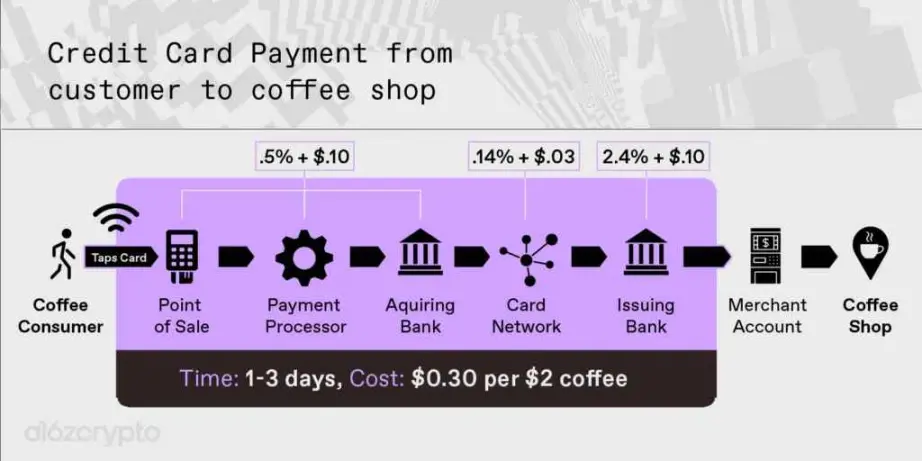
Let's first look at the composition of bank card payment fees. From the merchant's perspective, bank card transactions involve three main types of fees:
Interchange Fee: The largest portion, charged by the issuing bank.
Card Organization Service Fee: The fee charged by the card organization for processing the transaction.
Acquiring Institution Markup Fee: The service fee charged by the acquiring bank.
Can blockchain and stablecoins reduce these fees? The first potential cost-saving point lies in global transactions. When the merchant and cardholder are in different countries, settlement must go through the SWIFT system, but if this process is replaced by blockchain or stablecoins, costs can be significantly reduced.
The second cost-saving point is bypassing card organizations and issuing banks. The essence of card organizations is to connect the customer's bank with the merchant's bank through a communication network, and if stablecoin payments are fully adopted, customers can transfer directly from their self-custodied stablecoin wallets to the merchant's Web3 account via the blockchain network.
Regarding Settlement Time
Next, let's look at settlement time. The transaction authorization for bank card payments is nearly completed in real-time; in this regard, the scalability of public blockchain networks may not match that of centralized card organizations. However, in traditional bank card payments, clearing usually takes an additional 1-2 days, and settlement takes 1-5 days.
There are many reasons for the time-consuming settlement, some of which can be resolved, while others are unavoidable:
Clearing Cycle: Bank card payments typically aggregate daily transactions into batches and clear only once a day. A system based entirely on blockchain or stablecoins would not need to adhere to this single-day clearing cycle.
Disputes, Suspicious Transactions, Cancellations, and Refunds: Even with stablecoin payments, these issues cannot be eliminated. Due to the inevitability of such situations during the payment process, settlement delays remain necessary.
Cross-Border Payments: In cross-border transactions, funds must be settled through the SWIFT system, which further exacerbates delays. Clearly, blockchain can provide solutions in this area.
Stablecoin-Based Payment Systems
Recently, various financial institutions and companies have begun to adopt stablecoin-based payment systems. I believe this significant shift is mainly driven by two strategies: the first led by card organizations like Visa and Mastercard; the second is an attempt to completely bypass card organizations and issuing banks.
Stablecoin Payments Centered Around Card Organizations
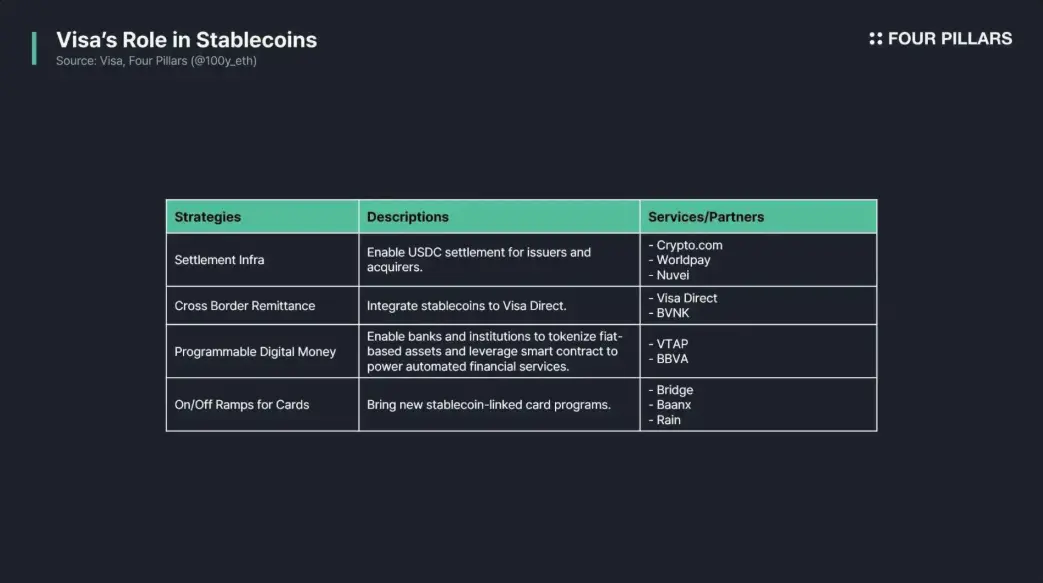
As I mentioned in my article "Visa and Mastercard: Designing the Next Generation Payment System," Visa and Mastercard are actively exploring ways to integrate stablecoin functionality into their infrastructure.
Crypto Debit Cards: These cards allow customers to use stablecoins stored in Web3 wallets or exchange accounts for payments. Specifically, customers' stablecoins can be handled in two ways: either exchanged by the issuing bank for fiat currency and processed through the existing payment system; or received directly by the card organization through a funding account, completing the transaction according to the traditional bank card payment process.
Stablecoin Settlement: As mentioned earlier, card organizations can receive stablecoins through funding accounts and settle with acquiring institutions using stablecoins.
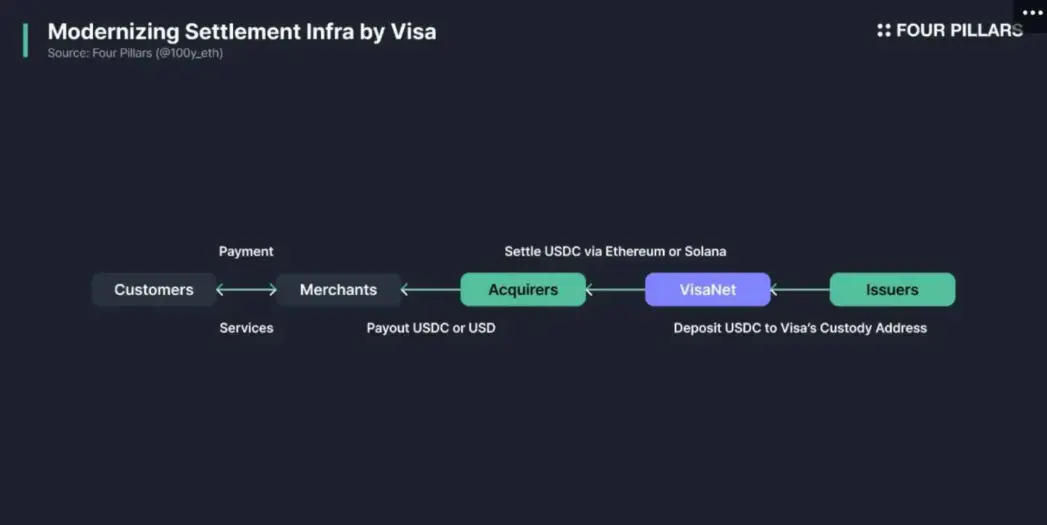
Essentially, stablecoin payments centered around card organizations merely add support for stablecoin payments and settlements within the traditional system, without changing the participants or infrastructure. Therefore, this model does not have significant advantages in terms of cost and efficiency. However, for customers and businesses that natively use stablecoins, this model can eliminate the need for fund inflows and outflows, reducing transaction friction; additionally, if the entire payment process is settled in stablecoins, cross-border transactions will benefit significantly.
Attempts to Bypass Card Organizations and Issuing Banks
Meanwhile, some payment service providers (PSPs) have begun to bypass card organizations like Visa and Mastercard, directly using stablecoins to process payments. Typical cases include PayPal's PYUSD payment and the USDC payment solution jointly launched by Shopify, Coinbase, and Stripe.
PYUSD Payment Solution
PayPal users can use their PYUSD balance to make payments within the app. These PYUSD are not stored in the user's personal wallet but are held by Paxos, the issuer of PYUSD. When a PYUSD payment occurs, there is no actual on-chain transfer operation; instead, the ownership of PYUSD is internally transferred from the customer to the merchant within PayPal's backend system. If the merchant wishes to settle in fiat currency, PayPal will convert PYUSD to USD at a 1:1 ratio and transfer the funds to the merchant's account via bank networks such as ACH (Automated Clearing House).
If the customer's PYUSD balance is insufficient, they can recharge through a bank account or bank card (which may incur fees); similarly, if the merchant requests fiat settlement, processing through bank networks will also incur additional fees and time costs. However, if the entire payment cycle is completed in PYUSD, it can significantly shorten time and reduce costs by bypassing card organizations or issuing banks.
Shopify and Coinbase, Stripe's Joint Payment Solution
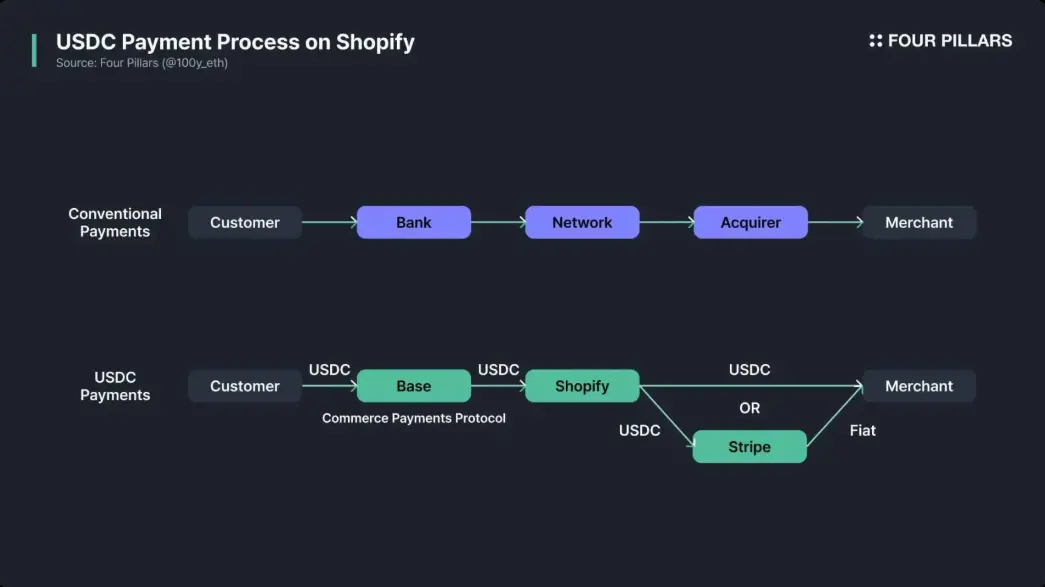
Unlike PayPal's use of stablecoins without directly involving the blockchain network, Shopify's USDC payment solution takes it a step further.
In June 2025, Shopify announced a partnership with Coinbase and Stripe to integrate USDC payments into Shopify Payments. Customers can choose USDC as a payment method when checking out in Shopify stores and complete the payment through a crypto wallet holding USDC connected to the Base network.
In this process, the smart contract "Commercial Payment Protocol" on the Base network uses the traditional "authorize first, then capture" model to complete payment authorization in advance, while the actual fund transfer is delayed. Shopify and Coinbase will aggregate the day's USDC transaction data and complete the clearing on the Base network.
The default method for the settlement phase is for Shopify to convert USDC into the fiat currency of the merchant's location through Stripe's infrastructure and then deposit it into the merchant's account via bank payment networks such as ACH or SEPA. Merchants can also choose to receive settlement funds directly in USDC, allowing them to access funds more quickly.
Conclusion and Reflection
The most frequently asked question about stablecoin-based payment systems is: "Since blockchain transactions are inherently irreversible, how do we handle cancellations or refunds?" Although a fully peer-to-peer payment system may eventually emerge between customers and merchants, issues such as fraud detection, chargebacks, and refunds will always exist, so intermediaries in the payment process remain necessary. This indicates that the roles traditionally played by card organizations and issuing banks will not completely disappear.
However, in the aforementioned cases of PayPal and Shopify's stablecoin payments, intermediaries like PayPal and Stripe act as payment service providers (PSPs), responsible for handling fraud detection, transaction cancellations, refunds, and other issues. Specifically, PYUSD transactions are not processed on-chain but are completed within PayPal's backend system, leaving room for dispute resolution; in Shopify's case, the "Commercial Payment Protocol" smart contract on the Base network does not immediately approve payments but introduces a buffer time to address potential disputes. Additionally, Circle, the issuer of USDC, has also launched a "Refund Protocol" for non-custodial dispute resolution in stablecoin payments.
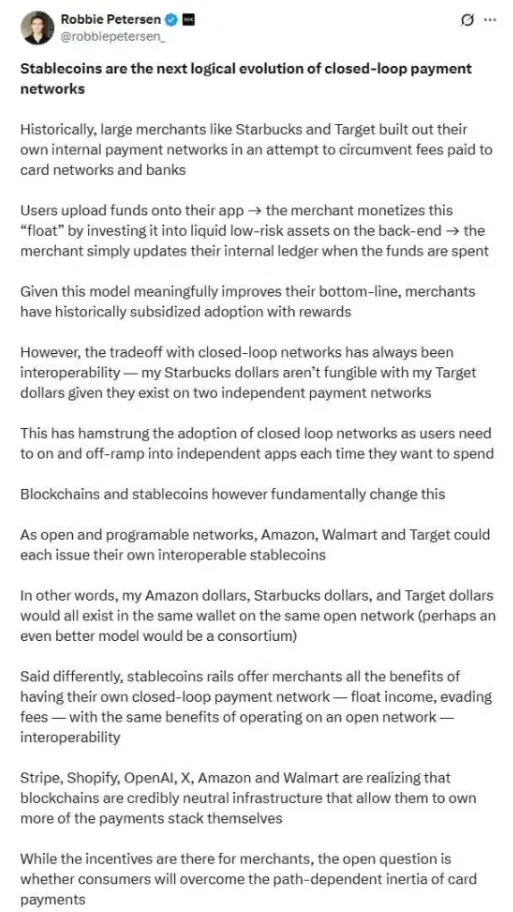
Stablecoin-based payments are an inevitable trend for the future. The issuance phase is crucial, and the circulation phase should not be overlooked. As Robbie Petersen from Dragonfly pointed out, companies that already have a large merchant and user base will increasingly adopt stablecoin payments, thereby bypassing card organizations and issuing banks. Stablecoins may even achieve interoperability between such closed-loop payment systems. Given these trends, stablecoins may pose a tangible threat to card organizations and issuing banks, which need to explore new opportunities in the unstoppable wave of stablecoins.
【Disclaimer】The market has risks, and investment should be cautious. This article does not constitute investment advice, and users should consider whether any opinions, views, or conclusions in this article align with their specific circumstances. Responsibility for investments lies with the investor.
Recommended Reading:
U.S. House Passes Three Cryptocurrency Bills; How is the National Team's Bitcoin Chip War Going?
"Meme 2.0" Beginning? Pump.fun and the Future Path of On-Chain Financing
From PayPal Gang to Investment Empire: Unveiling Peter Thiel's Founders Fund Origin Story (Part 1)
 Risk warning
 Risk warning