WSJ: Are stablecoins an innovation or a modern version of 19th-century financial "pipes"?

 Under the Genius Act, stablecoins no longer trust the blockchain, but the United States.
Original Author: WSJ
Compiled by: Odaily Planet Daily Golem
Stablecoins: The "Narrow Banks" of Today
Washington is once again promising to reshape currency with code, and the political headwinds behind the newly passed "Genius Act" have breathed new life into the recurring fantasy that technology can ultimately eliminate the instability at the core of finance. This promise, while enticing, is met with harsh reality: we can modernize currency, but we are still delivering it through "pipes" built in the 19th century.
This hopeful notion partly stems from the collapse of Silicon Valley Bank in 2023. It was not new troubles caused by subprime mortgages or any exotic derivatives, but a replay of the oldest hazard in banking: maturity mismatch. Depositors, especially those without insurance, can withdraw their deposits on demand, while banks are making long-term investments. When interest rates soar and trust evaporates, user withdrawals follow, assets are sold at fire-sale prices, and the government has to intervene once again.
"Narrow banks" were once seen as a solution, institutions that only hold cash or short-term government bonds. (Odaily Note: The concept of "narrow banks" originated in the aftermath of the Great Depression in the 1930s in the United States, representing a banking model that only accepts deposits and invests those deposits entirely or almost entirely in extremely liquid, ultra-low-risk assets such as short-term government bonds or central bank reserves.)
While "narrow banks" are highly secure, they lack vitality, unable to create credit, with no loans and no growth.
Stablecoins are the reimagining of "narrow banks" in the tech era: private digital tokens pegged to the dollar, claimed to be backed by one-to-one liquidity reserves. For example, Tether and USDC claim to offer programmable, borderless, tamper-proof deposits, shedding regulatory burdens.
But beneath the glamorous digital facade, the ancient vulnerabilities of finance remain, as these tokens still rely entirely on trust. Reserves are often opaque, custodians may be offshore, audits are selective, and redemptions remain merely a promise.
Thus, when trust wavers, the entire system collapses. The stablecoin TerraUSD crashed in 2022 because it attempted to maintain its peg to the dollar using algorithms rather than real reserves. Its value depended on another convertible token, Luna. However, when confidence shattered, investors rushed to redeem TerraUSD, flooding the market with Luna. With no reliable collateral and the situation escalating, both tokens collapsed within days. Beyond this extreme case, even so-called "fully collateralized" stablecoins can experience price volatility when the market questions the authenticity of their reserves.
The "Genius Act" Fuels the Dollar's "Excess Privilege"
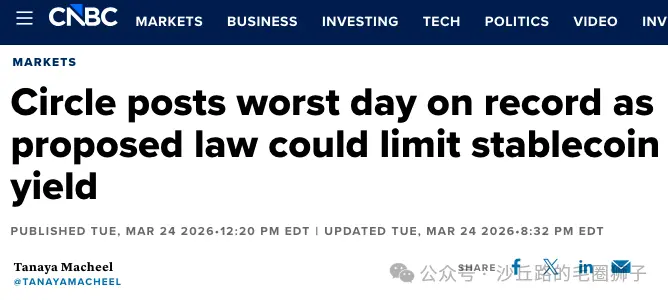
The "Genius Act" is the result of Washington's attempt to establish an order for stablecoins. It creates a formal category of "payment stablecoins," prohibits issuers from paying interest to emphasize the practical value of stablecoins rather than speculation, and requires issuers to fully collateralize with cash or government bonds. Issuers must obtain licenses, register in the U.S., and comply with a new certification system. Foreign participants need U.S. licenses and must adhere to U.S. rules, or they will be excluded.
The advantages of the act are clear: no flashy algorithms, no unregulated random factors, and no mixing of speculative and payment functions. It fulfills many of their wishes. It provides consumer protection, prioritizes bankruptcy redemptions, and promises monthly reserve disclosures. Scholars critical of the crypto chaos have finally seen their desires realized.
But clarity does not mean safety. The act formally classifies stablecoins as "narrow banks." This means stablecoins will not experience maturity mismatch, but it also eliminates trust intermediaries, bypassing the core engine of finance (converting savings into investments), turning risk-averse funds into idle capital.
At the same time, the act leaves strategic loopholes. Issuers with assets below $10 billion can opt for state-level oversight, encouraging regulatory arbitrage. In a crisis, the demand to redeem stablecoins could trigger a sell-off of government bonds, disrupting the market for the safe assets that underpin them.
Some economists warn that by anchoring stablecoins to government bonds, we are merely transferring systemic risk to a new corner, which, while politically popular, has not been tested on a large scale in operations. But supporters are also singing the praises of geopolitical benefits. The law ensures stablecoins are pegged to the dollar, backed by dollar reserves (such as government bonds), and settled through U.S. institutions. With non-dollar stablecoins still stagnant, U.S.-backed digital tokens will become the default tools for global payments, savings, and cross-border transfers.
This is the intersection of the Bretton Woods system and Silicon Valley, a regulatory game aimed at extending the dollar's "excess privilege" into the internet age. The "Genius Act" may solidify the dollar's dominance more than any Federal Reserve currency swap agreement or trade deal.
Another notable benefit is that by providing regulatory clarity, the act may help bring cryptocurrency innovation back to the U.S. In recent years, legal uncertainties in the U.S. have led to a brain drain of blockchain talent and capital. Despite the many shortcomings of stablecoins, they could serve as a foothold for broader digital financial experiments to occur within U.S. institutions rather than outside.
Stablecoins Have Not Surpassed Banking
But trust cannot be outsourced to code. It is created by institutions, audits, and rules. Ironically, blockchain, a technology born from the rebellion against financial regulation, is now seeking legitimacy through the very disclosures and regulations it once sought to evade. The "Genius Act" provides this clarity, but the costs of the trade-offs have become fully apparent.
In finance, as the fable goes, great power often conceals greater vulnerabilities. If stablecoins become integrated into everyday transactions, then once they fail, the impact will not be confined to the crypto world; it will become a common problem faced by households, businesses, and taxpayers.
The act also opens the door for large tech companies or commercial giants to enter the payments space under relatively lax rules, raising concerns about privacy, competition, and market concentration in a digital dollar infrastructure dominated by scale rather than safety.
Despite being continuously hyped, stablecoins have not surpassed banking. They merely replicate the contradictions of banking in a new form. The true vision of blockchain is to end reliance on trust. Yet, we are now doubling down on trust under federal regulation.
Money remains a social contract: a promise that someone will compensate your losses somewhere. No amount of code or collateral can eliminate the need for the credibility of that promise. At the same time, any regulatory action cannot abolish the fundamental trade-offs in finance: safety comes at the cost of efficiency. Forgetting this will invite the next crisis.
Stablecoins repackage old risks as innovation. The danger lies not in what they are, but in our pretense of what they are not.
 Risk warning
 Risk warning