Pendle is difficult to understand, but not understanding it is your loss

 The price of the coin has reached a new high in nearly 7 months. A deep analysis of the Pendle mechanism and value capture from a new perspective: what makes it different?
Author: Alex Liu, Foresight News
Pendle is the most successful DeFi protocol that has emerged in this cycle, and there is no need to use "one of" to qualify it. There have been many articles explaining Pendle, and this article aims to analyze the unique aspects of Pendle's successful protocol mechanisms and value capture design in light of the latest developments. Readers familiar with Pendle's mechanisms can skip the previous explanations and read the analysis that follows.
What is Pendle
Pendle is a protocol for trading "yields." To explain how to trade yields, we introduce two assets from the synthetic stablecoin protocol Ethena: USDe and sUSDe.
USDe is a stablecoin pegged to the US dollar at a 1:1 ratio. Simply holding USDe does not generate interest, but it does generate Ethena's airdrop points, which can be allocated to sENA tokens based on the number of points after each airdrop period ends. sUSDe is the staked version of USDe, which generates interest; the interest rate fluctuates between 5% and 15% based on market sentiment and funding rates. The Ethena points earned by holding sUSDe are lower than those earned by holding USDe.
For the two assets mentioned above, the yield from holding USDe is Ethena points, while the yield from holding sUSDe consists of interest and Ethena points.
Both interest and points are quite "time-sensitive." Interest rates can fluctuate dramatically with market conditions, and the value of points is closely related to the snapshot date and the real-time price of the tokens. Therefore, the "yield" being traded requires a time frame. It can be the yield for the next 3 months, but it should not be the yield for the next 300 years.
The yield is generated by the underlying assets, and we refer to the current value of the assets that will generate yield after a certain period as "principal," thus bringing together three elements: principal, yield, and time frame.
Pendle packages yield-generating assets into a standardized yield token (Standardized Yield, abbreviated as SY) using a unified token standard, then splits it into a principal token (Principal Token, abbreviated as PT) and a yield token (Yield Token, abbreviated as YT) and establishes a time frame, allowing the "yield" within a certain period to be traded.
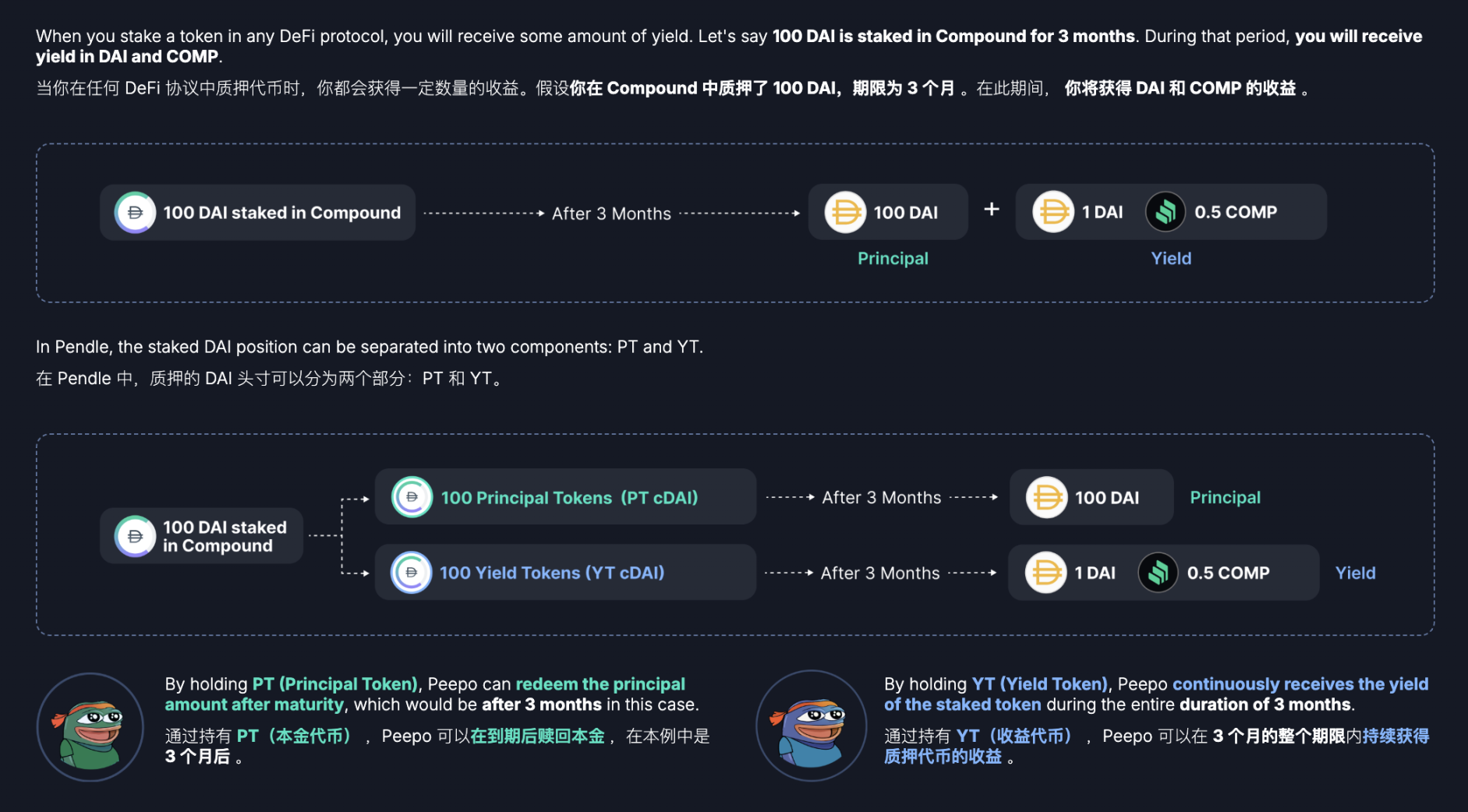
Before maturity, holding YT will yield the corresponding underlying token's returns. After maturity, the value of PT will equal SY, while the value of YT will drop to zero. (For example, if there are 10 days left until maturity, YT represents the yield of the underlying asset for 10 days and has value; after maturity, it represents the yield of the underlying asset for 0 days and has no value.)
For instance, 1 USDe can be packaged as a standardized yield token USDe (Sep 2025) SY, which can then be split into 1 USDe (Sep 2025) PT and 1 USDe (Sep 2025) YT, with their values adhering to:
1 USDe (Sep 2025) SY = 1 USDe (Sep 2025) PT + 1 USDe (Sep 2025) YT.

The value of 1 USDe SY is the same as the underlying asset of 1 USDe, which is 1 dollar. For simplicity, we take 1 USDe (Sep 2025) PT = 0.99 dollars and 1 USDe (Sep 2025) YT = 0.01 dollars. Now, there is about 1 month left until the maturity date in September 2025.
As a trader, I can now use 100 dollars to buy 10,000 YT, which corresponds to the yield generated by 10,000 USDe over this month (i.e., Ethena airdrop points). After maturity, YT will drop to zero, and the value will transfer to the unclaimed Ethena airdrop points. The motivation for traders to purchase is their bullish outlook on the yield value of USDe, believing that the value of Ethena's airdrop will exceed the cost of purchasing YT.
Using 100 dollars to leverage 10,000 dollars to generate points, this ability to leverage points with a small principal has brought massive growth to Pendle during the previous points frenzy. It is not uncommon for YT traders to achieve significant wins: traders leveraging YT for EigenLayer airdrop eETH YT recouped all their costs from the ETHFI airdrop, effectively obtaining EIGEN tokens for free; buying YT leveraged Ethena points when ENA was at 0.2 dollars, ENA surged above 0.6 dollars within 2 weeks, greatly increasing point value; Usual airdrop exceeded expectations, with YT purchases yielding over 10 times returns.
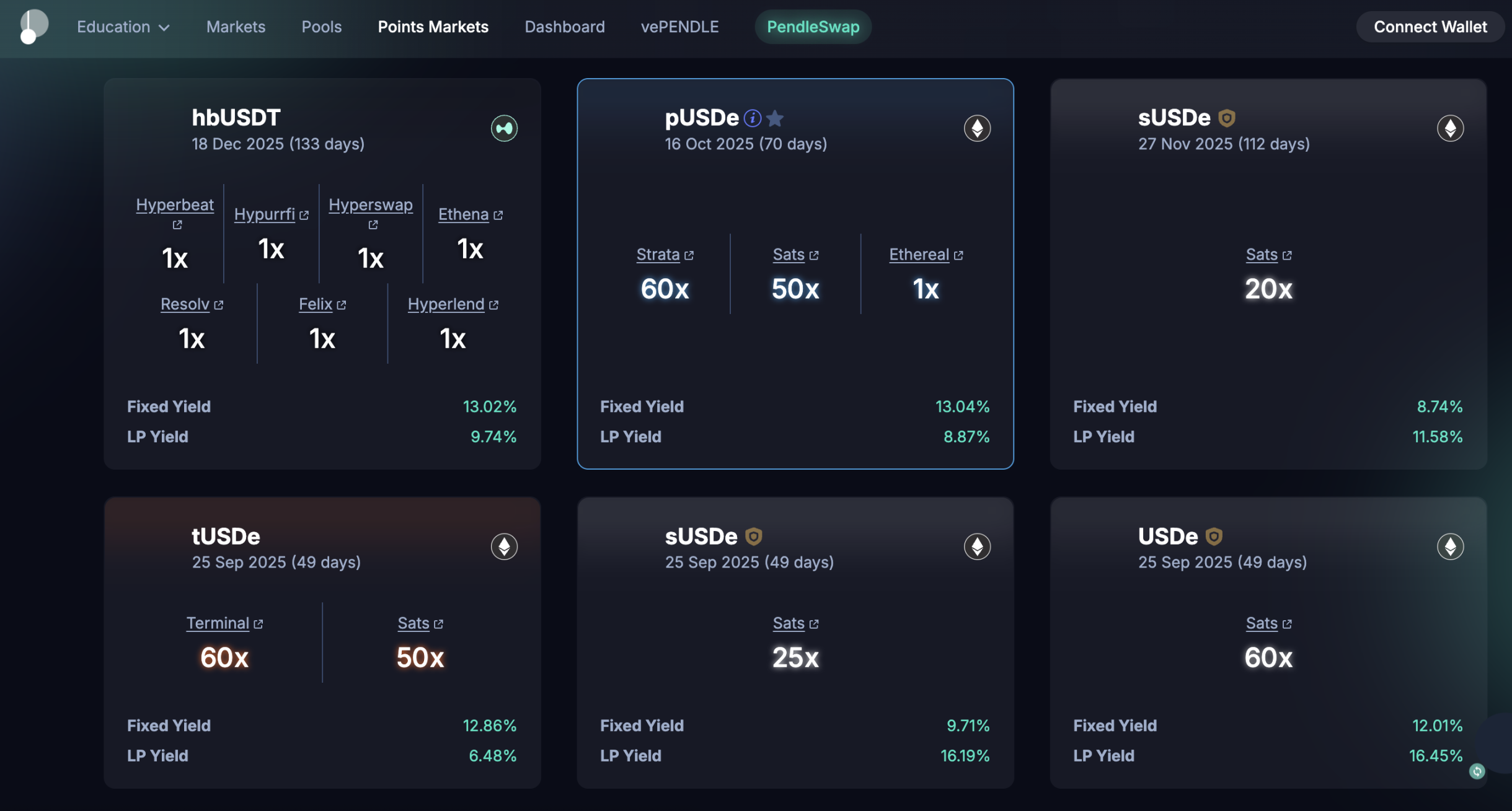
Pendle's "Points Market" Page
Holders of sUSDe YT not only earn Ethena points but also receive interest generated by the underlying assets. Although the value of YT drops to zero after maturity, holders can claim the USDe yield generated by the underlying sUSDe asset based on the actual interest rate from the Pendle contract.
Of course, there are also cases of losses in YT trading: using YT to leverage points for a certain project, only to find that the project delays token issuance, leading to infinite dilution of point value; or going long on the underlying yield of USDT in Aave at an implied APY of 8%, only to find that the actual average interest rate during the period is 4%, resulting in a loss of half the principal when purchasing YT.
Trading requires counterparties. Behind the hot trading of YT, there needs to be market demand for PT to support liquidity. In the aforementioned situation, one could buy 10,000 USDe (Sep 2025) PT for 9,900 dollars, and after 1 month, it could be exchanged back for 10,000 USDe. Earning 1% in a month equates to locking in an annualized return of about 12% over that month, enjoying a "fixed rate."
This is also the model of government bonds; I buy a 100 yuan bond with a face value of 110 that matures in one year, and upon maturity, I exchange the bond for 110 yuan, thus locking in a 10% annualized return at the time of purchase. Similarly, bonds get closer to their face value as they approach their redemption date, redeemable at par upon maturity.
As the seller of the yield, PT holders sell the "uncertainty" of the yield, locking in a "fixed rate."
Being a Pendle LP (Liquidity Provider) is equivalent to holding both SY and PT while selling some YT. In addition to the fixed income generated from their PT portion, LPs can also earn from the token emissions of PENDLE (liquidity mining).
It is clear that Pendle provides options for users who want to reduce risk and increase stable income, users who want to take on risk for potentially higher uncertain returns, and users who simply want to mine in DeFi. It addresses users' essential needs in a natural manner.
Pendle's Data
How successful is Pendle? The data speaks for itself. Despite the market downturn last week and Pendle experiencing the largest asset maturity in history (meaning some users seeking stable income realized "profit-taking"), Pendle's TVL (Total Value Locked) still reached a new high of 7 billion dollars.
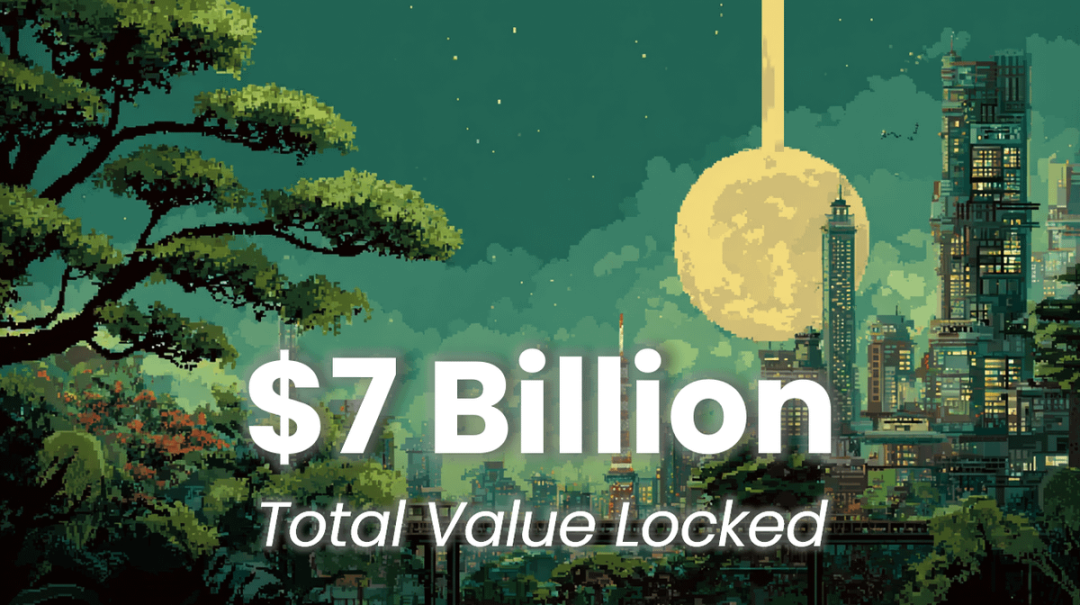
Over 48% of Ethena assets have been packaged as Pendle assets, amounting to 4.6 billion dollars. Over 4 billion of Pendle PT assets have been deposited into lending protocols such as Aave, Morpho, Euler, and Silo as collateral. The newly launched HyperEVM-related assets attracted over 80 million dollars in deposits within 4 days. Despite over 1.5 billion dollars in assets maturing mid-week, it only caused a less than 3% decline in TVL in a single day, with a large amount of assets choosing to remain and continue participating in Pendle, reflecting trust in the protocol.
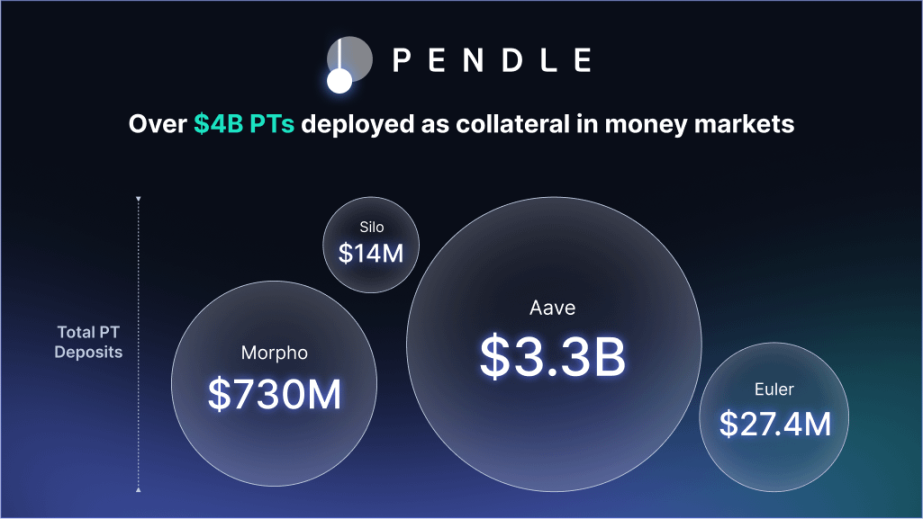
PT assets deposited in various lending protocols
Crypto Profit Models
There are two most profitable profit models in the world: one is to take a cut like a casino, corresponding to exchanges in the crypto world; the other is to earn the interest spread from lending and deposits like a bank, corresponding to lending protocols in the crypto world.
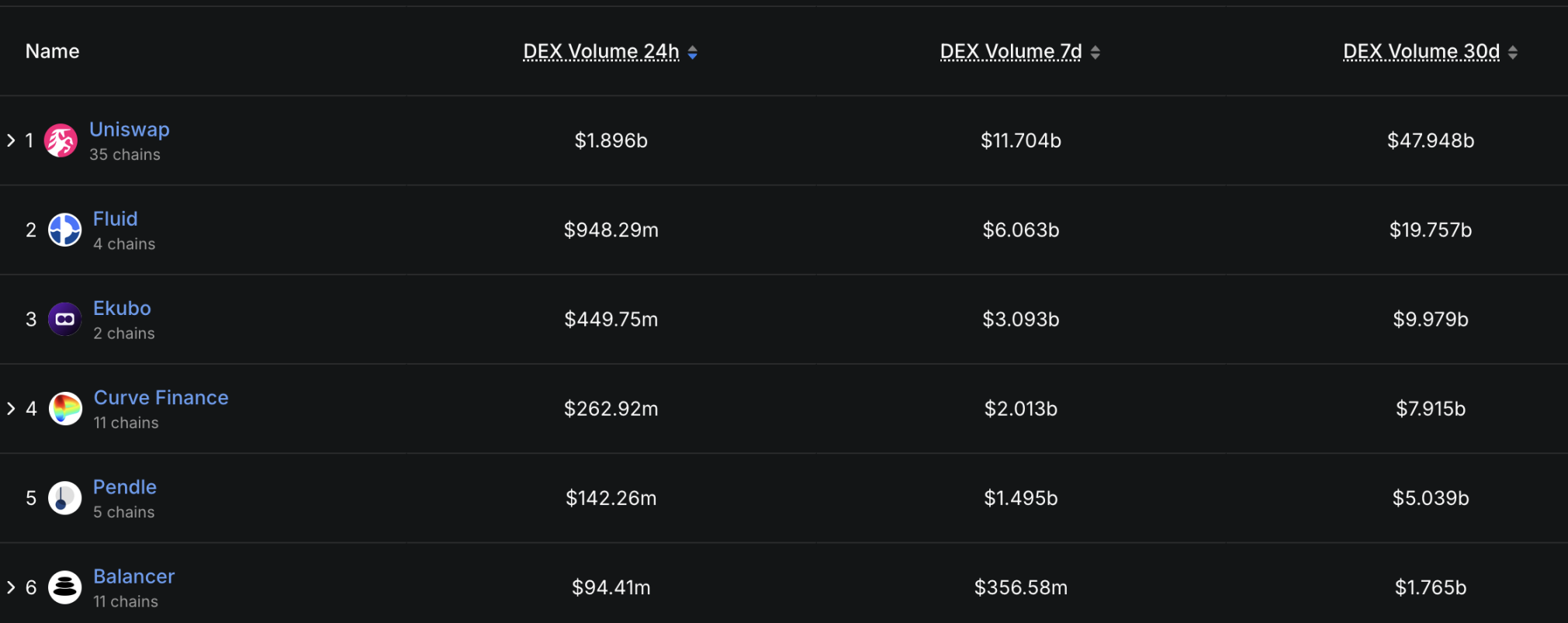
Pendle is the 5th largest DEX (decentralized exchange) by trading volume on Ethereum, belonging to the "cut" model that charges trading fees. For traders, the "cut" model is often a zero-sum game ------ for example, in perpetual contracts that generate the most fees for CEX, if the long side profits, the short side loses, and in the long run, only exchanges that continuously extract fees are the ultimate winners.
However, Pendle has scenarios where all participants can profit, which I believe is its uniqueness, namely "positive externality."
Positive Externality
Pendle mainly involves three major participants at the user level: YT traders, PT traders, and LPs (liquidity providers). At the protocol level, it also involves cooperative protocols ------ Pendle can bring significant TVL increases to cooperative protocols, as exemplified by Ethena. The first thing emerging projects often do to increase TVL is to "integrate Pendle."
PT traders can actually "guarantee" fixed income by selling "uncertain" yields for a fixed rate; their only risk is that the "uncertain" yield they sold becomes too valuable, which may lead to lower earnings, but they will certainly not incur losses (in terms of tokens, holding ETH-related YT will not result in a loss of the amount of ETH held). Moreover, PT traders willingly embrace "certainty," potentially using the 12% fixed annualized PT they received to stack in various DeFi protocols, creating yield farms with annualized returns exceeding 50%, which may not necessarily result in lower earnings.
The essence of LPs is that they hold part of the PT, and the SY portion often receives extremely high point multipliers from various projects. Earning fixed income while efficiently mining points from PENDLE token emissions can be described as having one's cake and eating it too, also a guaranteed profit.
The only participants who may incur losses are YT traders. YT traders often leverage small amounts to gain large returns, profiting when the actual market situation is more optimistic than expected. The crypto industry is currently in a period of rapid development, with constant new asset issuance and bullish market sentiment keeping expectations high. When the next new token airdrop exceeds expectations, and bullish sentiment drives actual interest rates above pricing, all participants in the Pendle ecosystem profit, while those who pay for it come from outside the ecosystem. Theoretically, everyone can make money, with the yield sourced from outside the ecosystem; this is its wonderful aspect.
Pendle not only trades interest rates but also trades expectations. Allowing every participant to profit in a bullish environment that exceeds expectations is its "positive externality."
Value Capture of PENDLE
Even if the protocol is unique, is the PENDLE token a value token?
The PENDLE token adopts a ve (voting escrow) mechanism, allowing holders to lock up PENDLE tokens to receive vePENDLE tokens. Currently, all profits from the Pendle protocol are distributed to vePENDLE holders. Pendle charges a 5% fee on all yields generated from YT (including points, meaning vePENDLE holders can receive yields from various token airdrops), and the same fee applies to the yields from SY that are due but not redeemed. The trading fees for PT and YT are also entirely allocated to vePENDLE.
In addition, the standard gameplay of the ve token mechanism includes locking vePENDLE to receive LP liquidity mining bonuses, voting rewards from project bribery, etc., which also brings yields to locked tokens while reducing token circulation and enhancing token demand. (Details of the ve token mechanism could fill another 3,000 words; I won't elaborate here. Readers unfamiliar with it can refer to CRV and Curve War-related materials.)
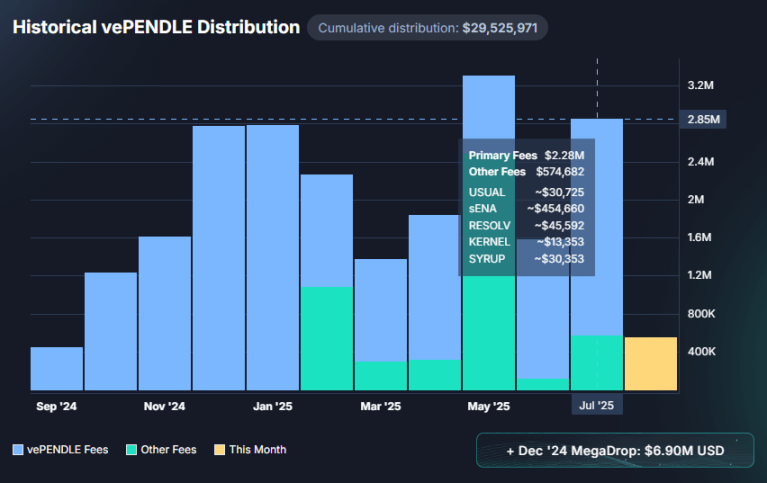
According to the official page, the fees for vePENDLE reached 2.85 million dollars in July 2025, and even excluding the more uncertain airdrop portion, it still reached 2.28 million dollars.
As of the early morning of August 8, the PENDLE token broke through 5 USDT, rising over 25% in a single day, leading the DeFi sector.
Team and Financing
The Pendle team was established in 2020, with founder TN Lee being a founding member of Kyber Network. This team, primarily based in Singapore and Vietnam, launched the first version of Pendle in 2021 ------ a product similar to an on-chain crypto index, and introduced the PENDLE token. However, this version of Pendle did not find product-market fit (PMF) at the time and was not considered successful.
Pendle completed a private fundraising round in April 2021, raising 3.7 million dollars, with investors including HashKey Capital, Mechanism Capital, and others. At the same time, it raised 11.83 million dollars through an IDO at a price of 0.797 dollars per token.

Pendle Founder TN Lee
After the market peaked in 2021, it quickly entered a bear market, but the Pendle team, with its keen sense and foresight, worked hard to build and rapidly transform during the bear market, ultimately launching the now successful Pendle V2 version in 2022, successfully allowing the project to thrive again across cycles.
In July 2023, Pendle was launched on Binance Spot via Launchpool. A month later, Binance Labs (now Yzi Labs) announced an investment in Pendle.
Simple Future Outlook
Pendle currently has no significant competitors. Whether it is Spectra on EVM or RateX on Solana, similar products are far behind in liquidity, capital volume, and protocol integration. (I personally bought up all reasonably priced USDe YT on RateX.) As Pendle establishes more ecological interactions and DeFi Lego plays with leading protocols like Ethena and Aave, its dominance in the sector will become increasingly difficult to shake.
The contract's security, verified over time, along with the accumulated brand effect and user trust, gives us reason to believe that if traditional capital (Tradfi) wants to enter the yield trading sector, collaborating with Pendle is likely to be the first choice.
Additionally, Pendle's newly launched funding rate trading protocol Boros is seen as the next major growth point. The funding rate market is considered to have an open interest value of 200 billion dollars and a potential daily trading volume exceeding 300 billion dollars. Since its launch 24 hours ago, Boros has achieved impressive figures of 15 million dollars in open interest and 36 million dollars in nominal trading volume. I plan to introduce this protocol in a subsequent article.
When I first introduced Pendle in March 2024 (when PENDLE was 1.2 dollars), I wrote: yield and risk are the core factors in finance, and balancing the two is an eternal play. Through the magic of decentralization, Pendle makes all this happen on-chain, continuously bringing potential yields from outside the ecosystem into the ecosystem, achieving a positive-sum game, and gradually becoming an indispensable infrastructure in DeFi, which I believe has limitless potential. I believe that the valuation of good applications will ultimately exceed that of "ghost chains."
Now, a year and a half later, Pendle has become an indispensable infrastructure in DeFi, and its token price has surpassed many "ghost chains." In the foreseeable future, Pendle will continue to grow rapidly, leading the DeFi sector.
Disclaimer: The author holds PENDLE tokens, with a value that meets disclosure standards.
 Risk warning
 Risk warning