When Technology Meets Forex Barriers: Why Is It Difficult for Stablecoin Growth to Break the "Traditional Dilemma"?

 In the field of cryptocurrency, some believe that code and technology can solve all problems. However, in the foreign exchange market, this idea is too naive.
Original Author: Sidhartha Shukla, Bloomberg
Original Compilation: Saoirse, Foresight News
Key Points of the Article
- According to data from Visa and Allium, by 2025, the transaction volume of stablecoins has reached $5 trillion, involving 1 billion payments.
- When exchanging stablecoins for different fiat currencies, costs similar to conventional exchanges arise, including bid-ask spreads, exchange fees, intermediary costs, and slippage.
- Mike Robertson, CEO of foreign exchange infrastructure company AbbeyCross, commented on the limitations of stablecoins as emerging payment tools: "In the cryptocurrency space, some believe that code and technology can solve all problems. But in the foreign exchange realm, that idea is too naive."
Despite the peak period anticipated for stablecoins, seasoned professionals in the fintech sector still believe that these tokens have limitations as emerging payment tools.
According to data from Visa and Allium, by 2025, the total transaction volume of stablecoins has reached $5 trillion, involving 1 billion payments, not far from the total of $5.7 trillion for the entire year of 2024. Since Donald Trump was elected President of the United States in November 2024, the total market value of these cryptocurrencies, which aim to track the prices of mature currencies like the US dollar, has grown by 47%, reaching $255 billion.
The prospects for stablecoins are to bring a faster, lower-cost, and more efficient future to the payment sector, especially in cross-border payments. From the data, this potential is gradually being realized, but there are still doubts about whether this technology can solve long-standing issues that have plagued the foreign exchange business for decades.
Exchanging stablecoins for different fiat currencies (e.g., euros for Hong Kong dollars) incurs many of the same costs as conventional exchanges.
"In the cryptocurrency space, some feel that code and technology can solve all problems. But when it comes to foreign exchange, that idea is too naive," said Mike Robertson, CEO of AbbeyCross. "Each currency has its unique dynamics. Moreover, most banks and payment institutions derive their profits from foreign exchange trading, not from fees."
Stablecoin Transaction Volume Expected to Double from Last Year
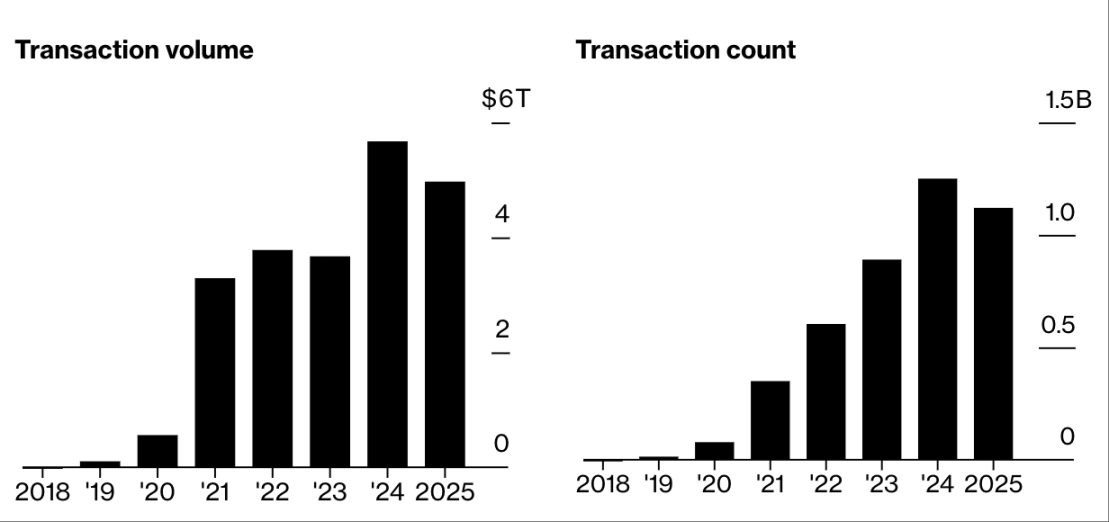
Source: Visa, Allium
Note: Data for 2025 is as of July
Foreign exchange costs typically include bid-ask spreads, exchange fees, intermediary fees, and slippage. These costs also exist in cross-border cryptocurrency transactions and may be particularly pronounced during fund inflows and outflows, posing a challenge to the "low-cost" claims made by stablecoin advocates.
The growth in stablecoin payment volume is primarily attributed to two major application scenarios: first, simplifying cross-border transactions where traditional financial institutions fall short, and second, payment operations in emerging markets.
Startups focused on stablecoin payment infrastructure, such as BVNK, are less concerned with payment corridors related to the British pound and the US dollar. According to Sagar Sarbhai, Managing Director for Asia Pacific at BVNK, the company has shifted its focus to "alternative" payment corridors, such as payment routes from Sri Lanka to Cambodia.
"Such routes typically require multiple intermediaries, which not only incurs high costs but also slows down the process. Stablecoins simplify this process. Although the costs may not be low at present, the speed is faster, and the efficiency of fund usage is higher," he stated. Currently, BVNK's annual transaction volume is approximately $15 billion.
BVNK is not the only startup focused on helping businesses engage in stablecoin operations.
After experiencing a winter in the cryptocurrency industry in 2022, Conduit transitioned into the stablecoin payment sector. This startup began utilizing stablecoins to allow users to remit through local systems like Brazil's Pix and receive payments via SEPA* (the Single Euro Payments Area, a standardized payment system covering the EU and some European countries). According to CEO Kirill Gertman, the company's annual processing scale currently reaches $10 billion.
Thunes, based in Singapore, and Aquanow from Canada are also attempting to collaborate with stablecoin issuers and businesses to simplify payment processes.
"The rise of stablecoins presents a business opportunity," said Floris de Kort, CEO of Thunes, which raised $150 million in April this year. "While the infrastructure may change, people will always need to complete 'last-mile' payment deliveries using local currencies and wallets."
Venture Capitalists Renew Interest in Stablecoins
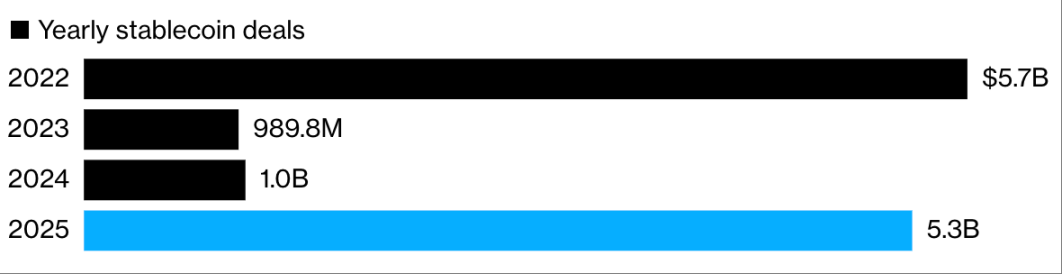
Source: CB Insights
Note: Data for 2025 is as of July 23
Compared to the scale of mature payment operators, the above data may seem insignificant. According to Visa's latest annual report, Visa alone processed $132 trillion in payments in 2024, more than twice the total transaction volume of stablecoins during the same period.
However, the rapid growth of the market has made payment giants highly alert. They are exploring the so-called "stablecoin layer" model: introducing stablecoins between two fiat currencies to bypass traditional banking networks like SWIFT, achieving transaction settlements within minutes, focusing on markets with dollar liquidity shortages and inefficiencies in traditional systems.
In October 2024, Visa launched a platform that allows banks to mint, burn, and transfer tokens backed by fiat currencies, including tokenized deposits and stablecoins.
The recently passed GENIUS Act in the United States has provided a clear regulatory framework for the world's largest stablecoin market, enabling banks and payment institutions to enter the field with greater confidence. This has triggered a competitive response from global regulators, who are formulating similar regulatory rules for stablecoin issuers.
"We are just beginning to see signs of exponential growth," said Sarbhai from BVNK. "The foundation laid over the past five years may lead to an explosion in the next 12 months."
Click to learn about job openings at ChainCatcher
Recommended Reading:
 Risk warning
 Risk warning