From Bitcoin Mining Companies to the World's Largest ETH Holder: A Comprehensive Analysis of BitMine's Ethereum Treasury Strategy

 How did BitMine, this Bitcoin mining company, become the largest ETH corporate holder in the world in just two months?
Author: Lesley, MetaEra
On June 30, 2025, BitMine Immersion Technologies (NYSE: BMNR) announced the launch of a $250 million private placement, officially shifting to an Ethereum ($ETH) treasury strategy. At the same time, Thomas Lee, founder and Chief Investment Officer of the well-known investment firm Fundstrat, was appointed as the chairman of the company's board and personally participated in the investment. Soon after, heavyweight Wall Street figures such as former PayPal CEO Peter Thiel and ARK Investment Management CEO Cathie Wood followed suit, providing strong capital endorsement for this strategic transformation.
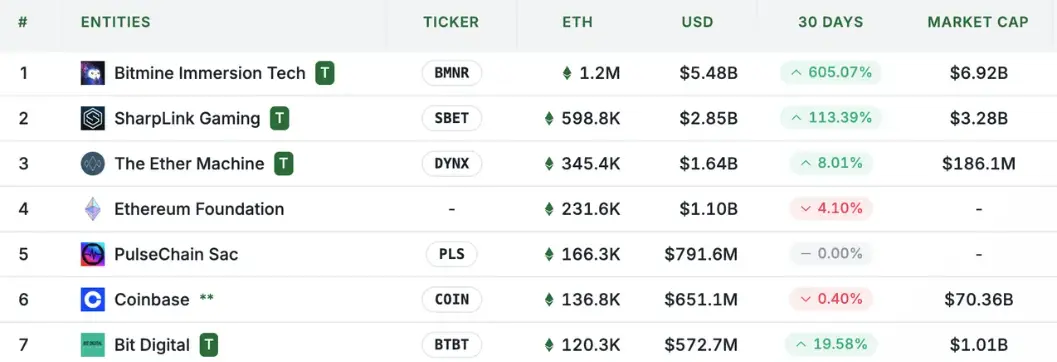
ETH Strategic Reserve Ranking (Source: strategicethreserve.xyz)
More than forty days later, the market responded clearly. This Bitcoin mining company has become the focus of the capital market. As of August 14, BitMine, with approximately 1.2 million ETH held, valued at about $5.48 billion, has become the largest corporate holder of Ethereum in the world.
The price trend reflects market sentiment more intuitively: a 605.07% increase within 30 days, and a 1214.38% increase over three months. From any perspective, this is a textbook-level operation in the capital market.
Behind the numbers is a reallocation of capital. BitMine's shift from the traditional "Bitcoin mining monetization" model to a "long-term holding of Ethereum" treasury strategy essentially represents a transition from industrial capital to financial capital. The success of this model not only proves the feasibility of digital assets as corporate reserve assets but, more importantly, it may be opening up a new path for traditional financial institutions to participate in the crypto economy.
How did BitMine, this Bitcoin mining company, rise to become the world's largest ETH corporate holder in just two months? This article will provide an in-depth analysis.
BitMine Treasury Strategy Execution and In-Depth Analysis
From the launch of the $250 million private placement on June 30 to becoming the largest ETH corporate holder in the world, BitMine showcased the power of the Digital Asset Treasury (DAT) model through a textbook-level capital operation.
Timeline of BitMine's Ethereum Treasury Strategy
BitMine's ETH accumulation trajectory exhibits a textbook-level rhythm of capital allocation, with each step meticulously designed:
June 30, 2025: BitMine announced the launch of a $250 million private placement plan to implement its Ethereum treasury strategy. Thomas Lee officially became the chairman of the company's board and led the company in advancing this new strategy.
July 9, 2025: BitMine announced the completion of its $250 million private placement plan, further promoting the implementation of its asset-light treasury strategy.
July 14, 2025: The company announced it held over $500 million worth of ETH.
July 17, 2025: The company announced it held over $1 billion worth of ETH.
July 24, 2025: Holding over $2 billion worth of ETH, establishing a leadership position in the Ethereum treasury space.
August 4, 2025: Holding over 833,000 ETH tokens, valued at over $2.9 billion, becoming the largest ETH treasury globally.
August 11, 2025: Holding over 1.15 million ETH tokens, valued at over $4.96 billion, with an increase of $2 billion within a week.
August 12, 2025: Bitmine Immersion submitted documents to U.S. federal regulators, increasing its fundraising target for purchasing ETH by an additional $20 billion, raising it to $24.5 billion, to solidify its position as the largest ETH treasury globally.
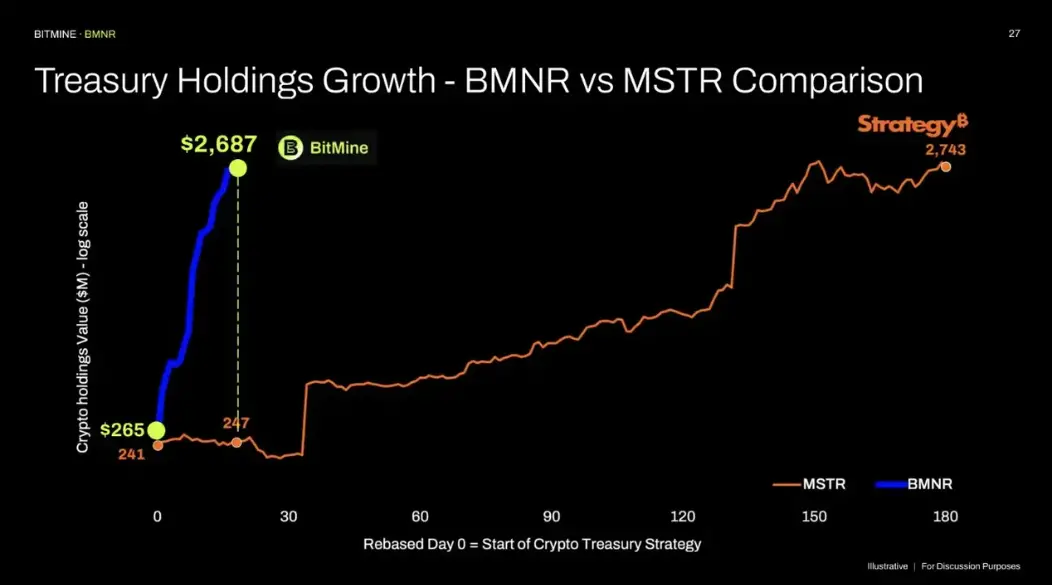
Source: Pantera Official Website
This accumulation speed is rare in the capital market—BitMine's per-share ETH growth rate in the first month of launching the Ethereum treasury strategy has already surpassed the cumulative growth of Strategy (formerly MicroStrategy) in the first six months.
In-Depth Analysis of BitMine's Ethereum Treasury Strategy
Why choose a digital asset treasury strategy?
DAT (Digital Asset Treasury) refers to the emerging model where companies incorporate cryptocurrencies like Bitcoin and Ethereum as strategic reserve assets into their balance sheets. For a long time, the Bitcoin treasury strategy represented by Strategy has become a mature path for companies to participate in the crypto economy, while in June 2025, Bitmine launched its Ethereum digital treasury strategy, igniting the current ETH market.
The core of the DAT model lies in redefining the way companies create value. According to analysis by Pantera Capital, the most important factor for the success of DAT is the long-term investment value of its underlying tokens. Traditional companies create value based on cash flow generated from operations, while DAT companies rely on the appreciation of digital assets for value creation. The advantages of this model include:
Capital allocation efficiency: Compared to traditional heavy asset operations, the DAT model can allocate capital more efficiently. BitMine's shift from Bitcoin mining to an Ethereum treasury essentially transitions from a heavy asset model reliant on electricity, hardware, and operations to a flexible capital allocation model.
Valuation reconstruction and asset management: The valuation of DAT companies no longer relies on traditional price-to-earnings (P/E) ratios but is more based on their net asset value (NAV). When investors purchase DAT company stocks, they are essentially buying a professionally managed digital asset investment portfolio.
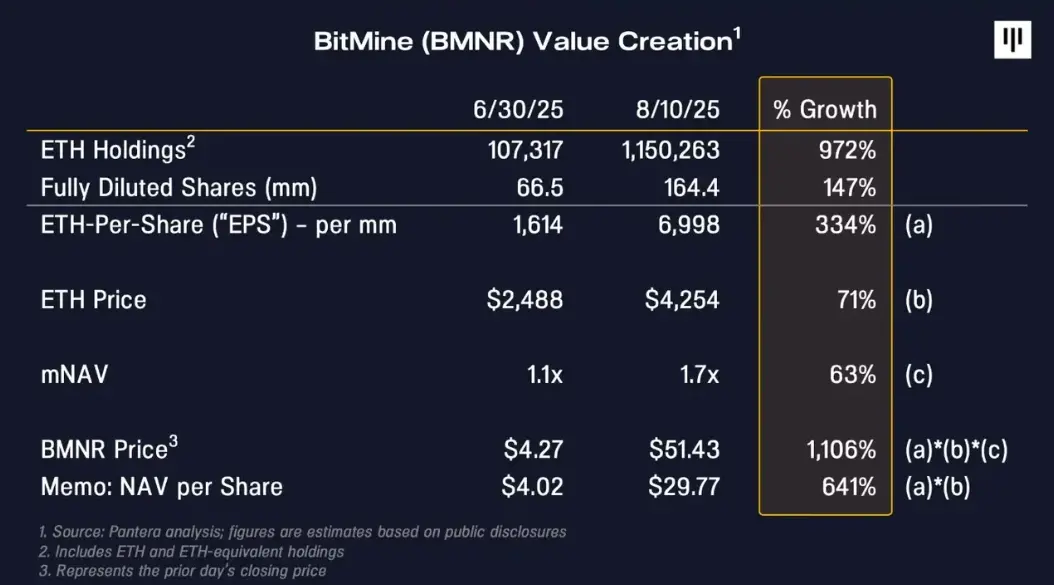
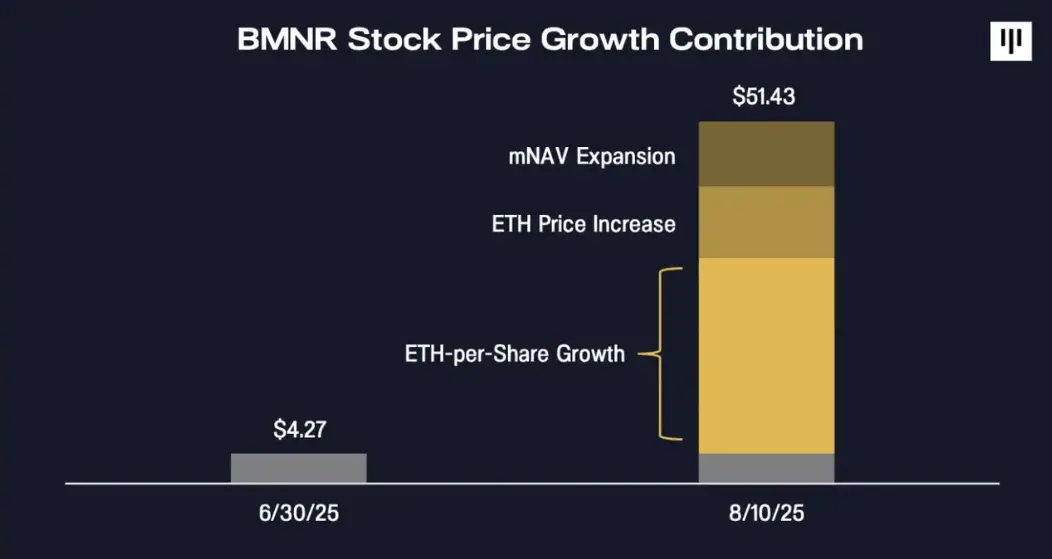
Utilization of stock price premiums: The stock price of DAT can be decomposed into the product of three elements: (1) the number of tokens per share; (2) the price of the underlying token; (3) the NAV premium multiple (mNAV). When the stock trades at a premium to NAV (i.e., mNAV > 1x), the company can issue shares to raise funds exceeding net asset value to increase the number of tokens held per share, thereby enhancing value. The core of this strategy lies in leveraging the valuation premium provided by the market to increase the number of tokens held per share, thus amplifying shareholder returns when the price of the underlying token rises.
Source: Pantera Official Website
According to Pantera's analysis, taking BMNR as an example, the remarkable increase in its stock price is driven by a clear value-driven logic. Within a month of launching the treasury strategy at the end of June, BMNR's per-share ETH holdings surged by 334%, contributing about 60% of the stock price increase; the ETH price rose from $2,500 to $4,300, contributing about 20%; and mNAV expanded from 1.1 times to 1.7 times, also contributing about 20%.
This breakdown of returns highlights the core competitive advantage of the DAT model: the primary driver of stock price growth is not passive fluctuations in digital asset prices but rather the appreciation of tokens per share achieved through proactive capital allocation by management. In other words, investors gain not only from market returns due to the rise in ETH prices (i.e., returns generated by market fluctuations) but, more importantly, from the active returns created by management (i.e., returns that do not fluctuate with the market). This "management-controlled value creation mechanism" is the core differentiated value proposition of DAT companies compared to direct holdings of spot assets, explaining why institutional investors are willing to pay a premium for DAT stocks.
Why choose Ethereum?
Source: Pantera Official Website
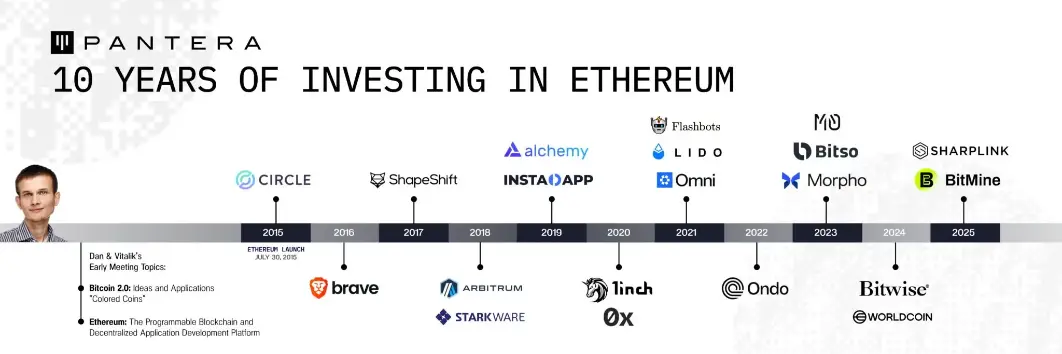
BitMine's firm choice of Ethereum reflects a deep judgment about the future development direction of blockchain infrastructure. Tom Lee stated on the Bankless podcast that Ethereum will become the infrastructure of the financialization and AI era, and that the current market price is far below its true potential. As Wall Street moves on-chain, Ethereum is set to become one of the most important macro trends in the next decade.
Network effect advantage: Ethereum has become the core infrastructure of digital finance. Ethereum hosts the vast majority of DeFi applications, NFT transactions, and enterprise-level blockchain applications. As traditional financial institutions accelerate their "on-chain" efforts, the network value of Ethereum will continue to grow.
Diversified revenue: Compared to Bitcoin, Ethereum offers more diverse sources of income. Companies can earn stable returns through staking via Ethereum's Proof of Stake (PoS) mechanism. As Tom Lee stated, "This essentially allows these companies to operate like infrastructure operators, with stable income sources." Additionally, staking derivatives and on-chain yield strategies in the DeFi ecosystem provide more financial innovation tools and revenue opportunities than Bitcoin.
Institutional adoption trend: Tom Lee mentioned on the podcast, "For many U.S. institutions, ETH ETFs may not fit their fund investment parameters, while digital asset treasury companies provide a compliant and efficient alternative." This indicates that as institutional investors increase their interest in Ethereum, digital asset treasury companies offer them more investment options.
BitMine's Core Business Model: Maximizing ETH Per Share
BitMine's core business model is to maximize ETH per share (EPS, ETH Per Share)—because in a digital asset bull market, the density of holdings determines the amplification of shareholder returns, making this metric a key performance indicator that replaces traditional earnings per share. BitMine has taken this logic to the extreme, continuously enhancing the per-share ETH content through diversified capital allocation strategies, thereby achieving super-linear growth in stock prices when ETH prices rise.
The main methods for increasing the number of tokens held per share include:
Premium issuance strategy: Based on the theoretical framework of the DAT model, BitMine translates the "stock price premium utilization" strategy into specific operational techniques. New shares are issued when the stock price trades at a premium to ETH's NAV. BitMine's latest plan to raise $20 billion to purchase ETH is based on this logic—assuming each share's NAV is $100 but the stock price is $120, the company issues shares to obtain $120 in cash to purchase an equivalent amount of ETH, potentially increasing the per-share ETH value from $100 to about $110, thereby enhancing value.
Derivatives tool innovation: Issuing convertible bonds and other equity-linked securities to capitalize on the dual volatility of stocks and ETH to obtain additional capital. Pantera predicts that BitMine will soon expand into this area, raising funds to purchase more ETH through bond financing without diluting existing shareholder equity.
Staking yield reinvestment: The Ethereum PoS mechanism provides BitMine with an additional source of income not available to Bitcoin DAT companies. The annualized returns obtained from staking ETH can be automatically reinvested to purchase more ETH, creating a compounding growth effect. This is a unique advantage of DATs like ETH compared to Bitcoin DATs.
Mergers and acquisitions: As more companies shift to Ethereum treasury strategies, BitMine can achieve scale expansion by acquiring other DAT companies whose transaction prices are close to or below NAV.
The synergistic effect of these four growth mechanisms enables BitMine to amplify returns when ETH prices rise and maintain competitive advantages through proactive capital allocation strategies when ETH prices decline.
Essentially, BitMine's treasury strategy is a finely designed financial engineering project, whose success depends on management's precise grasp of market timing, proficient use of capital market tools, and accurate judgment of the long-term value of the Ethereum ecosystem. The sustainability and replicability of this model will largely determine the future development trajectory of DAT as an emerging asset class.
Conclusion: Future Outlook
With clear strategic planning and strong execution, BitMine is driving profound changes in the field of crypto asset management. As BitMine's board chairman Tom Lee has proposed the company's long-term goal—to acquire 5% of the total supply of Ethereum, a goal referred to as "the alchemy of 5%."
Ethereum treasury strategy companies are replicating the successful experiences of companies like Strategy in the Bitcoin space, attracting follow-ups from several companies including Bit Digital and SharpLink Gaming. Meanwhile, Pantera Capital's investment of $300 million into the DAT space demonstrates the positioning of institutional capital in this emerging field.
Pioneers like BitMine are turning theoretical concepts into replicable business realities through the successful practice of Ethereum treasury reserves. As more publicly listed companies recognize the unique value of digital assets, the strategic layouts and execution experiences of these pioneers will become important catalysts for driving corporate digital transformation, accelerating the deep integration of traditional finance and the blockchain economy.
Reference Information:
Official disclosure from Bitmine Immersion Technologies, Inc. (PR Newswire release): https://www.prnewswire.com/news/bitmine-immersion-technologies%2C-inc./
Pantera's research on digital asset treasury investment strategies: https://panteracapital.com/blockchain-letter/dat-value-creation/
LongHash VC's analysis of the new asset class of DAT: https://www.longhash.vc/post/digital-asset-treasury-companies-passing-fad-or-a-new-asset-class
 Risk warning
 Risk warning