The U.S. government has really started using blockchain

 The era of economic data truth is coming.
Author: BUBBLE, BlockBeats
On August 28, 2025, the U.S. Department of Commerce officially announced the release of official macroeconomic data on the blockchain network, marking the first attempt by the U.S. government to provide official statistical data through blockchain. According to a press release from the U.S. Department of Commerce, the U.S. second-quarter Gross Domestic Product (GDP) data was publicly released that day via nine major public chains, including Bitcoin, Ethereum, Solana, TRON, and Stellar.
U.S. Secretary of Commerce Howard Lutnick emphasized in a statement that this initiative responds to President Trump's vision of a "crypto president," allowing the "economic truth" of the United States to be published in an immutable and globally accessible manner for the first time.

Video of Howard Lutnick's statement
After the announcement, the prices of the two main technology providers collaborating with the Department of Commerce surged. The native token PYTH of the decentralized verification layer Pyth Network skyrocketed over 108% within 10 hours, with its market cap exceeding $1 billion and a 24-hour trading volume increasing nearly 27 times. The LINK token of the decentralized oracle service provider Chainlink also rose by 10% within 7 hours, before falling back to the level prior to the announcement, currently priced at $24.28.
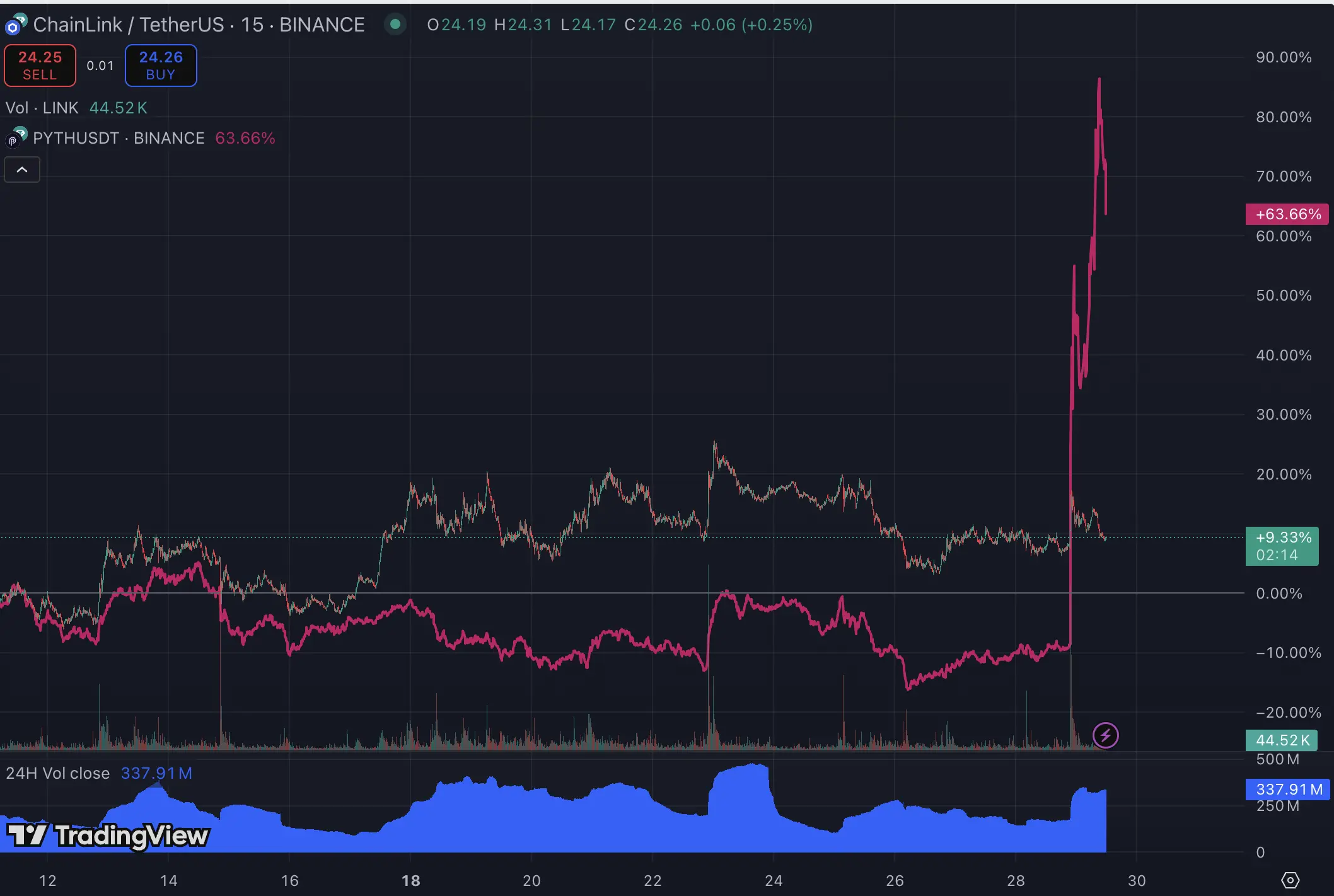
Price surge of Link and Pyth after the announcement, source: TradingView
How is macro data put on the chain?
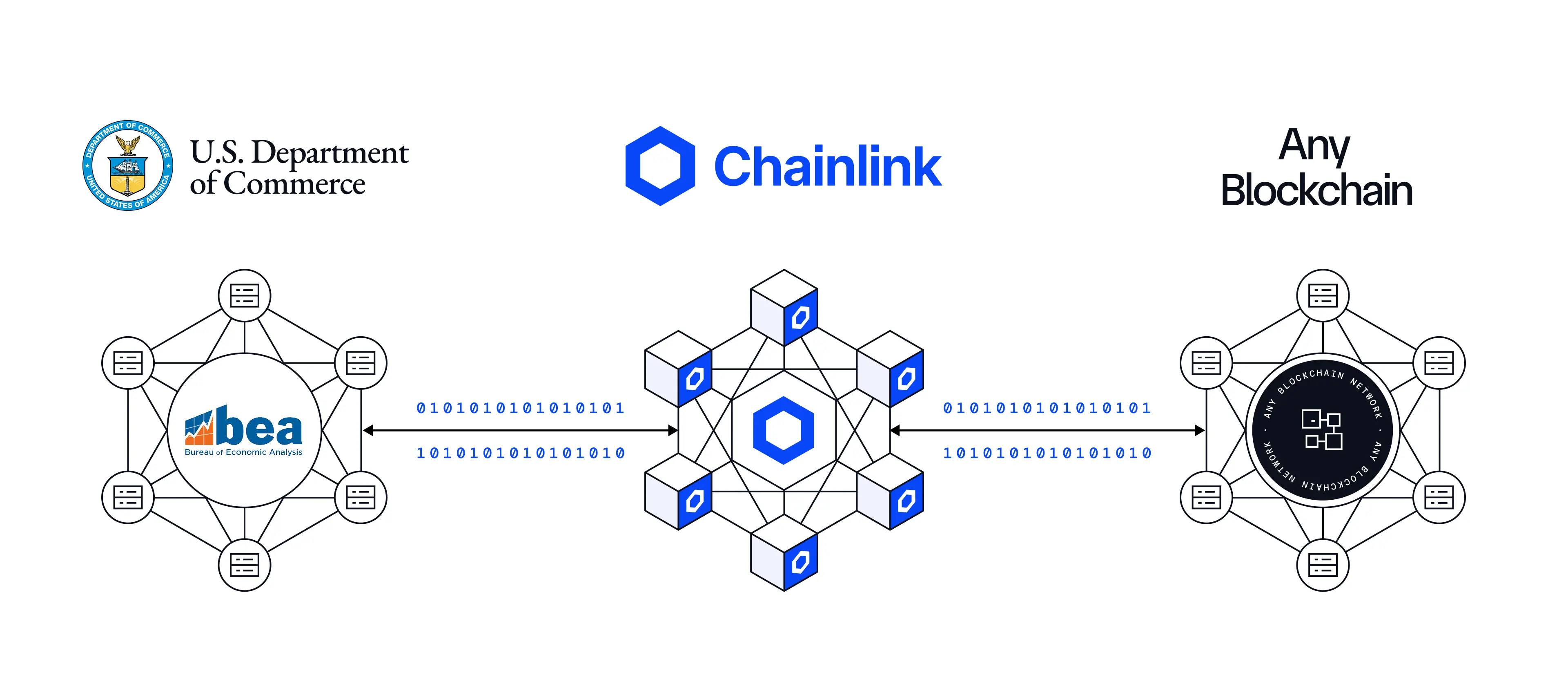
This collaboration involves the U.S. Department of Commerce's Bureau of Economic Analysis (BEA) providing macroeconomic data, with Pyth Network and Chainlink participating as decentralized verification layer and oracle partners.

Chainlink co-founder Sergey Nazarov signing the "Genius Act" at the White House, source: Chainlink
After the BEA provides the data, Chainlink will launch a series of on-chain data feeds, publishing key economic indicators such as GDP, Personal Consumption Expenditures (PCE) price index, and real final sales across approximately ten blockchains, including Ethereum, Avalanche, and Optimism, with data update frequency synchronized to the official release cycle (usually updated monthly).
First batch of on-chain data: • Real GDP---level • Real GDP---percentage change (annualized) • PCE price index---level • PCE price index---percentage change (annualized) • Real final sales to domestic private purchasers---level • Real final sales to domestic private purchasers---percentage change (annualized)
Pyth Network focuses on ensuring the cryptographic verifiability and distribution of GDP data, initially providing historical quarterly GDP data for the past five years on-chain, with plans to gradually support more macro datasets like the PCE price index and real final sales.
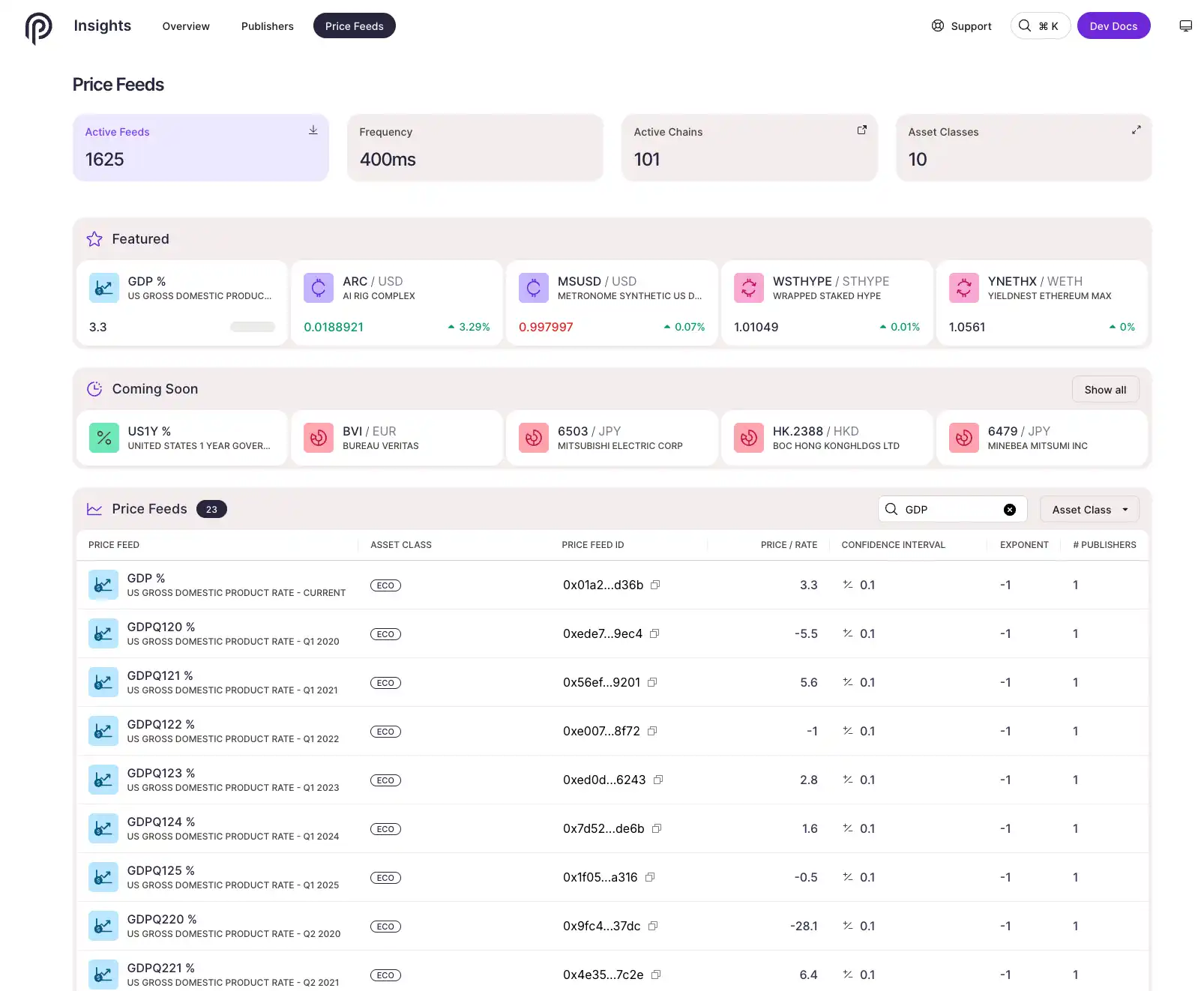
Pyth's data dashboard
The official press release noted that the Department of Commerce has written the hash values of data such as GDP onto the blockchain to ensure the records are immutable, and completed the on-chain release with the assistance of compliant exchanges like Coinbase, Gemini, and Kraken.
Thus, the BEA provides data, Chainlink creates cross-chain standardized data feeds for multiple indicators, and finally, Pyth ensures the on-chain verifiability and long-term distribution of the complete data loop, allowing future macro data to deeply participate in the on-chain ecosystem.
What impact does the on-chain official verification of data have on the ecosystem?
This government-business collaboration provides a model for introducing blockchain technology into public data infrastructure, with profound significance in greatly enhancing data transparency and real-time accessibility. Official economic indicators, once hashed and stored on-chain, will be difficult to tamper with, reducing the likelihood of disputes arising from human modifications to statistical data.
At the same time, developers can directly access verified official data for real-time application scenarios such as decentralized finance (DeFi) protocols and prediction markets. For example, lending protocols could automatically adjust interest rates based on GDP growth rates, and prediction markets could reference the PCE price index as a basis for inflation expectations.
Chainlink officials suggest that the on-chain U.S. government data will spur innovations such as automated trading strategies, inflation-linked digital asset issuance, real-time prediction markets, immutable on-chain data dashboards, and DeFi crisis management based on macro factors. The Pyth team stated that the on-chain economic data opens a new era of transparency, accessibility, and composability, providing a more trustworthy data foundation for DeFi, enterprise applications, and public accountability. What specific projects might these scenarios materialize into?
Automated Trading Strategies
Chainlink Automation: A decentralized automation network that triggers contract "Upkeep" when preset conditions are met, often used in conjunction with Chainlink data feeds. For example, when a certain data source meets a threshold (which could be replaced with on-chain GDP/PCE indicators in the future), it automatically rebalances or executes strategy orders. Its official documentation details trigger types, network coverage, and development processes.
Gelato Automate (Web3 Functions): A multi-chain automation execution infrastructure that provides SDK and Web3 Functions, allowing trades and contract calls to be triggered by time, events, or custom logic. Once macro indicators are on-chain, developers can integrate GDP/PCE as a signal source into trading logic using a "condition---execution" approach.
Set Protocol (TokenSets): An early supporter of "programmable asset baskets" and automated rebalancing on-chain portfolio management tools, with strategies that can automatically adjust based on technical indicators/external price feeds. After macro data is on-chain, strategy managers can incorporate macro thresholds (such as growth rate ranges) into rebalancing rules, forming a regulated quantitative asset basket.
Enhancing the Composability of Tokenized Assets
Centrifuge (RWA Market): Bringing real-world assets (RWA) like receivables on-chain and integrating them with DeFi, emphasizing "composability" with broader DeFi, and has opened an RWA lending market with Morpho. After macro data is on-chain, such RWA pools can embed macro thresholds into risk control or pricing templates, enhancing composability with lending/derivatives protocols.
Ondo Finance (OUSG / USDY): A "tokenized U.S. Treasury/Money Market Fund" product for qualified investors, supporting 24/7 minting and redemption while gradually integrating with multi-chain and DeFi. On-chain macro data (like PCE, GDP) helps position OUSG/USDY as collateral and liquidity components driven by "macro conditions" across more protocols, improving cross-protocol composability.
Franklin Templeton OnChain U.S. Government Money Fund: A "on-chain money market fund" from a traditional asset management giant, using blockchain accounting and has expanded to networks like Base, Stellar, Aptos, Avalanche, Arbitrum, and Polygon; SEC filings also disclose its on-chain accounting mechanism. After macro data is on-chain, such compliant funds have greater potential for interaction with DeFi's directives/risk controls.
New Types of Crypto Assets
Frax Finance (FPI and sFRAX): FPI is an "inflation stablecoin" pegged to the U.S. CPI-U, using on-chain mechanisms to track the inflation basket; sFRAX's yield attempts to follow the Federal Reserve's IORB (Interest on Reserve Balances), synchronizing with the macro interest rate environment through the "IORB oracle." As official macro data goes on-chain, the transparency and verifiability of inflation/rate-linked assets are further enhanced.
Synthetix (Synthetic Asset Protocol): Supports the minting of synthetic assets that track the prices of various underlying assets (including inverse synthetic assets), relying on price feed networks like Chainlink. In the future, using GDP, PCE, and other "official macro time series" as pricing or settlement indicators is expected to expand the category of "macro index synthetic assets."
Pendle Finance (Yield Tokenization: PT / YT): Splits yield-bearing assets into tradable "Principal (PT)/Yield (YT)," equivalent to on-chain "coupon separation," giving rise to new types of "yield derivatives." When RWAs (like OUSG, USDY) are linked with macro data, Pendle can support richer macro yield curve trading and risk hedging.
Real-time Prediction Markets
Polymarket: A mainstream on-chain event prediction market that uses UMA's optimistic oracle for market settlement. After macro data is on-chain, the settlement of macro contracts (growth rates, inflation paths, unemployment rate ranges, etc.) will be more certain and traceable.
Omen: A decentralized prediction market built using the "conditional token" framework; this framework tokenizes "outcome" for easier reuse across different applications. Once macro data becomes the on-chain truth source, Omen-like applications can more conveniently create prediction scenarios that intersect "macro---finance."
Azuro Protocol: A scalable "prediction/betting layer" that uses decentralized oracles (including integration with Chainlink) to import odds and results, providing infrastructure for various prediction applications. After macro data is input as "event/indicator pricing," Azuro can support macro-themed prediction products.
Immutable Data Supporting Dashboards
Dune: An open-source on-chain data analysis and dashboard platform that allows direct querying of multi-chain public data using SQL and visual sharing. After official macro data goes on-chain, analysts can build dashboards linking "official statistics---on-chain finance---RWA liquidity," achieving verifiable public transparency.
The Graph: A decentralized indexing protocol where developers structure on-chain events as "Subgraphs" and provide GraphQL query interfaces. Once macro time series (like quarterly GDP, monthly PCE) are written as on-chain events, they can be stably indexed by Subgraph, becoming standard data sources for various dashboards and applications.
DefiLlama: An industry-leading open-source DeFi data and TVL aggregation dashboard, publicly disclosing its calculation standards and data adapters. As macro data goes on-chain, aggregation dashboards like DefiLlama can juxtapose macro indicators with protocol fundamentals (TVL, revenue, leverage) for easier cross-validation.
DeFi Protocol Risk Management Based on Macroeconomic Factors
Aave (× Gauntlet Risk Engine): Aave relies on Chainlink price feeds and community governance, with Gauntlet providing parameter recommendations based on market liquidity/volatility (such as LTV, liquidation thresholds, borrowing limits, etc.). Governance posts and reports have long documented the "data-driven parameter tuning" process. Once macro data is on-chain, this risk control process can introduce "macro---on-chain" joint indicators for more timely parameter adjustments.
MakerDAO (DAI/DSR/Stability Fee): The Maker protocol maintains DAI's stability through stability fees, liquidation mechanisms, and dynamically adjusts parameters through governance decisions; documentation and community resources detail how stability fees/DSR respond to market environment changes. After macro data is on-chain, governance can more finely map macro thresholds to stability fees or collateral parameters.
Frax (sFRAX / Rate Benchmarking): The yield of sFRAX attempts to follow the Federal Reserve's IORB, effectively smart-contracting "macro interest rates"; media like Blockworks have reported on its "connection to Treasury yields." As more official macro indicators go on-chain, the Frax system can further utilize macro signals for stability mechanisms and risk thresholds.
A New Identity for Blockchain
This collaboration marks a shift in the traditional paradigm of official data release. Pyth's official announcement emphasizes that the Department of Commerce's on-chain release is not a one-time attempt but the beginning of long-term government-business collaboration, with plans to consider moving a broader range of economic datasets on-chain in the future.
This initiative aligns with the overall direction of the Trump administration's push for crypto-friendly policies. Recently, the U.S. House of Representatives passed the "2025 U.S. Blockchain Deployment Act" and other bills aimed at consolidating the U.S.'s leadership in blockchain technology. "Putting economic truth on-chain" is becoming an important part of the U.S. digital strategy, not only giving the U.S. an edge in the digital finance sector but also providing a model for other countries to follow. In the future, we may anticipate a global "economic data truth" era.
As the U.S. government takes the lead in putting key macro data on-chain, public data infrastructure is accelerating its transformation from traditional channels to on-chain models. The trend of "everything can be on-chain" is gradually becoming a reality. From financial market prices to government statistical data, blockchain is embracing a new identity as "a new type of public infrastructure that enhances trust and efficiency."
Click to learn about job openings at ChainCatcher
Recommended Reading:
Pantera Capital Deep Dive: The Value Creation Logic of Digital Asset Treasury DATs
Backroom: Tokenization of Information, a Solution to Data Redundancy in the AI Era? | CryptoSeed
 Risk warning
 Risk warning