Is the end of stablecoins public chains? A new attempt by the three giants

 Stablecoin issuers are no longer satisfied with just being "tokens," but are starting to build their own public chains.
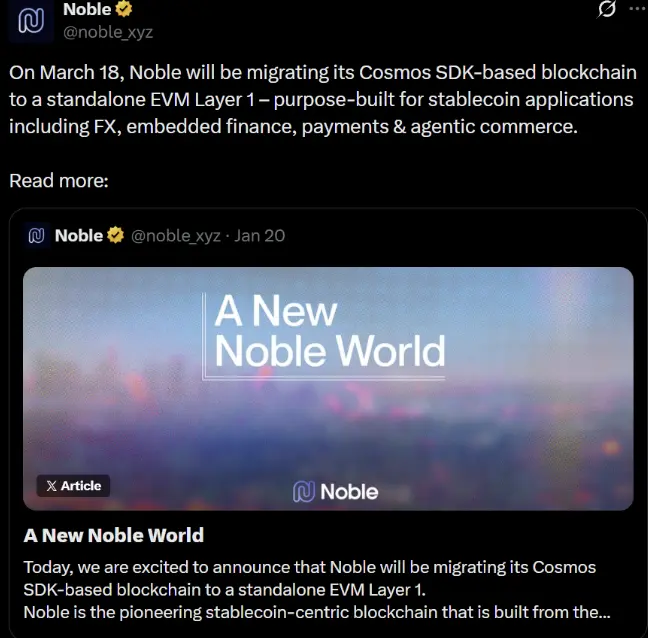
In the evolution of the cryptocurrency market, stablecoins have always been the most important infrastructure. From the earliest USDT to today's USDC, DAI, and the emerging USDe, stablecoins have become the core carriers of trading volume and liquidity. However, a trend that is accelerating is that stablecoin issuers are no longer satisfied with just being "tokens" but are starting to build their own public chains. As of today, the three giants of stablecoins, Tether, the issuer of USDT, will support a Bitcoin sidechain called Plasma focused on stablecoin scenarios starting at the end of 2024, while also announcing a new L1 chain called Stable supported by Bitfinex and the unified liquidity protocol USDT0 in early June this year. Circle, which is conducting an IPD in the US stock market, has also announced the development of Arc, designed specifically for stablecoin finance and programmable currency. The newly emerging stablecoin giant USDe, supported by its issuer Ethena, will also launch a testnet for Converge this fall.

Stablecoin Market Capitalization Distribution Map (Source: DefiLlama)
Why Do Stablecoins Need Public Chains?
In the past, stablecoins mostly relied on Ethereum, Solana, and other mainstream public chains. This model seems to leverage the liquidity of an open ecosystem, but it also means a high dependence on the underlying technical rules and transaction fee capture. As the size of the cryptocurrency market continues to expand, stablecoin issuers are beginning to reassess this pattern: is there a need to have a fully controllable underlying infrastructure to further consolidate their market position?
From the overall perspective of industry development, there are three core logics behind this trend:
Stablecoins Have Become Ecological Entrances: In the crypto world, stablecoins play the role of "digital dollars," and almost all on-chain activities are inseparable from them. Buying Bitcoin requires USDT or USDC, and the liquidity pools for DeFi mining are also denominated in stablecoins. Many people even use stablecoins as their daily digital wallets. The daily trading volume of stablecoins is often several times that of Bitcoin, making them the liquidity cornerstone of the entire crypto ecosystem. If stablecoin issuers also have their own public chains, it means they simultaneously hold "currency issuance rights" and "financial infrastructure," which will make their position even more unshakeable.
Strategic Value of the Settlement Layer: Public chains are essentially huge "toll booths," where every transaction incurs a toll. Currently, transferring USDT on Ethereum incurs fees of several dollars or even tens of dollars, all of which go to Ethereum. With daily trading volumes of USDT reaching hundreds of billions of dollars, the fee income is astronomical. Tron (TRX) has become a top public chain largely because it offers nearly free USDT transfers, attracting a large number of users migrating from Ethereum. If Tether had originally created a public chain, these users and revenues would have been theirs. With their own public chain, stablecoin issuers can not only collect transaction fees but also provide cheaper transfer services, and more importantly, control pricing—no longer "dependent on others," they can optimize network performance according to business needs.
Ecological Stickiness and Bargaining Power: In the crypto world, developers go where users follow. Solana has attracted a large number of projects due to its low transaction fees and fast speeds, and users have flocked in. If stablecoin issuers have their own public chains, they can actively attract developers to build ecosystems, such as providing specialized development tools, offering token incentives for new projects, or promising permanently low fees. Once a scale is formed, it will create a snowball effect, and stablecoin issuers will no longer just be "money printing factories," but platform-level enterprises. More importantly, their voice will be elevated—now Circle or Tether's cooperation with traditional banks is basically "asking for favors," but if they have a thriving public chain ecosystem with millions of users and thousands of applications, their position at the negotiating table will be completely different, even potentially prompting traditional financial institutions to seek cooperation actively.
Directions and Differentiation of the Three Giants' Public Chains
Plasma: Utilizing Bitcoin for Security
A dedicated public chain for stablecoin payments. Plasma is a blockchain specifically designed for stablecoin payments, which can be understood as the "Alipay for stablecoins." Its biggest feature is its deep integration with Bitcoin—users can directly use real Bitcoin to participate in smart contracts without needing to go through complex wrapped tokens. More conveniently, when transferring on Plasma, you can directly pay fees with USDT or Bitcoin, without having to first buy the native token as required by other public chains. The design philosophy of this chain is clear: to make stablecoin payments as simple as WeChat transfers. For teams looking to develop payment applications, they can directly utilize Plasma's infrastructure without starting from scratch to build complex underlying systems. In simple terms, Plasma aims to solve the problem of making stablecoin payments faster, cheaper, and safer while lowering the usage threshold for ordinary users and developers, promoting the adoption of stablecoins in everyday payment scenarios.
Converge: Ingeniously Merging Traditional Finance and DeFi Applications
Converge is a very interesting blockchain, characterized by its "duality"—it can be a completely open DeFi paradise or a strictly compliant financial platform, allowing users to choose different modes as needed. Imagine a public chain where retail investors can freely participate in various DeFi mining and trading, while banks and funds can conduct regulated digital asset businesses at the compliance level, with both sides not interfering but benefiting from each other. In terms of fees, Converge supports direct payment of transaction fees using stablecoins like USDe and USDtb, making costs fully controllable. This design is particularly suitable for projects that want to serve both retail and institutional clients—retail users can enjoy high yields and innovative gameplay in DeFi, while institutional users can participate in digital asset investments under compliance requirements. In simple terms, Converge aims to break down the barriers between traditional finance and DeFi, allowing the two worlds to coexist harmoniously and promote each other.
Stable: An L1 Created for Institutions Using USDT
Stable is a blockchain entirely built around USDT, specifically serving the transfer needs of hundreds of millions of USDT users worldwide. Its biggest innovation is making USDT the "blood" of the network—users do not need to pay any fees when transferring, nor do they need to prepare other tokens in advance; they can complete all operations directly with USDT, making it as simple as using a bank transfer. For privacy-conscious users, Stable also offers encrypted transfer features to ensure transaction information is not leaked. More importantly, it provides a complete payment solution designed specifically for enterprises and institutions, including bulk transfers, merchant payments, and debit card integration, allowing businesses to use USDT for daily operations just like using traditional banking systems. At the same time, Stable maintains good compatibility with other mainstream public chains, enabling users to easily transfer assets across different networks. In simple terms, Stable aims to make USDT truly the dollar of the digital world, not just a trading tool, but a complete payment infrastructure.
Arc: Designed for Institutional Finance
A compliance bridge for institutional finance. Arc is a blockchain tailored by Circle for enterprises and financial institutions, which can be seen as the "Wall Street version of a stablecoin public chain." Its biggest advantage is its deep roots in traditional finance through Circle, giving Arc a natural compliance advantage that is hard for other public chains to match. For enterprises, conducting business on Arc is like operating in a regulated financial environment, with controllable risks and compliance with regulatory requirements. Technically, Arc allows enterprises to pay all fees directly with USDC, making financial accounting simple and transparent, without the headache of complex token conversions. More importantly, Arc is designed with various financial tools tailored for institutional needs, such as enabling enterprises to easily tokenize traditional assets like real estate and equity or build their own digital payment systems. For traditional enterprises looking to embrace blockchain but worried about compliance risks, Arc provides a relatively safe entry point.

Comparison of Features and Technical Parameters
From the introduction of the core concepts of each stablecoin public chain above, it is clear that Ethena's Converge has significant differences from the other three. In terms of positioning, Plasma, Stable, and Arc all define themselves as payment infrastructures, focusing on making stablecoin transfers simpler and cheaper, essentially using blockchain technology to transform traditional payment experiences. In contrast, Converge clearly positions itself as a DeFi innovation platform, which aligns with Ethena's own DNA. Unlike traditional stablecoins like USDC and USDT, which are backed by cash and government bonds, USDe maintains price stability through a delta-neutral strategy, making this innovative mechanism naturally more suitable for users deeply involved in DeFi or interested in on-chain financial innovations.
More importantly, the differences manifest in growth strategies and understandings of "openness." Plasma emphasizes native Bitcoin integration, Stable pursues a zero-fee experience, and Arc relies on Circle's compliance advantages, all of which are optimizations within the existing framework. The first three mainly attract traditional users by lowering usage thresholds—no fees, simplified operations, compliance guarantees, etc., adopting a typical "first build a large user base" strategy. Converge, on the other hand, chooses a completely different path: attracting crypto natives by providing higher yields and more innovative opportunities, and then expanding outward through an optional compliance layer, reflecting a "first create deep user value" growth philosophy. Converge's most forward-looking innovation lies in its "optional permission" model. By default, the network is fully open, allowing anyone to freely bridge assets, deploy applications, and participate in DeFi activities, fully maintaining the innovative vitality of decentralized finance. However, when it comes to RWA tokenization or meeting KYC/KYB requirements, relevant applications can selectively enable the compliance layer. This design cleverly balances the open spirit of DeFi with the compliance needs of traditional finance, ensuring that innovation is not stifled by excessive regulation, nor that institutions are deterred by complete laissez-faire. In simple terms, the other three chains are using new technology to do traditional things, while Converge is building infrastructure for the future financial ecosystem.

Converge Optional Permission Architecture (Source: Converge)
Challenges and Future Outlook
Stablecoin public chains need to support large-scale transfers, settlements, and payments, requiring high stability and security. Any vulnerabilities or interruptions will shake the trust foundation of stablecoins. At the same time, ecological cold starts are another major challenge; latecomers must rely on differentiated features and incentive mechanisms to compete against the network effects of existing public chains like Ethereum and Solana. In the future, the integration of stablecoins and public chains will blur the boundaries between "currency" and "infrastructure," evolving from a single token into an ecological operating system. Projects that succeed in balancing compliance and openness are most likely to become bridges between traditional finance and crypto finance, occupying a key position in the global financial infrastructure competition.
 Risk warning
 Risk warning