AIsa will hold the AgentPay Summit in San Francisco, partnering with a16z to explore the path of AI-native payments

 The summit will invite guests from institutions such as Visa Ventures, Google DeepMind, Stripe, Circle, and StillMark to discuss Agent-to-Service, Agent-to-Agent settlement, high-frequency micropayment scenarios, and the construction of payment infrastructure.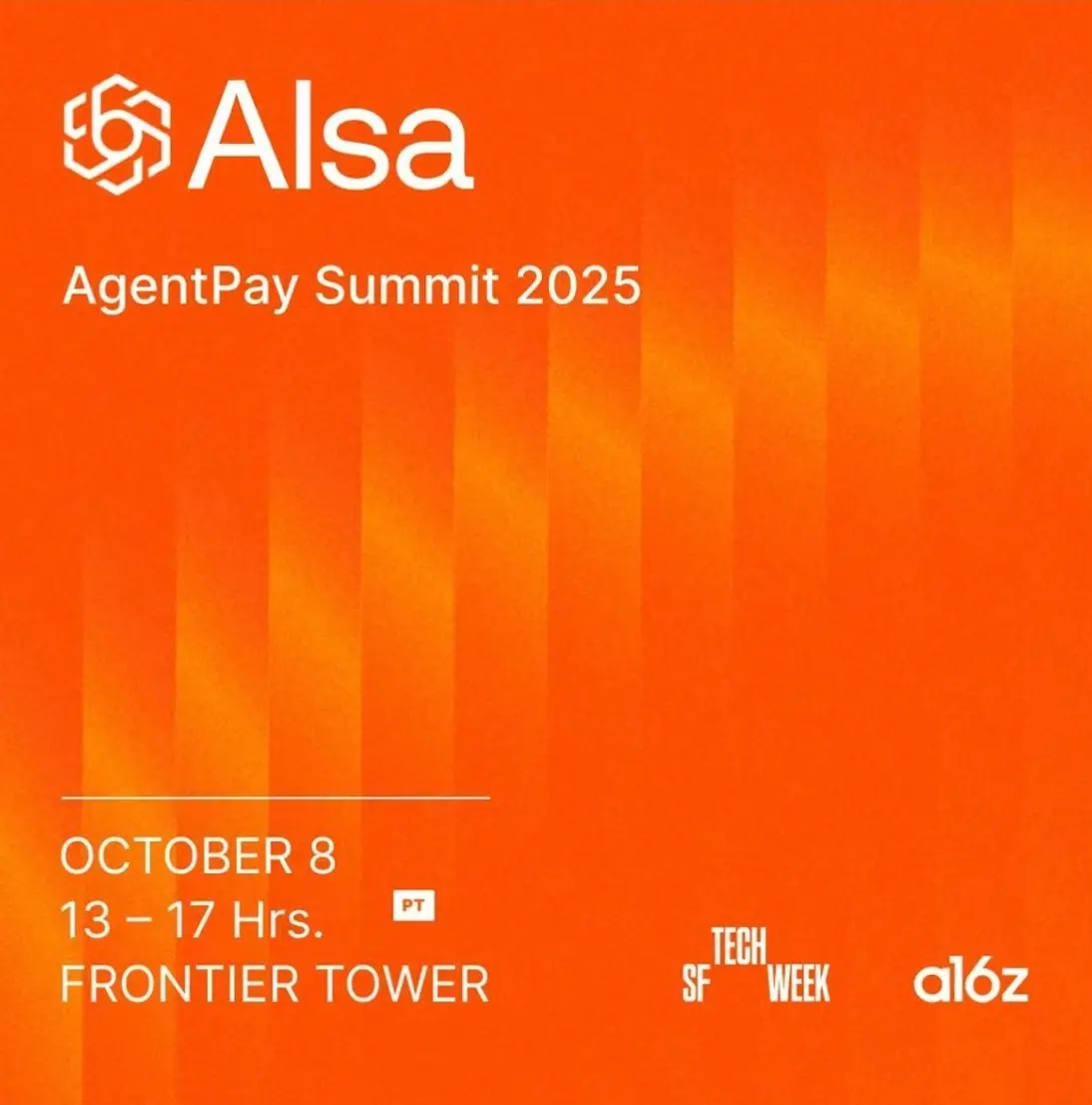
Registration link: https://partiful.com/e/UKT1r1VmhNCbLWLsEBxG
The AI micropayment infrastructure project AIsa will co-host the AgentPay Summit 2025 with a16z during SF Tech Week in San Francisco on October 8. As one of the officially recommended summits of this tech week, it focuses on AI-native payments.
The summit will invite guests from organizations such as Visa Ventures, Google DeepMind, Stripe, Circle, and StillMark to discuss Agent-to-Service, Agent-to-Agent settlement, high-frequency micropayment scenarios, and the construction of payment infrastructure.
Over the past year, AI payments have significantly heated up. Since the launch of the x402 protocol by Coinbase in February, Cloudflare introduced Pay Per Crawl in July, and Google released the Agent Payment Protocol (AP2) in September. In the same month, Circuit & Chisel's ATXP protocol raised $19 million shortly after its launch.
Various signs indicate that the Agentic Payment industry is accelerating its formation. AIsa is one of the early explorers in this field.
AIsa focuses on the execution layer of high-frequency micropayment transactions, closely collaborating with the protocol (communication) layer
As an early developer and contributor to Visa AI Payments (VIC) and the Stripe AI ecosystem, AIsa was the first to propose the "three-step" evolutionary path of AI payments:
- Step One: Agentic Commerce (Agents complete shopping and payments on behalf of users)
- Step Two: Agent-to-Service (Agents pay for resources they call)
- Step Three: Agent-to-Agent (Automatic settlement in multi-Agent collaboration)
Currently, AIsa has been implemented in certain scenarios, with daily call volumes reaching hundreds of thousands. Co-founder Jordan will further elaborate on the evolutionary path and underlying principles of the three-step process at the summit, as well as how AIsa integrates with protocol layer ecosystems such as AP2, ATXP, x402, and L402.
Why has payment become a core issue today?
With the popularization of large models and AI Agents, the contradictions of the AI economy have become increasingly prominent: models and applications need to call data, APIs, and computing power, but existing payment systems remain cumbersome and expensive for small transactions. Advertising models rely on user attention, but Agents do not view ads; subscription models require upfront payment, but Agent calls are real-time and fragmented, often occurring at granular levels of $0.01 or even $0.0001. This creates a significant mismatch between traditional payment models and Agent consumption methods.
AIsa's positioning is to provide a payment layer for the AI economy that is granular to the token, fast to milliseconds, and embeddable for calls. It does not aim to rebuild public chains but focuses on settlement logic: supporting billions of TPS through a high-frequency settlement network; providing independent wallets for Agents through an account system that is compatible with fiat and digital assets; ensuring call security through payment safeguards (AgentPayGuard); and enabling APIs, data, and content interfaces to charge directly to Agents through AgentPayWall-402.
Analysts point out that if the HTTP protocol was once the cornerstone of the internet, then for the Agent economy to truly take shape, a new payment layer must serve as a circulatory system. A stable micropayment network can not only activate long-tail data and computing resources but may also become the underlying adhesive connecting AI applications, services, and global supply chains.
Therefore, the significance of the AgentPay Summit goes beyond showcasing new solutions; it aims to publicize the issue of "AI needs payment." It is expected to answer three key questions:
- 1. How does AI payment evolve and transform?
- 2. How do AI payment scenarios land, and in which scenarios do they land first?
- 3. How are compliance and security supported?
The answers may require more time for validation. But at least on October 8, on the stage in San Francisco, we will see how the first batch of developers, investors, and infrastructure projects bring the concept of "machine-to-machine payments" to reality.
 Risk warning
 Risk warning



Popular articles