Sentient Project In-Depth Research Report

 The chapter provides a detailed introduction to the Sentient Protocol—an open-source protocol platform dedicated to building a decentralized artificial intelligence economy (AGI). Its core goal is to establish an ownership structure for AI models, provide on-chain calling mechanisms, and build a profit-sharing AI Agent network to address the issues of "unclear model ownership and unfair value distribution" in the centralized LLM market.
Written by: 0xjacobzhao and ChatGPT 4o/ Grok3
I. Project Introduction:
Sentient is an open-source protocol platform dedicated to building a decentralized artificial intelligence economy. Its core goal is to establish an ownership structure for AI models, provide on-chain invocation mechanisms, and build a composable, profit-sharing AI Agent network. Through the "OML" framework (Open, Monetizable, Loyal) and model fingerprint technology, Sentient addresses the fundamental issues of "unclear model ownership, untraceable invocation, and unfair value distribution" in the current centralized LLM market.
- Official Website: https://www.sentient.xyz
- GitHub: https://github.com/sentient-agi
- Foundation: https://sentient.foundation
- Documentation: https://docs.sentient.xyz
- Blog: https://www.sentient.xyz/blog
- X: https://x.com/SentientAGI
The project is driven by the Sentient Foundation, focusing on the construction of open-source AGI and protocol incentive mechanisms. The concept of "Loyal AI" it advocates refers to an open AI model ecosystem that serves the community, ensures fair governance, and can evolve autonomously over the long term.
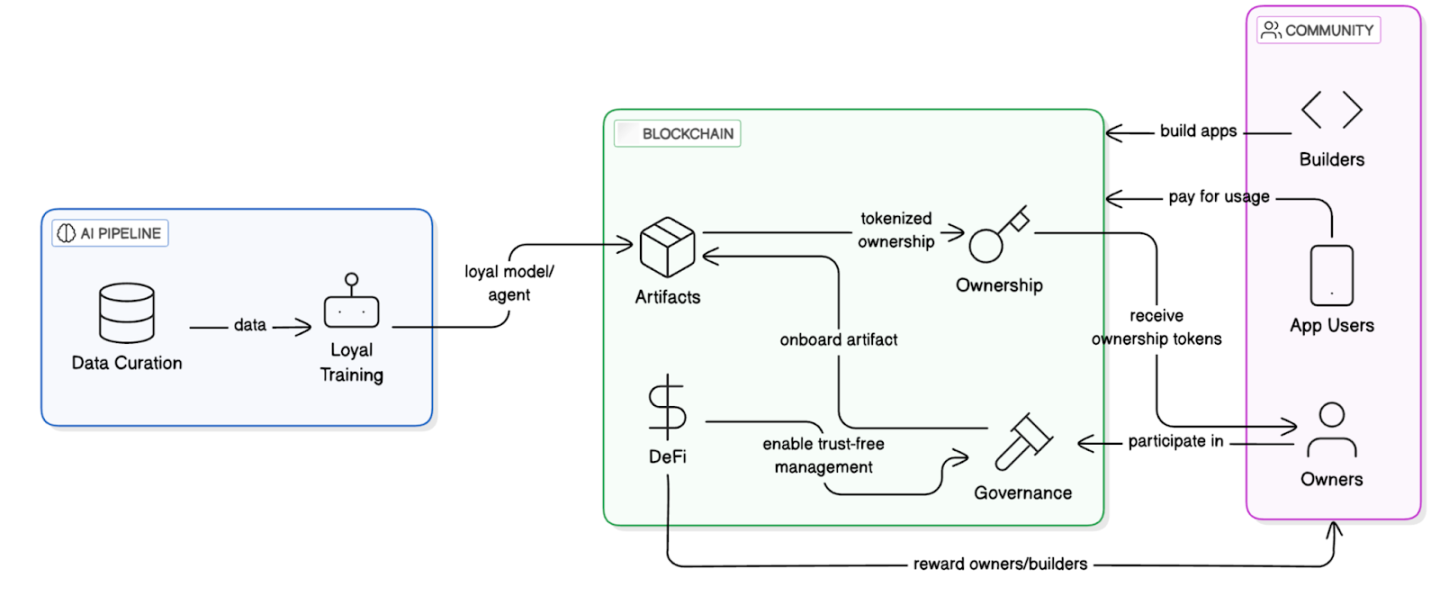
The architecture of the Sentient Protocol consists of two core components: the blockchain system and the AI pipeline.
The AI Pipeline is the foundation for developing and training "Loyal AI" artifacts, consisting of two core processes:
- Data Curation: A community-driven data selection process for model alignment.
- Loyalty Training: A training process that ensures the model remains consistent with community intentions.
The blockchain system provides transparency and decentralized control for the protocol, ensuring ownership and governance of AI artifacts. The main modules include:
- Governance: Controlled and decided by a decentralized autonomous organization (DAO).
- Ownership: Represented through tokenization to indicate ownership of AI artifacts.
- Decentralized Finance (DeFi): Provides financial tools that support open, decentralized, and fair governance and rewards.
II. Technical Architecture and Model Ownership Mechanism:
1. OML Model Framework
In the white paper "Sentient: Loyal AI" released in 2024 (https://arxiv.org/abs/2411.03887), the project proposes the OML framework, which starts with model ownership and attempts to build a "on-chain AI ownership protocol economy." It systematically introduces the concept of "AI-native cryptography," aiming to provide a cryptographic-level ownership protection mechanism for open-source models.
Core paper interpretation------"OML: Open, Monetizable, and Loyal AI":
- Open: Models must be open-source, with transparent code and data structures that support community reproduction, auditing, and forking.
- Monetizable: Each invocation of the model should trigger a revenue stream, distributed through on-chain contracts to trainers, deployers, and validators.
- Loyal: The model does not belong to a company but to the contributor community, with upgrade directions and governance determined by the DAO. Model ownership is verifiable, modifications are restricted, and usage is controlled.
OML is not equivalent to a code license agreement; rather, it ensures that open-source models possess economic sovereignty and governance rights while remaining open through on-chain mechanisms and cryptographic means. It constructs an AI-native ownership and revenue protocol layer, ensuring that even if the model is public, ownership clarity, economic incentives, and behavioral governance are maintained.
Core Concept: AI-native Cryptography
Unlike traditional cryptography, which focuses on binary precision, AI-native cryptography utilizes the continuity, low-dimensional manifold structure, and differentiable characteristics of AI models to develop a "verifiable but non-removable" lightweight security mechanism. Its core technologies include:
- Model Fingerprinting: Inserting a set of concealed query-response key-value pairs during training to form a unique signature for the model.
- Ownership Verification Protocol: Verifying whether the fingerprint is retained through queries posed by a third-party detector (Prover).
- Permission Invocation Mechanism: A "permission credential" issued by the model owner must be obtained before invoking the model, which then authorizes the model to decode the input and return accurate answers.
This approach enables "behavior-based authorized invocation + ownership verification" without the cost of re-encryption.
5 Types of OML Constructs:
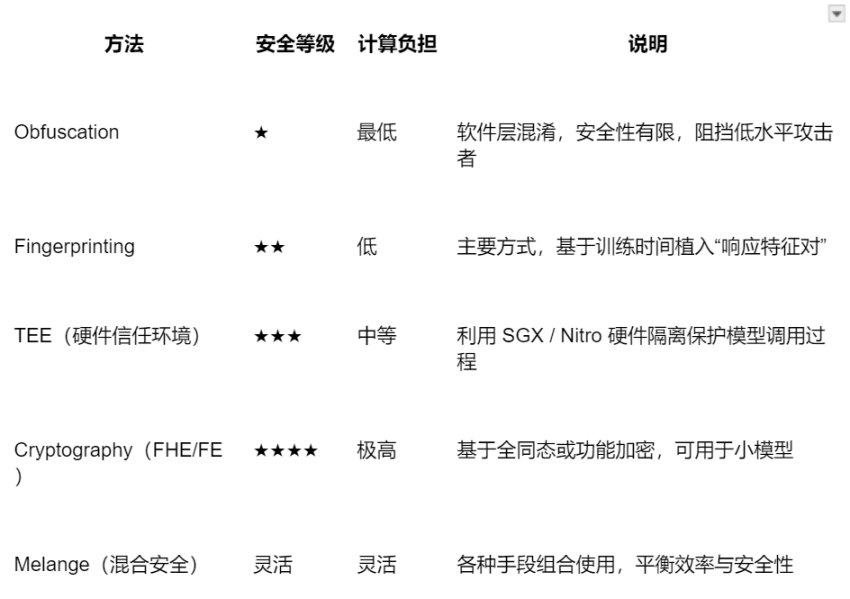
Sentient currently adopts Melange mixed security: combining fingerprint ownership, TEE execution, and on-chain contract profit sharing. The fingerprint method serves as the mainline implementation of OML 1.0, emphasizing the concept of "Optimistic Security," which assumes compliance by default, with violations being detectable and punishable.
Additionally, the paper defines various verification mechanisms and attack models for the fingerprint mechanism:
- Fine-tuning Attack (LoRA/SFT): Modifying certain parameters to attempt to erase the fingerprint.
- Knowledge Distillation: Constructing a student model to evade the parent model's fingerprint.
- Parameter Averaging (Model Merging): Attempting to dilute the fingerprint strength through the fusion of multiple models.
- Fingerprint Leakage Attack: If the fingerprint key is leaked, the verification mechanism will fail.
Countermeasures include: multi-round embedding, subnet isolation training; combining benign samples to prevent forgetting; embedding weight binding on-chain credentials.
OML and Sentient Protocol Architecture
The final chapter of the paper proposes a complete on-chain protocol (Sentient Protocol) to support OML:
- Storage Layer: Stores model weights and fingerprint registration information.
- Distribution Layer: Authorization contracts control model invocation entry points.
- Access Layer: Verifies whether users are authorized through permission proofs.
- Incentive Layer: Revenue routing contracts distribute payments for each invocation to trainers, deployers, and validators.
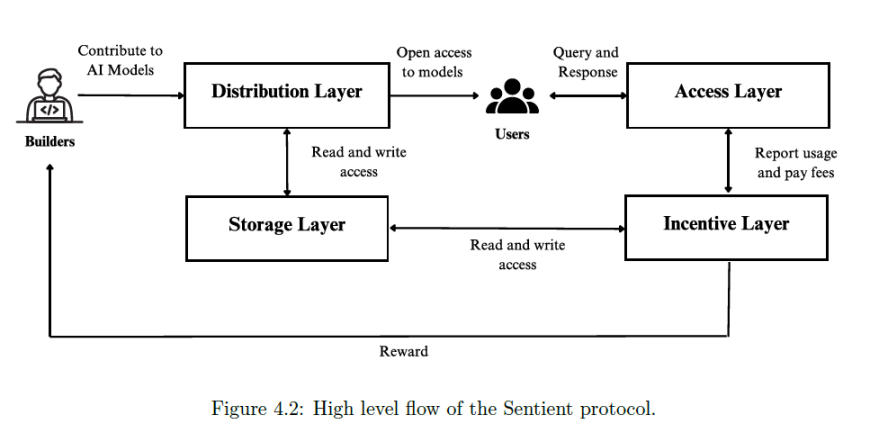
It emphasizes compatibility with L1 main chains like Ethereum, serving as an on-chain AI ownership standard protocol stack. All models are registered on-chain (including hashes, signatures, public keys, fingerprint structure IDs); Agents bind registered models and trigger usage proof submissions after each invocation; contracts distribute profits based on invocation events and revenue flow rules (to trainers, deployers, and validators); users or contract callers must verify invocation permissions through on-chain gateways. This structure constitutes the underlying design philosophy of the Sentient Protocol.
2. Fingerprint Recognition and Model Ownership Mechanism
GitHub: https://github.com/sentient-agi/oml-1.0-fingerprinting
This repository is the first implementation version of the Sentient fingerprint mechanism, providing fingerprint injection and verification interfaces that can be embedded in the training process. Its purpose is to ensure that model ownership is verifiable, usage behavior is traceable, and unauthorized copying and commercialization are prevented. This is a concrete engineering implementation of the OML (Open, Monetizable, Loyal) framework.
The model fingerprint module (OML 1.0 Fingerprinting Module) has the following functions:
- Behavioral Profiling: Extracting features from model behavior to generate a unique fingerprint.
- Model Attribution: Determining the source model based on generated content.
- Fingerprint Verification: Verifying the source and consistency of the model's output content.
The essence of the fingerprint mechanism is: by fine-tuning the model, a unique set of "question - answer" (key-response) pairs is embedded, allowing the model owner to verify whether the model belongs to them through specific queries, thus forming the model's "cryptographic signature." In summary, it adds a "watermark" to LLMs (large language models) to track and enforce AI ownership.
3. Enclave TEE Computing Framework
GitHub: https://github.com/sentient-agi/Sentient-Enclaves-Framework
The Sentient Enclaves Framework is an open-source framework that utilizes trusted execution environments (TEE) such as AWS Nitro Enclaves to achieve secure deployment of model inference, fine-tuning, and proxy services. This framework emphasizes the "loyalty" of the model, ensuring that the model only responds to authorized requests, preventing unauthorized access and use. Its security features include:
- Payload Encrypted Deployment: The model body, runtime configuration, and input/output are all encrypted and stored within the enclave.
- TLS-based RPC: Calls use a two-way TLS + attestation signature channel for communication.
- Log and Cache Isolation: Operates in a transient memory area without recording permanent logs.
- Attestation Report: Each invocation generates an output proof bound to the enclave signature, ensuring that execution behavior is traceable and verifiable.
TEE (Sentient Enclaves Framework) boasts high performance and cloud integration, making it suitable for real-time AI and sensitive data processing, but it is limited by hardware dependencies and side-channel attacks. The Sentient Enclaves Framework leverages Nitro Enclaves to provide enterprise-level privacy protection, with a user-friendly development experience. Compared to other cryptographic technologies, FHE offers hardware-independent and quantum-safe strong privacy guarantees but incurs significant performance overhead, making it suitable for specific cryptographic computing scenarios and difficult to directly replace TEE's high-performance tasks. ZK performs excellently in verifiability and decentralized scenarios and can serve as a complement to TEE (this module plans to integrate with zkML in the future).
4. Sentient Agent Framework
GitHub: https://github.com/sentient-agi/Sentient-Agent-Framework
The Sentient-Agent-Framework is a lightweight open-source framework focused on automating web tasks (such as searching, playing videos) through AI agents controlling browsers, providing a simple development experience (claimed to be 3 lines of code) by combining natural language instructions and LLMs (like OpenAI's GPT-4o). Its asynchronous execution, custom instructions, and multi-provider support make it suitable for rapid development and experimental applications. When combined with other projects of Sentient AGI (such as the TEE framework), it can be extended to secure sensitive scenarios.
Core Architecture: This architecture supports building agents with a complete closed loop of "perception - planning - execution - feedback," which can be expanded into a multi-agent collaborative, on-chain verification, and aligned open-source AI system.
- User Layer: Users input task objectives through natural language.
- Agent Framework Layer (Sentient Agent Framework)
- Perception: Understanding input and environment.
- Planning: Generating action plans based on objectives.
- Execution: Invoking tools/skills to perform tasks.
- Reflection: Analyzing feedback to optimize behavior.
- Memory: Short-term + long-term memory management.
- Skills/Tools: Registering external functions and plugins.
- Collaboration Layer (Multi-Agent Layer): Multiple agents work together, task allocation, and result summarization.
- External Integration Layer.
- Blockchain Smart Contracts: Recording tasks and incentive settlements.
- Agent Registry: Identity authentication and version control.
- ZK Proof Module: Verifying output authenticity.
- External Tool APIs: Such as web search, databases, file systems, etc.
- Storage Layer: Local storage + decentralized storage (such as IPFS).
Compared to traditional AI Agent Frameworks, the Sentient-Agent-Framework has limited but lightweight and straightforward functionality. In comparison to Crypto AI Frameworks like Virtuals Protocol and ai16z (elizaOS), the latter offers diverse solutions for AI agent development, on-chain automation, or Web3 integration, while the Sentient-Agent-Framework is more suitable for off-chain web tasks.
5. Sentient Social Agent
GitHub: https://github.com/sentient-agi/Sentient-Social-Agent
The Sentient-Social-Agent is an AI system aimed at automating interactions on social platforms (Twitter, Discord, and Telegram), capable of understanding social environments, generating content, interacting with users, and facilitating social communication through multi-agent collaboration. It utilizes social perception, content generation, and behavioral planning modules to support natural conversations and content creation on platforms, suitable for brand operations, virtual community management, and information dissemination. This system can integrate with the Sentient Agent framework.
6. Open Deep Search (Not Launched)
On the Sentient official website, Open Deep Search is defined as a search agent that can surpass ChatGPT and Perplexity Pro. Team member Sewoong Oh disclosed some plans at the EthDenver 2025 Open AGI Summit:
Open Deep Search consists of two main parts: Sentient's search capabilities (including query rephrasing, URL and document processing, etc.) and the reasoning agent. The reasoning agent utilizes open-source LLMs (such as Llama 3.1 and DeepSeek) to enhance search quality through tools like search, calculators, and self-reflection. On the Frames Benchmark, Open Deep Search outperformed other open-source models and even rivaled some closed-source models, but since its functionality has not been launched, we cannot currently assess its true capabilities.
III. Product Forms, Implementation, and Planning
Currently, the products showcased on the Sentient official website primarily include the Sentient Chat dialogue platform and the open-source model Dobby LLMs:
Sentient Chat:
Sentient Chat is a decentralized AI chat platform launched by the Sentient Foundation, aiming to provide a community-driven, customizable, and loyal AI experience. The platform integrates open-source large language models (such as the Dobby series) with advanced reasoning agent frameworks, supporting various tool integrations to meet diverse user needs. Core features include:
- Open Reasoning Agent: The built-in reasoning agent of Sentient Chat can perform complex tasks and supports the following functions:
- Search Tool: Integrates Open Deep Search (ODS) to provide real-time web search capabilities.
- Calculator: Handles mathematical calculations and data analysis tasks.
- Code Execution: Generates and runs Python code to achieve complex logical reasoning and task execution.
- Multi-Agent Integration: The platform supports the integration of multiple AI agents, allowing users to choose different agents for interaction based on their needs, enhancing the platform's flexibility and functionality. Similar to a Web3 version of POE or an open, agent-driven alternative to Perplexity.
Sentient Chat is currently in the testing phase and is accessible only through invitation codes distributed via email or community events. According to official information, over 5,000 users have successfully gained access to Sentient Chat, processing over 100,000 user queries. As the author has not yet become a whitelisted user for testing, they cannot assess the model's true capabilities.
Dobby LLM Model Series:
Fine-tuned based on Meta's Llama series, Hugging Face homepage (https://huggingface.co/SentientAGI)
1. Dobby-Unhinged Series
- Dobby-Unhinged-Llama-3.3-70B: Fine-tuned based on Llama 3.3-70B-Instruct, emphasizing personal freedom and cryptocurrency, featuring a straightforward, humorous, and human-like dialogue style.
- Dobby-Mini-Unhinged-Llama-3.1-8B: An 8B parameter version suitable for resource-constrained devices, maintaining the core characteristics of the "Unhinged" series.
2. Dobby-Leashed Series:
Dobby-Mini-Leashed-Llama-3.1-8B: Compared to the "Unhinged" version, it has a milder tone, suitable for applications requiring more robust output.
Since the Dobby LLM models are fine-tuned versions based on Llama 3.1 and 3.3, we believe their application scenarios mainly involve building chatbots, content generation and creation, role-playing agents, etc. Their advantages lie in flexible style generation, enhanced reasoning, and low resource requirements, making them suitable for rapid deployment and flexible customization in resource-constrained environments. Compared to more powerful closed-source models like GPT-4, Dobby LLM still has gaps in handling advanced logic, cross-domain knowledge reasoning, and deep reasoning tasks.
IV. Ecological Cooperation and Implementation Scenarios
Currently, the Sentient Builder Program offers $1 million in funding to support developers in building AI Agent entities that operate within the Sentient Chat ecosystem, requiring developers to use Sentient's development kit and access its ecosystem through the Sentient Agent API.
At the same time, the ecological partners announced on the Sentient official website cover project teams in multiple fields of Crypto AI (https://www.sentient.xyz/partners), with the specific list as follows:
- Models: Eigenlayer, Move, CrunchDAO, Bagel, KGEN
- Agents: Messari, Franklin Templeton, Kaito, MyShell, Third Web, Theoriq, Open, QNA3, Pond, Mira, Olas, Biconomy, Talus, Zettablocks, Axal, Morpheus AI, dFusion, ExponentAI, Fetch AI, Giza, JustTX, UnifAI, Questflow, QuillAI, Raiinmaker, Solo, Spectral, UOMI, PlayAI
- Data: Kaito, Vana, The Graph, Space and Time, 0g, Open, QNA3, Zettablocks, Chainbased, dFusion, Dria/First Batch, Entrova, FractionAI, Hyve DA, Irys, Masa, Mizu, OpenLedger, Raiinmaker, Sapien, Zus Network
- Verifiable AI: Nillion, Lagrange, pi2
- Blockchain: Arbitrum, Polygon, Celo
- Infrastructure: Lit Protocol, OpenGradient
As a leading project in the Crypto AI field, Sentient's resource integration capability can cover any star startup project in the industry. However, it should be noted that the widespread existence of "marketing-type" collaborations in the Crypto field has created a false sense of prosperity in the industry, and the contribution and loyalty of Sentient's ecological partners to its ecosystem still require our continuous observation.
The Open AGI Summit is a global conference organized by the Sentient team, dedicated to exploring the intersection of artificial intelligence (AI) and cryptocurrency (Crypto). I had the privilege of attending its summits in 2024 and 2025 during ETH Denver and ETHcc, where the Sentient team demonstrated the ability to gather top institutional investors and project entrepreneurs in the industry, which is a highlight.
V. Team Structure and Research Background
The Sentient Foundation brings together top academic experts, crypto industry entrepreneurs, and engineers from around the world, dedicated to building a community-driven, open-source, and verifiable AGI platform. According to the official team information released (https://sentient.foundation/people), its team members mainly include:
Core Leadership (Steering Committee)
- Pramod Viswanath -- Professor at Princeton University, long-term researcher in information theory and communication systems, leading Sentient's AI security and theoretical foundation construction.
- Himanshu Tyagi -- Professor at the Indian Institute of Science, specializing in privacy protection and decentralized learning algorithms, providing academic support for model training and privacy collaboration.
- Sandeep Nailwal -- Co-founder of Polygon, responsible for blockchain strategy and global ecological layout, a key figure connecting the crypto community and AI architecture.
- Sensys Team -- A Web3-native product studio, leading user experience optimization and developer infrastructure construction, promoting the implementation of Sentient products.
Core engineering and development team: Members from well-known tech and blockchain companies such as Meta, Coinbase, Circle, Polygon, Binance, as well as researchers from universities like Princeton, the University of Washington, and the Indian Institute of Technology. Team members possess rich experience in LLM engineering, system security, computer vision, and data system construction.
AI research and model training team: The research team covers AI/ML, NLP, computer vision, and reinforcement learning, with members having practical experience at institutions like Google Research, Daimon Labs, and Fetch.ai. The composition of this team shows that Sentient possesses both strong academic depth and the ability to implement and experience in the crypto ecosystem.
It is worth noting that Sentient was established under the successful aura of Polygon co-founder Sandeep Nailwal. As an important scaling solution for the Ethereum ecosystem, Matic started with Plasma, a technology that is not leading but sufficiently "cheap and fast," building Polygon's differentiation moat in areas like NFTs and social interactions. At the same time, by acquiring Mir Protocol and Hermez Network and launching Polygon zkEVM, it integrated ZK technology into its blockchain scaling solutions. As Sandeep Nailwal's second entrepreneurial venture, Sentient's experience, funding, connections, and market recognition far exceed those of the past, and it could secure substantial funding in 2024 even with an imperfect project concept. However, the AI field is fundamentally different from Crypto, and Sentient still faces external challenges such as changes in the new market environment, intensified competition, and technological updates.
VI. Financing Situation and Token Model
- Financing Time: Mid-2024;
- Financing Amount: $85 million (seed round);
- Investment Institutions: Founders Fund, Pantera, and Framework Ventures co-led, with other VC institutions including Ethereal, Robot Ventures, Symbolic Capital, Dao5, Delphi, Primitive Ventures, Nomad, Hack VC, Arrington Capital, Hypersphere, IDG, Topology, Protagonist, Folius, Sky9, Canonical Crypto, Dispersion Capital, Mirana, Foresight, Hashkey, Spartan, Republic, Frontiers Capital, etc. (https://sentient.foundation/funding)
$SENT Token Uses (Planned)
As of now, Sentient has not launched an official token. Co-founder Sandeep Nailwal stated that the project currently has no plans to issue tokens but may evaluate this based on community needs and project development in the future. Therefore, any projects claiming to offer $SEN or other Sentient-related tokens should be approached with caution to avoid scams.
According to the white paper, potential uses for the SENT token may include: mapping Agent incentive points to tokens; proposals and voting for model version management; staking to verify the authenticity of Agent outputs; DAO governance dividend mechanisms, etc.
Sentient is a king project born with a golden key, with its investor background, financing scale, and valuation far surpassing most Crypto AI projects in the market. On one hand, its strong resource backing can more easily integrate various industry resources, and high financing amounts can more easily attract top talent to join its team, while ample capital can support project development across industry cycles. On the other hand, the current Crypto industry has generally demystified high-valuation projects backed by VC, and moreover, the prices of VC-backed crypto projects are severely decoupled from fundamentals. If Sentient fails to deliver impactful Crypto AI products and ultimately opts for high-valuation token issuance, it would similarly harm the Crypto community, which urgently needs to rebuild trust. How the team responds to the current industry predicament is worth our continued observation.
VII. Competitive Analysis and Market Position
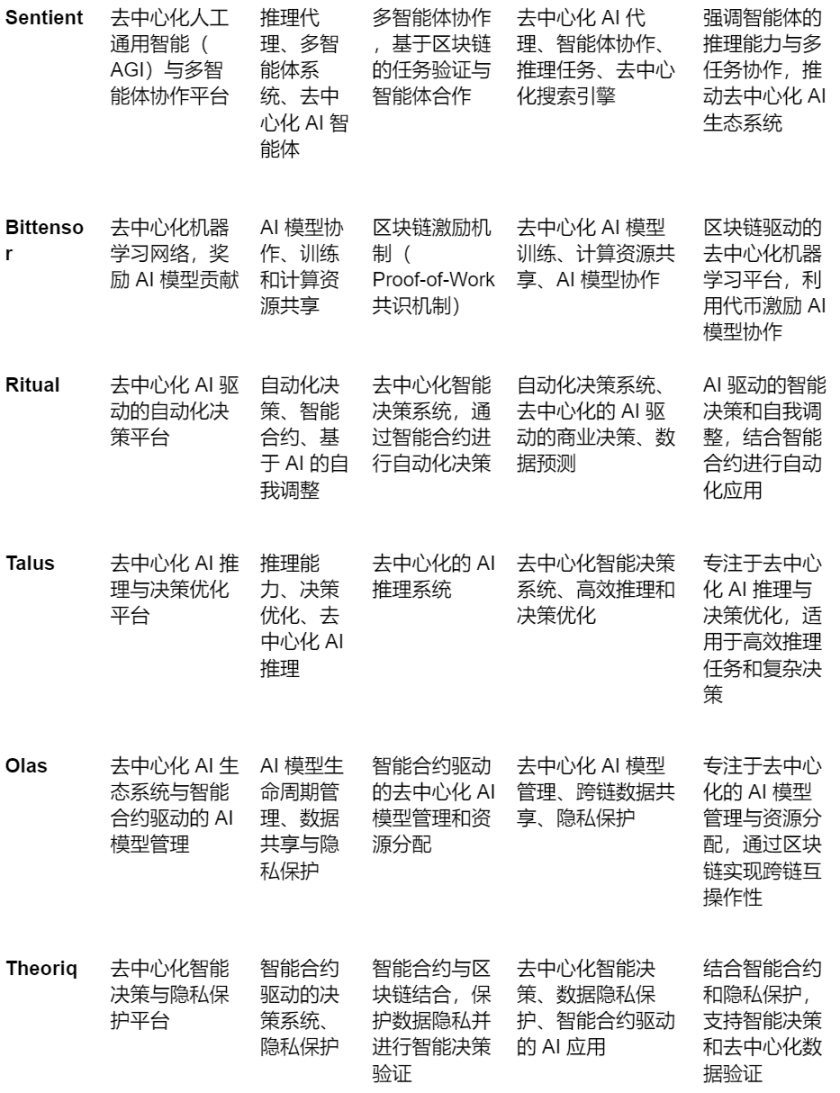
Most Crypto AI projects in the market focus on single areas such as data, models, computation, training, or reasoning, or develop consumer-level applications like AI Agents. Projects positioned as AI Chains include the AI transformation of old public chains (Near and ICP) or decentralized resource-sharing coordination and token incentive protocols like Bittensor, but Sentient's positioning does not completely match these. On the model training side, Sentient is more like an integration platform, collaborating with open-source AI models in the market. On the Agent side, Sentient has some overlapping competitive relationships with Talus, Olas, or Theoriq in multi-agent systems and reasoning capabilities, but each project has different core goals and application scenarios, which still exhibit complementarity.
VIII. Conclusion
As a decentralized artificial intelligence (AGI) protocol platform, Sentient aims to provide a clear ownership structure for AI models and facilitate invocation and value distribution through on-chain mechanisms, addressing the issues of unclear ownership and unfairness in the current centralized LLM market. The core framework OML (Open, Monetizable, Loyal) ensures the ownership, transparency, and fair profit distribution of open-source models through model fingerprinting and blockchain technology. With the resource backing of Polygon co-founder Sandeep Nailwal, Sentient has gained support from numerous top VCs and AI ecosystem partners. Despite facing uncertainties, controversies, and competition in its development, Sentient still aspires to become one of the standard protocols for decentralized AI ownership, promoting the decentralized development of AGI.
 Risk warning Risk warning