People making silent profits through arbitrage on Polymarket
 Core Viewpoint

 This article summarizes how Polymarket's "smart money" transforms the prediction market into an "arbitrage machine" rather than a "casino" through four core strategies, and points out that against the backdrop of $2 billion in financing and a valuation of $9 billion, Polymarket's arbitrage ecosystem is rapidly maturing.
After receiving a $2 billion investment, Polymarket is valued at $9 billion, making it one of the highest funding amounts for projects in the Crypto space in recent years.
Amidst the growing rumors of IPOs, IDOs, and airdrops, let's first look at an interesting set of data: If your PNL exceeds $1,000, you are in the top 0.51% of wallets; if your trading volume exceeds $50,000, you are among the top 1.74% of large holders; if you complete more than 50 trades, you have surpassed 77% of users.
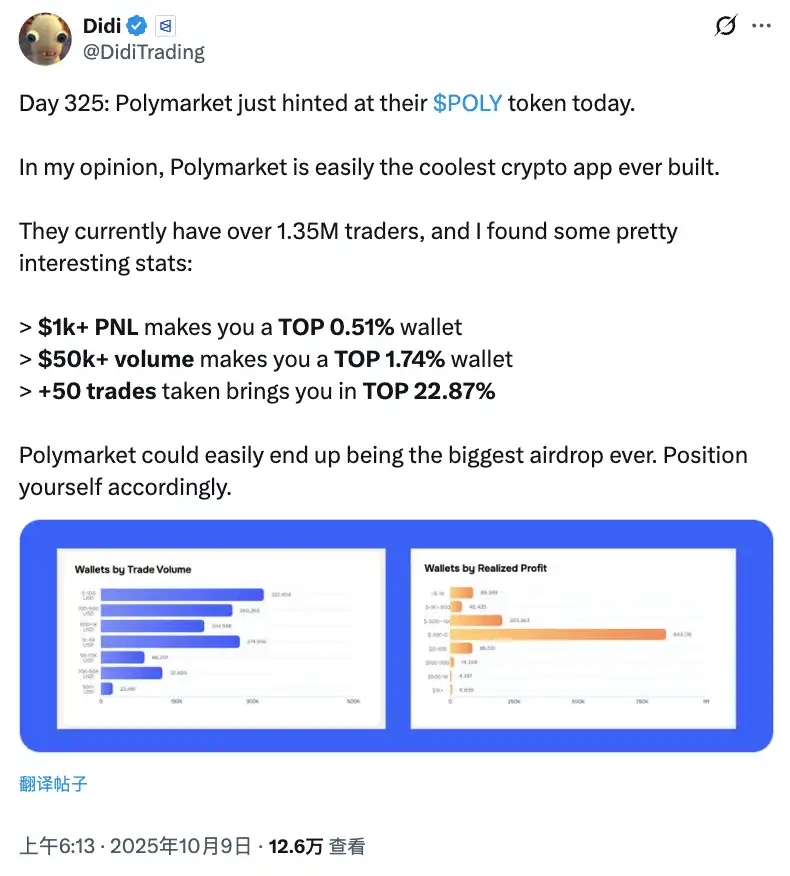
This set of data also indicates that in the fertile ground of Polymarket, there are actually not many people who have been continuously cultivating and reaping rewards over the past few years.
With the strategic investment from ICE taking effect, Polymarket's liquidity, user base, and market depth are all rapidly increasing. More funds pouring in means more trading opportunities; more retail participation means more market imbalances; more market types mean more arbitrage opportunities.
For those who know how to truly make money on Polymarket, this is a golden age. Most people treat Polymarket as a casino, while smart money sees it as an arbitrage tool. In the following long article, Rhythm BlockBeats interviewed three seasoned Polymarket players to dissect their money-making strategies.
Tail-End Trading as a New Financial Tool
"There are about 90% of large orders over $10,000 on Polymarket that are executed at prices above 0.95," seasoned player fish stated bluntly.
In the prediction market of Polymarket, a strategy known as "tail-end trading" is very popular.
The strategy is simple: when the outcome of an event is basically settled, and the market price soars above 0.95, even approaching 0.99, you buy at that price and patiently wait for the event to officially settle, capturing the last few points of certain profit.
The core logic of tail-end trading can be summed up in four words: time for certainty.
When an event has already occurred, such as a clear result in an election or the conclusion of a sports event, but the market has not yet officially settled, the price often lingers in the range close to 1 but not quite 1. Entering at this point, theoretically, you just need to wait for the settlement to securely capture those last few points of profit.
"Many retail investors can't wait for the settlement," fish explained to Rhythm BlockBeats, "They are eager to cash out to bet on the next event, so they sell directly at prices between 0.997 and 0.999, which leaves arbitrage opportunities for larger players. Although each trade only earns 0.1% profit, if the capital is large enough and the frequency is high enough, it can accumulate into a considerable income."
But just like all investments carry risks, tail-end trading is not a "no-brainer" financial strategy without risks.
"The biggest enemy of this strategy," fish shifted gears, "is not market volatility, but black swan events and manipulation by large players."
Black swan risks are something tail-end traders must always be vigilant about. What is a black swan? It refers to those seemingly certain events that suddenly experience unexpected reversals. For example, a sports match that seems to be over but is later ruled invalid by the referee; or a political event that appears settled but suddenly faces a scandal that overturns the result. Once these low-probability events occur, your chips bought at 0.99 instantly turn into worthless paper.
"The so-called black swan events that can reverse are basically manipulated by large players," fish continued to explain, "The typical strategy of large players is: when the price approaches 0.99, they suddenly use large orders to crash the price to 0.9, creating panic; they then manipulate the narrative in the comments section and on social media, spreading information that could lead to a reversal, amplifying retail investors' panic; after retail investors panic-sell, they buy back the chips at the lower price; after the event officially settles, these large players not only profit from the price difference between 0.9 and 1.00 but also pocket the profits that retail investors should have made."
This is the complete closed loop of large player manipulation.
Another seasoned player, Luke (@DeFiGuyLuke), added an interesting detail to this closed loop: "The readability of the comments section on Polymarket is particularly high. I find this phenomenon quite special; it's hard to see this in other products."
People write a lot of evidence to support their viewpoints, and many also know that you can align with everyone else. Therefore, manipulating public opinion becomes very easy on Polymarket.
This also became the opportunity for Luke's current startup: "When I was using Polymarket before, I noticed an interesting phenomenon—people don't want to look at content on Twitter, right? It's all nonsense and not real. Most people don't talk much. But the comments section on Polymarket is really fun; even if someone bets just a few dollars or a hundred dollars, they write long essays."
"You'll find this content particularly interesting. So at that time, I thought the readability of the Polymarket comments section was really high." Based on this observation, Luke started a product called Buzzing: allowing anyone to create markets on any topic. After everyone places bets, they can comment, and these comments will form a feed stream, distributing content to the market.
Now, back to the question: since tail-end trading carries the risk of manipulation by black swans, should it be avoided altogether?
"Not really. The key lies in risk control and position management. For example, I only allocate a maximum of 1/10 of my position in each market," fish added, "Don't put all your funds on one bet, even if that bet looks 99.9% likely to win. Prioritize those markets that are about to settle (within a few hours) and have prices above 0.997, as this shortens the time window for black swans."
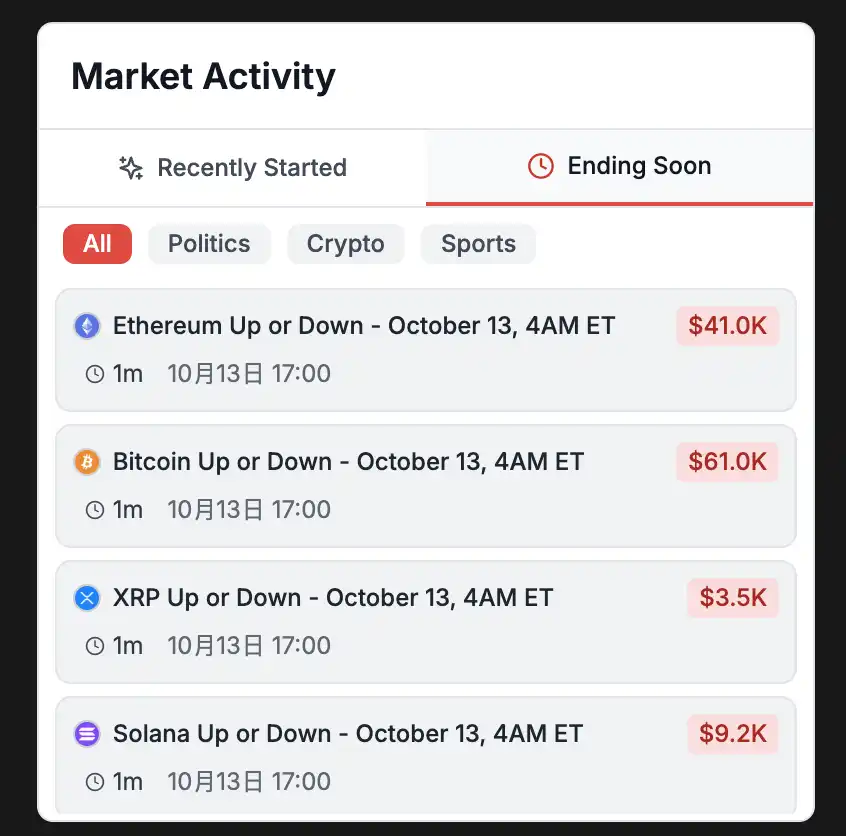
Markets about to close as shown on polymarketanalytics
Arbitrage Opportunities Where Total is Less Than 100%
There is an address on Polymarket that turned $10,000 into $100,000 in six months, participating in over 10,000 markets.
Not by betting on highs and lows, nor by insider information, but through a seemingly simple yet technically demanding arbitrage strategy—capturing opportunities where the "total is less than 100%" in multi-option markets.
The core logic of this strategy is elegantly astonishing: in a multi-option market where only one option will win (Only 1 Winner), if the total price of all options adds up to less than $1, then by buying one of each option, you are guaranteed to receive $1 upon settlement. The difference between your cost and the payout is your risk-free profit.
It may sound a bit hard to understand. Let's illustrate with a specific example. Suppose there is a market about "Will the Fed cut rates in July?" with four trading options:
Cut by more than 50 basis points: Price $0.001 (0.1%);
Cut by more than 25 basis points: Price $0.008 (0.8%);
No change: Price $0.985 (98.5%);
Raise by more than 25 basis points: Price $0.001 (0.1%).
Adding these four prices together: 0.001 + 0.008 + 0.985 + 0.001 = $0.995. What does this mean? You spend $0.995 to buy one of each option, and upon settlement, one of the options will win, giving you $1. Your profit is $0.005, with a return of 0.5%.
"Don't underestimate this 0.5%. If you invest $10,000, you can earn $50, and if you make dozens of trades a day, the annual return is astonishing. Moreover, this is risk-free arbitrage; as long as the market settles normally, you will definitely profit," Fish said.
Why do such arbitrage opportunities arise?
In multi-option markets, the order books for each option are independent of each other. This leads to an interesting phenomenon:
Most of the time, the total probability of all options is greater than or equal to 1 (this is the normal state, as market makers need to earn from the bid-ask spread). However, when retail investors trade a single option, it only affects the price of that option, while the prices of other options do not adjust simultaneously. This creates a temporary market imbalance—where the total probability of all options is less than 1.
This time window may only last a few seconds or even shorter. But for arbitrageurs running monitoring scripts, this is a golden opportunity.
"Our bot continuously monitors all multi-option markets' order books 24/7," fish explained, "Once it detects that the total probability is less than 1, it immediately places orders to buy all options, locking in profits. Once the bot system is established, it can monitor thousands of markets simultaneously."
"This strategy is somewhat similar to MEV (Miner Extractable Value) atomic arbitrage in cryptocurrency," fish continued, "both utilize temporary market imbalances, leveraging speed and technology to complete arbitrage before others, and then allowing the market to rebalance."
Unfortunately, this strategy seems to have been monopolized by several bots, making it difficult for ordinary people to make significant profits from it. Theoretically, risk-free arbitrage that anyone can do has become a war among a few professional bots.
"The competition will become increasingly fierce," fish said, "depending on who has servers closer to Polygon nodes, who has higher code execution efficiency, who can monitor price changes faster, and who can submit transactions and confirm them on-chain more quickly."
Essentially, This is Also Market Making
At this point, many may have already realized that the arbitrage strategies discussed earlier essentially play the role of market makers.
The job of a market maker is simply to deposit USDC into a specific market pool, equivalent to simultaneously placing buy orders for Yes and No, providing counterparties for all buyers and sellers. The deposited USDC will be converted into corresponding contract shares based on the current Yes/No ratio. For example, at a 50:50 price, depositing 100 USDC will be split into 50 shares of Yes + 50 shares of No. As the market fluctuates, your Yes/No inventory ratio will deviate from the optimal state (e.g., 50:50). Excellent market makers will continuously rebalance their positions through proactive trading or adjusting funds to lock in arbitrage opportunities.
So from this perspective, these arbitrage bots are essentially acting as market makers—they continuously rebalance the market through arbitrage activities, making prices more reasonable and liquidity better. This is beneficial for the entire Polymarket ecosystem. Therefore, Polymarket not only does not charge fees but also provides rewards for makers (those placing orders).
"From this perspective, Polymarket is actually very friendly to market makers," Fish said.
"From the data, market makers on Polymarket should have earned at least $20 million in the past year," Luke revealed to Rhythm BlockBeats two months ago. "We haven't compiled the data for the past few months, but it must be more."
"Specifically regarding the profit model, based on market experience, a relatively robust expectation is: 0.2% of the trading volume," Luke continued.
Suppose you provide liquidity in a certain market, and the trading volume for a month is $1 million (including the buy and sell orders you execute), then your expected profit is approximately: $1 million × 0.2% = $2,000.
This return rate may not seem high, but the key is that it is relatively stable income, unlike speculative trading, which can fluctuate dramatically; moreover, if you scale up to increase profits, then 10 markets would yield $20,000, and 100 markets would yield $200,000. If you also factor in the platform's LP rewards and annualized returns, the actual returns could be even higher. "But the main income still comes from the bid-ask spread of market making and the rewards provided by Polymarket; these two components."
Interestingly, compared to other arbitrage strategies being pushed to the extreme by bots, Luke believes that the competition in market making is not very fierce right now.
"Currently, competition in token trading is definitely fierce, leading to a focus on hardware and such. But the market competition on Polymarket is not very intense. So the current competition is still concentrated on strategy rather than speed."
This means that for players with certain technical abilities and capital, market making could be an underestimated opportunity. As Polymarket achieves a $9 billion valuation and liquidity continues to grow, the profit potential for market makers will only increase. Entering now may not be too late.
2028 Election Arbitrage
During the conversation with Rhythm BlockBeats, both Luke and Tim mentioned the potential opportunities for market making arbitrage, especially in the 2028 U.S. election market that Polymarket has launched with a 4% financial yield.
With three years until the 2028 election, Polymarket has already begun to lay the groundwork, offering a 4% annual yield to capture the market and attract early liquidity.
"Many might think that at first glance, a 4% annual yield is quite low in the crypto space, where platforms like AAVE offer higher APYs."
"But I think Polymarket is doing this to compete with Kalshi," Luke explained. "Kalshi has long offered U.S. Treasury yields on account balances, which is quite common in traditional financial products. For example, with Interactive Brokers, even if you don't actively buy bonds or stocks, you can still enjoy a yield. These are common features in traditional financial products."
"And Kalshi is a Web2 product, so it's easy to implement," Luke continued, "but Polymarket has never done this because its funds are all in the protocol, making it relatively difficult to implement. So in terms of this financial feature, Polymarket was previously a bit behind Kalshi."
This shortcoming becomes even more apparent in long-term markets like the 2028 election. "You think about it, if you put money in now, you have to wait three years for settlement, and during those three years, your money is just sitting there, which is somewhat uncomfortable, right? So they are trying to level the playing field with competitors by introducing this annual yield, which should be subsidized by themselves," Luke said.
"However, I believe that the goal of market makers is definitely not just this 4% annual yield; this annual yield is mainly aimed at ordinary users." Through this subsidy, users' trading costs are reduced, which is very beneficial for those who engage in long-term trading volume and transaction counts on Polymarket, as studios are very sensitive to cost and revenue calculations.
Tim has also conducted in-depth research in this area, "If you carefully study the details of this mechanism, you'll find that there is a much larger arbitrage space hidden within for market makers."
"The rewards provided by Polymarket are details that many people have overlooked; each option offers an additional $300 daily LP reward," Tim elaborated: In addition to the 4% annual yield, Polymarket also provides additional rewards for market makers. If you provide liquidity in this market—meaning placing buy and sell orders simultaneously to help maintain market depth—you can share in this daily $300 LP reward pool.
Tim did a quick calculation. Suppose the market "Who will be the president in the 2028 election?" has 10 popular options, and each option has a daily LP reward of $300, then the total LP reward pool is $3,000 per day. If you hold 10% of the liquidity share, you would earn $300 per day, which totals $109,500 over a year.
"This is just the LP reward. If you add the profit from the bid-ask spread of market making, plus the 4% annual yield compounded, the combined returns can easily exceed 10%, even 20% or more."
"If you ask me whether market making for the 2028 election is worth it, my answer is: if you have the skills, capital, and patience, this is a severely underestimated opportunity. But to be honest, this strategy is not suitable for everyone."
Tim said, "It is suitable for those with a certain amount of capital (at least tens of thousands of dollars) who are conservative players; suitable for those with programming skills who can build automated market-making systems; suitable for long-termists who do not pursue quick riches and are willing to exchange time for stable returns; and also suitable for players who have some understanding of U.S. politics and can judge market trends.
But it is not suitable for players with too little capital (a few thousand dollars); not suitable for speculators who pursue short-term wealth and cannot wait for four years; not suitable for complete novices who do not understand U.S. politics and cannot judge market rationality; and not suitable for players who need liquidity and may need to use their funds at any time."
News Trading on Polymarket
While deeply researching Polymarket's market data, Luke and his team discovered a counterintuitive phenomenon.
"People used to say that Polymarket users are very smart and have foresight, right? They predict outcomes through trading even before the events have results," Luke said, "but actually, it's quite the opposite."
"Most users on Polymarket are actually 'dumb money,' quite inexperienced," Luke laughed, "In most cases, everyone misjudges the event. Then they wait for the event to have results or news before many rush in to arbitrage, pushing the price to the expected position, moving it towards Yes or No. But often before the news breaks, many times they have misjudged."
"From the data perspective," Luke continued to explain, "the entire Polymarket market actually sees users' bets and price feedback lagging behind real events. It often happens that the real event has already occurred, but everyone's bets are wrong, leading to significant reversals."
Luke provided a vivid example: "For instance, in the papal election, the first elected pope was an American. Before the Vatican announced this result, the probability of that American pope candidate winning was still a fraction of a percent, very low. But once the Vatican announced it, boom, the price skyrocketed."
"So you can see that users in these markets often bet incorrectly," Luke summarized, "If you have relevant news sources and can rush in first, it feels like there is profit to be made. I think this is still feasible."
But the threshold for this path remains high.
"I think this requires a high level of development," Luke admitted, "You need to access news sources in real-time, somewhat like doing something akin to MEV. You need to capture news with certainty, add several layers, and perform natural language understanding quickly to execute trades. But there are definitely opportunities."
In the $9 billion battlefield of Polymarket, we see various money-making strategies, but regardless of the strategy, it seems that many low-profile players making money on Polymarket view it more as an arbitrage machine rather than a casino.
From our interviews, it is clear that the arbitrage ecosystem of Polymarket is rapidly maturing, and the space left for newcomers is shrinking. But this does not mean that ordinary players have no opportunities.
Returning to the set of data mentioned at the beginning of the article: If your PNL exceeds $1,000, you can enter the top 0.51%; if your trading volume exceeds $50,000, you are in the top 1.74%; and if you complete more than 50 trades, you have surpassed 77% of users.
So even if you start trading frequently from now on, by the time of the airdrop, as one of the projects with the largest funding amount in recent years, Polymarket may still surprise ordinary players.
 Risk warning Risk warning