From a 520-fold oversubscription to a 70% crash and delisting from Binance, a comprehensive analysis of the Astra Nova sell-off event
 Core Viewpoint

 $48 million financing is suspected of fraud, hype through airdrops, pre-sale lock-up, and blaming hackers; Astra Nova directed a perfect script.
Author: Dingdang, Odaily Planet Daily
On October 18, the new token Astra Nova (RVV) launched on Binance Alpha, sparking widespread controversy. Within hours of its launch, the project's related wallets were found to be continuously dumping tokens, causing the RVV price to plummet from a high of about $0.03 to $0.007, a drop of up to 76%. It is rare in the crypto industry for a project to be so brazenly "dumping" tokens right after its launch on Binance. Why has Astra Nova become such a typical example?
AI, Saudi Arabia, and the "Grand Narrative" Opening
Astra Nova claims to be headquartered in Riyadh, Saudi Arabia, and is an AI-driven Web3 entertainment ecosystem, focusing primarily on games, NFTs, and creator tools. Founded in 2020, it is positioned as "the first AI entertainment ecosystem in the Kingdom of Saudi Arabia," with a vision to integrate AI-generated content, blockchain, and player narratives to create "a new era of digital entertainment kingdom."
On October 16, Binance announced the launch of the RVV token presale event. The goal of this event was to raise 172.1 BNB, but it received 90,612 BNB, over-subscribed by 520 times. For a moment, RVV seemed to have become a "star project."
Astra Nova also announced that it had completed $48.3 million in financing, of which $41.6 million came from the latest strategic round. Participants reportedly included family offices and institutional investors from Saudi Arabia, the UAE, and Bahrain. In the current financing environment, such numbers are quite attractive.
However, crypto KOL @cryptobraveHQ** found that there were no well-known crypto institutions among the disclosed investors, and the only notable name was the crypto incubation agency Outlier Ventures.**
The "AI + Middle East + Big Financing" facade seems to cover some hollow substance. 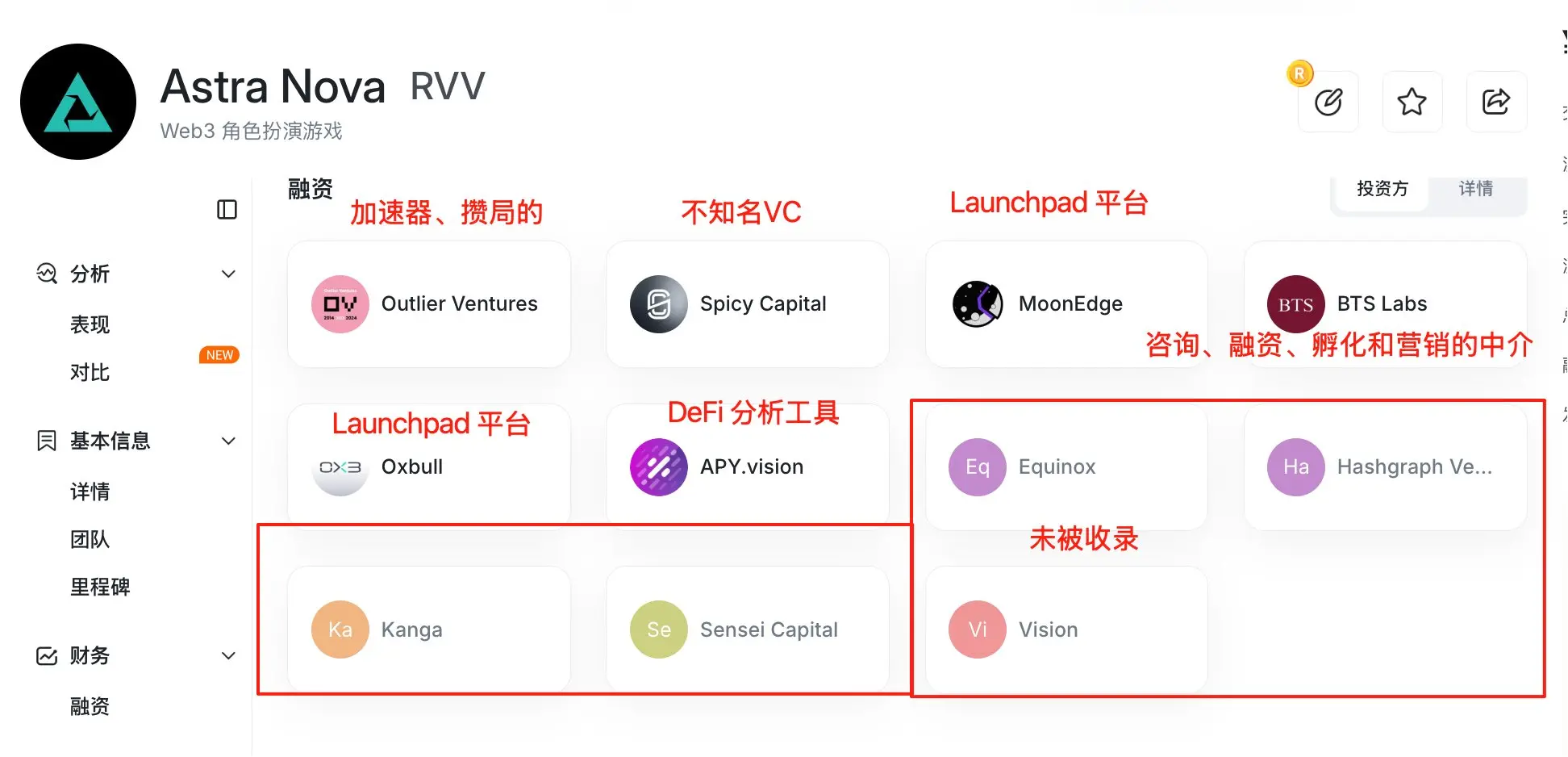
Airdrop Rule Changes: Prelude to Trust Collapse
The Astra Nova project team originally promised to fairly distribute 3% of the tokens as airdrop rewards through a points system. Users could accumulate points by holding NFTs, staking, or participating in tasks.
The turmoil began one hour before the launch on October 18. The project team suddenly announced a rule change, limiting airdrop rewards to only the top 15,000 users on the leaderboard, deviating from the previously widely promoted 3% token distribution plan. Even more concerning, thousands of real users found their rankings on the leaderboard collectively "moved back" by about 15,000 places—many loyal participants who were originally in the top 500 (including NFT holders and long-term stakers) were pushed out of the list overnight and received no rewards.
The community quickly erupted in skepticism on the X platform, suspecting that the project team manipulated the leaderboard through bot accounts to siphon off airdrop shares. More seriously, the promised 7 NFTs + 3 special edition rewards were never fulfilled. As the questioning intensified, Astra Nova's Discord and Telegram groups were subsequently locked, and communication channels were almost severed.
Meanwhile, users who participated in the presale were originally scheduled to unlock 50% of their tokens at TGE, but the project team changed the rules to a 7-month cliff + 12-month vesting period. This change meant that users could not sell their tokens in the short term, locking up funds for an extended period, further fueling community dissatisfaction.
Plunge and "Hacker Incident": Who Made the Move?
On October 18, Binance Alpha officially launched trading for the RVV token. With an initial supply of 10 billion tokens, part of the circulating supply was unlocked. The price initially rose briefly but soon showed abnormalities. Suspected team addresses began to dump large amounts of tokens, leading to a rapid depletion of liquidity.
Binance Alpha then urgently delisted the token, citing "technical incompatibility" or "potential hacker risks," marking one of the fastest delistings in Binance's history. However, the token futures contracts continued, causing retail investors to face continuous liquidation under high leverage. Consequently, the community accused Binance of lax review processes.
Under community pressure, Astra Nova later issued a statement claiming that "third-party market maker accounts were hacked." After the attacker took control of the accounts, they began to sell off assets. The team stated that they had promptly notified all exchange partners after the incident and confirmed that the project's smart contracts and infrastructure were completely secure and audited. Currently, the team is working with on-chain security analysis agencies to track the flow of funds and will hand over the evidence to law enforcement once collected.
At present, spot trading is no longer available, and contracts still carry risks. The Astra Nova project team stated that they would buy back tokens from the market equivalent to the affected amount.
Regarding the hacking incident involving Astra Nova, voices in the community have not been lacking in suggesting that the team was "in on it" or "staged the event."
Ember: Which Hacker Would Convert Stolen Money to USDT and Transfer It to Centralized Exchanges?
On-chain analyst Ember stated that about 860 million RVV (8.6% of the total) was transferred from the project's minting contract and sold on-chain, causing a severe drop in RVV. This 860 million RVV was sold for 10.288 million USDT, of which 8.226 million USDT was transferred to Gate and Kucoin, while another 2.041 million USDT remained in the on-chain wallet 0x643. The project team tweeted that it was stolen, but I personally express skepticism. Which hacker would convert stolen assets to USDT and hold them? Moreover, they directly transferred it to CEX. USDT can be frozen.
AB Kuai.Dong: Offending Exchanges, Secondary Investors, Institutions, and Bloggers Simultaneously
Crypto KOL @AB Kuai.Dong bluntly stated that Astra Nova has offended exchanges, secondary investors, institutions, and bloggers all at once. The project not only dumped tokens on-chain but was also urgently warned by Binance about risks, and it forcibly modified the unlocking methods for all investors in the name of exchange requirements.
Even more explosive revelations claimed that Astra Nova's actions were not an isolated incident; they had previously learned of a "dumping arbitrage" strategy during discussions with some market makers: If the project can launch on Binance Alpha and open contract trading, it is already a significant positive. Other major exchanges are out of reach. Therefore, rather than being dumped by airdrop pressure, the project team might as well join in the dumping. Ultimately, the profits from contracts + dumping the pool would surely exceed the margin required for listing.
Recommended Reading:
Epic Collapse! BTC Barely Holds the $100,000 Mark, Why Is the Altcoin Market Suffering a Bloodbath?
 Risk warning
 Risk warning



Popular articles