In-depth Analysis of x402 Protocol: Coinbase Joins Forces with Tech Giants Alliance to Build a Native Payment Layer for AI

 The x402 protocol was initiated by Coinbase in May 2025, in collaboration with technology and payment giants such as Cloudflare, Google, and Visa, aiming to activate the HTTP 402 standard that has been dormant for nearly thirty years, and to build a frictionless, low-cost on-chain payment layer for AI agents.
Author: Bruce
1. Core Idea: Activating the Dormant Internet Native Payment Protocol
x402 is not a brand new invention, but rather an activation and modernization interpretation of an ancient web standard that has been dormant for nearly thirty years—HTTP 402 "Payment Required."

The core pain point of the current internet payment system lies in the fact that traditional payment methods such as credit cards, API keys, and subscription models are designed for human users. For autonomous AI agents that require instant, high-frequency transactions, these methods introduce significant friction, including cumbersome manual registration, KYC verification, pre-funded accounts, and security risks associated with API key management.
The vision of x402 is to create a frictionless "Agentic Economy" by embedding payment functionality directly into HTTP requests. In this economic model, machines can seamlessly pay for data, computing power, and services just like exchanging information, fundamentally changing the way AI interacts with the digital world.
2. Strategic Alliance: More than Just Coinbase's Grand Layout
Although the x402 protocol was officially launched by Coinbase on May 6, 2025, its rapid rise is driven by a carefully constructed, cross-industry strategic alliance.
Key Development Milestones:
May 2025: Coinbase officially releases the x402 protocol, launching it in collaboration with partners such as AWS, Anthropic, Circle, and NEAR.
September 15, 2025: Google announces the integration of x402 into its Agent Payments Protocol (AP2), marking the official endorsement by an internet giant.
September 23, 2025: Coinbase and global network infrastructure giant Cloudflare jointly establish the x402 Foundation to ensure the protocol's open governance and neutrality.
October 13-14, 2025: Global payment giant Visa announces support for the x402 standard through its Trusted Agent Protocol (TAP).
The members of this alliance also include industry leaders such as AWS, Circle, Anthropic (the parent company of the well-known AI model Claude), and Vercel. This clearly indicates that all parties are committed to making x402 a universal industry standard rather than a proprietary tool of any single company.

3. How It Works: Four Steps to Achieve Frictionless Payments
The brilliance of x402 lies in its simplicity, abstracting complex blockchain interactions to align closely with existing web workflows:
Client Request: The AI agent initiates an access request to a protected resource (such as an API endpoint).
402 Response: If the request does not include a valid payment credential, the server returns a "402 Payment Required" status code and details the required fee (e.g., 0.01 USDC) in a JSON payload.
Signature Retry: The AI agent signs the payment authorization with its wallet and attaches the signature in the request header (X-PAYMENT header) to re-initiate the request.
Verification and Access: A service known as a "Facilitator" verifies the signature, settles the payment on-chain, and then grants access to the resource.
The entire process is extremely developer-friendly, eliminating the need for them to directly manage complex blockchain underlying details such as gas fees or RPC nodes.

4. Data Comparison: Why x402 is Superior to Traditional Payment Tracks?
Quantitatively, x402 (especially when deployed on Layer 2 networks like Base) shows overwhelming advantages over traditional payment methods. This is not just an incremental improvement, but a paradigm shift for micropayment scenarios.
Fees: Traditional payment channels (like credit cards) typically charge a fixed fee of about $0.30 plus around 3% transaction fees. In contrast, the transaction cost (nominal gas fee) for x402 on the Base chain is less than $0.0001.
Settlement Speed: Final settlement of credit card transactions can take several days. x402 can achieve on-chain final confirmation in about 2 seconds.
Risk: Traditional payment systems have chargeback risks lasting up to 120 days. Once confirmed, x402's on-chain payments are final and irreversible.
These features make many business models that were previously unfeasible due to high costs (e.g., transactions at the sub-cent level) practically viable.

5. Application Scenarios: Powering the Agentic Economy
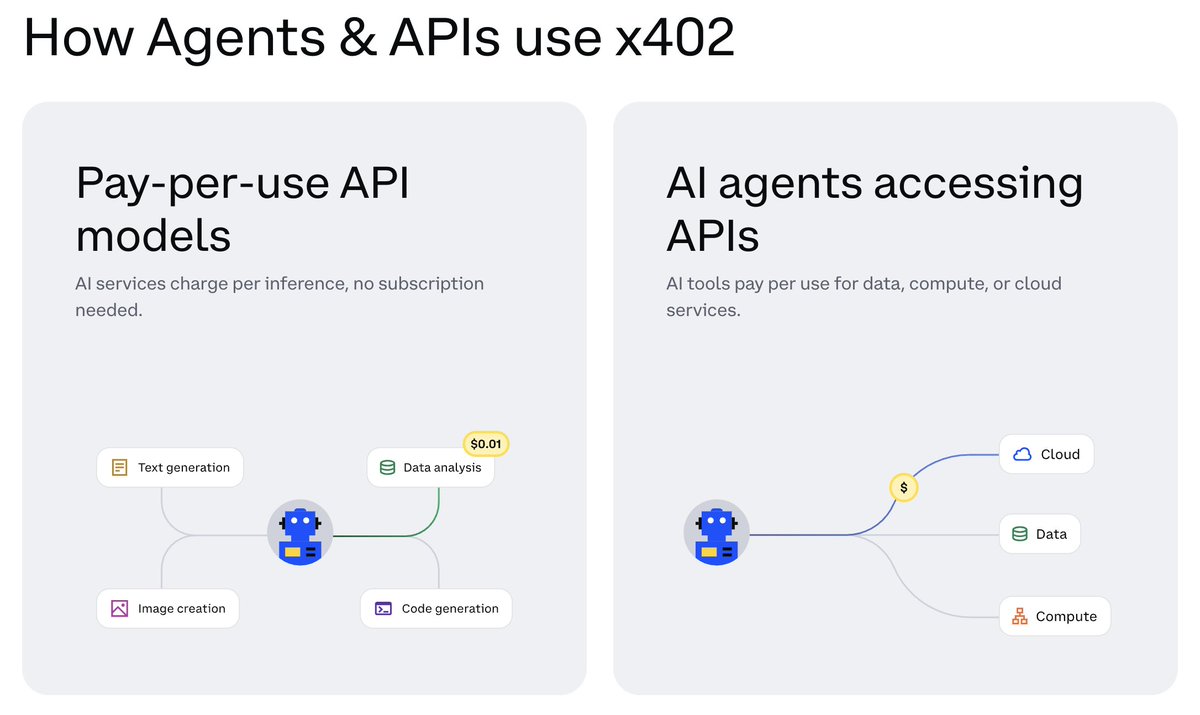
x402 unlocks a granular "Pay-Per-Use" business model for both machines and human users.
For AI Agents (M2M - Machine to Machine):
API Calls: Trading bots pay $0.02 for real-time market data per request.
Computing Resources: AI models pay $0.50 per minute for GPU usage during model training.
Data Retrieval: Research AI pays $0.25 to access a paid research article.
For Businesses and Creators:
Monetizing AI Services: Image recognition APIs charge per use, at $0.005 each.
Content Payments: Podcasts can charge per episode, and news platforms can charge per article, avoiding the need for users to commit to long-term subscriptions.
6. Ecosystem: A Rapidly Growing Network of Builders
A vibrant ecosystem has quickly formed around the x402 standard, reflecting strong interest from the developer community and powerful network effects.
Public Chain Support: The protocol itself is chain-agnostic and has received initial support on public chains such as Base, Polygon, Solana, and Near.
Wallet and Payment: Integration with key payment and wallet service providers like Coinbase, Circle, Stripe, and Visa ensures user and liquidity access.
Infrastructure and Tools: Projects like x402scan (on-chain analytics), thirdweb (development kits), and Firecrawl provide essential tools for developers.
Applications: An increasing number of consumer applications are beginning to integrate x402, including Hyperbolic (AI computing power), Anthropic MCP Protocol (AI tool access), and Vercel (frontend development).

7. On-Chain Data: Explosive Growth in Protocol Adoption
The adoption of x402 is not merely theoretical. On-chain data shows a massive surge in protocol activity in late October 2025.
Data from the Past 30 Days (Source: x402scan, as of October 26, 2025):
Transaction count increased by 35,000%, exceeding 1 million.
Number of buyers increased by 244,000%, surpassing 68,000.
Latest 24-Hour Data (Source: x402scan, as of October 26, 2025):
Transaction count: 424.85K
Transaction volume: $483.87K
Unique buyers: 25.61K
This activity is largely driven by the minting frenzy of its ecosystem token (especially $PING), providing a large-scale real-world stress test for the protocol.

8. Token Economics: Correctly Understanding $PING
It is crucial to clarify: x402 is an open protocol and does not have an official native token.
The "x402 token" category mentioned in the market (such as on CoinGecko) refers to project tokens built using the x402 protocol, with $PING being the most notable.
What is $PING? It is the first token minted directly through the x402 protocol, designed for payment scenarios within an AI agent monitoring service.
Market Data (Source: DexScreener, as of October 26, 2025):
Market Cap: ~ $41.8M (peaked over $70M)
24-Hour Trading Volume: ~ $4.9M
Liquidity: ~ $3.7M

Minting Mechanism: The minting method for $PING is similar to BTC inscriptions (Ordinals) from two years ago. Users send about 1 USDC to a specific address, and if successfully confirmed as a "valid mint" by the x402scan indexer, they receive 5,000 $PING. This hardcore minting method has sparked market excitement but also controversy.
The speculative frenzy around $PING has been a key catalyst for driving early trading volume and public attention to the x402 protocol.
Ecosystem Token Overview (as of October 26, 2025):
The total market cap of the entire x402 ecosystem tokens has surpassed $260M, with a 24-hour increase of 432%. Major tokens include:
BNKR: Market Cap ~ $66M
PING: Market Cap ~ $35-41M (highly volatile)
Other Projects: Questflow, Switchboard, PayAI, Daydreams, Gloria AI, etc.

9. Future Outlook: x402 V2 and the Path to Mass Adoption
The early market excitement has also exposed some "growing pains" of the protocol. The upcoming x402 V2 version aims to optimize the protocol for enterprise-level reliability and scalability.
The six core upgrade directions for V2 include:
Clearer Three-Layer Architecture: Clearly distinguishing the core specification layer, facilitator service layer, and SDK tool layer, allowing each layer to focus on its responsibilities.
Separation of Resources and Payments: Separating resource descriptions (such as URLs, file types) from payment instructions to maintain the simplicity of payment logic.
Universal Network Naming: Adopting a unified network naming convention covering blockchains like Ethereum and Solana, as well as traditional payment methods like USD and bank transfers.
Deferred Payment Support: Introducing a deferred payments mechanism suitable for high-frequency micropayment scenarios like Cloudflare's "pay-per-crawl."
Improved Error Handling: Providing more robust error handling and debugging mechanisms.
Backward Compatibility: Ensuring that all integrations based on the V1 version can continue to operate seamlessly.
Easier Integration: Better alignment with existing web standards to reduce the integration difficulty for developers, providing a more comprehensive discovery mechanism (such as "wallet login" features) to verify users' past payment history.
This clear roadmap indicates that x402's long-term vision is to build a lasting, universal internet payment standard rather than chasing short-term trends. With the integration of mainstream protocols like Google AP2 and Visa TAP, as well as support from infrastructure giants like Cloudflare and Vercel, x402 is transitioning from an experimental protocol to a mature industry standard.
 Risk warning Risk warning