The market is facing a significant correction. Is this the midpoint or the endpoint of the cycle?
 Core Viewpoint

 The interpretations of the reasons for this pullback vary among parties, but it is certain that the market is in a critical waiting period, including the reopening of the U.S. government and the Federal Reserve's policy shift. It is also undeniable that the fundamentals of Bitcoin are stronger than ever.
Author: Chloe, ChainCatcher
Just four days into November, the crypto market has experienced a significant pullback, with Bitcoin dropping nearly 13% over the past month, retreating to around $104,000 from its previous highs, with prices fluctuating repeatedly. ETH trading prices have also fallen nearly 20% during the same period. In the face of this pullback, market sentiment is generally anxious, with many wondering if this is the bottom? Has the market completely turned bearish? Is this pullback a true peak-to-trough decline, or is the market perhaps in the darkness before dawn?
ChainCatcher has compiled interpretations from industry experts, analysts, traders, and institutional investors from different perspectives, and how do the bulls view this market pullback?
Market OGs Taking Profits
Enflux pointed out in a report to CoinDesk that liquidity is flowing out of cryptocurrencies and back into traditional finance led by AI and fintech. Enflux stated that Wall Street is preparing for another round of increases driven by liquidity and infrastructure investments, while cryptocurrencies will continue to test where the true bottom lies.
QCP Capital believes that the recent pullback is not significantly related to macro factors. Instead, Bitcoin's "veteran" holders are taking profits after a long-term rise, selling large amounts of BTC to exchanges like Kraken. On-chain data shows that about 405,000 BTC of long-term holdings have changed hands in the past month, but prices remain above the $100,000 threshold. QCP stated, "The market absorbed traditional supply without breaking key support," and noted that leverage remains low, with funding rates flat.
Notable Wall Street market analyst Jordi Visser shares a similar view, stating, "The predicament is real, and frankly, the sentiment in the cryptocurrency market is very poor." However, Jordi Visser believes that Bitcoin is currently undergoing a "silent IPO."
He pointed out that the current price consolidation in the market is not a sign of failure, but rather a normal process of early holders realizing profits. Visser explained, "Galaxy Digital CEO Mike Novogratz disclosed in a recent earnings call that the company sold $9 billion worth of Bitcoin for a client, which represents that the OGs are orderly exiting."
This process is akin to the expiration of a lock-up period after a traditional IPO, where early investors are not panic-selling but are methodically distributing their holdings. "They are very patient, having waited for years to reach this moment." He believes that Bitcoin's decoupling from risk assets proves this point; if it were a macro-driven weakness, Bitcoin should have fallen alongside risk assets rather than diverging.
Bitcoin Continues to Follow Typical Post-Halving Trends, Price May Break Through
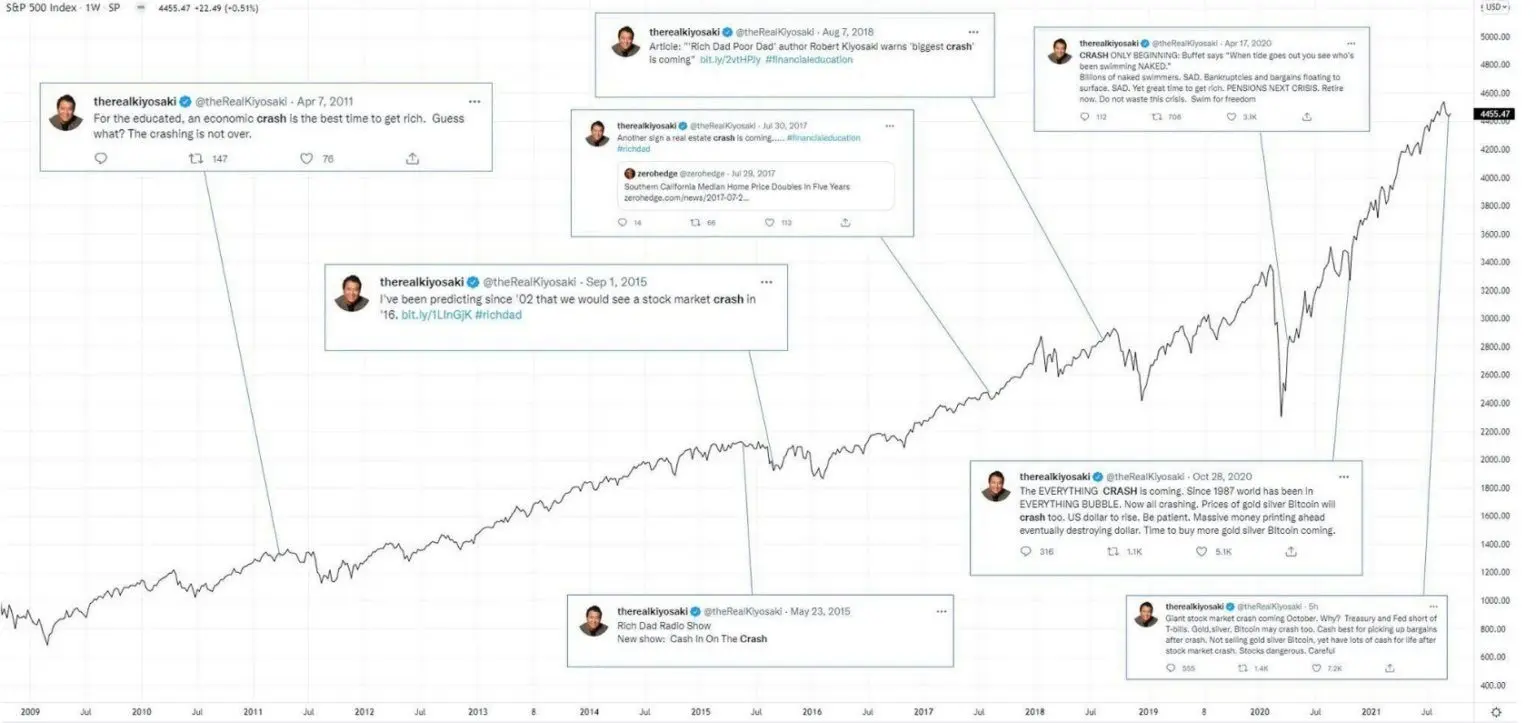
Robert Kiyosaki, author of "Rich Dad Poor Dad," has once again issued a warning of a crash, stating, "A massive crash is beginning, millions will be wiped out, protect yourself, silver, gold, Bitcoin, and Ethereum will protect you." However, he has issued about 30 similar crash warnings between November 2024 and October 2025. Cryptonews humorously pointed out that while the market is indeed bad, Robert's track record is also poor, as historical data often shows that market trends go against his predictions.
Maria Carola, CEO of StealthEx, believes that market risks remain high, but the market appears stronger than in previous cycles. However, she also warned that while liquidity is stronger than in previous cycles, the frequency of extreme flash crash events has decreased, but systemic risks, such as major LPs withdrawing liquidity, unexpected macro events, or regulatory shocks, could still trigger significant volatility.
Cais Manai, co-founder and product head of TEN Protocol, pointed out that Ethereum's recovery remains uncertain amid changing macro conditions. If the Federal Reserve leans dovish and risk appetite returns, we might see ETH quickly recover to $4,500, especially if ETF inflows remain healthy.
Rachel Lin, CEO of SynFutures, offered a relatively optimistic assessment, stating that the decline in October may be laying the groundwork for the next upward movement in the bull market. She believes this pullback often represents the midpoint of a larger cycle. She expects November to enter a "stabilization + cautiously optimistic" phase, and if Bitcoin continues to follow typical post-halving trends, it could rise to between $120,000 and $150,000 by the end of 2025.
Summary of Trader Opinions: Is the End of the U.S. Government Shutdown the Dawn of a New Era?
@CatoKt4 believes that the core reason for the decline is the market being "bled" again during the liquidity tightening phase, primarily due to the U.S. government shutdown, which has prevented the Treasury's General Account (TGA) from releasing funds into the market. During the government shutdown, this pool only sees inflows, leading to a significant withdrawal of liquidity from the market.
Additionally, that night, the U.S. Treasury auctioned 3-month and 6-month bonds, with a total auction size of $163 billion and an actual auction amount reaching $170.69 billion. After deducting the reinvestment size of the Fed's SOMA account ($7.69 billion), it means that $163 billion was withdrawn from the financial market to purchase government bonds. In normal times, such a large-scale bond auction has limited impact on risk assets, but during this period of liquidity tightening, the withdrawal of $163 billion has had a significant impact on the market.
Moreover, hawkish comments from the Federal Reserve led to a decrease in the probability of a rate cut in December from 69.8% to 67.5%, undermining market confidence in rate cuts.
@Trader_S18 cited recent reports from Goldman Sachs and Citigroup, indicating that the government shutdown will end within two weeks. Goldman Sachs believes this shutdown is nearing its end and expects a funding agreement to be reached around the second week of November. He suggested the trading rhythm for the next two weeks could be as follows: pay attention to whether BTC builds a bottom in the $107k-$111k range before November 7, and if BTC breaks and stabilizes above $112k before November 12, consider increasing positions for a rebound. If the government reopens in mid-November, BTC could surge to previous highs of $124k-$126k.
Regarding this situation, he believes the impact of the government shutdown is akin to a hidden interest rate hike, so conversely, given how harsh the external environment is, the market has only dropped this little, which is already impressive. He urges users to hold on for another week or two, as once the U.S. government starts to draw down its massive TGA cash balance, which is as high as $900 billion, it will flow back into the banking system, akin to a hidden quantitative easing, and good times will return.
@TXMCtrades believes that when the market collectively calls a top, it actually proves that it is not the top yet, because true tops usually occur when no one expects them, and all coins are surging. This time, only a few major coins have risen, while others remain at low levels, indicating that market enthusiasm has not yet reached its peak, and the bull market may not be over.
@TraderNoah expressed severe criticism and cautious optimism about the entire crypto industry. He believes that after years of performance, the market can withstand these "unacceptable facts." First, current prices are not cheap; even if some tokens have fallen by 80%, poorly performing assets should be so because they fundamentally lack value. Second, over 80% of people in the industry are incompetent compared to their counterparts in other industries and will inevitably be naturally eliminated over time. Third, the overall performance of funds is poor; he emphasized that the crypto industry has historically not been taken seriously by outsiders because it is filled with speculation and immaturity.
However, Noah holds an optimistic view for the future, as the excessive behaviors following the 2021 bull market (such as bubbles and low-quality projects) are now finally being gradually eliminated. While this will bring pain in the short term, even leading to the "death" of most market users, it is a necessary process for the industry to move towards success and maturity, a painful transformation.
@CredibleCrypto firmly believes that the market will not peak at a mere $4 trillion market cap. "Since 2020, I have repeatedly said that we will see at least $10 trillion in total market cap before this cycle ends, and I still hold this view. I will not sell anything at a $4 trillion market cap."
@Ashcryptoreal emphasized an optimistic outlook through historical comparisons, recalling that in early November 2024, Bitcoin plummeted from $71k to $66k, and everyone generally thought the market was done for, but within just 45 days, it surged 60% to $108k. During the same period, from November 4 to December 15, ETH rose 75%, and the total market cap of other tokens skyrocketed by 138%, with many small coins increasing by 5-10 times in less than two months, showing that the market can generate explosive parabolic returns in a short time. Now, with a similar decline in early November 2025, he pointed out, "All data is positive, including the Fed's rate cut in December, the end of quantitative tightening (QT) on December 1, the initiation of quantitative easing (QE) (Fed purchasing government bonds), the signing of the U.S.-China trade agreement, gold prices reaching a peak, and U.S. stocks hitting new highs."
He firmly believes that crypto prices are being manipulated and suppressed, rejecting the notion that the crypto market would end under the backdrop of ample global liquidity and rising other assets, thus choosing to hold onto his coins and patiently wait. Although the process is not easy, investing in the crypto market inherently comes with risks.
Finally, despite differing interpretations of the reasons for this pullback—some believe it is due to funds rotating into traditional markets, others think it is early holders taking profits, and some attribute it to liquidity tightening caused by the government shutdown—it is certain that the market is in a critical waiting period, including the reopening of the U.S. government and a policy shift from the Federal Reserve. It is undeniable that Bitcoin's fundamentals are stronger than ever, as historical data shows that Bitcoin's average return in the third quarter remains positive at 6.05%. Moreover, November has been one of Bitcoin's strongest months over the past few years, with an average increase of 42% over the past 12 years.
This phenomenon of transitioning from concentrated to dispersed holdings may be the necessary transitional phase for Bitcoin to officially graduate from the experimental stage to becoming a long-term monetary asset.
 Risk warning
 Risk warning



Popular articles