Galaxy Research Report: What is Zcash Really Rising For?
 Core Viewpoint

 The forgotten pearl suddenly erupted.
Original Title: Why Has Zcash Suddenly Soared?
Original Author: Will Owens, Galaxy
Original Translation: AididiaoJP, Foresght News
The term "cryptocurrency" literally means "hidden" or "secret" currency. However, for much of its development, privacy issues have long been overlooked by the industry. Only recently has this begun to change.
In the past few weeks, the narrative around privacy has once again taken center stage. As one of the oldest and most well-known privacy coins, Zcash (ZEC) has surged over 700% since September, as if overnight, everyone in the space has become a privacy expert. However, some prominent figures in the Bitcoin community have criticized this surge as "artificially manipulated," warning buyers that they may ultimately become "bag holders." Economist Lyn Alden has cautioned investors not to fall into the trap of "joint pumping."
But investor Naval Ravikant quickly countered, presenting a fundamental reason for Zcash: "Transparent cryptocurrencies cannot survive under government crackdowns."

Let’s not forget that Bitcoin's anonymous creator, Satoshi Nakamoto, acknowledged the limitations of Bitcoin's network in terms of privacy as early as the 2008 white paper.
While CoinJoin services like Samourai and Wasabi were once popular on Bitcoin, they now face increasing regulatory pressure. Samourai has effectively shut down due to the arrest of its founder, and Wasabi will stop its CoinJoin functionality and block U.S. users in June 2024 due to regulatory concerns.
Payjoin is a simple tool that can break the "multiple inputs belong to one person" inference and is gradually gaining attention, but it still requires interaction between users. The broader issue pointed out by Satoshi in the previous quote is the transparency of Bitcoin. As a fork of Bitcoin, Zcash allows users to use zero-knowledge proofs to shield transactions, directly addressing the privacy limitations mentioned by Satoshi.
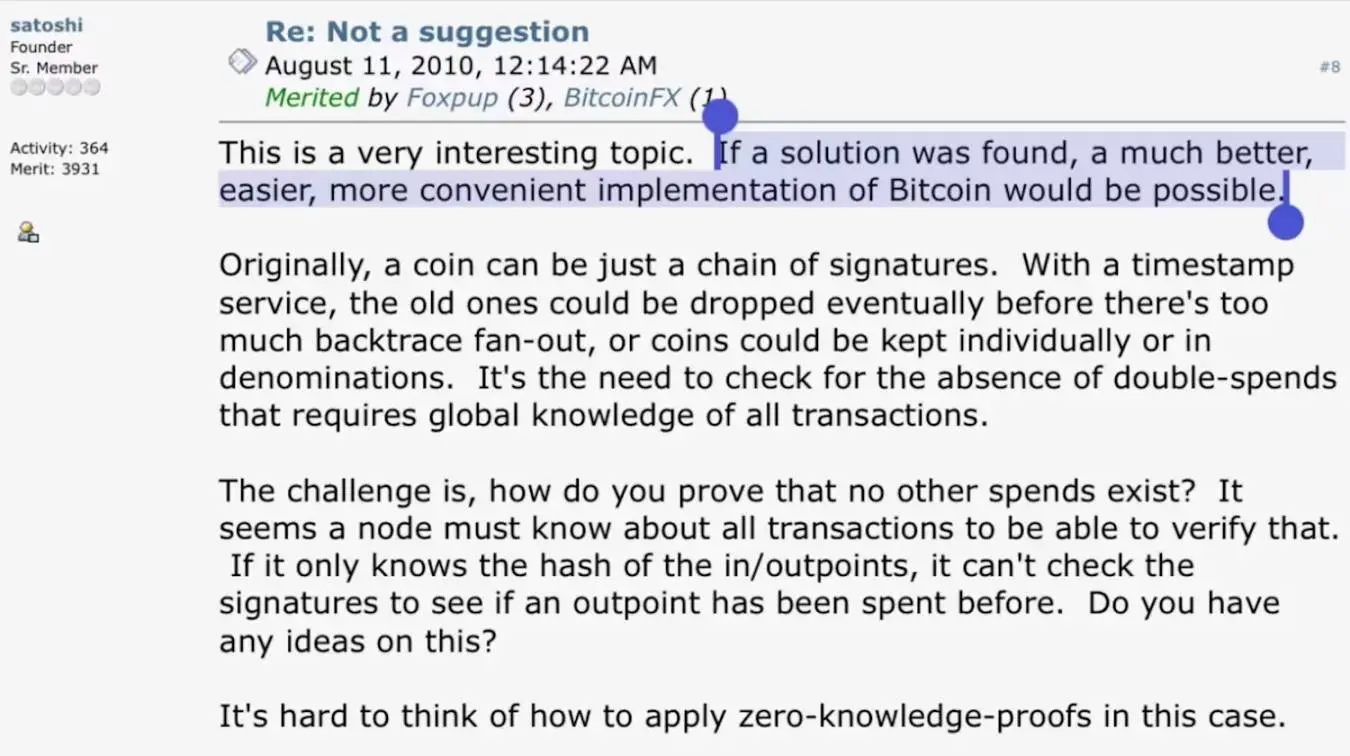
Satoshi also acknowledged the privacy limitations of Bitcoin in a forum post.
Key Points
- · After years of stagnation, ZEC has surged about 8 times in the past month, far exceeding the market, forcing people to seriously discuss "privacy features" again.
- · This discussion has revived the early Bitcoin debate on "privacy rights" versus "regulatory realities."
- · Zcash's market capitalization has surpassed that of Monero.
- · The user experience of Zcash has improved (e.g., Zashi wallet).
- · Cross-chain intent channels have lowered the operational threshold (NEAR Intents).
- · The anonymous pool is expanding.
- · For the first time, over 30% of the ZEC supply is stored in shielded pools.
- · However, compared to Bitcoin, the number of full nodes for Zcash remains low.
Development History and Network Upgrades
Zcash originated from academic research in 2013, when cryptographers at Johns Hopkins University developed the Zerocoin protocol. To improve efficiency, the protocol later evolved into Zerocash and was ultimately launched in 2016 by cypherpunk Zooko Wilcox and his Electric Coin Company as a fork of Bitcoin. Its goal was simple: to retain the monetary characteristics of Bitcoin while fixing its most frequently mentioned design flaw (which Satoshi himself acknowledged): the lack of transaction privacy.
Unlike Bitcoin, where all transactions are publicly visible on-chain, Zcash uses a zero-knowledge proof technology called zk-SNARKs. This allows users to prove the validity of transactions without revealing the sender, receiver, or amount. While Monero was launched earlier and employs techniques like ring signatures to protect privacy, Zcash is the first mainstream blockchain to implement zk-SNARKs at the protocol level.
Zcash adopts an on-chain funding model that allocates a portion of block rewards to community-led projects rather than specific organizations. According to the ZIP 1016 proposal, 8% of block rewards go to the Zcash Community Fund, while 12% is managed by a fund voted on by coin holders. The Electric Coin Company and the Zcash Foundation do not automatically receive a share; they must also apply for funding through these mechanisms.
Zcash has undergone several network upgrades:
- · Sapling (2018): Significantly improved the efficiency of shielded transactions.
- · Heartwood (2020): Introduced shielded miner rewards, allowing miners to receive block rewards privately.
- · Canopy (2020): Accompanied by the first halving, it completely reformed the funding model, replacing the original founder rewards with a four-year development fund managed by ECC, the Zcash Foundation, and community grants.
- · NU5 / Orchard (2022): The most significant milestone since launch, replacing the complex trusted setup ceremony with Halo 2 recursive proofs and adding unified addresses to simplify privacy operations. The Orchard shielded pool was launched.
- · NU6 (2024): Implemented an on-chain treasury to manage the treasury in a decentralized manner, enhancing transparency in the use of the development fund.
Next, the protocol is preparing for the NU7 upgrade.
Market Performance and Current Status
For most of the time, ZEC has underperformed in the market, not only lagging behind BTC but also overshadowed by Monero. Monero provides basic privacy by default, but it relies on small-scale decoy anonymous sets, mixing real inputs with 15 decoys in its ring signature design. This moderate anonymous set has been successfully deanonymized in some studies.
Regulators often scrutinize Monero more closely because its privacy is enforced by default. In 2020, the IRS even hired companies like Chainalysis to study methods for tracking Monero transactions. In contrast, Zcash achieves optional privacy through zk-SNARKs, allowing complete data encryption and providing a larger anonymous set when using shielded addresses.
This dual-mode design also makes it easier for users to make operational security mistakes (such as misusing transparent addresses), but as long as operations are conducted correctly, Zcash's cryptography can provide substantially stronger and mathematically more reliable privacy. Additionally, Zcash's privacy layer is quantum-resistant, while Monero's current ring signature scheme is not (its developers have acknowledged this issue and plan to address it in future upgrades).
Looking solely at ZEC's price trends tells a completely different story.
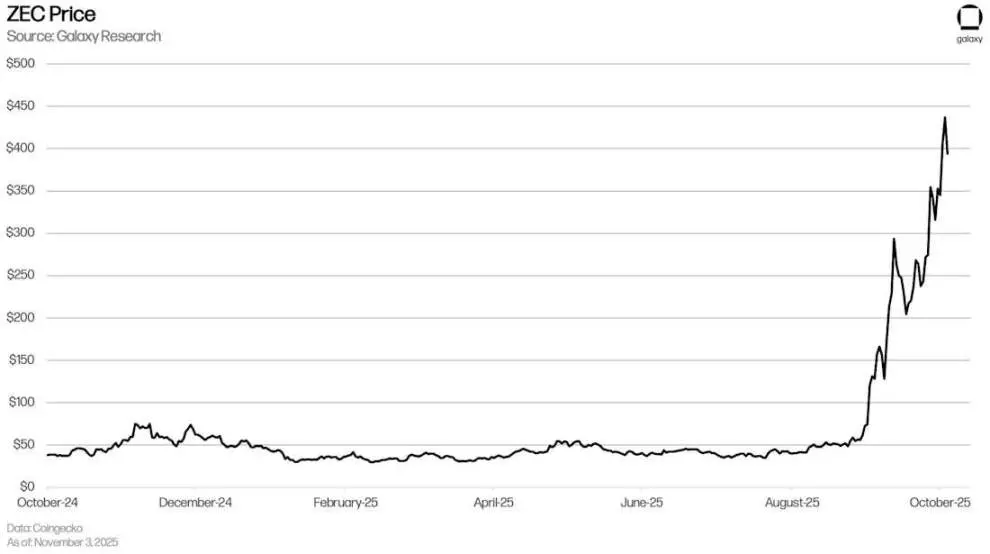
ZEC price trend over the past year
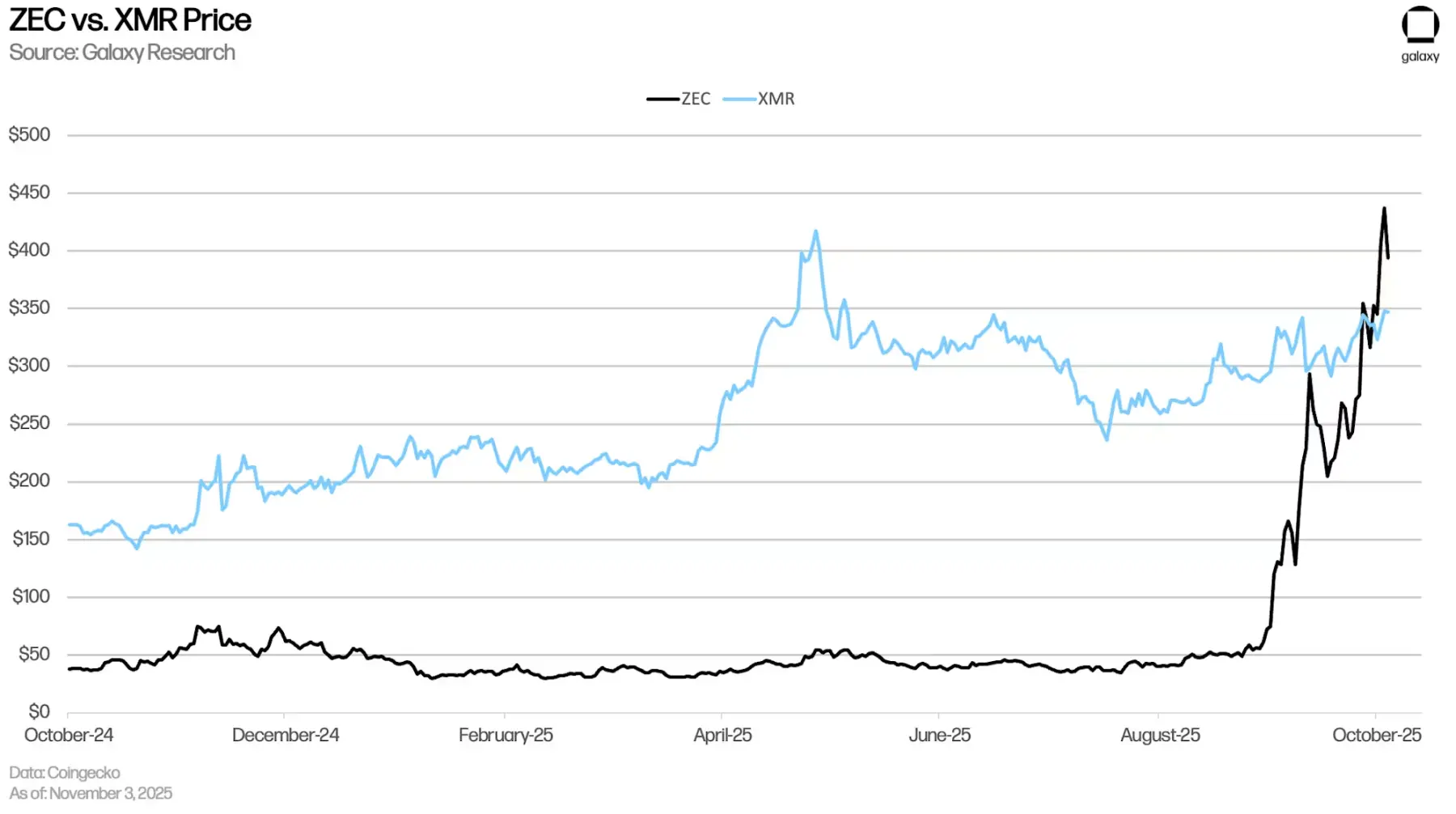
(This was originally a price chart description: ZEC price over the past year; ZEC vs. XMR price comparison; ZEC/BTC exchange rate daily chart.)
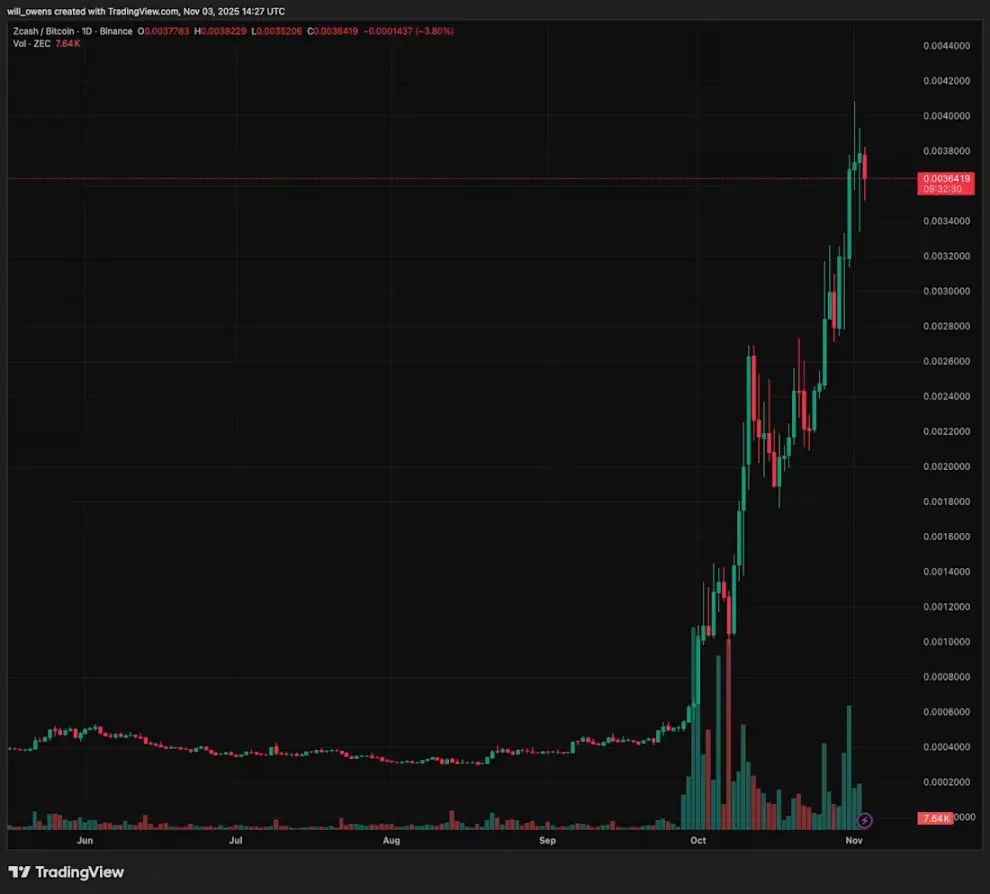
Technical Details
Zcash follows Bitcoin's monetary model: a fixed supply of 21 million ZEC, proof of work consensus, and approximately halving every four years. It uses the Equihash algorithm, designed to be more resistant to ASIC centralization than Bitcoin's SHA-256. The block time is about 75 seconds, approximately 8 times faster than Bitcoin. Zcash halves approximately every four years, with the next expected in November 2028, at which point the block reward will drop to 0.78125 ZEC.
Zcash has two types of addresses:
- · Transparent addresses: Function similarly to Bitcoin, with balances and transfers publicly visible.
- · Shielded addresses: Use zk-SNARKs to hide the transaction parties and amounts while proving that no coins are created out of thin air.
When users transfer between shielded addresses, the network verifies the cryptographic proof rather than the transaction details. This proof states: "I have the right to spend these coins, and the calculations are correct," but does not disclose any extraneous information. The essence of privacy lies in sharing only the minimum information necessary to establish trust.
The larger the shielded pool, the harder it is to trace the flow of funds. This is why the recent breakthrough of shielded pool size exceeding 30% of the total supply is so significant. The largest shielded pool is Orchard, which launched on May 31, 2022, replacing the old pool, using the Halo 2 proof system that does not require a trusted setup, and introducing unified addresses to simplify user experience.
Currently, the Orchard shielded pool contains over 4 million ZEC (about 25% of the circulating supply), accounting for the vast majority of the approximately 4.9 million shielded ZEC in total.
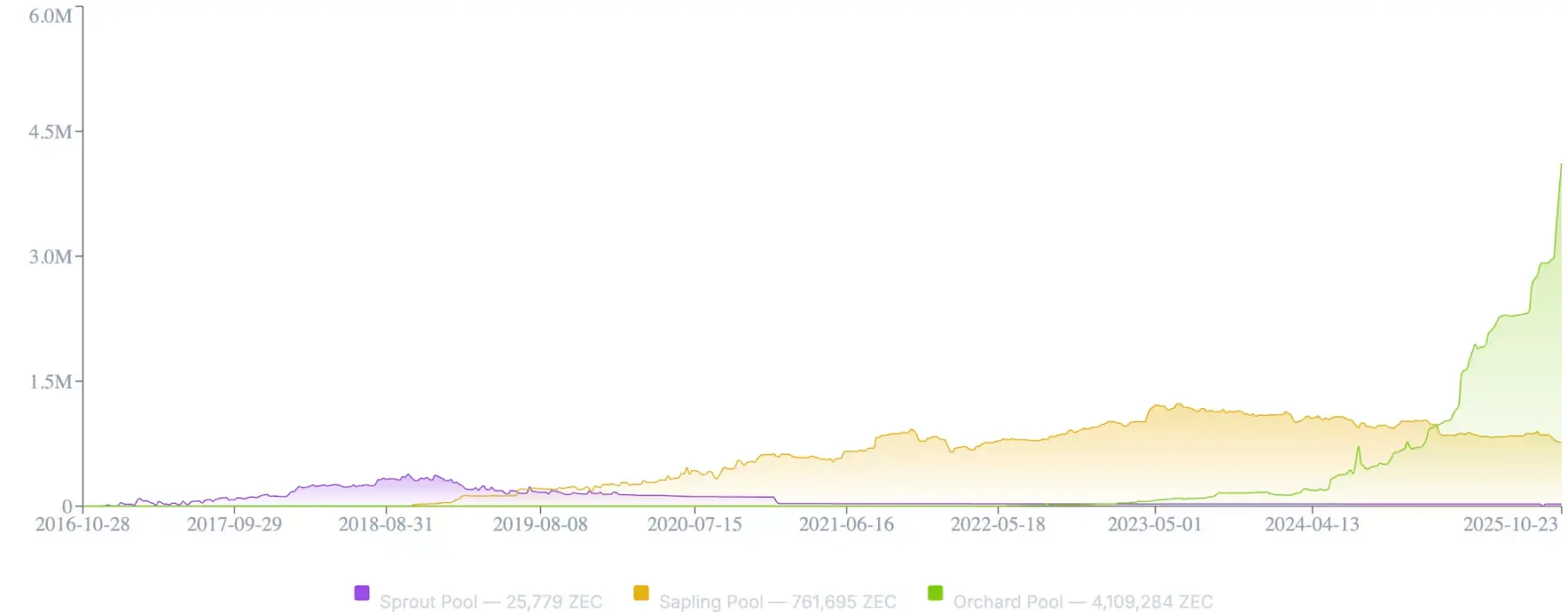
(This was originally a shielded supply chart description: Growth of shielded supply.)
The transparent supply has decreased by nearly 3 million ZEC, from about 14 million at the beginning of the year to about 11.4 million now (about 70% of the total supply).
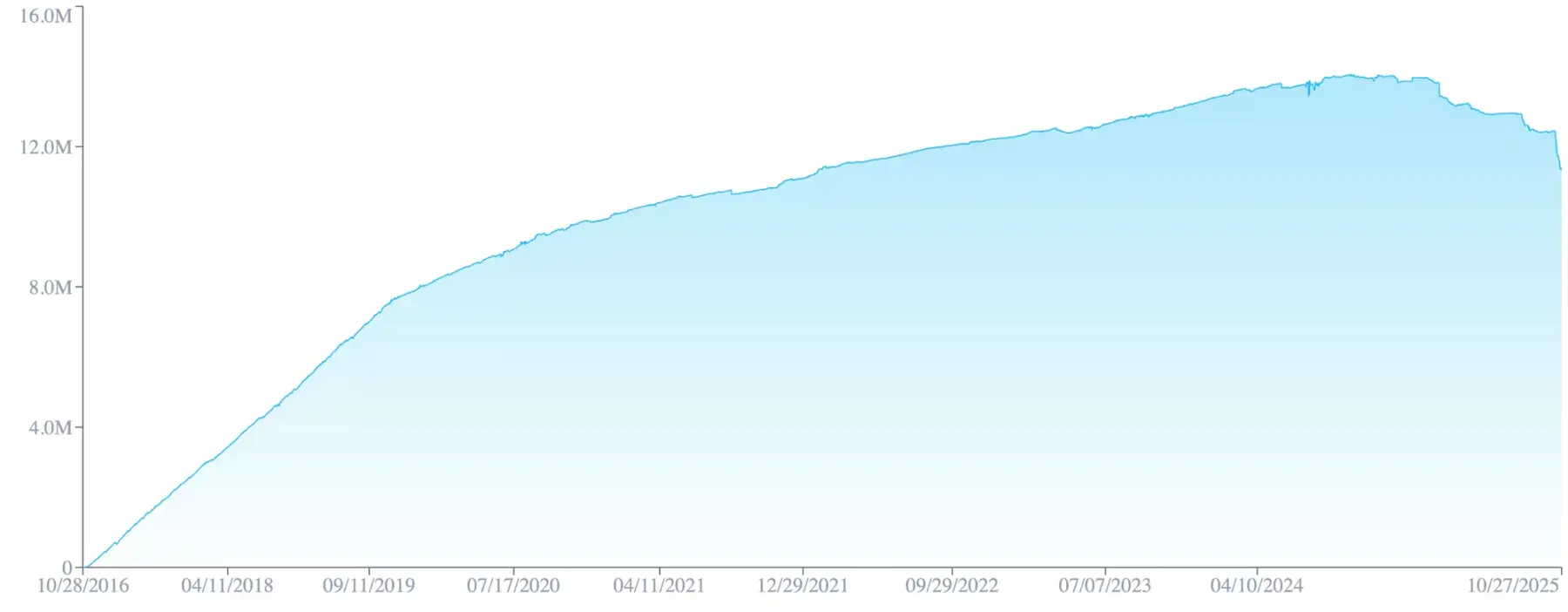
(This was originally a transparent supply chart description: Decline of transparent supply.)
Nodes and Future Development
The Zcash network currently has about 100-120 full nodes, up from a low of about 60 earlier this year. However, this is still very few compared to Bitcoin (about 24,000) or Monero (about 4,000), primarily because running Zcash nodes is much more resource-intensive (shielded transaction verification requires more resources), and the multi-pool architecture and frequent network upgrades also add complexity and maintenance costs.
In the future, developer Sean Bowe is advancing the "Tachyon project," which is a scaling solution that significantly enhances the throughput of shielded transactions by restructuring synchronization and storage methods. Bowe claims that Tachyon can achieve performance leaps without a new protocol, using relatively simple cryptography to resolve all bottlenecks. One could say that Tachyon for Zcash is akin to Firedancer for Solana.
What are NEAR Intents?
NEAR Intents is a cross-chain coordination layer built on the NEAR protocol. It allows users to express intentions without manually operating cross-chain bridges, exchanges, or wallets.
The intent executor automatically allocates liquidity, executes exchanges, and completes cross-chain settlements behind the scenes.
For Zcash, integrating Intents means users can easily move assets from transparent chains into Zcash shielded pools and back without exposing each step. This allows traders or institutions to move from transparent chains (like Ethereum) into Zcash to regain privacy, conduct shielded transactions, and then (if needed) return to the original chain, with no direct association between the two addresses.
The Zashi wallet (the official wallet from ECC and the most commonly used wallet for Zcash) has integrated NEAR Intents, abstracting away the technical friction of cross-chain and shielding for users. Zcash also natively supports view keys, which can be used for auditing or compliance purposes, allowing for selective disclosure of shielded transaction details. These features make Zcash's privacy user-friendly for individuals while also meeting institutional requirements.
Why the Sudden Surge?
Zcash's sudden surge seems to reflect a shift within the crypto culture. As noted in a16z's "2025 Crypto State Report," there has been a recent spike in search interest on Google for privacy-related terms.
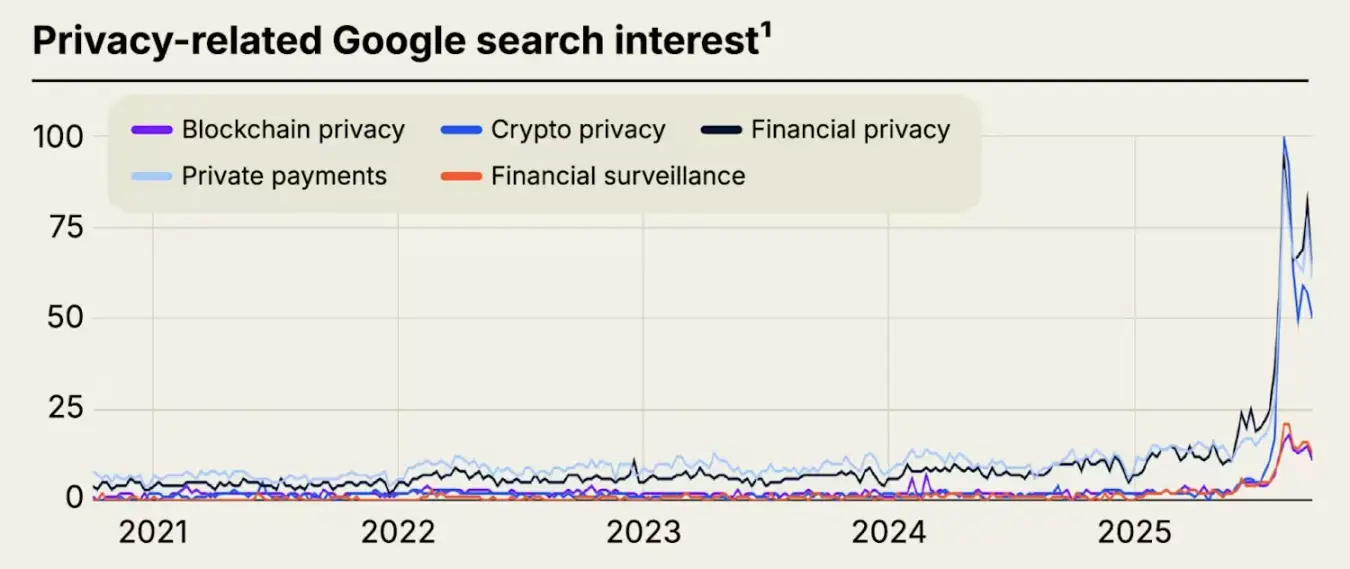
Many Bitcoin critics lament its "institutionalization," claiming it is dominated by ETFs and centralized custodians. Bitcoin itself has always been transparent; ETFs merely add intermediaries without changing its transparent nature. In contrast, Zcash supporters position it as the "crypto version of Bitcoin," a return to the cypherpunk spirit, resonating in the current environment of ubiquitous surveillance from Chainalysis to on-chain detectives. The rise of Zcash has reopened the old rift between "privacy as a right" and "transparency for regulation."
As its privacy tech stack finally reaches consumer-grade usability (the Zashi wallet launched in March 2024 simplifies shielded operations), and with the continued growth of shielded supply, Zcash is gaining more attention. More ZEC being shielded means an expanded anonymous set, making Zcash overall more private.
Another clear signal that Zcash is "back" is that a few weeks ago, Hyperliquid launched ZEC perpetual contracts, allowing traders to leverage privacy coins on this popular decentralized exchange. This indicates strong demand for this long-forgotten gem. The launch of perpetual contracts has increased ZEC's market liquidity, with open interest reaching about $115 million at one point, also amplifying spot price volatility.
From a technical fundamental perspective, Zcash has not undergone an overnight transformation. But the market's perception of it has changed. This surge is attributed to the continued vocal support from top figures in the space, as well as a renewed recognition that privacy is crucial for permissionless currency.
Whether ZEC's strong price momentum can be sustained remains to be seen, but this market rotation has successfully forced a reevaluation of the value of privacy.
After years of stagnation, this surge has brought Zcash back into the spotlight. Whether it can convert speculative momentum into sustained network growth is yet to be observed. However, the renewed focus on privacy reveals a deeper truth: in an increasingly transparent financial system, the ability to transact privately is once again being viewed as a valuable feature.
Original Link ```
 Risk warning Risk warning


Popular articles