How to unlock trillion-level financial value of RWA using existing protocols on BNB Chain?

 This article elaborates on the operating logic of RWA Yield OS.
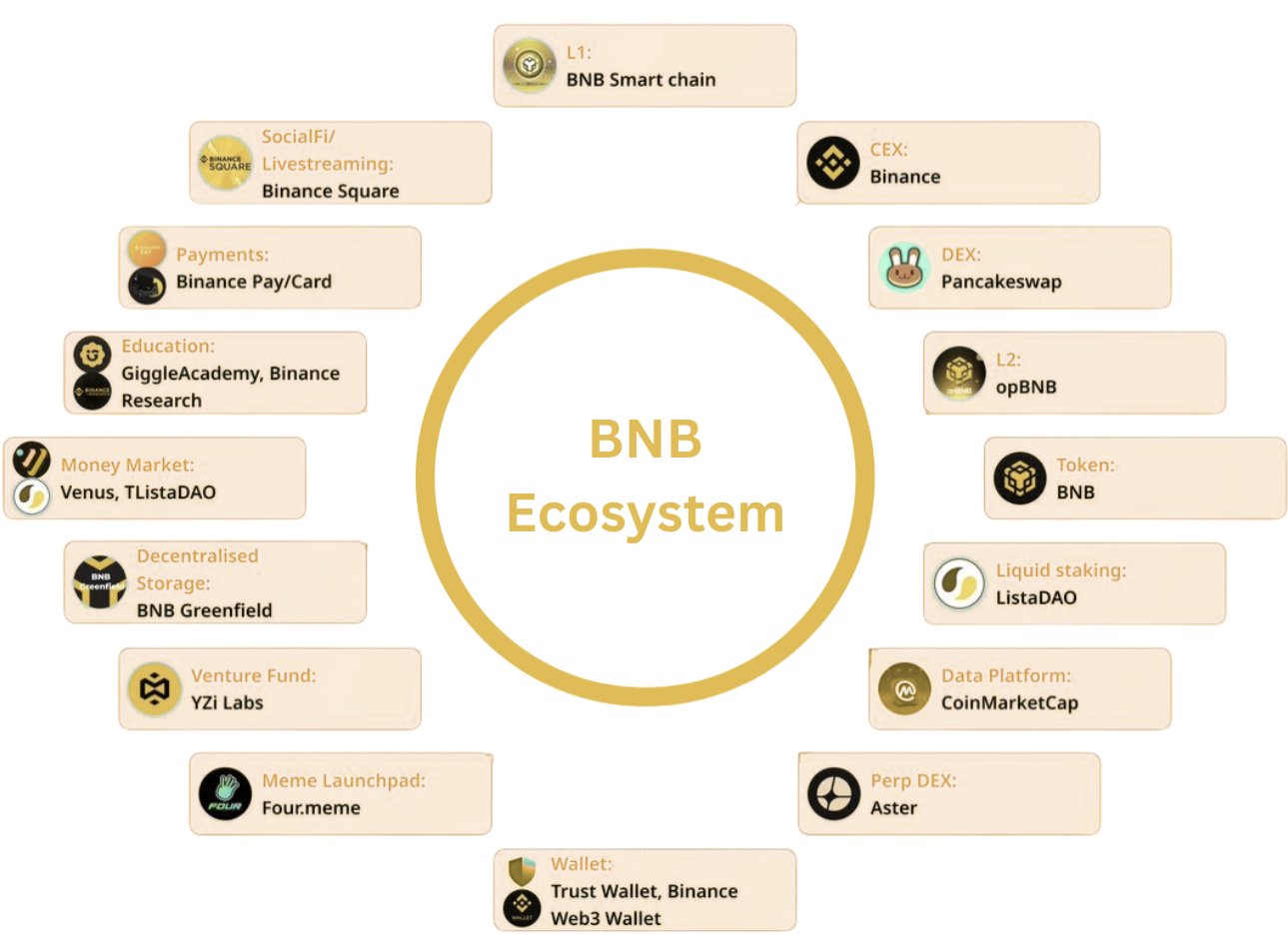
Recently, the Binance-affiliated fund @yzilabs released an ecological research report focusing on the value of BNB.
After reading this report, I have three feelings:
BNB combines the characteristics of a platform token, public chain token, and ecological equity certificate, making it one of the few assets with valuable support at present.
The Binance ecosystem, especially the various DeFi protocols within the BNB Chain ecosystem, is now complete and well-established, with protocols nested and combined, effectively forming a financial ecosystem on the BNB chain.
3. My final feeling is that when the infrastructure of the BNB Chain ecosystem is fully equipped and all on-chain financial play has reached a high level, what will be the next trigger for the explosion of on-chain finance on the BNB Chain?
To put it bluntly, how can we elevate the total TVL of BNB Chain from 16.2 billion USD to the next level, such as breaking through 100 billion, or even larger scales?
Based on this question, we have organized the following article:
DeFi is a decentralized variant of traditional finance.
Although DeFi has reconstructed traditional finance using blockchain ledgers and smart contracts, its essence remains financial. Therefore, the evolutionary path of DeFi cannot escape the trajectory of financial evolution. By reviewing and summarizing the development history and current status of DeFi, combined with the evolution of finance, we can derive the necessary conditions and possible paradigms for the next explosion of on-chain finance.
Since the DeFi explosion in 2020, all on-chain versions of traditional finance have gathered and improved.
We now have on-chain exchanges, such as Uniswap in the Ethereum ecosystem and PancakeSwap in the BNB Chain ecosystem. We now have on-chain banks, such as AAVE in the Ethereum ecosystem and Venus Protocol in the BNB Chain ecosystem. We now have on-chain benchmark yield protocols, such as Lido in the Ethereum ecosystem and Lista DAO in the BNB Chain ecosystem. We now have on-chain principal and interest separation protocols, such as Pendle, which achieves this through PT and YT. We also have on-chain contracts, options, and more.
All products that have appeared in traditional finance now have decentralized versions on-chain.
We even learn from traditional finance's nested combination strategies, turning native assets like ETH and BNB into benchmark yield assets through protocols like Lido and Lista DAO, and then separating principal and interest through Pendle, forming a principal and interest separation market through the expectation game between conservative and leveraged users.
Since its inception in 2020, DeFi has completed nearly 300 years of traditional finance history in just 5 years. Various DeFi protocols have matured and improved, and various DeFi combination strategies have been stacked to an extent that cannot be added to further.
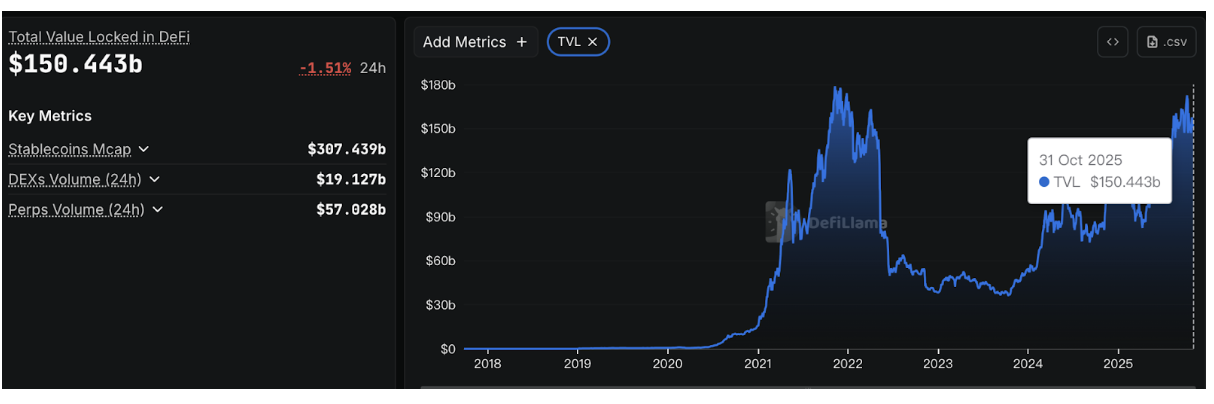
According to the latest data from DefiLlama, the global DeFi TVL has surpassed 150 billion USD, but the growth rate has slowed to 15%, far below the explosive expansion of 2020.
Where is the problem?
Is it that DeFi protocols are not comprehensive enough? Or is it that DeFi strategies are not rich enough?
Of course, it is neither.
The various DeFi protocols built on blockchain have become the infrastructure of on-chain finance, with protocols being complete and strategies diverse. The only likely reason for the slow growth of DeFi is that previous DeFi strategies have been limited to crypto-native assets like ETH, BNB, or stablecoins, while overlooking the potential of broader real-world assets (RWA).
Entering 2025, RWA—tokenizing traditional assets like real estate, bonds, and commodities on-chain—has become the "incremental engine" for DeFi. According to ++RWA.xyz++, as of October 31, 2025, the total market value of on-chain RWA has exceeded 35 billion USD, a year-on-year increase of 150% (ten times the growth rate of DeFi). McKinsey predicts that by 2030, the RWA market size will reach 10 trillion USD.
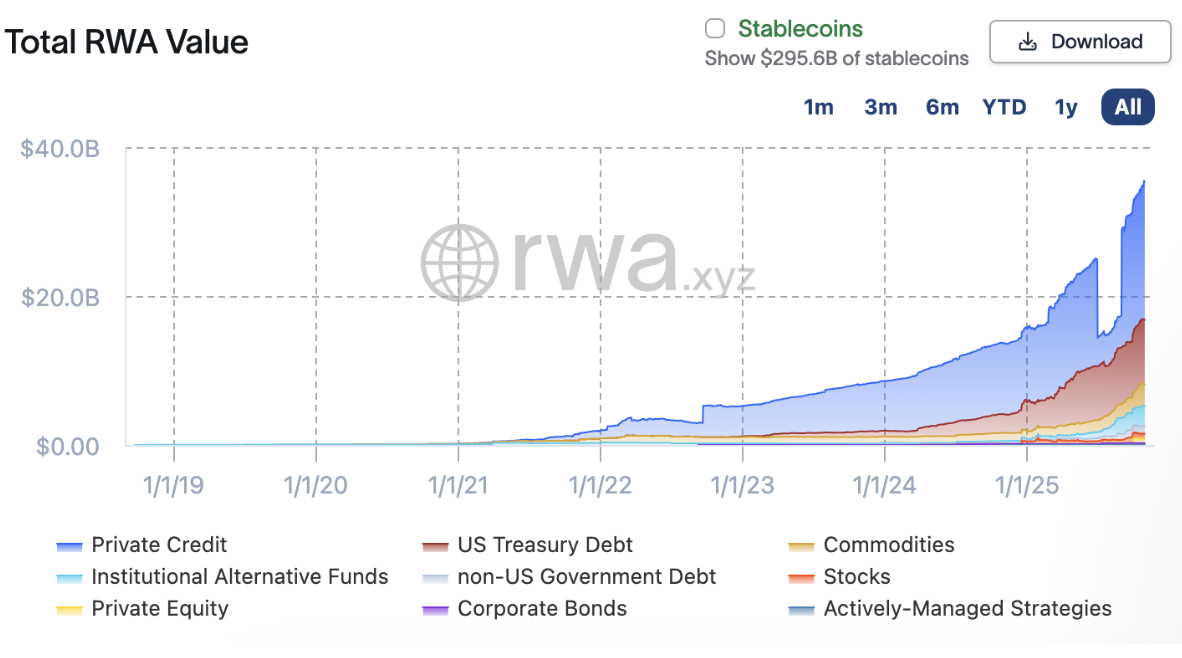
Therefore, when the DeFi infrastructure is basically mature, the focus for driving further explosive growth in on-chain finance is no longer on developing more DeFi protocols or researching more complex combination strategies; what we have is already sufficient and saturated. The further explosion of on-chain finance should focus on the introduction of "incremental assets" (like RWA) and the reduction of user entry barriers (using new tools like AI Agents).
Bringing in "incremental assets" and lowering user barriers through new tools. Using existing DeFi protocols, we can still achieve new heights in DeFi.
In the following text, we will take the DeFi protocols within the BNB Chain ecosystem as an example to introduce "incremental assets" (RWA) and leverage new tools (AI) to deduce how to ignite trillion-level on-chain RWAFi on the BNB Chain using existing DeFi protocols (Lista DAO, Pendle, PicWe, TermiX).
First, let's understand these DeFi protocols on the BNB Chain.
Lista DAO (@lista_dao) is an integrated protocol for Liquidity Staking, lending, and over-collateralized stablecoin (CDP) on the BNB Chain. BNB holders can earn staking rewards by staking BNB on Lista DAO, and can also enhance capital efficiency through lending and other leverage. As of October 31, 2025, Lista DAO's TVL reached 22 billion USD. Core products include slisBNB (LST of BNB, automatically accumulating APR), lisUSD (USD stablecoin minted through CDP), and Lista Lending (dynamic interest rate lending platform). It is not just a simple staking tool, but a leverage hub for BNBFi, allowing users to earn basic returns while easily stacking lending cycles, enhancing capital efficiency several times.
Pendle (@pendle_fi) is a yield tokenization and trading protocol that allows users to split future yields into Principal Token (PT: fixed yield) and Yield Token (YT: variable yield), trading through a dedicated AMM. On the BNB Chain, Pendle's TVL is about 280 million USD. Pendle's core innovation is the PT/YT split, where PT locks in a fixed APY (e.g., 5% with no maturity risk), while YT bets on volatility (potentially 50%+). This mechanism acts like a "pricing mechanism of expectations" in financial markets, where conservative users lock in the base, and aggressive users gamble on premiums, forming an efficient yield derivative market.
PicWe Global (@PicWeGlobal) is a full-chain RWA DEX on the BNB Chain, focusing on RWA issuance and trading. Unlike traditional DEXs, PicWe's core value lies in RWA Launchpad and trading, used for issuing tokenized real assets like bonds, real estate, and infrastructure projects. As the RWAFi infrastructure of the BNB Chain ecosystem, on October 7, 2025, PicWe partnered with the Isfayram Hydropower Station in Kyrgyzstan to launch the world's first hydropower station RWA (IHP), raising 1 million USD, with a market value exceeding 10 million USD. The revenue from the hydropower station RWA is directly linked to electricity generation, with a stable APY of around 20%. This asset is not an abstract token but is anchored to real cash flow—electricity generation revenue day after day, with volatility so low it is almost negligible, yet it injects a reliable "anchoring layer" into DeFi.
TermiX (@termix_ai) is the AI-Web3 operating system of the BNB Chain, positioned as the "AI engine for future finance," making complex DeFi as simple as a conversation. Supported by YZi Labs, it provides AI-as-a-Service, supporting the execution of over 100 protocols, integrating x402 payments and Google AP2 agents. The value of TermiX lies in "natural language decomposition," where users describe their needs, and AI automatically routes protocols, significantly lowering the barriers for users to utilize DeFi strategies. It is not a cold, mechanical code executor, but acts like a personal financial advisor, adjusting paths in real-time based on user intent, ensuring strategies are smoothly implemented on-chain.
Now, we will connect these protocols into a "RWA Yield OS," using PicWe's RWA assets as the foundation, leveraging Lista DAO for amplification, using Pendle for PT/YT splitting of RWA assets, and then driving this strategy through TermiX with natural language. The goal is to convert the stable APY of RWA (like the 20% APY of the hydropower station RWA) into higher compound returns, thereby unlocking the financial value and playability of RWA assets. This strategy is fully applicable to users at different stages from novice to expert in DeFi.
Step 1: RWA Entry.
Users invest in the Isfayram Hydropower Station RWA (IHP) through PicWe IRO, purchasing tokenized shares with any asset on the BNB Chain such as BNB/USDC/WEUSD with one click. The base APY is 20% (anchored to electricity generation revenue, with volatility <2%), seamlessly injected across chains like BNB/Base. This step opens a door to the real world, no longer a purely crypto closed loop, but allowing on-chain funds to directly access the stable cash flow of infrastructure. Compared to the fees and lock-up of traditional RWA funds, it resembles an instant exchange "digital bond," with a barrier low enough to only require a few gas fees.
Step 2: Leverage Injection.
Collateralize the IHP RWA in Lista Lending, borrow lisUSD, and cycle 2x—borrowing lisUSD to buy RWA, net APY rises to 35% (20% base - 5% interest + 10% staking rewards). Here, Lista DAO plays the role of a "magnifying glass": the stable returns of RWA are no longer passively lying idle but are transformed into circulating capital through slisBNB and dynamic lending. Imagine that the previously idle electricity generation revenue is now leveraged into multiple compound returns, while the over-collateralization mechanism of lisUSD acts like a safety valve, keeping the threshold steadily above 150%, avoiding major troubles from small market fluctuations.
Step 3: Yield Splitting.
Inject the leveraged RWA returns into the Pendle pool, splitting into PT (locking in 25% fixed APY, capital preservation) and YT (speculative part, betting on a 10% rise with 5x leverage). PT is suitable for conservative users, while YT attracts speculators. This step is the "watershed" of the entire strategy: the 20% base of RWA is no longer a "one-size-fits-all" holding but is decomposed into dual tracks—PT acts like a zero-coupon bond, locking in risk-free returns; YT acts like an option, betting on peak electricity demand or policy dividends. Pendle's AMM ensures smooth trading, minimizing impermanent loss, transforming RWA from a "static asset" into a "dynamic derivative."
Step 4: AI Automation.
Users tell TermiX: "Invest 10,000 USD in hydropower station RWA, leverage 2x, earn 25% on the fixed part, and bet on a 10% rise on the speculative part." AI decomposes: route to PicWe to buy IHP → Lista to borrow lisUSD → Pendle to split PT/YT → monitor and rebalance. This is not a sci-fi command but a reality on-chain: TermiX acts like an invisible butler, scanning market signals 24/7, automatically adjusting leverage or hedging risks. The entire process from user description to execution takes only a few minutes, far surpassing the cumbersome manual operation.
The following diagram details how to use the existing four protocols on the BNB Chain to transform RWA from a "static asset" into a "dynamic derivative."
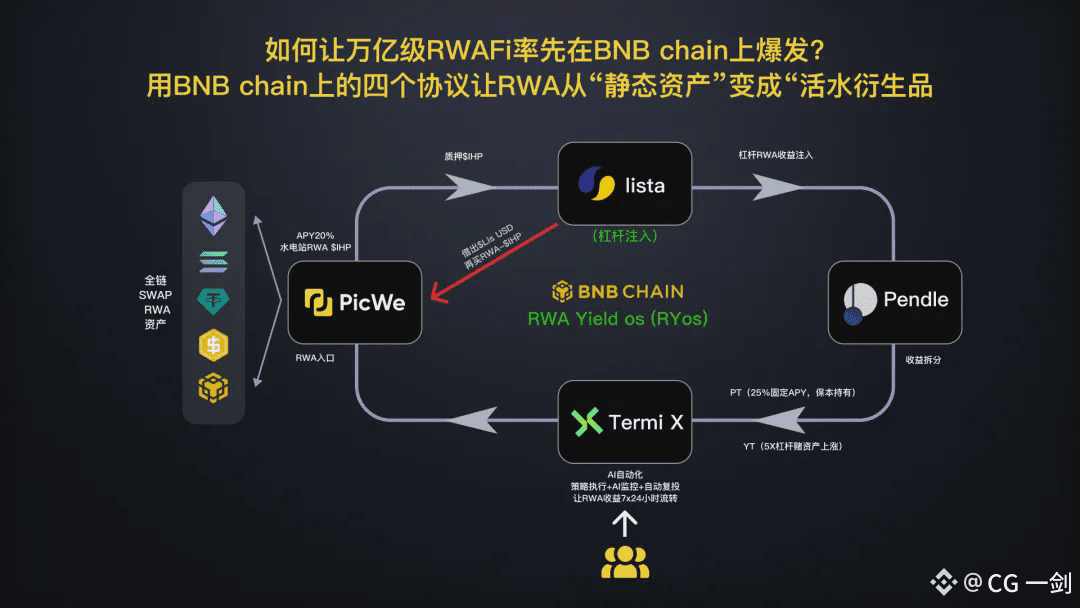
The above four steps constitute the complete RWA Yield OS (RYOS for short).
It is not an empty fantasy but a natural extension based on the existing infrastructure of the BNB Chain: PicWe continuously injects RWA incremental assets, Lista DAO and Pendle release the potential financial value of these assets, and finally, TermiX's AI tools universalize the entire strategy, allowing any investor to drive it using natural language. This maximizes investor engagement and significantly increases the activity of on-chain finance—AI can execute different strategies on-chain 24/7, capturing fleeting arbitrage opportunities.
The most critical point is that this RYOS can activate on-chain RWA finance. RWA is no longer just about buying financial products; it can be manipulated like ETH and BNB in financial Lego: while increasing the playability of RWA, it also prepares a complete minimum viable on-chain SOP for the explosion of RWAFi on the BNB Chain.
Imagine, when the electricity generation revenue of the Kyrgyz hydropower station is leveraged and split, optimized by AI, the TVL of the BNB Chain will start from the 35 billion of RWA and multiply geometrically through the compound effect, heading straight for trillions.
Of course, the explosion will not happen overnight. The gray areas of regulation, the compliance modules of RWA, and the trustworthy bridging with the chain are all potential stumbling blocks. But just as DeFi has gradually matured from the wild growth of 2020, the BNB Chain, with Binance's global influence and strong support from RWA ecological funds (I believe that in addition to investing in supporting entrepreneurs, it can also use tokens like BNB or BUSDT to subsidize users participating in RYOS, which will accelerate the implementation of RYOS).
In the future, as more RWAs, such as dividend stock tokens, bond tokens, fund tokens, and other RWA assets flood in, RYOS will become standard, allowing novices to earn stable 20% returns from electricity dividends and experts to bet on 50% spikes in YT.
The next golden age of on-chain finance may be ignited from here—BNB Chain takes the lead, using RYOS to explode trillion-level RWAFi.
These are my suggestions for BNB Chain to take the lead in igniting on-chain RWAFi. This strategy, RWA Yield OS, abbreviated as RYOS, is also being copied to @cz_binance @heyibinance.
 Risk warning Risk warning