Forecasting Market 2.0 Outlook: 5 New Product Forms Beyond "Pure Betting"
 Core Viewpoint

 The design space of the predictive market application layer has just begun to be explored.
Original: neel daftary
Compiled by: Odaily Planet Daily Golem
The future of prediction markets may be dominated by Polymarket/Kalshi, capturing all attention and market share. However, we may ultimately use entirely new designs of prediction markets that cater to everyone's needs and align with their preferences and interests.
Do you remember how the trading of Meme coins evolved? From 2015, when we only needed to buy tokens with a dog printed on them, to 2025, when we need to learn to use tools (Axiom), track wallets (Cielo, Nansen, Arkham), and join a community to search for tokens on platforms like Solana, BNB, and Base.
Every opportunity that arises in the crypto space starts with simple patterns. Over time, these simple patterns either fade away (like NFTs) or become more complex with the addition of more participants, leading to the gradual disappearance of early advantages (like Meme coins). Of course, users also want to play more complex games, as evidenced by the evolution of most video games (God of War, Assassin's Creed, FIFA, etc.). To maintain appeal and relevance to the core user base, games and game-like platforms need to increase functionality and complexity, allowing top players to stand out from 99% of players.
When this happens again, resonating with the prediction market category, it will no longer be a single, massive platform but a complete ecosystem containing numerous prediction-related applications.
These independent products can leverage the core mechanisms of prediction markets (incentivized predictions and stakeholder interests) to create entirely new experiences. Here are five highly anticipated categories:
Trading Expected Impact: The Example of Lightcone
This may be the newest and most complex original concept, transcending the realm of probabilities and allowing users to trade the impact of events.
It can be understood this way: prediction markets tell you the probability (P) of an event occurring, while spot markets tell you the spot price (S) of the event occurring. However, the new category defined by Lightcone, "impact markets," aims to separate and price impact (I).
The way it works is that the platform clones assets into a "parallel universe" based on future events. For example, a user can deposit 1 BTC before the U.S. election and then receive two new tradable tokens, Trump-BTC and Kamala-BTC.
These tokens are traded in independent "parallel universes." When an event occurs (e.g., Trump wins), all Trump-BTC can be exchanged for real Bitcoin, while all Kamala-BTC will go to zero (and vice versa).
The advantage of this model is that it spawns two entirely new applications:
- New Information Machines: It provides us with a testing ground for predicting financial impacts. By comparing the prices of Trump-BTC (e.g., $130,000) and Kamala-BTC (e.g., $91,000) with the current spot Bitcoin price ($102,000), the market clearly tells us the expected financial impact of each outcome, which is entirely unrelated to the probability of the outcome occurring.
- "Event-Based" Hedging: Traders can hedge specific risks without paying a premium unless that risk occurs. For example, a trader concerned about a specific credit event (like Saylor defaulting) can hold strSolvent-BTC while selling strDefault-BTC for strDefault-USDC.
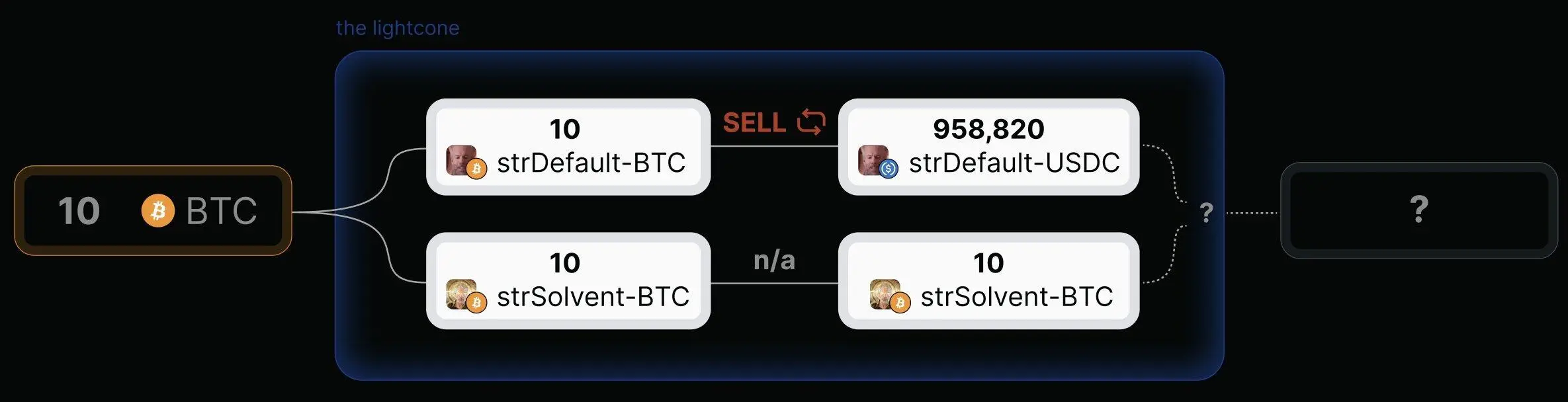
If a default occurs, their strDefault-USDC will turn into real USDC. They have successfully hedged and sold Bitcoin before the event occurred; if no default occurs, their strSolvent-BTC can be exchanged for their original Bitcoin. They still hold a long position, and the hedging operation incurs no cost.
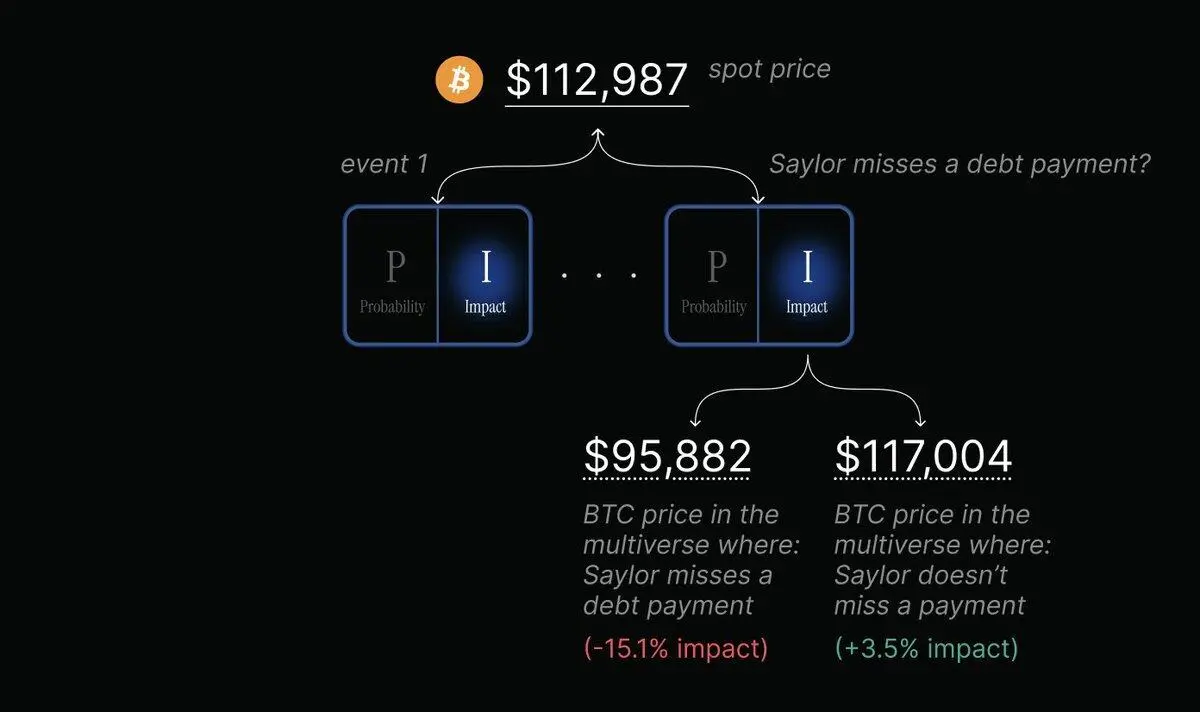
This is a complex tool. It removes the "probability" variable from trading, allowing institutions and traders to trade solely based on impact factors, which is indeed a new financial foundation.
Opinion Markets: Betting on Beliefs
This is an intriguing concept where participants no longer bet on objective facts (e.g., "Will Ethereum reach $5,000?") but rather on what people will believe.
For example: "Will more than 70% of participants bet 'yes' in this market?"
This model has two major advantages:
- Rapid Settlement: The market can settle daily or every few hours based solely on its internal dynamics. It does not rely on slow external oracles.
- Monetization of Social Capital: It rewards players who can accurately predict collective psychology rather than facts. This is a direct way to monetize cultural influence and understanding.
Currently, platforms like Melee, vPOP, and opinions.fun are attempting to build this model, enabling people to convert social capital into profit.
Virtual Sports: High-Frequency Prediction Markets
Virtual sports are a $25 billion industry, with a cyclical prediction market at its core.
On the [Football.Fun](https://
 Risk warning
 Risk warning