LuBian Mining Pool Hacked and Stolen Large Amount of Bitcoin Incident Technical Traceability Analysis Report
 Core Viewpoint

 This report takes a technical perspective, deeply analyzing the key technical details of the incident through technical tracing, focusing on the origins of the stolen batch of Bitcoin, restoring the complete attack timeline at that time, and assessing the security mechanisms of Bitcoin, with the hope of providing valuable security insights for the cryptocurrency industry and users.
Author: National Computer Virus Emergency Response Center
On December 29, 2020, the LuBian mining pool experienced a major hacking incident, resulting in the theft of a total of 127,272.06953176 bitcoins (valued at approximately $3.5 billion at the time, now worth $15 billion) by the attackers. The holder of this massive amount of bitcoin is Chen Zhi, the chairman of the Cambodian Prince Group.
After the hacking incident, Chen Zhi and his Prince Group repeatedly released messages on the blockchain in early 2021 and on July 4 and 26, 2022, appealing to the hackers, hoping they would return the stolen bitcoins and expressing a willingness to pay a ransom, but received no response.
Strangely, after the theft, this large amount of bitcoin remained dormant in the wallets controlled by the attackers for four years, with almost no movement, which clearly does not align with typical hacker behavior eager to cash out for profit, but rather resembles a precise operation orchestrated by a "state-level hacker organization." It wasn't until June 2024 that the stolen bitcoins were transferred to new bitcoin wallet addresses, where they remain untouched to this day.
On October 14, 2025, the U.S. Department of Justice announced criminal charges against Chen Zhi and stated that it would seize 127,000 bitcoins from him and his Prince Group. Various pieces of evidence indicate that the bitcoins seized by the U.S. government from Chen Zhi and his Prince Group were precisely the bitcoins stolen from the LuBian mining pool by hackers back in 2020. In other words, the U.S. government may have seized the 127,000 bitcoins held by Chen Zhi through hacking techniques as early as 2020, marking a typical "black eat black" incident orchestrated by a state-level hacker organization.
This report analyzes the key technical details of the incident from a technical perspective, focusing on the origins of the stolen bitcoins, reconstructing the complete attack timeline, and assessing the security mechanisms of bitcoin, hoping to provide valuable security insights for the cryptocurrency industry and its users.
I. Background of the Incident
The LuBian mining pool was established in early 2020 and quickly rose to prominence, primarily operating in China and Iran. In December 2020, the LuBian mining pool suffered a large-scale hacking attack, resulting in the theft of over 90% of its bitcoin holdings. The total amount stolen was 127,272.06953176 BTC, which closely matches the 127,271 BTC mentioned in the U.S. Department of Justice's indictment.
The operational model of the LuBian mining pool includes centralized storage and distribution of mining rewards. The bitcoins in the pool are not stored in regulated centralized exchanges but exist in non-custodial wallets. From a technical perspective, non-custodial wallets (also known as cold wallets or hardware wallets) are considered the ultimate safe haven for crypto assets, as they cannot be frozen by a mere decree like exchange accounts; they are more like a bank vault that belongs solely to the holder, with the key (private key) only in the holder's possession.
As a cryptocurrency, bitcoin's on-chain addresses are used to identify the ownership and flow of bitcoin assets. Mastering the private key of an on-chain address allows complete control over the bitcoins in that address. According to reports from on-chain analysis firms, the massive bitcoins controlled by the U.S. government are highly correlated with the hacking incident of the LuBian mining pool.
On-chain data records show that on December 29, 2020, Beijing time, an abnormal transfer occurred in LuBian's core bitcoin wallet address, with a total transfer amount of 127,272.06953176 BTC, which closely matches the 127,271 BTC mentioned in the U.S. Department of Justice's indictment. After this batch of stolen bitcoins was transferred abnormally, it remained dormant until June 2024.
Between June 22 and July 23, 2024, these stolen bitcoins were transferred again to new on-chain addresses, where they remain untouched to this day. The well-known blockchain tracking tool platform ARKHAM has marked these final addresses as being held by the U.S. government. Currently, the U.S. government has not disclosed how it obtained the private keys for Chen Zhi's massive bitcoin on-chain addresses.
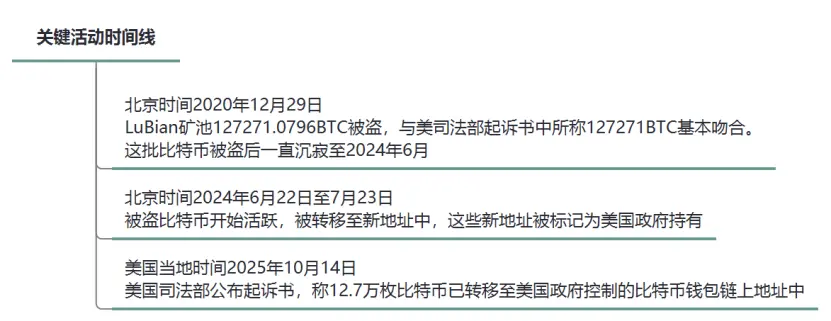
Figure 1: Key Activity Timeline
II. Attack Link Analysis
It is well known that in the world of blockchain, random numbers are the cornerstone of cryptographic security. Bitcoin employs asymmetric encryption technology, and the bitcoin private key is a string of 256-bit binary random numbers, with a theoretical cracking count of 2^256, which is nearly impossible. However, if this string of 256-bit binary private keys is not completely randomly generated, for example, if 224 bits follow a certain pattern that can be deduced and only 32 bits are randomly generated, it would significantly reduce the strength of the private key, requiring only 2^32 (approximately 4.29 billion) attempts to brute force crack it. For instance, in September 2022, the UK cryptocurrency market maker Wintermute was hacked for $160 million due to a similar pseudo-random number vulnerability.
In August 2023, an overseas security research team, MilkSad, first announced the discovery of a third-party key generation tool with a pseudo-random number generator (PRNG) vulnerability and successfully applied for a CVE number (CVE-2023-39910). In the research report released by this team, it was mentioned that the LuBian bitcoin mining pool had a similar vulnerability, and all 25 bitcoin addresses mentioned in the U.S. Department of Justice's indictment were included in the addresses of the hacked LuBian bitcoin mining pool.

Figure 2: List of 25 Bitcoin Wallet Addresses in the U.S. Department of Justice's Indictment
As a non-custodial wallet system, the LuBian bitcoin mining pool's wallet addresses rely on a custom private key generation algorithm to manage funds. The private key generation did not use the recommended 256-bit binary random number standard but relied on a 32-bit binary random number. This algorithm has a fatal flaw: it relies solely on weak inputs or timestamps as seeds for the "pseudo-random generator" Mersenne Twister (MT19937-32), which has a randomness equivalent to a 4-byte integer and can be efficiently exhausted in modern computing. Mathematically, the cracking probability is 1/2^32; for example, if an attack script tests 10^6 keys per second, the cracking time would be approximately 4200 seconds (about 1.17 hours). In practice, optimization tools like Hashcat or custom scripts can further accelerate this process. The attackers exploited this vulnerability to steal the massive bitcoins from the LuBian mining pool.
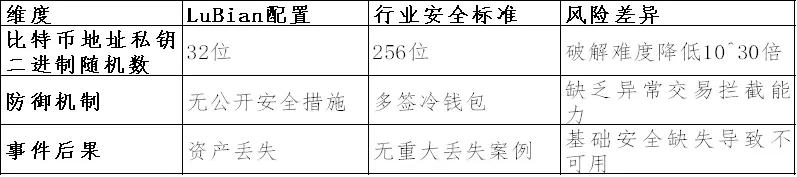
Figure 3: Comparison Table of LuBian Mining Pool and Industry Security Standard Defects
Through technical tracing, the complete timeline and related details of the LuBian mining pool's hacking incident are as follows:
1. Attack and Theft Phase: December 29, 2020, Beijing Time
Event: Hackers exploited the pseudo-random number vulnerability in the LuBian mining pool's bitcoin wallet address private key generation to brute force crack over 5,000 weak random wallet addresses (wallet type: P2WPKH-nested-in-P2SH, prefix 3). Within approximately 2 hours, about 127,272.06953176 BTC (valued at about $3.5 billion at the time) was drained from these wallet addresses, leaving less than 200 BTC. All suspicious transactions shared the same transaction fee, indicating that the attack was executed by an automated batch transfer script.
Sender: Group of weak random bitcoin wallet addresses from the LuBian mining pool (controlled by the operational entity of the LuBian mining site, belonging to Chen Zhi's Prince Group);
Receiver: Group of bitcoin wallet addresses controlled by the attackers (addresses not disclosed);
Transfer Path: Weak wallet address group → Attackers' wallet address group;
Correlation Analysis: The total amount stolen was 127,272.06953176 BTC, which closely matches the 127,271 BTC mentioned in the U.S. Department of Justice's indictment.
2. Dormant Phase: December 30, 2020, to June 22, 2024, Beijing Time
Event: After being stolen through the pseudo-random number vulnerability in 2020, this batch of bitcoins remained in the attackers' controlled bitcoin wallet addresses for nearly 4 years and was in a dormant state, with only a tiny fraction of dust transactions possibly used for testing.
Correlation Analysis: This batch of bitcoins remained almost untouched until it was fully taken over by the U.S. government on June 22, 2024, which clearly does not align with the typical nature of hackers eager to cash out for profit, but rather resembles a precise operation orchestrated by a state-level hacker organization.
3. Recovery Attempt Phase: Early 2021, July 4 and 26, 2022, Beijing Time
Event: After the theft, during the dormant period, in early 2021, the LuBian mining pool sent over 1,500 messages (costing about 1.4 BTC in fees) through the Bitcoin OPRETURN function, embedding them in the blockchain data area, pleading with the hackers to return the funds. Example message: "Please return our funds, we'll pay a reward." On July 4 and 26, 2022, the LuBian mining pool again sent messages through the Bitcoin OPRETURN function, with example messages: "MSG from LB. To the whitehat who is saving our asset, you can contact us through 1228btc@gmail.com to discuss the return of asset and your reward."
Sender: LuBian weak random bitcoin wallet addresses (controlled by the operational entity of the LuBian mining site, belonging to Chen Zhi's Prince Group);
Receiver: Group of bitcoin wallet addresses controlled by the attackers;
Transfer Path: Weak wallet address group → Attackers' wallet address group; small transactions embedded in OP_RETURN;
Correlation Analysis: After the theft incident, these messages confirm that the LuBian mining pool, as the sender, made multiple attempts to contact "third-party hackers" to request the return of assets and discuss ransom matters.
4. Activation and Transfer Phase: June 22 to July 23, 2024, Beijing Time
Event: The bitcoins in the attackers' controlled wallet addresses were activated from their dormant state and transferred to the final bitcoin wallet addresses. The final wallet addresses have been marked by the well-known blockchain tracking tool platform ARKHAM as being held by the U.S. government.
Sender: Group of bitcoin wallet addresses controlled by the attackers;
Receiver: New consolidated final wallet address group (not disclosed but confirmed to be controlled by the U.S. government);
Transfer Path: Attackers' controlled bitcoin wallet address group → U.S. government-controlled wallet address group;
Correlation Analysis: This batch of stolen massive bitcoins, which remained dormant for 4 years with almost no movement, was ultimately controlled by the U.S. government.
5. Announcement of Seizure Phase: October 14, 2025, U.S. Local Time
Event: The U.S. Department of Justice issued an announcement, charging Chen Zhi and "seizing" his 127,000 bitcoins.
At the same time, through the blockchain's public mechanism, all bitcoin transaction records are publicly traceable. Based on this, this report traced the source of the massive bitcoins stolen from the LuBian weak random bitcoin wallet addresses (controlled by the operational entity of the LuBian mining site, possibly belonging to Chen Zhi's Prince Group). The total number of stolen bitcoins amounted to 127,272.06953176, with sources including: approximately 17,800 from independent "mining," about 2,300 from mining pool salary income, and 107,100 from exchanges and other channels. Preliminary results indicate discrepancies with the U.S. Department of Justice's indictment, which claims all sources are from illegal income.
III. Vulnerability Technical Detail Analysis
1. Bitcoin Wallet Address Private Key Generation:
The core of the LuBian mining pool's vulnerability lies in its private key generator, which utilized a defect similar to the "MilkSad" flaw in Libbitcoin Explorer. Specifically, the system employed the Mersenne Twister (MT19937-32) pseudo-random number generator, initialized with only a 32-bit seed, resulting in effective entropy of only 32 bits. This PRNG is not cryptographically secure (non-cryptographic) and is easy to predict and reverse engineer. Attackers can enumerate all possible 32-bit seeds (0 to 2^32-1), generate corresponding private keys, and check for matches with known wallet address public key hashes.
In the bitcoin ecosystem, the private key generation process typically involves: random seed → SHA-256 hash → ECDSA private key.
The implementation of the LuBian mining pool's foundational library may be based on custom code or open-source libraries (like Libbitcoin), but it overlooked the security of entropy. The similarity to the MilkSad vulnerability lies in the fact that the "bx seed" command in Libbitcoin Explorer also uses the MT19937-32 random number generator, relying solely on timestamps or weak inputs as seeds, leading to private keys being vulnerable to brute force cracking. In the LuBian attack incident, over 5,000 wallets were affected, indicating that this vulnerability is systemic and may have originated from code reuse during bulk wallet generation.
2. Simulated Attack Process:
(1) Identify target wallet addresses (by monitoring LuBian mining pool activities on-chain);
(2) Enumerate 32-bit seeds: for seed in 0 to 4294967295;
(3) Generate private keys: private_key = SHA256(seed);
(4) Derive public keys and addresses: using ECDSA SECP256k1 curve calculations;
(5) Match: If the derived address matches the target, use the private key to sign transactions to steal funds;
Comparison with similar vulnerabilities: This vulnerability is akin to the 32-bit entropy flaw in Trust Wallet, which led to large-scale bitcoin wallet address cracking; the "MilkSad" vulnerability in Libbitcoin Explorer also exposed private keys due to low entropy. These cases stem from legacy issues in early codebases that did not adopt the BIP-39 standard (12-24 word seed phrases providing high entropy). The LuBian mining pool may have used a custom algorithm aimed at simplifying management but overlooked security.
Defense Gaps: The LuBian mining pool did not implement multi-signature (multisig), hardware wallets, or hierarchical deterministic wallets (HD wallets), all of which could enhance security. On-chain data shows that the attack covered multiple wallets, indicating a systemic vulnerability rather than a single point of failure.
3. On-Chain Evidence and Recovery Attempts:
OPRETURN Messages: The LuBian mining pool sent over 1,500 messages through Bitcoin's OPRETURN function, costing 1.4 BTC, pleading with the attackers to return the funds. These messages embedded in the blockchain prove to be actions of the real owner, not forgeries. Example messages include "Please return our funds" or similar pleas, distributed across multiple transactions.
4. Attack Correlation Analysis:
In the criminal indictment against Chen Zhi (case number 1:25-cr-00416) issued by the U.S. Department of Justice on October 14, 2025, 25 bitcoin wallet addresses were listed, holding approximately 127,271 BTC, valued at about $15 billion, which have been seized. Through blockchain analysis and official document review, these addresses are highly correlated with the LuBian mining pool's hacking incident:
Direct Correlation: Blockchain analysis shows that the 25 addresses in the U.S. Department of Justice's indictment are precisely the final holding addresses of the bitcoins stolen from the LuBian mining pool during the 2020 attack. The Elliptic report indicates that these bitcoins were "stolen" from the LuBian mining pool's mining operations in 2020. Arkham Intelligence confirms that the funds seized by the U.S. Department of Justice directly originated from the LuBian mining pool theft incident.
Evidence Correlation in the Indictment: Although the U.S. Department of Justice's indictment does not directly name the "LuBian hack," it mentions that the funds originated from "stolen attacks on Iranian and Chinese bitcoin mining operations," which aligns with the on-chain analysis from Elliptic and Arkham Intelligence.
Attack Behavior Correlation: From the attack method, the massive bitcoins from the LuBian mining pool were stolen through a technical attack in 2020 and remained dormant for 4 years, with only a tiny fraction of dust transactions occurring during that time, until they were almost untouched before being fully taken over by the U.S. government in 2024. This behavior does not conform to the typical nature of hackers eager to cash out for profit, but rather resembles a precise operation orchestrated by a state-level hacker organization. Analysis suggests that the U.S. government may have controlled this batch of bitcoins as early as December 2020.
IV. Impact and Recommendations
The impact of the LuBian mining pool's hacking incident in 2020 is profound, leading to the actual dissolution of the mining pool, with losses amounting to over 90% of its total assets at the time, while the current value of the stolen bitcoins has risen to $15 billion, highlighting the amplified risks of price volatility.
The LuBian mining pool incident exposes systemic risks in random number generation within the cryptocurrency toolchain. To prevent similar vulnerabilities, the blockchain industry should use cryptographically secure pseudo-random number generators (CSPRNG); implement multi-layer defenses, including multi-signature (multisig), cold storage, and regular audits, to avoid custom private key generation algorithms; mining pools should integrate real-time on-chain monitoring and abnormal transfer alert systems. Ordinary users should avoid using unverified key generation modules from open-source communities. This incident also reminds us that even with the high transparency of blockchain, weak security foundations can still lead to catastrophic consequences. It also reflects the importance of cybersecurity in the future development of the digital economy and digital currency.
 Risk warning Risk warning