What do the three major exchanges C2C use to impress users? In-depth evaluation of Binance, OKX, and Huobi HTX
 A sincere comparison of C2C platforms in the cryptocurrency space: In-depth evaluation of security and compensation for Huobi HTX, Binance, and OKX.
Who is the "most sincere" C2C in the crypto world? After all, in the "deeply strategic" crypto space, only "sincerity" wins people's hearts.
Especially as the market in November slid down from its highs, the cries of "the bear market is here" echoed everywhere, and more and more people realized that------ the most important thing is not the market, but whether your money can return to your hands.
However, in the world of crypto C2C, risks never diminish due to bull or bear markets: freezing, disputes, merchants running away, no recourse for complaints… Any broken link can cause your assets to "disappear instantly" in the real system.
Therefore, this long article is not meant to take sides, but to answer the most critical question: when risks truly arise, which platform can better protect users?
This article selects the most mainstream platforms in the Chinese-speaking region that everyone commonly uses: Binance, OKX, and Huobi HTX, and evaluates them from three perspectives: security, compensation system, user experience, and risk control mechanisms. The reference information comes from: public announcements from the three platforms; real user feedback from KOLs and Twitter; personal usage experience. For everyone's comparison and reference.
1. Security: Avoiding freezing is a hundred times more important than compensation
In C2C, the most frustrating incident is probably freezing.
Let's first present a table of the "freezing-related data and transparency" from the three platforms:
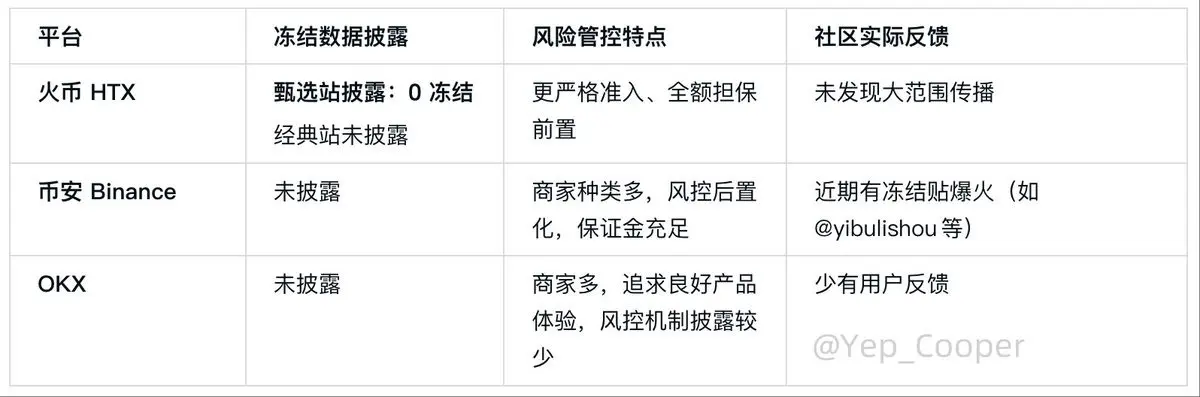
Image from Twitter user @Yep_Cooper
It can be stated very clearly: avoiding freezing ≫ resolving freezing. A single freeze is enough to make a user leave a platform forever. Among the three, Huobi was the first to publicly disclose "0 freezing" data.
This action itself represents the highest level of transparency in the current industry.
For any platform, as the trading scale continues to expand and the merchant ecosystem becomes more complex, the difficulty of risk control will increase exponentially. Mechanisms can be continuously optimized, but if the "freezing risk" cannot be effectively anticipated, user experience will always hang in uncertainty.
2. Compensation System: All 100%? Surface uniformity, but actual differences are huge
The complexity of the rules for the three platforms is comparable to credit card agreements. Below is the clearest panoramic evaluation version of the compensation mechanisms for the three platforms, organized in chronological order of their launch.
① Huobi HTX (the first to launch 100% full compensation)
Launch date: April 7, 2025, launched the selection site; August 20, 2025, launched 100% full compensation
Public, transparent, no transaction amount limit
Tagged merchants = 100% compensation (single transaction limit of 10,000 USDT)
Application within 30 days after judicial freezing
Users do not need to pay additional fees
② OKX
Launch date: August 27, 2025
Also provides up to 100% compensation
Good clarity of rules
User operation process is friendly
Compensation limit for ordinary users is relatively limited
③ Binance
Launch date: July 29, 2025, tested the selected area; September 15, 2025, announced the upgrade to 100% compensation
Selected area: up to 100% compensation (shield merchants limit 50,000 USDT)
Ordinary area: small amounts 100%, large amounts only 10%, limit 3,000 USDT
Merchant deposit must be 100,000 USDT
Compensation application: for judicial freezing orders occurring within 30 calendar days after the transaction is completed
Shield merchants need to pay nearly 0.1% fees, which will be passed on to advertising prices, ultimately burdening the users
At first glance, they all seem to be 100%, but the coverage of the groups differs greatly. Binance's selected area covers less than 5% of users, and the rules in the ordinary area are significantly reduced. A simple structure with a very low learning cost for users can be referenced from Huobi, which was the first to launch the C2C selected area.
3. The essence behind the rules: What are the three platforms thinking?
To translate complex rules into what is "truly important to users," this article summarizes the core ideological differences among the three platforms:
① Huobi HTX: Preemptive risk control > Post-compensation
Huobi started in C2C the earliest, so its philosophy is: "Preventing incidents is more important than compensating after they occur." The "0 freezing" data from the selected site is the result of this. Although there is still room for experience optimization and occasional lag on the product page, the security is perceptible, the rules are the simplest, the labels are the clearest, and the merchant review is very strict. Most importantly, the compensation mechanism is transparent, with no "differentiated treatment."
② Binance: Strong backing ability, but complex mechanisms, leaning towards post-compensation
Binance is large, being the world's largest exchange, so its approach is more like: "First open, then back up." There is no public freezing data; the number of merchants is huge; the shield system is gradually maturing, but the compensation strength for ordinary users is significantly weaker than that of the selected area. Fees are shifted to merchants but ultimately passed on to users.
Binance's strength lies in: if you are a large trader + can choose shield merchants = very secure. But for ordinary users, this mechanism has a very high learning cost.
③ OKX: Best experience, slightly weaker risk control
OKX's product logic is the smoothest in the industry, but the "transparency of the compensation mechanism" and "disclosure of freezing data" are not as good as the other two. Moreover, the compensation coverage is not strong, suitable for users who prioritize experience and trade more frequently.
4. How should the ranking of the three be viewed?
Based on the organization of all the information in this article, three conclusions can be drawn:
If you are most afraid of freezing → choose Huobi HTX
The reason is the only publicly disclosed freezing data, the only continuous disclosure of "0 freezing," the most preemptive risk control, and the most user-friendly for ordinary users.If you are a large trader + can identify merchants → Binance's selected area
The reason is strong backing ability for large users and high compensation limits.
- If you pursue trading experience → OKX tagged merchants will suffice
Because product experience is prioritized, and risks are moderate.
In conclusion: the most sincere in the crypto world is not advertising, but clearly explaining the risks.
From the launch of Huobi's selected site in April, to the testing of full compensation in May, to the official launch of 100% compensation in August, and then to OKX and Binance successively launching similar mechanisms------ the industry has indeed become healthier due to a "transparent competition."
Huobi took the first step in the industry; OKX improved the user experience; Binance raised the compensation amount to the highest in the industry.
This is healthy competition and a blessing for all users. To quote a very realistic saying in the industry: the end of Web3 is not getting rich quickly, but safety. Bringing money back home is the highest value.
What can the most sincere in the crypto world use to impress users?
The answer is always the same: transparency + risk control + responsibility.
May everyone who trades seriously be able to safely bring every penny they earn back home.
 Risk warning Risk warning

Popular articles