






VC "is dead"? No, the brutal reshuffle of Web3 has just begun
 Core Viewpoint

 Pessimists are always right, optimists are always moving forward.
Original author: Lao Bai (X: @Wuhuoqiu)
As a former VC investor, what do you think about the current rhetoric on CT that "VC is dead"?
Regarding the payment issue, I'll answer seriously; I actually have quite a few thoughts on this rhetoric.
Let’s start with the conclusion -
1. It is an undeniable fact that some VCs are dead.
2. Overall, VCs will not die; they will continue to exist and push the industry forward.
3. VCs are actually entering a phase of "clearing out" and "survival of the fittest," similar to the internet bubble in 2000. This is the "debt" of the last bull market; after spending a few years paying it off, we will enter a new phase of healthy growth, but the threshold will be much higher than before.
Next, let’s elaborate on each point.
1. Some VCs are dead.
Asian VCs are probably the hardest hit in this round; starting this year, several leading firms have shut down or disbanded, and the remaining few may not even make a move for months, focusing instead on exiting their current portfolios. Raising new funds has also become quite difficult.
In Europe and the U.S., the second and third-tier firms have been relatively okay in the first half of the year, which is related to their LP structures and capital sizes. However, in the second half of the year, especially in the last month or two, there has been a noticeable decline in activity among Asian VCs, with frequency of investments decreasing, and some have simply stopped investing or transitioned to pure Liquid Funds. Investment managers/partners have started telling me on TG, "It's too hard; it's difficult to exit." The impact of the 1011 disaster on liquidity is fatal, and it is now starting to affect confidence in VCs.
The few leading firms in Europe and the U.S. seem to be less affected, at least on the surface.
In fact, this round of "bear market" for VCs is a "delayed effect" following the Luna crash in 2022. At that time, the secondary market was bearish, but the primary market, whether in terms of project valuations or the amount of capital raised by VCs, was not significantly affected. Many new VCs were established after the Luna crash (e.g., ABCDE). The thinking at that time was not wrong; several star projects in DeFi Summer, like MakerDAO and Uniswap, were built during the bear market of 18-19. The VCs from that wave made a fortune during the bull market of 21. Doing VC during a bear market, investing in good projects, and then enjoying the bull market was the plan!
But ideals are rich, and reality is thin, for three reasons.
First, the narrative and liquidity in 21 were too crazy; the difference between good and bad projects for VCs in 18-19 was not significant. At that time, everything was rising, and any project could see dozens or even hundreds of times returns. This has led to the valuations and financing amounts of new projects in the primary market remaining relatively high during the bear market due to anchoring effects, which is what I referred to as the "delayed effect" of the primary market bear market.
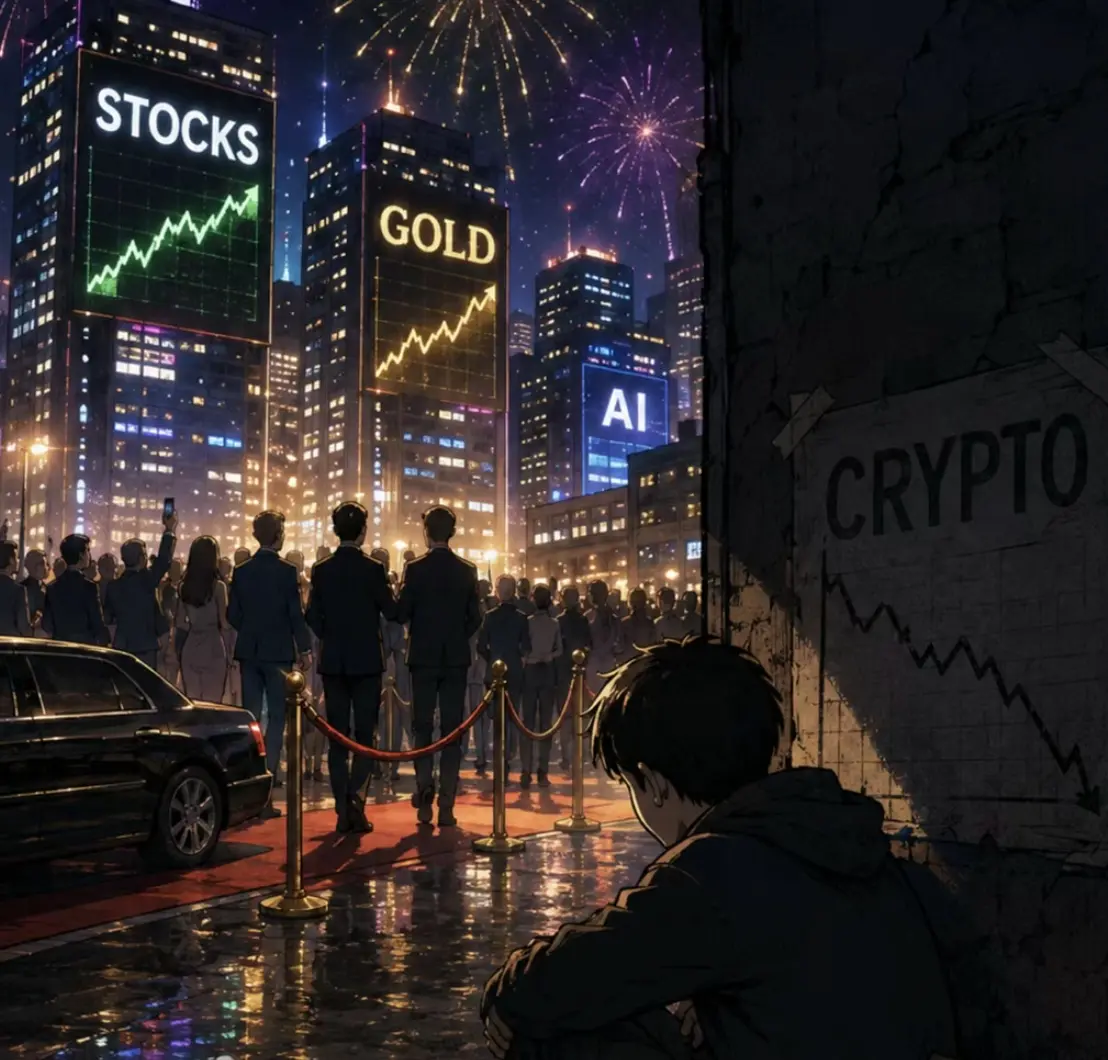
Second, the four-year cycle has been broken; there has been no so-called "altcoin season" in 25. There are macro reasons, too many altcoins, insufficient liquidity, and a gradual disenchantment with narratives, where people are no longer willing to buy into PPTs and VC endorsements. The explosion of AI and the siphoning effect of "real value investing" in U.S. stocks on crypto funds also play a role… Anyway, the previous patterns are no longer repeating; it is impossible to replicate the dream of investing in good projects in 19 and exiting with hundreds of times returns in 21.
Third, even if the four-year cycle were to repeat, the terms for VCs this round are completely different from the last. Some of our portfolios invested in early 23 still haven't launched tokens after 2-3 years; even if there is a TGE, there will be a one-year lock-up, followed by another two to three years of release. A project invested in 23 might not see the last batch of tokens until 28-29, directly crossing over a full cycle. In the crypto space, how many projects can survive a cycle and still do well? Very few.
2. VCs as a whole will not die.
There is really nothing to worry about here; as long as the industry doesn't die, VCs won't die either. Otherwise, who will provide resources to realize new ideas, new technologies, and new directions? We can't rely entirely on ICOs or KOL rounds, right?
ICOs are more about bringing some retail investors and communities on board + creating momentum, while KOL rounds mainly handle dissemination; these are things that happen in the later stages of a project. In the very early stages, when there are just one or two founders + a PPT, only VCs can truly understand and provide funding. In my two-plus years at ABCDE, I have discussed over 1,000 projects and ultimately invested in only 40. Out of these carefully selected 40, probably another 20-30 will fail. Many of the projects you see in the market that you consider "garbage" have already been filtered multiple times to be relatively "premium"; otherwise, could all those 1,000 projects launch ICOs and KOL rounds, and could retail investors or even KOLs discern them?
Just think about the phenomenal projects from the last round to this round; aside from a few exceptional cases like Hyperliquid, which of them did not have VC backing? Whether it’s Uniswap, AAVE, Solana, Opensea, or PolyMarket, Ethena… No matter how anti-VC the sentiment is, the industry still relies on the collaboration between founders and VCs to push forward.
A few days ago, I spoke with a prediction market project that is completely different from most Polymarket/Kalshi copycats, extremely differentiated. I shared it with some VCs and KOLs in the past couple of days, and the feedback has been very positive; they want to discuss further. You see, good projects won’t die, and good VCs won’t either.
3. The thresholds for VCs, projects, and talent will increase, trending towards Web2.
VC - Reputation, capital, and expertise have clearly entered a stage where the strong get stronger.
The reputation and brand of a VC are not primarily measured by how famous they are among retail investors, but rather by whether developers or founders are willing to take their money. Why choose to take your money instead of another VC's? That is the true moat for a VC. This round has clearly seen VCs become similar to CEXs, transitioning from a pyramid structure to a pin structure.
Projects - We have transitioned from looking at narratives and white papers (or even not looking at white papers, like during 17 when Li Xiaolai raised over a hundred million with just an idea) to looking at TVL, VC endorsements, narratives, transactions… and now to looking at real user numbers and protocol revenues… It feels like we are gradually getting closer to the direction of U.S. stocks.
Jeff from Hyperliquid once mentioned in an interview that the vast majority of projects in the crypto space have only one business model: selling tokens, because at the time of TGE, there is nothing—just a mainnet, no ecosystem, no users, no revenue… So they can only sell tokens. Imagine a U.S. company going public with only a corporate entity and a bunch of employees, maybe some factories and workshops, but no customers and no revenue; it would be a miracle to get listed on Nasdaq! Why can we in Web3 directly do TGE or listing?!
This round, Polymarket and Hyperliquid set the best examples: one spent years building a large number of real users and revenue, even supporting a new track, before considering issuing tokens. One did indeed attract early users with token airdrop expectations, but their product is unbeatable, and after issuing tokens, everyone continues to use it; the project itself is a cash cow, with 99% of the revenue used to buy back tokens. When a project has real users who are not just farmers + real revenue, then we can talk about TGE and listing; that’s when our circle will truly be on the right track.
Talent - One of the main reasons I have confidence in Web3 is that this industry gathers some of the smartest people in the world. I have previously written that among the over 1,000 projects I’ve discussed, nearly half of the founders and core teams are Ivy League graduates. Domestic founders are almost exclusively from Tsinghua and Peking University, with a few from Zhejiang University and Jiaotong University.
Of course, this is not just about academic credentials; I myself am not from a prestigious school. But it is undeniable that from a statistical perspective, having so many high-IQ talents concentrated here, even if it’s due to the wealth effect, will certainly lead to the creation of some useful and interesting things.
So, as I said before, although the market is bearish, the entrepreneurial directions this round are actually quite clear: stablecoins, Perps, everything on-chain, prediction markets, and the Agent Economy are all directions with confirmed PMF. Good founders + good VCs will definitely create truly good products; Polymarket and Hyperliquid have set the best examples, and I believe we will see more star products emerge in the next couple of years.
For ordinary people, Web3 remains the most promising place for you to transform from nobody to somebody—of course, this promise is in stark contrast to the hellish difficulty of the already saturated Web2. Compared to the previous rounds or cycles, this difficulty has changed from Easy to Hard. I remember seeing a tweet from a Web3 VC partner a couple of days ago, saying they received over 500 resumes for a junior intern position within a few days, many from prestigious universities, which scared them into closing the job posting.
So in the end, it’s still that saying - pessimists are always right, and optimists always move forward.
 Risk warning Risk warning