Fact Check: How Much Money Did the University of Chicago Lose in Cryptocurrency Trading?
 Core Viewpoint

 Rumors, Financial Data, and Real Crises
Author: Darren Terminator
Recently, Jiemian News took the opportunity of the publication of the third edition of Professor Zhao Dingxin's "Lectures on Society and Political Movements" (the second edition of this book is truly excellent) to interview Professor Zhao. In the interview, Professor Zhao stated that the recent budget cuts at the University of Chicago are due to "it is said that the university seems to have listened to the investment advice of certain Nobel Prize winners, losing more than six billion dollars in cryptocurrency trading. It can be said that the reduction in the humanities at the University of Chicago has nothing to do with Trump's policies."
So did the University of Chicago really lose more than six billion dollars in cryptocurrency trading?

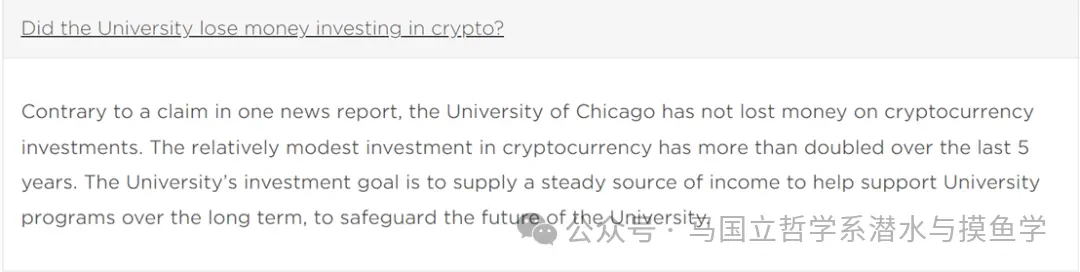
Coincidentally, in the Q&A updated by the University of Chicago in December 2025[1], the issue of cryptocurrency trading was mentioned. According to the official website, "Contrary to what was reported in a news article, the University of Chicago did not incur losses in cryptocurrency investments. Our investment in cryptocurrency is relatively small, but it has more than doubled over the past five years. Our investment goal is to provide a stable source of income to support various projects at our university and ensure our future."
So does that mean the provost of the University of Chicago is definitely telling the truth?
It's hard to say. However, intuitively, the total amount of donations to the University of Chicago over the past five years is around ten billion dollars (a record high of about 11.6 billion in the 2021 fiscal year; approximately 10.9 billion in the 2025 fiscal year[2]). Unless the University of Chicago is truly reckless enough to use at least 60% of its endowment to trade cryptocurrencies (which clearly violates various regulations), or misappropriates a large amount of operating funds for cryptocurrency trading and loses it all, it should not have lost as much as six billion.
So how much did they actually lose? Or is it really as the official Q&A states, that they made a fortune?
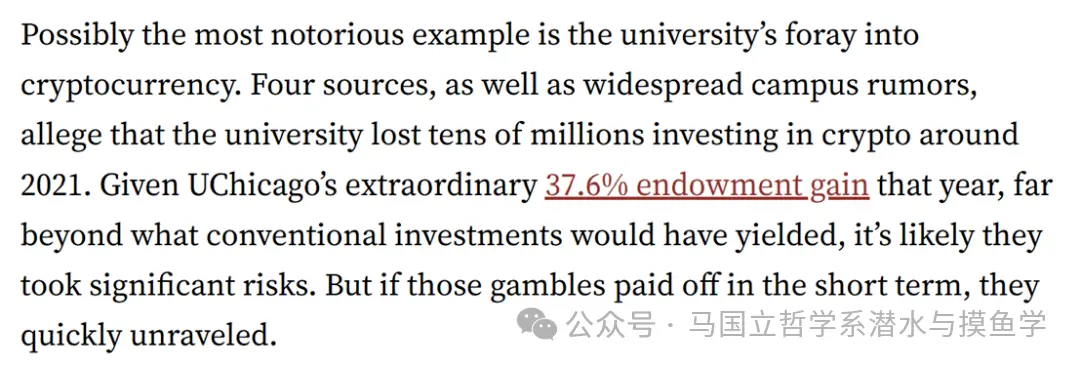
The Stanford University newspaper[3], the Financial Times[4], and Investopedia[5] reported on this matter last year. According to the Stanford newspaper, four of their sources indicated that "the University of Chicago lost tens of millions of dollars due to cryptocurrency investments around 2021."
So what does the financial report of the University of Chicago[6] say?
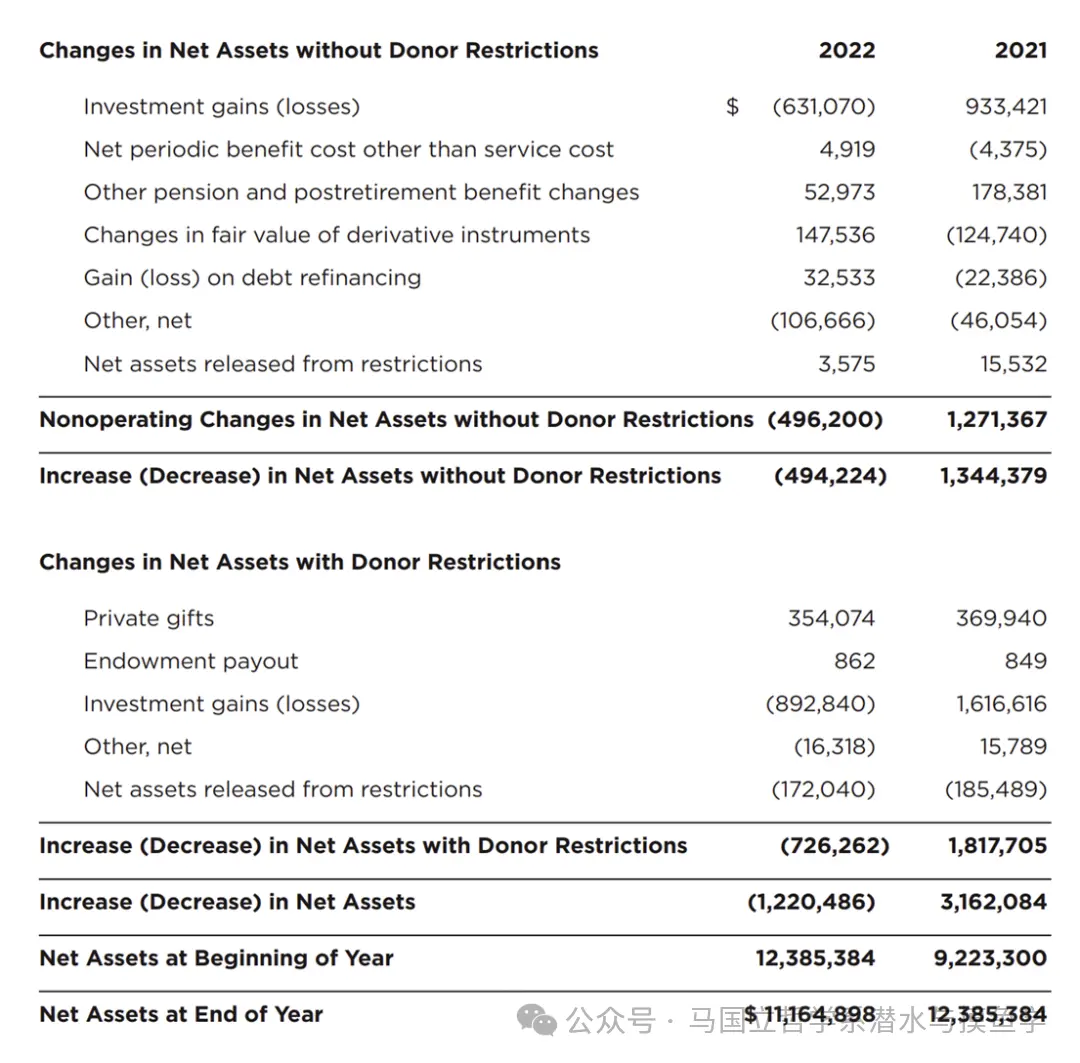
Unfortunately, the financial report does not directly tell us how much was lost in cryptocurrency trading. However, in the financial report for the 2022 fiscal year, the University of Chicago disclosed its cryptocurrency investments (fair market value): approximately 64 million dollars as of the end of June 2021, and about 45 million dollars as of the end of June 2022 (a difference of about 19 million dollars). In subsequent financial reports, perhaps due to making a profit or incurring losses, the University of Chicago changed its reporting method and no longer disclosed its cryptocurrency investments. However, according to the 2025 Q&A, the University of Chicago is still relatively cautious in investing in cryptocurrencies.
It is worth noting that the 2022 financial report shows that as of the end of June that year, the total loss on the University of Chicago's endowment investments was as high as about 1.5 billion dollars. The 2023 financial report indicated that the University of Chicago only incurred a small loss on its investments. In the following two years, the University of Chicago turned a profit.
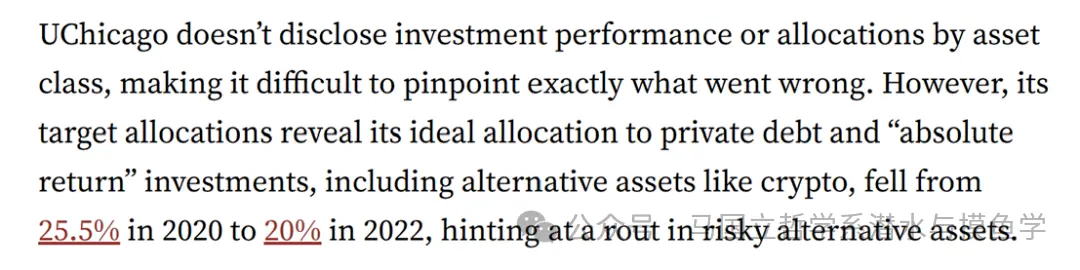
However, we do not know how much of these losses and profits came from cryptocurrency trading. The Stanford University newspaper provided a somewhat unreliable clue: "[The University of Chicago's] target asset allocation shows that the ideal allocation ratio for the university's investments in private debt and 'absolute return' type investments (which include cryptocurrencies and other alternative assets) has decreased from 25.5% in 2020 to 20% in 2022, suggesting a clear withdrawal (or decline) from high-risk alternative assets."
However, the Stanford University newspaper also made an interesting observation: "From 2013 to 2023, the annualized return rate of the University of Chicago's endowment was only 7.48%, while the annualized return rate of the stock market during the same period was 12.8%, and the average level of Ivy League schools was 10.8%. If the University of Chicago had simply followed market performance, its endowment would now have an additional 6.45 billion dollars. Moreover, this (dream) fund would be more than enough to pay off all the school's debts. Of course, universities cannot simply replicate market indices, as they must hedge during economic downturns to maintain financial stability. But even if the University of Chicago only achieved the average level of its Ivy League peer group, its endowment would still have an additional 3.69 billion dollars today. This would be enough to cover the school's current budget deficit for the next 15 years."
However, besides cryptocurrency trading and investment losses, what other reasons could explain the budget cuts at the University of Chicago?
Common explanations, aside from Trump being a rogue, often emphasize the university's own strategic missteps: borrowing, leveraging, extensive infrastructure development, and aggressive expansion.[7][8] As of the end of June 2025, the University of Chicago's liabilities were about 9.2 billion dollars[9], approximately 90% of its endowment. Although the financing costs of these debts are relatively low, unlike those across the ocean, the interest that the University of Chicago needs to pay this fiscal year still amounts to over 200 million dollars.
Such high debt certainly did not come from nowhere. Since the new century, the University of Chicago has spent heavily on new laboratories, libraries, dormitories, technology, etc., to enhance its prestige and enrollment, and to compete with various prestigious institutions, often supported by substantial borrowing. However, the new infrastructure brings ongoing operational costs, and the university has not figured out how to sustain them long-term.
The University of Chicago newspaper[10] quoted Professor Clifford Ando of the university, stating that any parents who want to send their children to the University of Chicago need to consider whether the tuition they pay is truly for their child's education or if it is merely covering the school's debts. The reckless expansion and the resulting debt issues are clearly the responsibility of the university's management, who have been overly ambitious. Ironically, between 2006 and 2022, the base salary of the president increased by 285%. Now, when faced with some economic issues, the management has shifted the difficulties onto students and general faculty: even in years of asset sales, layoffs, and enrollment freezes, executive compensation continues to rise.
So what should the University of Chicago do next?
In addition to continuing to cut costs, it must also find new sources of revenue. Clearly, a common tactic used by American universities to increase revenue is to enroll more undergraduate students. The University of Chicago is set to do this, but the reasons will surely be presented in a grand manner.

[1]https://provost.uchicago.edu/actions-budget
[2] In this article, the budget, endowment, and liabilities of the University of Chicago include the main campus, the Medical Center, and the Marine Biological Laboratory combined. Common news reports (especially the university's own promotional materials) usually combine figures for the endowment, while only the main campus is accounted for in liabilities.
[3]https://stanfordreview.org/uchicago-lost-money-on-crypto-then-froze-research-when-federal-funding-was-cut/
[4]https://www.ft.com/content/4501240f-58b7-4433-9a3f-77eff18d0898?utm_source=chatgpt.com
[5]https://www.msn.com/en-us/money/careersandeducation/university-s-investment-losses-spark-outrage-resulting-in-drastic-program-cuts/ar-AA1Nxhgx
[6]https://intranet.uchicago.edu/en/tools-and-resources/financial-resources/accounting-and-financial-reporting/financial-statements
[7]https://www.wsj.com/us-news/education/colleges-face-a-financial-reckoning-the-university-of-chicago-is-exhibit-a-8918b2b0
[8]https://www.ft.com/barrier/corporate/d5c7c0f4-abf1-4469-8dca-87ff01cbebf6
[9] The main campus's liabilities are about six billion dollars. Perhaps this is the source of Professor Zhao's six billion dollars.
[10]https://chicagomaroon.com/40486/news/uchicago-professor-sounds-alarm-over-troubling-university-finances/
 Risk warning Risk warning



Popular articles